Monday, 10 October 2016

Drive-through birding

I stopped in at the disused airfield at Davidstow on the way back from the Isles of Scilly last month, hoping to find an American wader on the closely cropped sward. There were none that day, but over the following few weeks it played host to a Buff-breasted Sandpiper, a Pectoral Sandpiper and an American Golden Plover, a species I saw here a few years ago. None of these was quite enough to tempt be back down to Cornwall, but a long staying Baird's Sandpiper, somewhat rarer than all the aforementioned species, was another matter, and as I had not previously photographed this species very well, I resolved to head down there on Sunday morning if the forecast was anything better than dire.
I decided on an early start in case the airfield was busy with model aircraft enthusiasts, but I had forgotten just how vast the site is, and even though model planes were buzzing around in one corner, there was still acres of ground for waders to feed in undisturbed. There are two useful rules for birding Davidstow: first, on arrival scan for stationary cars in the distance, and if you see one with a dirty great lens hanging out the window, head for it as it will probably be pointing at a rare bird. Second, stay in the car - the waders will tolerate a close approach from a vehicle, presumably viewing a slow moving car as some kind of lumbering livestock. Open the door, however, and you risk flushing whatever it is you are looking at.
An early morning view on the pool with Dunlin in the background
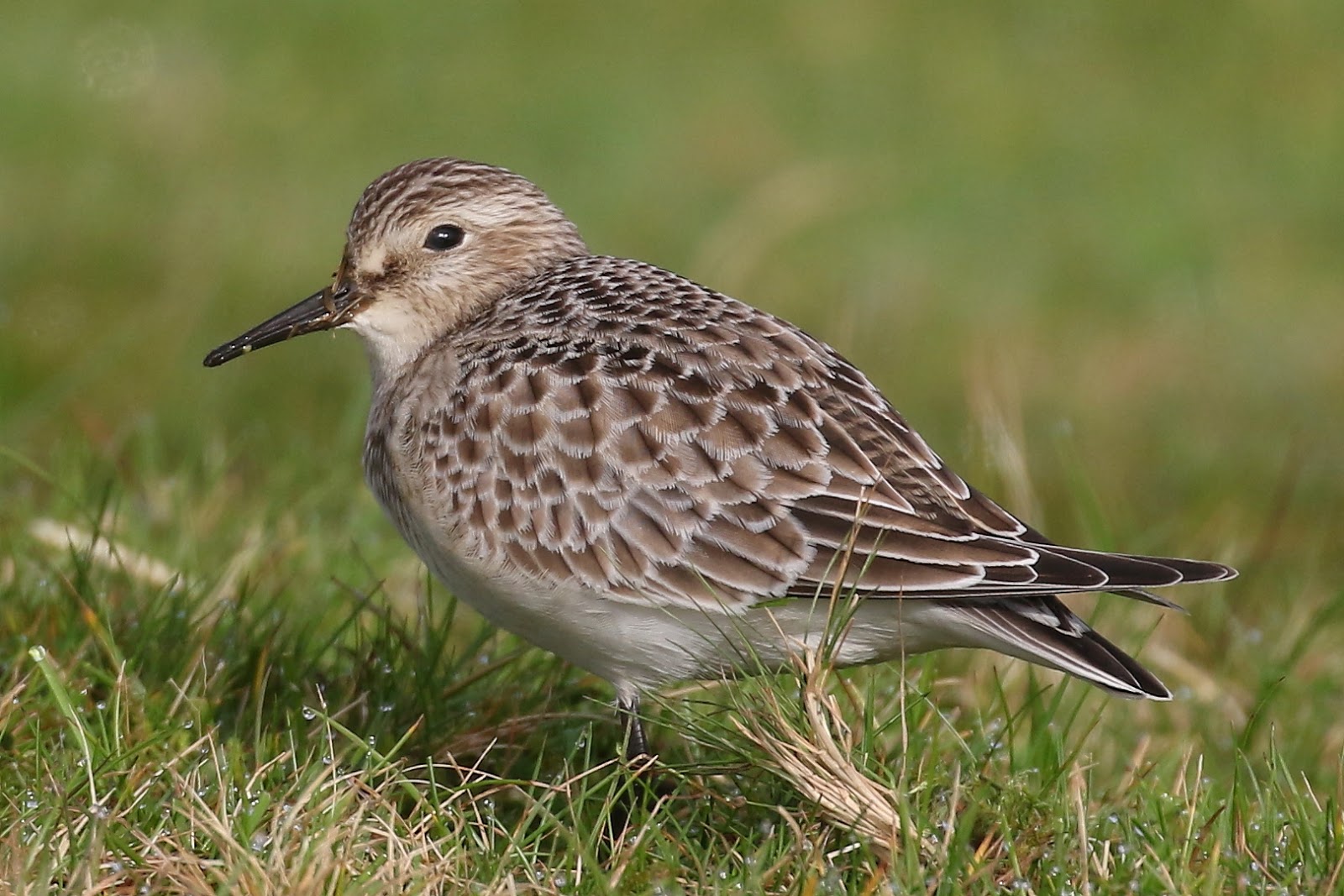
Baird's Sandpiper - the scaly back pattern makes this a juvenile bird
Note the buffy breast band and long primary projection
The bird was reported as being 'near the runway' - sometimes it was on the runway running between the cars!
Head on Baird's shows a flattened oval body shape
So with these rules in mind I arrived just after sunrise, drove up to a car parked in the middle of the capacious runway, and immediately saw the Baird's Sandpiper feeding on a small pool at close range. Eventually it, and the Dunlin it was with, had enough of the pool and headed off to feed on the grass with some Ringed Plover. A small and slightly comical convoy of vehicles tracked them as they fed along, and sometimes on, the pock-marked runway. I spent a couple of absorbing hours photographing the Baird's, by the end of which the sun had conveniently come out.
The Baird's was feeding initially with a few Dunlin
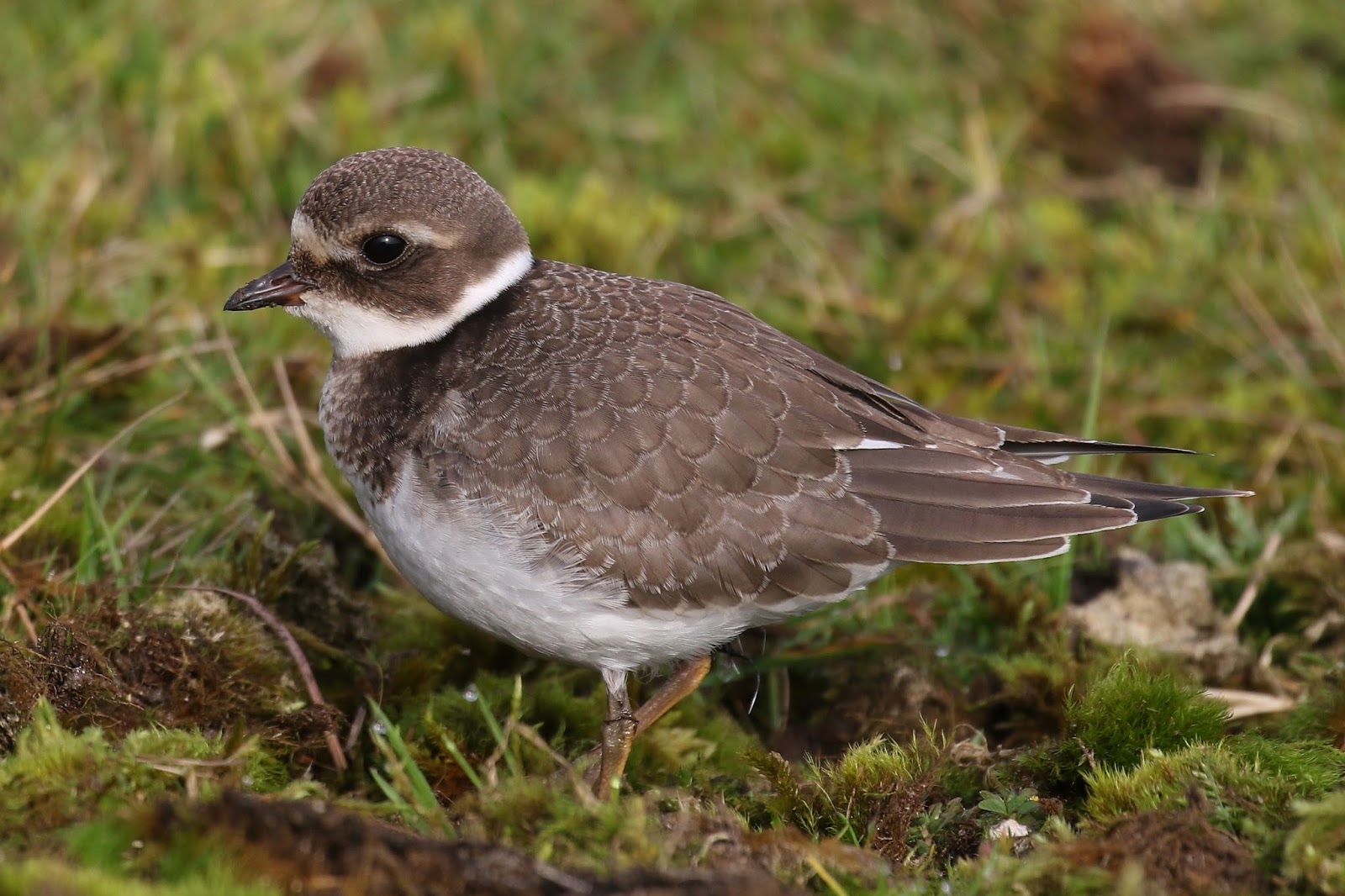
Later they joined up with a small flock of Ringed Plover
I couldn't find a Semi-P among them!
Ringed Plover with Baird's Sandpiper behind
Baird's Sandpiper

Monday, 26 September 2016

It's that time of year again

It's that time of year again: the Dorset Youth League Football Season is underway. Eldest son George is now Wareham Rangers' under-14s utility right-back/midfield/whatever-the-team-commands-guy, on account of us having no subs due to transfer window defections and drop-outs. Another change this season has been the move to a far more parent-friendly regime of weeknight training, freeing up Saturday mornings, and earlier kick-offs on match days, freeing up Sunday afternoons. The start of the football season coincides, of course, with the autumn bird migration season, so I have been enjoying these new-found weekend freedoms by checking out some favourite hotspots around Dorset. Some highlights from a joyous middle-age reclaimed below:
Wryneck at Portland Bill
Wryneck appears regularly on Portland at this time of year
This one was in the Bill Quarry
A half-decent flight shot
Rose-coloured Starling is another regular autumn migrant on Portland
This one took a shine to a rooftop solar panel, alternating between lying down under it and loafing alongside it
It had hooked up with local Starlings on a housing estate near Weston
Middlebere is another good location for migrants at this time of year: Green Sandpipers have been on the pools in front of the hide
An attractive wader
Migrant Ospreys have also been showing some interest in the false nest platforms erected for them
The hope is they can be persuaded to stay and breed one day. Well, unlike Wareham Rangers, who have yet to win a game this season, we can dream, can't we?
I have had the pleasure of the company of Wareham Rangers right-back on several post-match jaunts - here he is practising one of the essential skills of digital photography: chimping

Saturday, 24 September 2016

A night out in Plymouth

The 400th species of bird I saw in Britain was Lesser Grey Shrike, one of which spent some time around Middlebere in Dorset in 2008, not long after I moved here, but long before I had a decent camera. Reports of another of this species in neighbouring Devon saw me head down after work on Friday night in the hope of improving on my digiscoped efforts from eight years ago.
There had been no news on the bird after 1230 on Friday so I wasn't sure it would still be there, but talking to several birders who were on site when I arrived, it emerged that it had been seen shortly before, and I caught up with it shortly after. I had left it a bit late though, and despite enjoying a close but obscured view as it sat in an Elder, and extended views of it feeding distantly before it went to roost at about 1840, the hope of a decent photograph remained unfulfilled. I put the news out, and, feeling a little disappointed, and none too keen on the idea of a long drive, phoned home and was granted permission to stay over in Plymouth so I could have another look for the Shrike in the morning. I found a reasonably priced B&B via the miracle of the internet, though was slightly disconcerted to find a wedding disco taking place under my bedroom window when I arrived.
The DJ was pure Ray Von, and plans of an early night were put on hold as he lurched from The Kooks She Moves in Her Own Way (no problem with that) to Grease Lighting (more problematic) via a stompy disco version of Take Me Home Country Roads (a plutonium-grade problem). Eventually the ear-torturing Abba sing-alongs died down and I entered the land of nod. I was back on the coast path at 0700 this morning and just under an hour later the Shrike emerged from where I had seen it go to roost.
After a distant showing, the Shrike flew closer but then did a most un-shrike like thing and failed to perch up as expected on a prominent tree. It continued not to do so for the best part of the next three hours, by which point I convinced myself it had done a bunk and started heading for the car, now regretting my decision to stay over. Newly arriving birders appeared to know different though and persuaded me to turn back as the group I had just left were indicating that the bird was back on view.
I returned to find the Shrike perched up at close range for an extended period - here the pinkish underparts and black forecrown of an adult bird were visible. The black mask shape reminded me of a Penduline Tit more than a typical Shrike. Viewing was restricted to a small area so having got some half-decent photographs and concluded it was unlikely to come closer, I retreated to let others squeeze in to the confined space - at which point the Shrike flew even closer with the petrol blue sea off Jennycliff Beach as a backdrop! As you can see from these links, Steve Carey and James Packer, among others, were able to get some attractive photographs in this position. Still, I was happy with my efforts - a distinct improvement on those fuzzy digiscoped images of the Dorset bird. 

Sunday, 18 September 2016

Brownsea through a variety of lenses

Both my sons have been showing an interest in photography lately so I've been digging out old camera bodies and lenses in the hope of encouraging them. I am thinking that if I can get them hooked now, I will have someone to drive me round in my old age while I sit in the back barking directions. The novelty of having their own cameras helped persuade them that a day trip to Brownsea yesterday would be a good idea, as opposed to their normal Saturday morning routine of slaying elf-lizards on Skyrim.
Taking the slightly complex but more scenic route from Wareham around the south side of Poole Harbour, over on the Studland ferry as foot passengers and to Brownsea via the famous yellow boat from Sandbanks, we got the first one of the morning and were in the hides overlooking the lagoon shortly before 1030. Large numbers of waders were present, the most numerous being Oystercathcer, Black-tailed Godwit and Avocet, flocks of which are building up for the winter.
Two Curlew Sandpipers close in to the Low Hide with a Dunlin behind
Juvenile Curlew Sandpiper on the right with characteristic peachy wash on the breast - with Dunlin for comparison
A very smart wader
Another juvenile Curlew Sand - the peach colouration has faded on this one
Much scarcer among the waders were a few each of Ruff and Curlew Sandpiper, both of which eventually came in close to the hides having initially been viewable only distantly through the telescope. A dozen Spotted Redshank were also hanging out with the Redshank flock.
Spotted Redshank - one of a dozen present
Avocet - part of a flock of almost 200
Black-tailed Godwit - a scaly-backed juvenile
A couple of Ruff were secreted amongst the Godwits
In truth, despite my efforts to tool them up with half-decent camera gear, the boys didn't take many photos of birds - they spent most of the time at opposite ends of the generously appointed hides photographing each other, or spraying imaginary bullets around using the camera's high speed burst mode to simulate semi-automatic assault rifles. Charming. But they did seem to appreciate the compelling nature of wildlife photography eventually when a tame Red Squirrel allowed a close approach near the Villa. A kindly soul had left a few nuts out and it kept returning to eat a few and bury the rest.
A flock of at least 25 Spoonbill was present - looking unusually awake here...
...and even more lively here
Red Squirrel
A slightly messy eater