Sunday, 10 September 2017

Ragged royalty

Barra for an American Redstart would have been a bridge too far this weekend: Brighton was a more practical destination to see a new species for me in Britain: a Queen of Spain Fritillary butterfly. It's difficult to believe that almost eleven years have passed since I saw my last new British butterfly. That was a Monarch, one of which was just around the corner from a Long-tailed Blue I found earlier in the day on the Isles of Scilly back in October 2006. A few days after that, a Queen of Spain Fritillary was also seen on the islands near the Trenoweth flower farm but despite much searching I was unable to find it.
Male Queen of Spain Fritillary - it looks like it survived a bird attack judging by the state of hind-wing on the right hand side
A slightly more flattering photograph of the fritillary showing the most intact hind-wing
Details of a sighting of three of these rare migrants at Halcombe Farm near Piddinghoe first emerged two weekends ago and was immediately of interest. Unfortunately, the news broke the day before the gloriously sunny Bank Holiday Monday - not the sort of day you want to be driving along the south coast, and I couldn't get away in any case. Last weekend was equally compromised, as being on call for emergencies meant that I was unable to leave Dorset.
The species is known for spending much of the time basking on the ground: this one was no exception
A brief bout of nectaring provided one of the few opportunities to get a shot of the bold silver spots on the underwing
Discussing the survival chances of the fritillaries with Phil Sterling during the week, he was pretty convinced that unless the weather turned really foul, they would still be present this weekend. So with one eye on the forecast, and the other on Butterfly Conservation's excellent Sussex branch website, I resolved to go on Saturday as full sunshine was promised throughout the morning. Internet updates suggested that two individuals were still present on Thursday, both looking more than a little worn, and that was enough to persuade me to make the effort of an early start to beat the traffic yesterday morning.
This Clouded Yellow was one of 15 butterfly species on view at Halcome Farm
Comma
I arrived at Halcombe Farm around 0900 and began combing the area around a bonfire which was being used as a lek site by the fritillaries - all three having been identified as males. As the morning warmed up, a Clouded Yellow landed nearby but there was no sign of the fritillaries. Other butterflies, and then another butterfly watcher, arrived. We split up and shortly before 1000 he gave me a shout to indicate he had found one.
A female Adonis Blue was lying low in the grass
A male Common Blue was easier to see
Queen of Spain Fritillary is reasonably common on the near continent but still very rare in the UK with just a few hundred records and a small number of unsuccessful attempts at colonising documented. So despite the slightly ragged appearance of the visiting royalty, I was very glad I got to see one of the trio before their inevitable demise, particularly as the famous bonfire is apparently scheduled to go up in smoke within a matter of days.
Small Copper
Small Heath
Well done and thanks to the diligent transect walker, Dave Harris, who first discovered them, to Neil Hulme for getting the news and directions out to the wider world, and to the landowner Colin Appleton for allowing access to the site which has provided a lot of pleasure to many visitors over the last fortnight.
Brown Argus
Painted Lady - another migrant at Halcombe Farm
The bonfire adopted by the Queen of Spain Fritillaries

Monday, 4 September 2017

300 up

I come from a long-line of under-achievers so when it comes to listing, I try to keep my goals to a bare minimum to avoid disappointment. At this stage of mid-life, in fact, I have just two self-imposed targets - first, to see 300 species of bird in Dorset before reaching the age of 50 and, second, to see 500 species in Britain before I die. Daft these targets may be, but yesterday I ticked off the first of them by adding Baird's Sandpiper to my county list, and with a couple of years to spare.
Common Sandpiper was one of a number of migrant waders on Brownsea
300 species for Dorset is no big deal, of course - the top county listers are closer to 400 than 300, and the county list as a whole currently stands at 423, with at least 3 more species (Spectacled Warbler, Elegant Tern and Yellow Warbler) certain to be added when the 2017 record books come to be written. But having only moved here in 2007 I still think it represents a pretty good effort for a fully-employed father of two who can't always drop everything to chase rarities.
There weren't just migrant birds on Brownsea - this Painted Lady was also on the heath at the top of the island
Yesterday was a case in point: I wrote as recently as June how visits from family/friends were guaranteed to result in the appearance of a rare bird. This weekend the visit of my sister and sister-in-law threatened the same - the rare bird being the Baird's Sandpiper on Brownsea, found on Friday lunchtime by Paul Morton. Work commitments meant there was no chance of twitching it that day, and even though the bird went missing on the Friday afternoon and evening, a day trip to the island on Saturday seemed a good idea. Fortunately our visitors and the rest of the family agreed.
Redshank on the Brownsea lagoon
Soon after our arrival I was scanning the back of the lagoon for waders, and had a brief view of a bird with an obvious pectoral band, apparently smaller than the Dunlin with which it was associating. It was then lost to view in vegetation but I had seen enough to keep an eye on the same area. I was soon joined by Graham Armstrong and we simultaneously locked on to a bird which looked a good candidate, and similar to the one I had seen earlier.
The Spoonbill flock had risen to 26 birds by Saturday - they spent a lot of time in the air flushed by...
...the Red Arrows, in the area for the Bournemouth Air Show
Despite the heat haze and the considerable distance between us and the bird, we gradually pieced together the key features - the pectoral band in combination with otherwise pure white underparts, attenuated rear end, scalloping on the wings, shorter bill and legs, slightly paler and more concolorous upperparts compared to the more variable Dunlin it was with. It was often out of view behind vegetation, and re-locating it required some care due to the haze and the fact that a number of the Dunlin also showed relatively neat pectoral bands - but the latter invariably displayed scruffier underparts and larger heads and bills than the more diminutive Baird's.
In this record shot to end record shots, the bird on the left is the Baird's - even in this terrible image the impression of a slighter bird with a smaller bill, cleaner white underparts and more attenuated rear end is confirmed compared to the Dunlin on the right
Increasingly confident with the identification, we put the news out enabling several Dorset birders to catch up with the rare visitor in the afternoon. The rest of the day was then free to be devoted to touring Brownsea with the family and enjoying its exotic selection of non-native spongecakes and flans.
A slightly better comparison shot of Baird's Sandpiper (right) and Dunlin illustrates the key features mentioned above rather more clearly - this was taken last October at Davidstow Airfield in Cornwall

Wednesday, 30 August 2017

Better late than never

Blogging appears a bit passé these days, what with Twitter and the like offering more instant gratification and immediate feedback for and from today's time-poor social media user. So passé, in fact, that I needn't feel remotely guilty about posting almost pre-historic news from a family holiday in Yorkshire earlier this month. Today the wonderful Bempton Cliffs RSPB reserve is playing host to two Greenish Warblers - one of a small number of species I have seen in Britain but not yet photographed. A couple of weeks ago there were no Greenish Warblers - but there were signs of early migration with a juvenile Cuckoo providing me with my best opportunity this lifetime to photograph a normally skittish species. Wheatears, Whitethroats and Wagtails were also in evidence in the fields behind the clifftops.
Cuckoo at Bempton Cliffs
Feeding on caterpillars in the long grass
Wheatear
Whitethroat
Yellow Wagtail
Bempton is world renowned for its Gannet colony - thousands were still on the cliffs, providing, in my humble opinion, about the best natural spectacle one can see in mainland Britain today. I now know I am not alone in holding this opinion - to quote another visitor overheard behind me at one of the many well-positioned viewpoints: 'That's, like, the most amazing nature I have ever seen. You know, with my actual eyes'. Quite.
Gannet
An imposing bird in an imposing setting
Note the pin-striped feet
Still much displaying taking place
A family party at Staple Newk
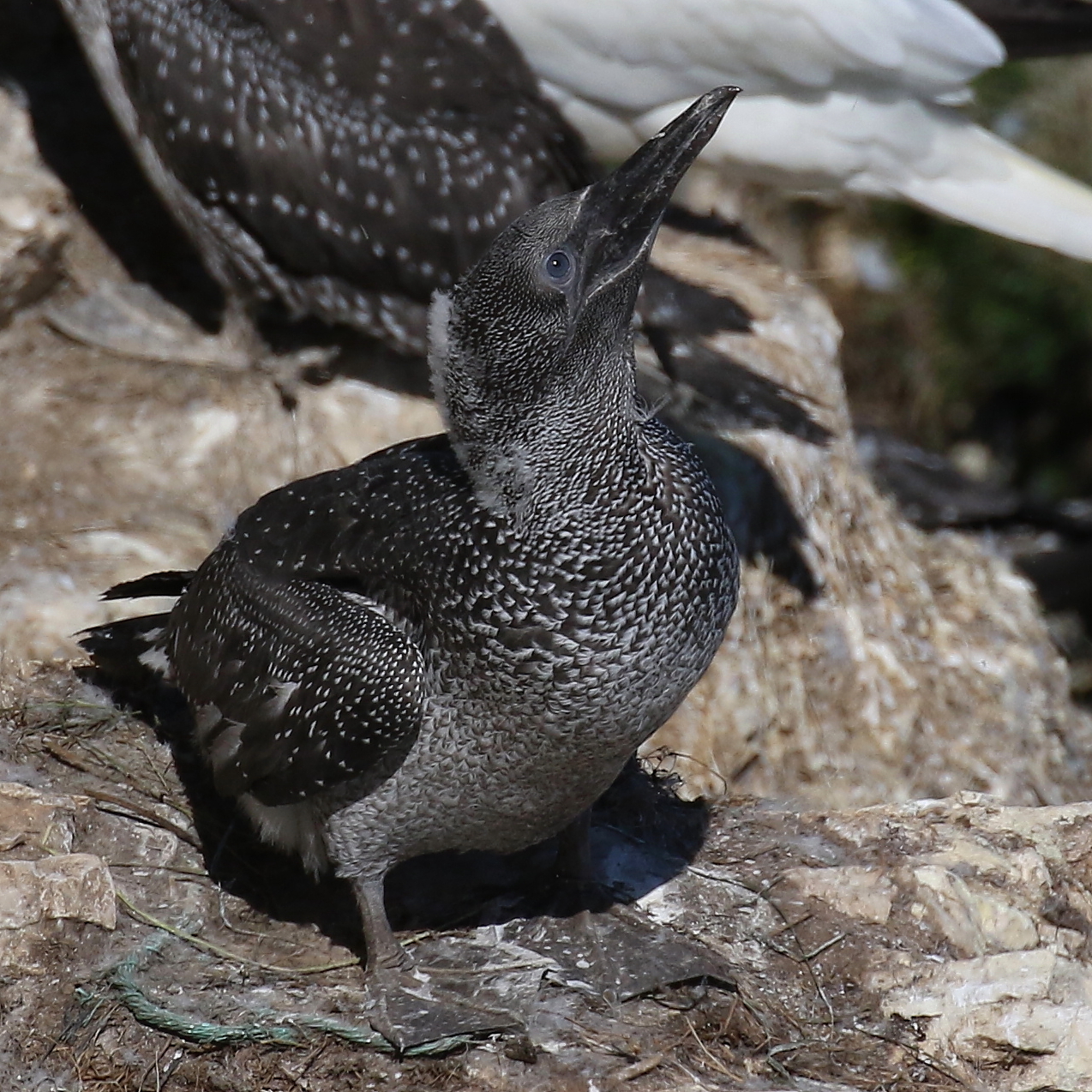
I had not been to Bempton at this time of year previously, so it was an opportunity to study Gannet chicks and fledglings at close quarters and in a variety of stages of advancement towards making their first flight. Some still looked like the plush toys in the RSPB shop, others were similar in proportion to the adults but their flecked grey-brown plumage was in complete contrast to the black, white and cream colours of the parent birds.
Gannet nestlings are prehistoric looking creatures
They breed so closely together that constant squabbling is the order of the day
Young birds can be viciously pecked by neighbouring adults if they cross an invisible line
Very young birds look like polar bears with dinosaur faces grafted on
They can get very large before the white down is replaced by feathers
Over 11,000 pairs of Gannet breed at Bempton, and at such a high density disputes between neighbours are inevitable - we winced as we watched young birds take quite a battering if they strayed into the wrong territory.
The rocky outcrop at Staple Newk is prime real estate for Gannets
A tiny fraction of the extensive Gannet colony
Gannet preparing to lunge off the sheer cliff
Gannet
It was quite difficult to isolate a single bird in the frame
The auks - Puffins, Guillemots and Razorbills - which are also a feature of Bempton in the summer had left their breeding ledges before our arrival in Yorkshire. But it wasn't just Gannets to admire - Kittiwakes were also still present in good numbers, and the Tree Sparrow flock around the visitor centre also appeared to be in good health.
Juvenile Kittiwake
Kittiwake on the rudimentary nest
Tree Sparrow
Tree Sparrow
Tree Sparrow
Tree Sparrow

Monday, 28 August 2017

Little bit of birding

Our recent family holiday to Yorkshire wasn't really a birding trip but I did manage a few excursions with the bins and camera. My eldest son surprised me by showing an interest in going to see the Hornsea Mere Little Gull roost at which over 8,000 birds had been reported on some evenings, so we headed there as dusk approached. Unfortunately on our chosen night, the Little Gulls chose to go somewhere else - just 200 or so were present but that's still the largest flock of Little Gull I have ever seen. A very friendly and knowledgeable local birder explained that it wasn't actually a roost but a feeding frenzy with the Little Gull taking advantage of millions of flying insects which emerge over the Mere.

He also suggested that it might be worth visiting the Mere in the morning as Little Gulls hang out on the jetties near the sailing club, giving much closer views than we were getting in the evening. I followed his advice and enjoyed excellent views of a flock of 25 in a variety of plumages. Unfortunately the light was unkind - I really needed to be out on the end of a jetty parallel to the one being used as a roost by the gulls. I asked a sailing club official if it would be OK to wander out there and he said it was fine as long as I wore a life-jacket. That seemed like a fair deal to get even better views and photos!