Showing posts with label Grey Wagtail. Show all posts

Monday, 6 December 2021

Second chances

Back in January there were various species wintering in Portland Harbour or on the Fleet which I would have dearly liked to have added to my non-motorised year list, but which at the time seemed too far away to track down by bike. They included such scarce waterfowl, in a Dorset context at least, as Red-necked Grebe, Velvet Scoter and Whooper Swan.

Whooper Swan (right), Hampreston
With my horizons broadened in the intervening months, today I wouldn't hesitate to 'pop down' to Ferrybridge or Abbotsbury. And one of the good things about year listing is that if you miss a species at the start of the year, there might be a chance to make amends when winter comes around again at the end. As November drew to a close, I had already caught up with a Red-necked Grebe at Studland, and the next 'second chance' species appeared in the same area, in the form of not one but four Velvet Scoter off Middle Beach.
Can I get a 'Whoop'? Apparently, yes.
It was late in the day when I first set off to look for them but, not for the first time this year, Garry Hayman was on site and kindly lingered until my arrival to point me in the right direction. The birds were extremely distant and the light was fading, so much so that I went back on the bike a second time later that weekend to see if I could improve on my views. They were a bit closer enabling some very poor record shots to be taken for posterity. In the middle of last week I had to give my son an early morning lift to work which is literally 200 yards from Middle Beach so I went for another quick look before starting work myself. It was a case of third time not much luckier but I did manage to photograph one Velvet flapping to reveal the diagnostic white wing panels.
    A record shot if ever there was one - but the double face-spots help identify this as a female Velvet Scoter
So two of the three wintering targets had been clawed back and sporadic reports of the third - a Whooper Swan at Longham Lakes - offered the prospect of completing the hat-trick. The problem was, with the dark evenings, I would be unable to get there mid-week, and last weekend was earmarked for a Uni friends re-union in Lyme Regis. In the end, after a lovely weekend and more ale than I can handle these days, I returned from Lyme a bit earlier on Sunday than expected, leaving the afternoon free for a bike ride. 
Another record shot showing the white secondaries of a Velvet Scoter
There had been no news on the swan all day, but after a couple of nights of over-indulgence, I was in the mood for some serious exercise so made the 14 mile trip to Longham in the hope of finding it. Conditions were a bit grim but not enough to stop me making progress, and I arrived at Longham about 1330. One other birder was present but neither she nor I could locate the swan on the lakes or surrounding Hampreston fields, and she left me to it. A second birder walked past and on enquiring if he had seen the swan he seemed reluctant to say and basically suggested I would have to find it myself - a most unusual response in the normally friendly world of birding.
A very distant Common Scoter (bottom left) also at Studland
This brought out my stubborn streak and I resolved that I damn well would find it myself, despite the hostile environment! I could see a few swans distantly but they were just white blobs through a hedge so couldn't be identified to species level. They looked nearer to Hampreston village, a mile or two away if I returned to the main road east of Longham, and a helpful couple explained that if I headed for the Church I should be able to view more fields from the footpath leading from there towards Longham. 
As I drove to Lyme Regis in foul weather on Friday night I was reminded that I had cycled the same 80+ mile return journey back in the summer to add Dipper to the non-motorised year list. This one was photographed on Saturday. 
On arrival I found what I assumed was the right footpath, signposted to Longham, and soon after located a decent herd of swans in the distance. Through my dinky MM4 scope they all appeared to be Mutes at first glance, but with some patient scanning eventually a slimmer, more elegant head and neck appeared and, at full zoom, the characteristic yellow wedge on the bill of a Whooper Swan came into focus. Success was sweet and the cold wind whistling over the fields immediately lost its bite.
Grey Wagtail, also on the River Lym this weekend
As I was watching the swans, the couple who had given me directions earlier appeared on another footpath apparently between me and the birds. I retraced my steps to the church, found the previously unseen right of way through the churchyard, and joined them on the public footpath to view the herd to the south. Through binoculars they hadn't been 100% sure that the bird they were focusing on was the Whooper but with the scope I was happy to remove any doubt for them and grab a few record shots for myself.
The Cobb at Lyme Regis with Golden Cap beyond
Mercifully, the wind was at my back for most of the journey home, and the year list had ticked over to 216. The next big milestone of 220 is therefore in sight, but for this to be achieved would require obscene levels of neglect of family duty as forthcoming weekends are earmarked for weddings, birthdays and Christmas gatherings. So as long as I don't change my behaviour too much I may well make it ;-).

Wednesday, 2 June 2021

Lyme and soda

I didn't intend to go to Devon when I set out yesterday morning, it's just how it panned out. After surviving Cogden in a gale, I had come round to the idea of cycling to Lyme Regis where Dipper is reliably seen on the River Lim. So with a week off, and good weather ahead, putting a day aside to make the 40 mile journey seemed like a good option. So the plan was: (i) avoid the bank holiday weekend traffic (ii) go early the next available day (iii) spend rest of week recovering. Tuesday looked ideal with a sunny day forecast and a fresh easterly breeze to push me there and cool me down on the return journey.

Grey Wagtail (juv), Lyme Regis

Psychologically, I had broken the journey down into thirds - home to Dorchester via Tincleton would, I knew, be a quiet first 15 miles. And indeed it was - 2 Lesser Whitethroat and a couple of singing Woodlark cheered me along the Puddletown Road. The middle third (Dorchester-Bridport) would be a more challenging 15 miles on what I hoped would be a relatively quiet A35. It was indeed fairly quiet, and while lorry and bus drivers were invariably considerate, a few car and van drivers came close enough and fast enough to cause some discomfort. Camper van drivers seem particularly oblivious to the width of their vehicles, perhaps being car drivers mid-week they 'forget' the extra foot or two of girth they are packing at the weekend. 

Anyway, once I had reached the zenith of this stretch at Askerswell Down with spectacular views of the Jurassic Coast, the long descent into Bridport was a breeze. I clocked a respectable 36.7 mph with the following wind on the steepest part, ticking Corn Bunting and Yellowhammer for the day list in the process.

The final third (Bridport-Lyme Regis) was the shortest at 10 miles but also the most daunting - it would be later in the day and the hills up to and out of Chideock, and the final push up Raymond's Hill to Lyme Regis, would be a struggle in the rising heat. And so they were, though there was just enough 'hard shoulder' to push the bike where needed and feel reasonably safe on the narrowest parts. 

Having left at 0500, I arrived on the outskirts of Lyme Regis just after 0900. The obvious thing to do was start at the 'top' of the river and make my way down through town, a strategy that usually doesn't fail to produce a Dipper. It did on this occasion unfortunately, but no matter, I thought, I will just go back up that way having first paid a visit to the Harbour for the chance of another year tick: the long-staying drake Eider. 

I knew this bird was still around following recent news from another Purbeck resident, Garry Hayman. Sure enough, he was, sitting on a dinghy, and I enjoyed a late breakfast/early lunch in his company whilst catching my breath and contemplating my strategy for the return journey. I had hoped to see Dipper fairly promptly and be away by 1000, but it was already that time so I decided to head back up the river slowly towards Uplyme, for as long as it took to see this river-dwelling speciality.

Eider, Lyme Regis Harbour

It was now a pleasant morning but warming up rapidly so I was glad of the shade by the river and the smell of wild garlic added a spring-like feel. Juvenile Grey Wagtails called from the banks but of Dipper there was no sign. I continued on up and realised I had gone too far, literally and metaphorically, when I came across a sign saying - 'No cycling: Devon County Council'! I crossed the border, mainly so I could say I cycled to Devon in a blog post, and headed back down.  

Coming to Lyme Regis and not seeing Dipper would have been a disaster, so although I knew it was only a matter of time, I also had my eye on the clock and half a mind on the gruelling return journey. Garry had seen Dipper by a small footbridge above town, away from the crowds, which had been a Dipper-free zone on the way down and up, so as I reached this point for the third time I resolved to stake it out until one appeared. As I walked to the centre of the bridge and looked upstream a tiny bow wave in the water caught my eye. Then through the wave broke the unmistakeable shape of a Dipper. It sat up on a rock mid-stream, bill full of prey, bobbed as if to curtsey after a bravura performance, then flew literally underneath me downstream to where I presume young birds were waiting to be fed. Success!

Dipper, Lyme Regis

To add Dipper and Eider to the list now required one more small thing: get back in one piece. National cycle route 2 is the 'official' cycle route for this part of the south coast, but the stretch from Lyme Regis to Bridport involves a fairly massive detour, so I thought I would retrace my steps on the A35 and see how it went before rejoining route 2 there for a quieter journey home. The Charmouth bypass was easy enough - a broad hard shoulder felt like a luxury - but I knew the road would narrow on the long climb to Morecomblake. I needn't have worried though as traffic was by now at a standstill and I was able to crawl past in first gear! A few motorists gave me dirty looks, as if I, not they, was the cause of the congestion. Remember chaps: you're not stuck in traffic, you are traffic.

Not the best way to see a Weasel but it was on the road next to...

...a Field Vole. I presume the Weasel killed the Vole but got run over whilst dragging it across the road.  I avoided the same fate by only snacking in lay-bys on the A35.

Steaming down the hill into Chideock, I realised I needed more water and fizzy drinks (there you go, if you were wondering where the title of this post fitted in) before the hellish ascent out of the village. The local shop for local people had run out of big bottles of water, so a Lucozade Sport (downed in one) and a Lemon Fanta had to suffice. Traffic was again crawling up the steep incline, and while I did my best to keep pace the early start was taking its toll, and I had to take advantage of the only pull in half way up to let a truck past. It was more of a drain than a lay-by, just about big enough to get the bike off the road, but an appreciative double thumbs up and blast on the air horn from the driver made me smile. Once at the top, I rolled down into Bridport and knew that the worst - in terms of traffic if not distance - was behind me.

The start of cycle route 2 east from Bridport involved another massive detour so I followed a likely looking shortcut on a bridleway from Bothenhampton to Shipton Gorge. This started well enough, but the bridleway was not one of those nice gravel jobs, rather a proper horse track, deeply pitted with hoofprints, and petered out into a footpath which was barely more than a dry stream bed overgrown with vegetation. I pressed on and was relieved to reach the bright lights of Shipton Gorge soon after. Route 2 from then on was a delight - although a bit up and down, it avoided the fierce climb up to Askerswell Down, and took me past inviting country pubs and the chocolate box villages of the Bride Valley. An idyllic place that should be full of purring Turtle Doves and jangling buntings, it was slightly depressing to find it relatively birdless.

Portland from the Hardy Monument

After a final long climb up to the Hardy Monument, I knew the worst really was behind me now and I could take the rest of the journey easy. One more quick stop in Dorch was required for additional soda intake and I was home shortly after 1830. 88 miles had been travelled, 10 hrs 40 mins in the saddle, with a monster elevation gain of 7,710 - the equivalent of going up Snowdon twice from sea level. I consumed about 3 litres of fluids and almost as much sun block, knowing that dehydration and sunburn were probably my two greatest health risks, after getting mown down on the A35 of course. I'll probably never do it again, at least not via the A35, though I'm glad I did!

In a previous job I had the pleasure of looking after the Dorset AONB team - one of their many successes was bidding to get these monster pylons removed from the landscape. It's taken many years but work is now underway - the 'scar' on the right shows the route of what will now be the underground power lines. Taken near Black Down.
 

Sunday, 26 November 2017

Finch finding

I mentioned recently that the Hawfinch invasion was in danger of passing me by - I finally caught up with one last weekend on a visit to friends in Kent but had still yet to see one at home in Dorset, so I set out this morning with the aim of doing just that. Several sites seem to be holding Hawfinch since they arrived but Bonsley Wood near Blandford Forum sounded like one of the most reliable so I headed there. I bumped into one of these chunky, short-tailed birds before I got to the main wood, a few more whilst there, and even more on the way back, confirming the impression formed from recent reports that they can be seen just about anywhere in suitable habitat at the moment. Brambling, Redpoll and Bullfinch were also in the wood, an enjoyable couple of hours in a location I hadn't checked out before.
Hawfinch, Bonsley Wood
This head-on view shows the bulk of a Hawfinch bill
Side view of the impressive bill
The best flight shot I could manage - note the curled tips to the primaries can just be seen on the edge of the folded wing
A few Brambling were in with the Chaffinch flock in Bonsley Wood
Grey Wagtail, Bonsley Wood
Bullfinch last weekend at Sissinghurst in Kent
Fieldfare, Sissinghurst, Kent
Fieldfare, Sissinghurst
Mistle Thrush in Yew at Igtham Mote, Kent
Redwing, Sissinghurst
Nuthatch, Sissinghurst

Tuesday, 3 January 2017

Suffering for your art

The first day of 2017, normally a red letter day in the birding calendar, was a bit of a washout with heavy rain causing me to abort a planned afternoon visit to Swineham. Well it's the 'post-truth' era so much easier to conclude it would be birdless from the comfort of the armchair than to actually go there and prove it. So here are a few pictures from before and after that from two of Dorset's urban birding hotspots - Lyme Regis, which I visited to see my godsons last Friday, and the built up north shore of Poole Harbour, around which I strolled with the family yesterday. The sun shone mightily at both, and photographs were the inevitable result.
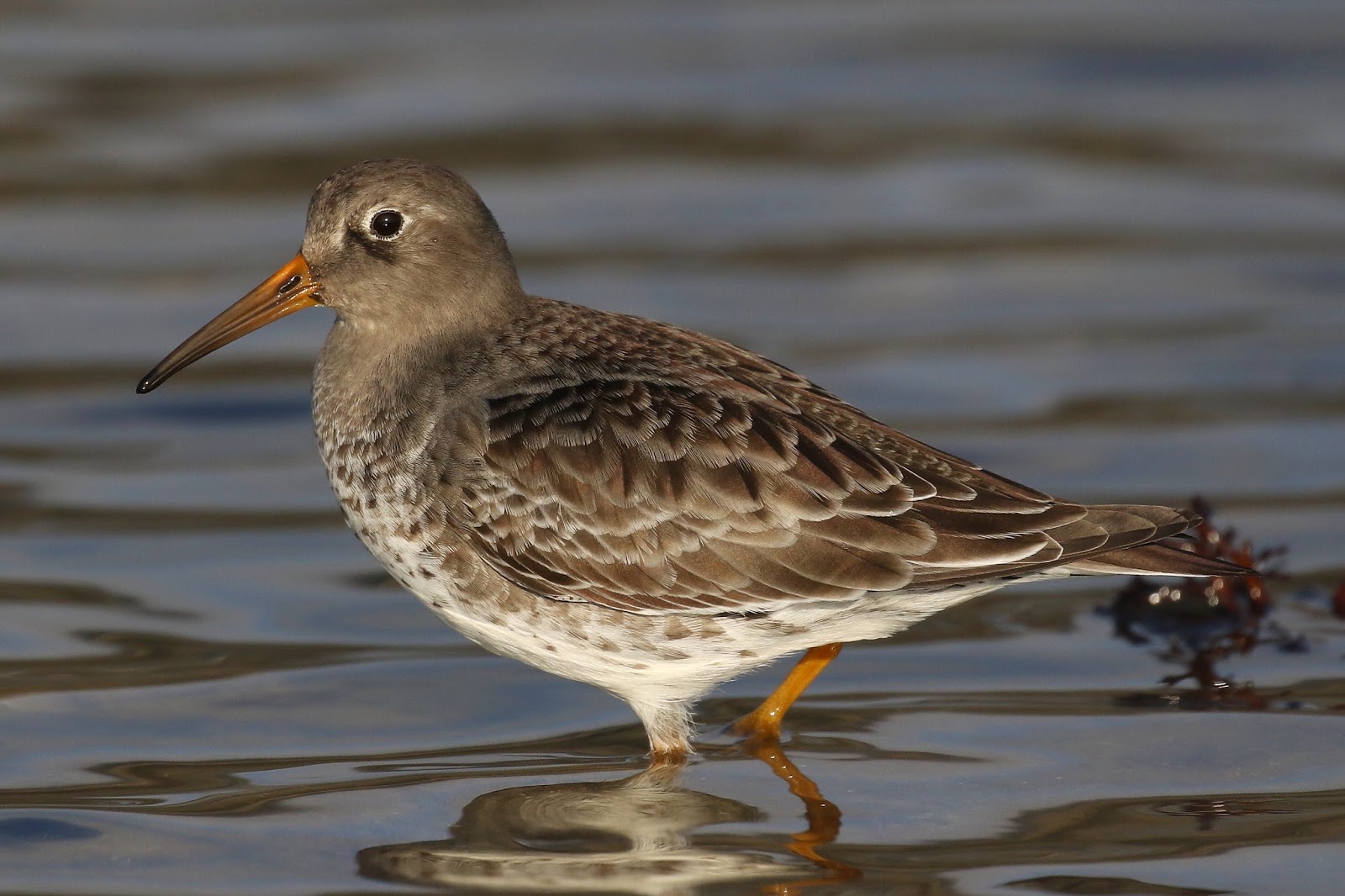
Purple Sandpipers often roost on The Cobb at Lyme Regis but they are either distant there or right underneath you making photography difficult - but it was low tide so I caught up with a flock on a rocky shelf at the beach 
The snag was they were feeding on a ledge surrounded by six inches of water and I was only wearing my 'about-town' shoes. So off they came enabling me to wade through the freezing water, lacerating my feet on the barnacled rocks. Well you have to suffer for your art...
Not often you get to see the beautiful purple iridescence on a Purple Sandpiper - but it can be seen on this one (click to enlarge)
A careful approach allowed me to get pretty close
A pair of Dipper were in the Mill stream which runs through the heart of town
A curtsying courtship display with a flash of the white eyelid
One of very few locations in Dorset where Dipper can be seen

Grey Wagtail also frequent the same stream

A misty Golden Cap from Lyme Regis beach
Mediterranean Gulls were also on the beach at Lyme Regis
No longer a rare sight on the Dorset coast
Ethereal sunset looking west from Chideock - we could see the reflection but not the sun itself
Black-tailed Godwits were present in large numbers at Upton Country Park yesterday - the first sunny day of 2017
Also a large Dunlin flock out in Holes Bay
Mixed flock of Dunlin and Blackwits against the backdrop of urban Poole
A good selection of wintering duck were in the bay including this smart drake Pintail
Blue Tit in the woodland at Upton CP
Finally from Upton a backlit male Stonechat
Earlier in the day saw me on the groynes at Sandbanks where a patient approach allowed me to get close to another favourite wader: Sanderling
Sanderling at Sandbanks
The roosting birds tolerated my careful approach and a less careful approach from a couple of dogs, but ultimately a jetski put them to flight - unfortunately an occupational hazard for the Sandbanks Sanderlings

Thursday, 23 July 2015

A dull boy

If you're thinking 'it's been so long since he posted anything that he must be working like a dog between jet-setting off to glamorous holiday locations', well, you'd be half right. The first half, specifically. The photo year list, around which this blog has been themed in 2015, ground to a shuddering halt on 202 following a Father's Day Terek Sandpiper. After bursting through the 200 barrier in style, with 3 lifers among my last 4 additions, I have had neither the time nor the energy to add to it, with some eminently achievable target species remaining unsnapped.
Silver-washed Fritillary (male)
Gatekeeper - male
Meadow Brown
The closest I have come to escaping the thraldom of wage slavery was a trip last weekend to see my parents in North Devon. Mainly bumbling around busy beaches and arcades, so not a lot of time for wildlife watching, but a walk from Lynmouth up the river to Watersmeet produced a family of Grey Wagtail every 100 yards or so, a couple of Dipper and a hyper-active Shrew - I think a Common Shrew, but how does one tell for sure? Star of the walk though was a stunning male Silver-washed Fritillary.
Dipper on the River Lyn
One of many young Grey Wagtails on the same
And who doesn't love a newly fledged Robin?

Still, August is fast approaching and with some holidays booked, including a few pelagic trips out of the Isles of Scilly, I aspire to resuming a better balance of work and play very soon, making this Jack a slightly less dull boy, I hope. Stand by for an upsurge in average photos, tawdry narratives and cheesy puns in this space. I know they have been missed.
Shrewd move. And he's back!
My book says Pygmy Shrew's tail is hairy, and this looks pretty bald. However, it also says Pygmy's tail is 70% of head and body length, Common Shrew's just 50%. But this tail looks nearly 100% of body length. Perhaps they only measure them once they've been run over. Anyway, that confused me.
Common Shrew has 3 toned fur - brown on top, paler on sides, paler still underneath. Pygmy 2 toned - brown on top, paler under. While this looks 3 toned in the photo, it's a tough call to make on a tiny mammal which bombs around at 100mph in the dark.
Anyway, a charming beast, snuffling it's way along a woodland path.