Wednesday, 22 January 2014

It's my birthday and I'll twitch if I want to

It was my birthday last week and I was told that for the weekend that followed I could do anything I wanted. Anything. After twitching an American Coot in Inverness was ruled out, along with some other unprintables, the suggestion of a weekend in Sherwood Forest was deemed acceptable. The choice of accommodation was between (i) the children's dream weekend at Centerparcs for the price of a medium-sized family car or (ii) a couple of nights in a cheap motel for a fraction of that. The motel was great, complete with a private plunge pool (ok, bath), multi-media entertainment centre (clock-radio) and acres of landscaped grounds (car park). I did say it was my birthday.
Twitching the American Coot in Scotland did not fall within the definition of doing 'anything I liked' last weekend. So here's a Eurasian Coot in Clumber Park, Notts, instead - a Honey Buzzard hotspot in summer.

Marsh Tit, Sherwood Forest
In truth this choice of location was not entirely motivated by a desire to imbibe the spirit of Robin Hood. No, the area is currently playing host to a flock of Parrot Crossbills, a bird I felt cruelly robbed of catching up with late last year after a couple of dips followed by my extended absence from birding due to 'health problems'.
Coal Tit, Sherwood Forest
Blue Tits, Sherwood Forest
Speaking of health, time was I would have marked the passage of another year of my life with a boozy session. Two things have put paid to this. First, acceptance that my tolerance of the ale is approaching that of Blackadder - a couple of pints and I'm singing songs about goblins and insulting close relatives.

Second, some well-intentioned but rather joyless experts have created the idea of 'Dry January'. It's hard enough to get people to go drinking at this time of year with everyone skint after Christmas without this: no consideration for those of us with birthdays in the New Year! And if you go to the Alcohol Concern website, there's a tiny disclaimer at the bottom: 'Please note that this is not a medical detox programme and should not be attempted by people with an alcohol dependency problem'. So just killing responsible levels of joy then?
Goosander, Rufford - a good site for Hawfinch and Lesserspot
Drake Goosanders, Rufford Mill
Anyway, enough bitter recriminations about a high-life lost. At first, if I'm honest, I was worried that this trip was just me dragging a reluctant family along on a tick-hunt: the workmanlike pursuit of a new bird to add to the list for the shallow satisfaction of seeing it grind forward by another meaningless notch. But in the end it was much better than that: yes another meaningless tick was indeed gained (at least until the Crossbills are lumped) but there was also quality time away with the family, a new part of the country to explore, other good birds to see and another potential holiday venue recce-ed for future reference. Plus we got to don capes of Lincoln Green, shoot our bows and arrows in the woods and visit the Major Oak of legend.
Drake Pochard, Rufford
Drake Tufted Duck, Rufford
I say I gained a tick, but actually these birds have proved controversial on 'Birdforum'. (Sorry - I've just realised how ridiculous that sounds - the suggestion that adding two and two makes four being controversial on Birdforum). Some say you can't really tick Parrots in the absence of sonogram evidence. Others that some are so obviously 'Parroty' that they can be safely identified with good views and on call. The Budby Common birds had been hanging around in a flock of 14, had been faithful to the same area of pines (which Parrots favour), and sonograms of their calls apparently looked good for Parrot, so they seemed a reasonably safe bet. 
This male had a particularly chunky bill, and repeated the curse words of passing birders, both good features for Parrot
This forehead-less female was chucking cones around like, well, like they were the tiny seed-bearing fruits of a pine tree. We weren't fortunate enough to have them drinking out of puddles at our feet, and the light was shocking, but got good views through other people's scopes at least.

To me, having listened to and read about as much about Crossbills as my brain could handle, they sounded good for Parrots and they looked good for Parrots. While there was undoubtedly some variation in bill size/shape within the flock, none of the bills looked small enough to be 'typical' Common, and the flight calls were definitely purer and deeper than the 'glip' of Common. After further research, however, I have settled on the most scientifically fool-proof method of deciding whether or not they can be ticked: eenie, meenie, miney, moe...
The flock flew off after a while but heading back to the car in the direction they had flown, I came across what appeared to be part of the flock feeding right overhead. A horrible angle, and shocking light again but the head and bill looking disproportionately large here.
Deep-billed and bull-headed, like the books say, and looking very Parrot-like at this angle, though perhaps the lower mandible not bulging as much as some.

Thursday, 16 January 2014

Welcome to the club

Joyous news reaches me that fellow birder and blogger David Bradnum has become a father, with a little help from Mrs B apparently. I first met David in the Findhorn Valley with his Dad some time in the late 20th century, scanning for eagles, and while I can't say he was in short trousers - too bloody cold as I recall - I'm guessing he was too young to have a driving licence at the time. As is the way for those of us given to the occasional twitch, I have been bumping into him ever since wherever rare birds turn up, memorably in Shugborough, Staffordshire, where a Belted Kingfisher paid an April Fool's Day visit in 2005 but had gone by the time we arrived the following morning.

Apart from the non-appearance of the bird, the occasion was memorable for the looks on the faces of the local publicans and restauranteurs who, on waking to find their village green surrounded by several hundred birders with nothing better to do than sup cream teas, prepared to open up early for a bumper brunch-time shift, only to find, when news broke that the bird had relocated to Yorkshire, that the whole lot had vanished before the first till could be rung. If ever the expression on the face of an entire community could have said 'WTF?', this was it.

But back to the here-and-now, and many congratulations to the new parents. Like all first-time fathers, David is now eligible for honorary life membership of the Dorset Dads' Bird Club. Member benefits include:
  • A substantial discount in the rate at which the number of new birds you see increases: on the upside you'll have more time at home to chart the progress on Bubo of young upstarts as they catch up with and then surpass your totals before you can say 'school run'.
  • An inversely proportional increase in opportunities to tick nocturnal lepidoptera: you'll be awake at midnight, 0200, 0400 and 0600 so might as well check the moth trap while you're up.
  • An unlimited supply of paranoid feelings that your newborn, immediate family and entire circle of non-birding friends will stop at nothing to prevent you going twitching: 'such a special time' blah blah, 'never get it back' blah blah. What-ever!
  • Free and unfettered access to a whole internet's worth of blogs and websites providing incontrovertible proof that everyone, yes everyone, is getting out in the field more than you are: console yourself with the thought that the partners of their authors are only keen to see the back of them so they can pursue sordid liaisons with a variety of passing tradesmen.
Then one day, in about 7 years time, you wake up, as I did recently, to find a mis-spelt, food-stained post-it note stuck to your wardrobe door bearing words to the effect of 'I love you Dad, you are the best Dad in the world'. And it'll all have been worth it. [Alternative ending for those whose gag reflex has kicked in at the cloying paternal sentimentality: 'Almost'.]

Budding birder and author of charming, mis-spelt and food-stained post-it notes.

Tuesday, 14 January 2014

Doing things by halves

Still haven't managed a full day's birding yet this year, just a couple of half-days, and this weekend, despite plans to do a grand tour of Poole Harbour, I only made it half way around that as well. Some good birds though especially as the half I did check out was the highly developed northern shore.

Purple Sandpiper, Sandbanks

First stop was Poole Park where Swan Lake, haunt of a Ring-billed Gull a few winters back, was playing host to precisely no swans, but instead a Scaup, a scarce but regular winter visitor to the Harbour but not often seen among the Park's regular Tufties and Mallards. A Kingfisher also skulked in the bushes, occasionally scudding across the lake but not catching the light which was notable by its absence.

Juvenile drake Scaup, Poole Park. A bit of an ugly duckling, to be frank.

Vermiculations (lovely word) can just be seen on the pale patch on the Scaup's back.

Nearby Baiter Park held a few Med Gulls, a couple of hundred Oystercatchers and 300+ Brent Geese, all the Dark-bellied flavour. A stiff breeze was helping to keep some of the usual jogging/ barking/kicking/screaming sources of disturbance at bay so there was plenty of time to pick through them looking for rarer sub-species, of which I could find none.

Ranks of Brent Geese joined by ranks of Oystercatchers on Baiter.
Juveniles can be identified by pale fringes to the feathers on the upperparts.

I'm still under Doctor's orders to not carry 'anything heavier than a kettle' (?) so it's a choice between camera or scope at the moment. My decision to leave the scope behind no doubt contributed to my failure to find a lingering Black-necked Grebe at Longham Lakes in a detour from the harbour shore. I later discovered it was still there. Plenty of these in the Harbour in winter but difficult to see them close so it was worth a try.

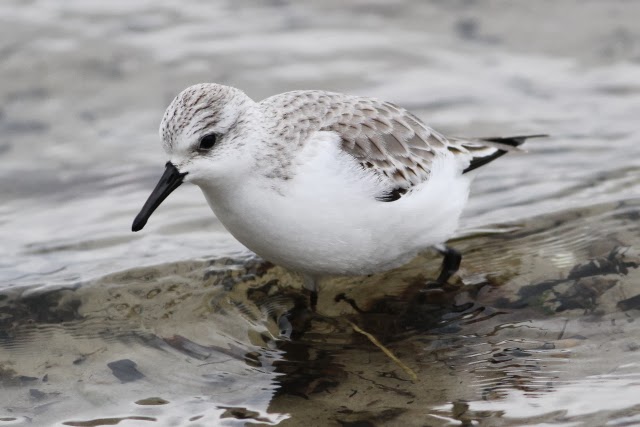
Sanderling: what a charmer.

Barwits can often be found along Shore Road.

No matter, there was just time to get down to Sandbanks before a dash home to the touchline to cheer on son George and his team mates in the Sunday afternoon fixture (a hard fought draw with rivals from west Dorset, followed by bitter recriminations about dodgy refereeing decisions etc. Honestly, I don't know where they get it from).

Purple Sandpiper, Sandbanks.
Rock Pipit was also feeding near the ferry slipway.

I was determined to leave plenty of time for the Purple Sandpipers which can often be found on the ferry slipway but, weak soul that I am, it ended up being a bit of a rush as I was distracted on the way there by small flocks of Sanderling and Bar-tailed Godwits on the high tide at Shore Road. So many birds, so little time. That's Poole Harbour for you.

Purple Sandpiper

Tuesday, 7 January 2014

The wet patch

Well I'm trying, but patch birding is just not happening this year so far: it started well enough as I managed a quick canter around on 2nd Jan, and while I don't really yearlist I netted a half-century of species. (If birding were cricket, that would be enough to get me in the England team at the moment. I still can't do overarm since breaking a collarbone but I reckon I would probably make it into the bowling attack too). But by the 4th the main footpath to Swineham was impassable, even with wellies.
 
A good excuse, then, to neglect it for slightly higher and drier ground. The harbours of Dorset and Devon are enjoying a purple patch with six species of auk, five species of grebe, four species of diver and three species of scoter viewable in recent weeks between Brixham, Portland and Poole. With only a brief weather window forecast on Sunday morning I headed for Portland:
This Great Northern Diver was plucking up crabs just yards from the shore at Hamm Beach
Great Northern Diver preening and showing the webbed feet
And here trying to swallow that crab.


A Black-throated Diver was further out but still a good view of this species
Female Eider, also off Hamm Beach

Razorbills were also fishing close to the shore...
...as was this Shag...
...while a small flock of Turnstone fed on the shingle
Back in Weymouth, a lingering Glossy Ibis was still present.
Buy any wildlife photography book and it will tell you not just to shoot close-ups but to depict a bird in its natural habitat. So here goes: prime Glossy Ibis habitat, Radipole Park Drive. Back of the net!
And no visit to Weymouth would be complete without a twirl around the Radipole Lake car park to check the gull roost. This smart Med Gull was the highlight on Sunday.

Not just the weather that was rough in Weymouth this weekend: this Shag was hanging around industrial buildings drinking lager and hurling insults at passers-by

Saturday, 4 January 2014

Grey days

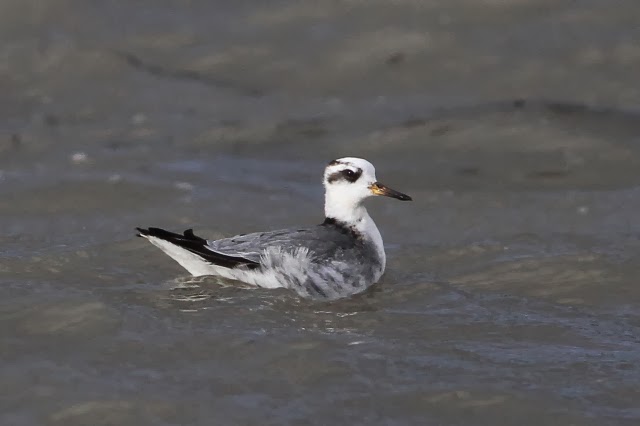
A brief break between squalls yesterday saw me and the family make a dash for Kimmeridge, our nearest stretch of coast as the crow flies if we exclude the inner shore of Poole Harbour. Two Grey Phalaropes had been blown into the bay the previous day. I lashed myself to a boulder on the water's edge to avoid being blown away by the extreme winds and, while initially elusive, the Phalaropes flew in just in front of me for a preen.
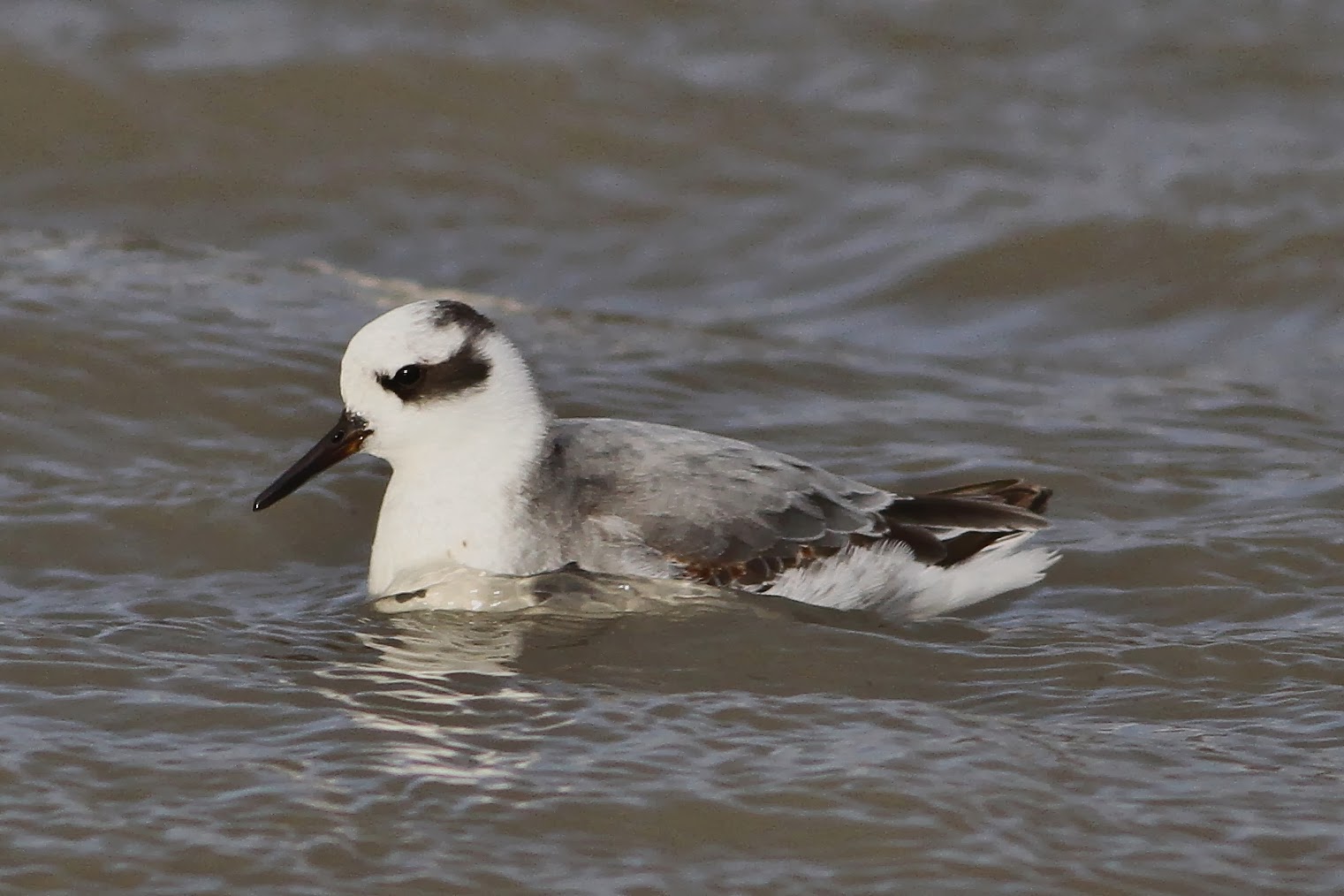
Grey Phalarope in winter plumage
Very difficult to photograph in flight with high winds shaking the camera
The phalarope taking evasive action as some driftwood approaches
A first winter bird
An Arctic breeder which winters out at sea but can be blown inshore by gales
Both birds moved up and down the bay together
Amazing how they can tolerate these conditions
Grey Wagtail on the beach

Kittiwake in the surf
One of two birds present
Kittiwake
Waterfalls blow uphill at Kimmeridge


Tuesday, 31 December 2013

2013: Anas Horribilis?

No, not a new species of duck, just a reference to a year when bad luck (and/or bad judgement) combined to produce more than my fair share of disappointment, plus a bit of comedy and no small amount of tragedy. The Queen had one in 1992. An Annus horribilis that is. Then again her house burnt down and two of her kids got divorced in the glare of international publicity, which rather puts my minor setbacks in perspective. But it started going downhill for me in February when ill health prevented a long distance twitch to Shetland for a Pine Grosbeak. Probably for the best as I try not to make a habit of twitching islands, especially those close to the Arctic Circle. If only there were some kind of seasonal opportunity to make a resolution about stuff like that, I'd take it.
Sabine's Gull (Cogden, November): a photographic highlight of 2013
Then there was a hat-trick of long distance dips - for a Rock Thrush (Spurn, bird departed overnight, missed by a day), a Bridled Tern (Northumbs/Cleveland, mobile bird, missed by 20 minutes) and a Great Snipe (Spurn again, killed by cat, missed by a whisker, so to speak). None gave me the option of waiting on news, and while I obviously had the option of not going at all, I hoped that fortune might favour the brave. Sadly fortune was in Aberdeenshire (where another Rock Thrush was found later in the year), or on the Farnes (where the Bridled Tern relocated) or had to go back to work on the Tuesday when I went for the Snipe.
I kept this feather which fell from the lifeless corpse of the Great Snipe - a real low point in my twitching career.
I hung up my long distance twitching boots for a while after that but that didn't work either: the Great Snuff tragedy was cruelly mirrored by a similar fate suffered by a local Pallid Swift (snaffled by a Sprawk, missed by 20 minutes). Untimely deaths also befell a Short-toed Lark I saw (alive) on Portland, and rarities I never even went for, like the White-throated Needletail and a Glossy Ibis on the Western Isles. Of course, death is a fate which awaits many rare birds, but this year they just seemed to be more public and tragic than usual.
This picture explains why I got so little birding done with one arm out of action in November and December - the birdspotter needs two good arms: one to hold bins, one to hold Collins.
Then as the year approached its end I made a failed bid for a Darwin Award and suffered my first ever broken bone, rendering birding, photography and driving all but impossible for most of November and December. I missed a couple of sitters during this period, notably a long-staying Orphean Warbler, a Baikal Teal and any number of Parrot Crossbills. On the up-side, a period of sedentary reflection forced me to conclude that I should not allow myself to be defined quite so much by the length of my list, and perhaps more by the length of my scar:
Selfies were all the rage in 2013 - so here's the scar from my collarbone op in November: breaking this probably cost me three British ticks - almost as painful as breaking it in the first place.
Despite this brush with mature self-realisation, and lest I acquire a reputation for complete haplessness, I should say that I did manage to add six new birds to my British list in 2013. A Hooded Merganser from the armchair early in the year was a cheeky bonus but it took the Kent Dusky Thrush (pending decision from the birding police on racial purity) to bring an end to a record 7 month run without a new bird. A Pacific Swift in Suffolk in June gave me something to show for an exceptional summer when I either couldn't go for or missed everything else.
Pacific Swift (Suffolk, June)
A stonking October put a gloss on the year, starting with a Semipalmated Plover in Hampshire and ending with a Hermit Thrush in Cornwall. Steve Smith was driver for the first three of these (cheers Steve), and Jol Mitchell came along for the ride for the Plover, maintaining our 100% record as a trio, but I managed the Hermit Thrush all by myself, just when I was starting to believe my solo efforts at twitching were cursed. Then, as Britain's birding community was hanging up its bins under the mistletoe for 2013, and bloggers had prematurely published their 'reviews of the year', up turned the Brünnich's Guillemot - long-staying, photogenic and just down the road in Portland Harbour.
Hermit Thrush (Cornwall, October)
It wasn't all tazzing around the country chasing other people's rarities though: sometimes I just tazzed around Dorset chasing other people's rarities; and frequently, if not religiously, I could be found at Swineham, looking for my own, hope rarely fulfilled, but the experience always enhanced by not needing to travel far to get there.
Caspian Tern (West Bexington, July): this carrot-nosed brute was a Dorset tick for me in 2013.
A patch can be a cruel mistress, and while my relationship with Swineham improved overall, I continue to suffer from a form commitment-phobia, and confess to long periods of neglect during which my head has been turned by more exotic locations. When I did pay it more attention than a fleeting booty call though it rewarded me with quality patch ticks like Water Pipit, Jack Snipe, Red-throated Diver, Long-eared Owl and, best of all, White-winged Black Tern. The absence of the year-round floods made it a bit less appealing to bird than last year, but a patch is a patch, and as I'm stuck with it, I stuck with it, if only for the sake of the children who get to see much more of me when I bird locally.
White-winged Black Tern (Swineham, October): patch gold, in monochrome.
Photographically it was a rewarding year, all the lifers above being snapped for the record though only the Guillemot with any distinction. Fortunately I have low standards so I was happy with that. More successful photographically were a series of pelagics in August, and a trip to Scilly from where most of these embarked.
Great Shearwater (August, off Scilly): one of many highlights from four August pelagics.
Best birding day in 2013? A toss-up between a January bird race around Poole Harbour, and a Lyme Bay pelagic with Dorset birders and my old mate Matt Jones, taking a break from his miserable job of showing Stewart Island Kiwis to tourists for money, to revisit his native Blighty.
Sooty Shearwater (Lyme Bay, August): another pelagic highlight
Rare bird of the Year? Contenders for me include the Pacific Swift - the unlikely combination of a rare bird and an even rarer opportunity to drop everything as news broke to go see it - and the Hermit Thrush - the irresistible draw of a Yank in an idyllic Cornish valley in October. But for sheer chutzpah it has to be the Brünnich's Guillemot - mega-rare, very obliging and just down the road. Most photogenic bird of the year though was probably the approachable Sabine's Gull which graced the Dorset coast for a few days in October. Exquisite plumage + co-operative bird + too big to be killed by cat + good light - large crowd = happy days. A juvenile Dotterel with which I spent a happy hour on Bryher ran it a close second, and an Otter-dodging Black-bellied Dipper in Norfolk takes third place for charm.

Dotterel (Bryher, August)
My Dorset list profited reasonably well from in-county birding, with such scarcities/rarities as Bluethroat, Green-winged Teal, Caspian Tern, Icterine Warbler, Rosefinch, Semipalmated Sandpiper, Red-breasted Flycatcher, Penduline Tit, Surf Scoter and Black (as well as Brünnich's) Guillemot being added to the county list. The county list seems to be gaining increasing importance for me, despite being based on an arbitrary medieval boundary subjected more recently to a random act of gerrymandering in the 1974 local government re-organisation. Silly really, but then so are most lists I suppose, so it's in good company.
Black-bellied Dipper (Norfolk, March)
And speaking of lists I suppose I ought to consider resolutions for the New Year. I do so with some trepidation as it was a quiet pledge to myself to aim for '500 before I die' that led to some of the rash decisions to go for stuff I would normally be more reticent about that led to the sorry dips mentioned above. 300 for Dorset before I'm 50 seems a bit more realistic though. Currently in the low 270s, with five years to go, assuming that Darwin Award comment doesn't come back to haunt me.
Bluethroat (Portland, March): a slightly tarty Dorset tick for me, but no less attractive for that. I waited for ages, then three came along at once.
All in all then, 2013 was not that horribilis at all, there was certainly more success than failure, and even the failures have, I hope, provided some amusement for the readers of my more confessional posts. Writing them has certainly been cathartic for the author and I dare say there'll be more to come in 2014. Happy New Year.
Brünnich's Guillemot (Portland, December): bird of the year for Dorset and beyond.