Showing posts with label Black-throated Diver. Show all posts

Wednesday, 14 June 2017

Some Scottish specialities

Before I was so rudely interrupted by a flurry of local and national rarities, I was regaling you with tales from our recent Scottish holiday. We'd done the star mammals and the cetaceans, so let's have a look at a few birds. I found a notebook recently from a childhood visit to Gairloch which recorded sightings of three species of diver - Red-throated, Black-throated and Great Northern. By the end of the first day of our recent trip there, I had seen all three species again in a short drive from our cottage on the southern shore of the sea loch to Red Point. Later I counted at least 10 individuals (mostly Red-throats) in one brief scan from the Big Sands campsite where we spent family holidays almost 40 years ago.
This immaculate Red-throated Diver was just off the beach of Red Point
Such a beautiful bird

Another Red-throat was just offshore at Big Sands 
Red-throated Diver flying past us at Red Point
Click to enlarge for a better view of the pinstriped neck pattern
Divers are one of my favourite bird families, combining sleek good looks with haunting calls and an exquisite choice of breeding habitats. It's bad form, not to mention illegal, to bother these protected birds during the breeding season too close to their nesting sites (typically islets on small lochans for Red-throated and on larger lochs for Black-throated), so my plan was to check out plenty of coastal and roadside habitat and hope for close views in areas where there was no risk of disturbance. An early morning visit to the vast shoreline of Loch Maree - the most important breeding site for Black-throated Divers in the country - produced very distant sightings of three birds, which nest on the large islands way out in the middle of the loch. A visit later in the day was equally unsuccessful as the lochshore was busy with kayakers - no chance of a close view in those circumstances.
A reasonably close view of not one...
...or two...
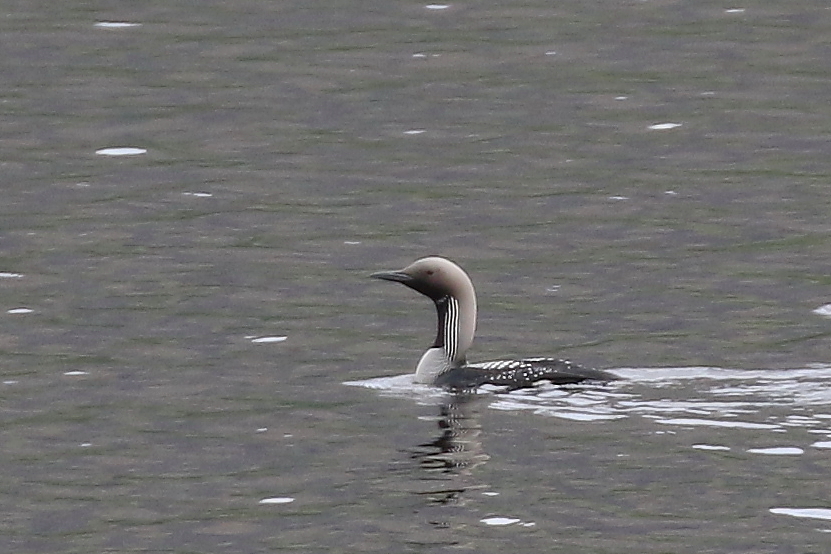
...but three Black-throated Divers on Loch Maree
You have to be a long way north to see Hooded Crow - this one was on the shore near Gairloch harbour
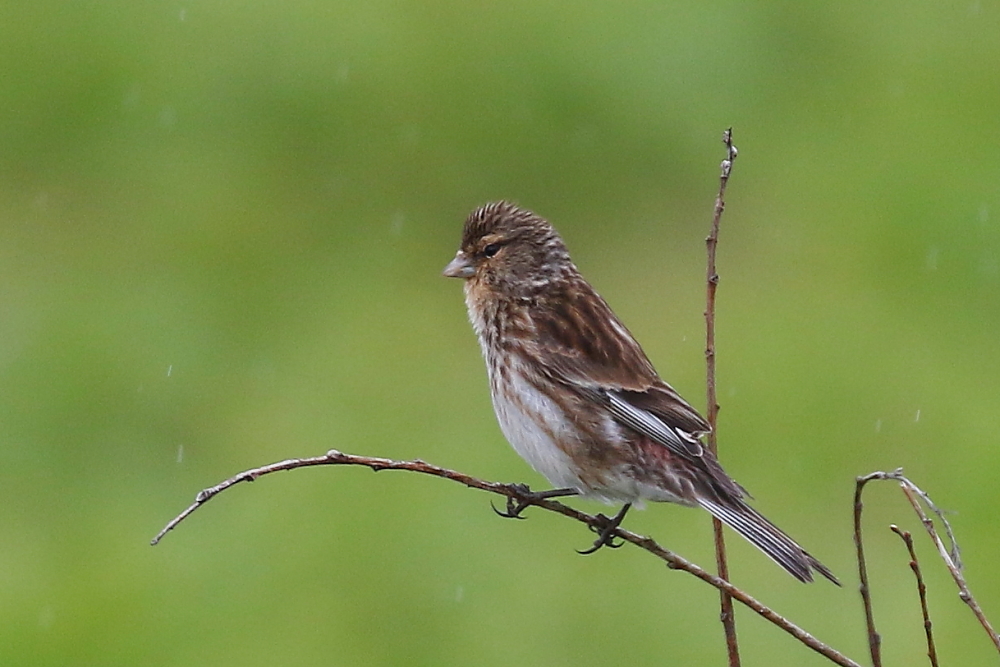
Twite was on my target list for the week - we saw just the one pair, in the rain along the north shore of Gairloch
On another day a couple Black-throats were snoozing close in to an inaccessible stretch of coast near Red Point. So despite good telescope views I was struggling for a photo of a breeding plumaged bird. Then a few days later, when at the south end of Loch Maree looking for dragonflies (more on that in a later post), in an area with few islands and therefore not where one would expect to see divers, not one, or two, but three Black-throated Divers sailed past, apparently too absorbed in each other to pay much attention to me as I fumbled with my camera settings on the shore.

Siskin in the garden of our holiday accommodation
Red-breasted Merganser flying over the sealoch
Skylark at Red Point
Repoll at Red Point - apparently we don't even have to worry about what flavour these days
Northern Wheatear with prey near Red Point
The Beinn Eighe National Nature Reserve, close to where we were staying, is home to another special bird I was hoping to see on our trip - Scottish Crossbill, the UK's only endemic species. A couple of quick visits to suitable habitat had produced nothing more than some distant calls, but a more leisurely stroll with the family around the woodland trail in the NNR was more successful: first a male Crossbill, then a pair. The various site guides I had suggested that Crossbills in this area ought to be Scottish Crossbill, but as I was not carrying sound recording equipment, I guess I can't really prove it. They were fairly chunky, and the calls sounded deeper to my ear than the Common Crossbills near home, so for the sake of argument and the want of a sonogram, let's just call them 'presumed' Scotsbill.
Presumed Scottish Crossbill
Scottish Crossbill has a chunkier more bull-necked appearance than Common
Tree Pipit, Beinn Eighe
I really enjoyed the general 'bumbling around' birding and bumping in to commoner species as well as seeing the local specialities - plenty of breeding Skylark, Siskin, Redpoll, Tree Pipit and Wheatear, all pictured above, were a delight to see. Stand by for one more post on the birds of Wester Ross and then we'll make our way down the food chain to the odonata and lepidoptera before closing the Scottish chapter at the very bottom of the ecological and moral web with an excoriating critique of the West Highland Midge...


Tuesday, 7 January 2014

The wet patch

Well I'm trying, but patch birding is just not happening this year so far: it started well enough as I managed a quick canter around on 2nd Jan, and while I don't really yearlist I netted a half-century of species. (If birding were cricket, that would be enough to get me in the England team at the moment. I still can't do overarm since breaking a collarbone but I reckon I would probably make it into the bowling attack too). But by the 4th the main footpath to Swineham was impassable, even with wellies.
 
A good excuse, then, to neglect it for slightly higher and drier ground. The harbours of Dorset and Devon are enjoying a purple patch with six species of auk, five species of grebe, four species of diver and three species of scoter viewable in recent weeks between Brixham, Portland and Poole. With only a brief weather window forecast on Sunday morning I headed for Portland:
This Great Northern Diver was plucking up crabs just yards from the shore at Hamm Beach
Great Northern Diver preening and showing the webbed feet
And here trying to swallow that crab.


A Black-throated Diver was further out but still a good view of this species
Female Eider, also off Hamm Beach

Razorbills were also fishing close to the shore...
...as was this Shag...
...while a small flock of Turnstone fed on the shingle
Back in Weymouth, a lingering Glossy Ibis was still present.
Buy any wildlife photography book and it will tell you not just to shoot close-ups but to depict a bird in its natural habitat. So here goes: prime Glossy Ibis habitat, Radipole Park Drive. Back of the net!
And no visit to Weymouth would be complete without a twirl around the Radipole Lake car park to check the gull roost. This smart Med Gull was the highlight on Sunday.

Not just the weather that was rough in Weymouth this weekend: this Shag was hanging around industrial buildings drinking lager and hurling insults at passers-by

Tuesday, 24 December 2013

Tystie. Very Tystie.

Still at the mercy of the rest of the family for trips out and they have gone beyond the point where indulging Dad is a selfless act of loyalty: now they have taken to extorting expensive treats in return. So yesterday's deal was, I get to stand in the cold for half an hour looking for birds in Portland Harbour, they get to sit in the warm car followed by lunch at the reassuringly expensive 'Taste' cafĂ© at Ferrybridge. And very tasty it was too.
This may look like a bug going splat on a windscreen but it is in fact a first winter Black Guillemot. The red bits, rather than bug blood squishing out of its butt on impact, are in fact the trailing legs of the bird coming in to land.
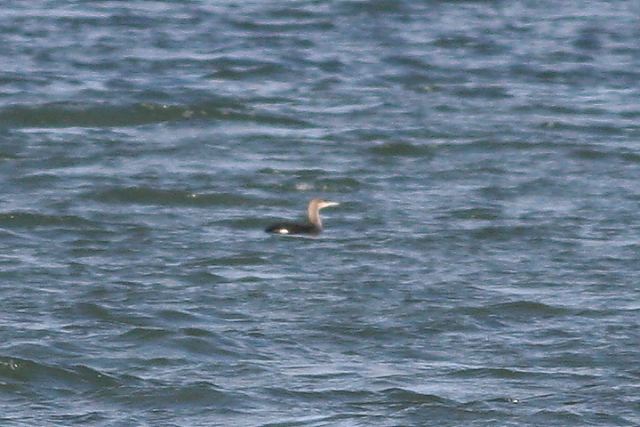
While the boys only had eyes for strawberry milkshakes, my target for the trip was a Black Guillemot, or Tystie, as they call them in Shetland where they are pretty common. Not common in Dorset at all though - this was my first in fact, having failed to see a different bird of the same species which hung around in the same spot last winter, despite several attempts. This year was a bit easier with the bird showing almost immediately, diving around a group of coloured buoys, with a Black-throated Diver for company.
An even worse photo of a Black-throated Diver

Holding the camera is still far from comfortable since clavicle-gate, but I'd pretty much written off the rest of 2013 birdwise anyway so this was a bit of a bonus. And what with the foul weather I have all but succumbed to the temptations of a sedentary life on the sofa, stuffing potato-based snacks until I feel sick with guilt.

Speaking of guilt, as if vegetating on the couch eating unhealthy food and watching repeats and reality shows wasn't enough, along come the NSPCC seasonal ads. As one of life's natural cynics, who takes a dim view of most of humanity and its impact on the rest of the planet, Christmas is the one time of year when I get to pretend, just for a few days, that I can see the good in humankind and that everything is going to be fine, rest-of-the-world-wise. Then along comes the NSPCC to remind us of the true horror of existence, and the awful fact that life is, for many younger members of our species, cheap, nasty, brutish and short, and that quite a lot of people who ought to be looking after them are actually scum. Phew, for a minute there I was in danger of having a Merry Christmas. Hopefully it won't stop the rest of you having one. That's me wishing you all a 'Merry Christmas' by the way. What, too jolly?

Wednesday, 2 January 2013

A New Year in Poole Harbour

New Year's Day in Dorset means a boat trip around Poole Harbour laid on for the locals courtesy of Mark and Mo Constantine. Birders may know Mark as the driving force behind the Sound Approach. Normal people who tend to have a greater interest in personal hygiene may know the couple as the founders of the Lush cosmetics empire.

 A typically distant view of a diver in Poole Harbour, but any view of Black-throated Diver is a good view - the white flank patch helped identify this bird
Yesterday's boat was one of the best yet with a rare combination of dry weather, good company, fine food and, most important, excellent birds. The boat headed out of Poole Quay towards Brownsea and one of the first birds of note was a distant diver. We all assumed this to be a Great Northern before it gradually materialised into a Black-Throated - a very good bird for the area. Great Northern is the more likely diver in the Harbour and at least four more were indeed seen, 2 or 3 of which were unusually close to the boat.

Great Northern Diver - a scaly juvenile - the commonest diver within Poole Harbour
A sail-past of Brownsea Lagoon revealed it to be well-stocked with waders, mostly Black-tailed Godwits and Avocets but also good numbers of Barwits, Oystercatchers, Grey Plover, Dunlin and Redshanks. Heading south around Brownsea brought us into the wintering grounds of several Black-necked Grebes, many Red-breasted Mergansers and, although in smaller numbers than usual, a few Goldeneye. I was pleased to pick up a distant Red-necked Grebe as we rounded Brownsea which everyone eventually managed to see. Upwards of a dozen Spoonbill were on Shipstal Point and Razorbill and Guillemot were also seen.
Red-breasted Merganser - surely one of the most attractive plumages of any British bird
The trip proved to be excellent reconnaissance for a forthcoming Dorset bird race in which I will be participating for the first time. As it approaches, the local news grapevine becomes strangely withered as competing teams try to keep news of potentially tricky day-ticks to themselves. Even yesterday amid the bonhomie of the boat trip I overheard an out of place Mandarin Duck being discussed as furtively as would be a breeding pair of Golden Oriole! And, no, I'm not telling you where it is...
Black-necked Grebe - this one was west of Brownsea