Tuesday, 13 October 2015

Minimal effort

While the Northern Isles and Scilly have had their share of October rarities already this year, there haven't been many to chase within striking distance of home so far this month, apart from a flurry of goodies on Portland today while I was busy at work. But it was the desire for a change of scene, without much physical effort or lugging my gear too far, rather than desperation, which saw me heading off to Exmouth on Sunday morning where a Ridgway's Cackling Goose, Branta hutchinsii minima, has been present for the last few weeks.
Ridgway's Cackling Canada Goose: a bit of a mouthful, but worth a fortune in Scrabble.
A smart wee bird, whether tickable or not
A similar sized bird to the Dark-bellied Brents with which it was associating - conspicuously not with its much larger cousin...
...the more familiar, larger and lighter feral Canada Goose
Now before all the purists out there start castigating me for twitching untickable dross, let me explain. First, I like the Exe Estuary. Unlike Swineham, it is always full of birds, even if, like Swineham, some of them are escaped from wildfowl collections. Second, while I have seen presumed wild Richardson's Cackling Geese among flocks of Barnacles on Islay and at Caerlaverock, I'd never knowingly seen Ridgway's before, in or out of a pen. And third, I couldn't face trudging around the patch, and just fancied going a bit further afield without having to make much effort. The Exe is good for that: in several places you can just pull up and scope it.
The Ridgway's in context with the Brents
It took off with two Brents and headed out into the Estuary
A few Pale-bellied Brents (which breed in Svalbard, Greenland and Canada) like this one above, and a Black Brant (which breed in Alaska), were also with the Russian Dark-bellied Brent flock on the Exe - indicative of their ability to pick up all sorts of rough trade.

Brents on the Exe
The chances of the Ridgway's being accepted as a wild bird may therefore be slim, but, as finder Matt Knott points out in his blogminima breeds just a short hop across the Bering Sea from Russia, and the Dark-bellied Brent's breeding grounds on the Tamyr peninsular are about the same distance away from minima's breeding grounds in Alaska as their wintering grounds - albeit in the opposite direction. So, with a little imagination, it isn't wholly inconceivable that it hooked up with what is, on the face of it, an unlikely carrier species.
Sika Deer back near home at Arne
A little more bashful in the woods
Not much point in this leucistic Sika trying to hide - taken at Middlebere last weekend
Water Vole at Arne
After Sunday morning's jaunt, I was back home in time to watch number 1 son and the rest of Wareham Rangers U-13s retain their 100% league record this season, and take a walk around Arne with number 2 son and his mum. Sika Deer serenaded us in the woods, Spoonbills gathered by the dozen in the channels, and an array of autumn funghi presented endless opportunities to remind them via the medium of hackneyed puns that, despite going AWOL around this time of year in search of rare birds, I can still be a fun-guy to be with.
Some funghi
Some more funghi
Even more fun guys (groan)
Insert bad deer pun of your choice, I'm done here

Sunday, 4 October 2015

Mellow fruitfulness

It was certainly the season of mists this morning when I rolled up at Middlebere hoping to see a Ring Ouzel, only to find I couldn't see my hand in front of my face. When the sun eventually burnt it off I could see it was also the season of mellow fruitfulness as branches bowed under the weight of Rowan, Hawthorn and Blackberries.
I managed to miss the spring passage of Ring Ouzel so catching up with the one above today more than made up for that. A hearty crop of Rowan berries kept it happy, as it fed with a flock of Mistle Thrush, Song Thrush and Blackbird, plus a few Bullfinch.


Tuesday, 29 September 2015

Change of scene

Sunday saw me heading east over the border to Hampshire, Keyhaven Marshes to be precise. This is a great stretch of coastal lagoons and saltmarsh which has attracted some fine rarities over the years, and I have some fond memories of visiting here. Memorably, I chanced my arm to twitch a Lesser Sand Plover just two days before my eldest son was born. Fortunately, he didn't arrive early. The year before I saw my first Stilt Sandpiper here, and since then I have also caught up with Baird's Sandpiper and Semipalmated Sandpiper on the pools behind the seawall.
Long-billed Dowitcher: #225 for my photo yearlist
The Dowitcher on the deck
Kinder light than in the above flight shot
This was as close as the Dowitcher came while feeding, and it was always facing away unfortunately
With such a track record for American waders, the recent arrival of a Long-billed Dowitcher, one of our commoner trans-Atlantic visitors, was not a huge surprise. Needing to travel a bit further at this stage of the year to add to my photo year list gave me a good excuse to reacquaint myself with the area. Half a dozen Bearded Tits were pinging manically around the reedbed as soon as I stepped out of the car - a promising start.
Bearded Tit - male
Bearded Tit - female
The small flock would fly around before landing back in the reedbed
Here the male in flight
A short amble down the seawall to Keyhaven Lagoon brought the Dowitcher within view, and, when it woke up and moved from behind some other waders, within camera range. Grey Plover, Knot, Redshank, Black-tailed Godwit, Lapwing and Dunlin kept it company.
Black-tailed Godwit
Another Blackwit in winter plumage
Dunlin on the shore
Lapwing on the pools behind the seawall
My photos weren't terribly satisfying so I stuck around. It took an age for the Dowitcher to move, and I had returned to the car for lunch when it returned to the saltmarsh. This was enough to tempt me back and despite patiently waiting for a few more hours, the closest I got was when it flew over my head to commute between the lagoon and the saltmarsh.
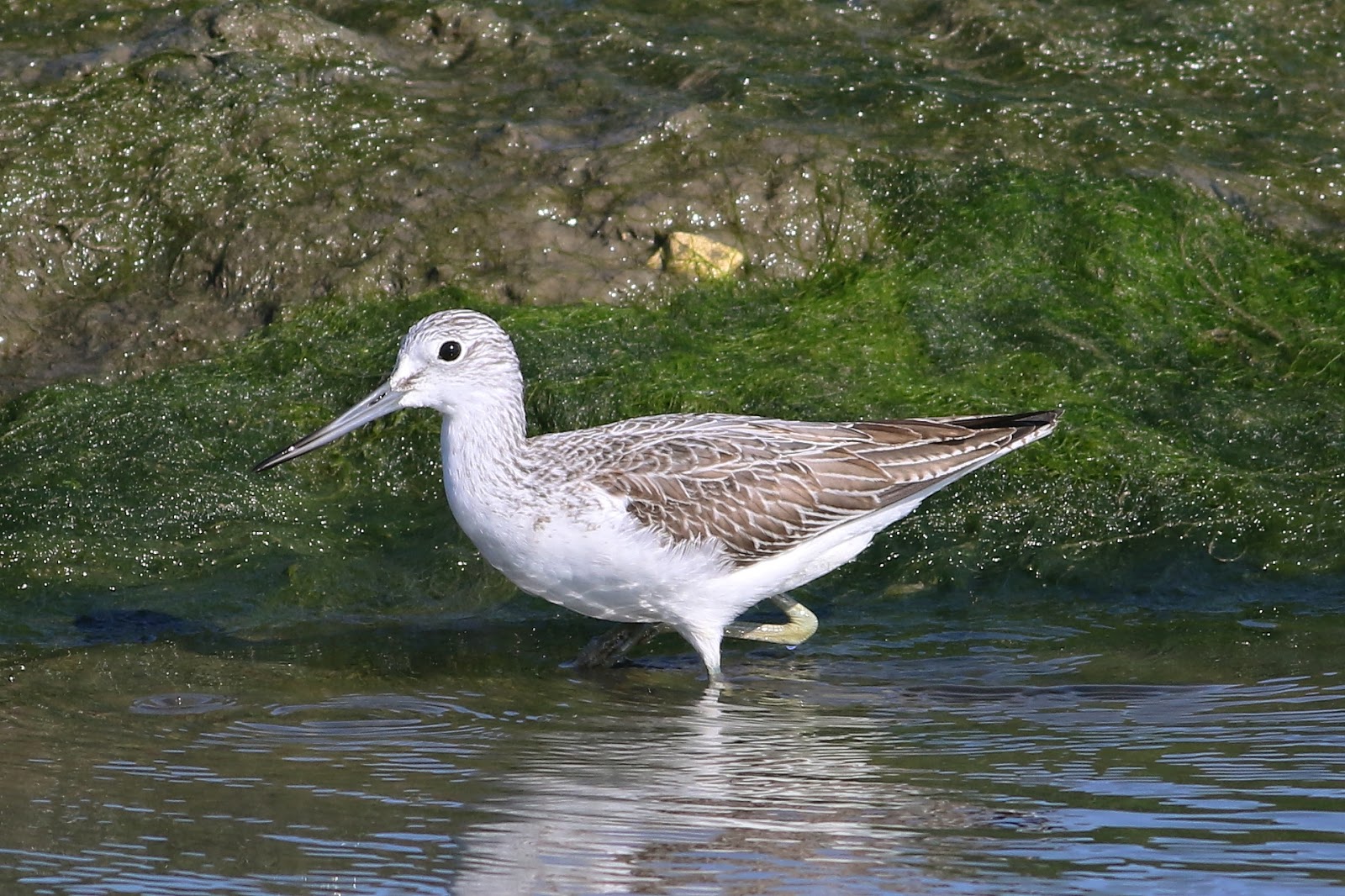
Greenshank: why couldn't the Dowitcher show like this?
Greenshank in flight
The distinctive black armpit of Grey Plover
Grey Plovers on Keyhaven Lagoon
So, while the Dowitcher didn't quite perform as hoped, it was a still a day well spent on a fine stretch of the south coast. The Isle of Wight provides a dramatic backdrop across the Solent, and with so much good habitat there is always a sense of promise at Keyhaven. I'm sure I will be back again soon.
Meadow Pipit
Meadow Pipit
Stonechat - a male
Hurst Castle and Lighthouse from Keyhaven
Male Bearded Tit

Monday, 28 September 2015

Talon spotting

Having been a bit starved of quality time with the camera in recent weeks I reluctantly had to neglect parental duties this weekend to mend relations with the Canon 7D Mark II. As well as depriving me of the opportunity to watch Wareham Rangers U-13s concede eight and get dumped out of the Dorset Youth League Cup at the first time of asking, this required me to try photograph a variety of passerines and waders. Not easy when they were being terrorised by the following:
This Peregrine over Keyhaven lagoon flushed the waders half way to the Isle of Wight
Tune in to next post to see if I was able to photograph the Long-billed Dowitcher which was among them
This Sparrowhawk caught a thermal over a warm Middlebere on Saturday morning
It posed for pictures before having a tilt at one of the Chiffchaffs I was photographing
Kestrel at Keyhaven