Showing posts with label Greenshank. Show all posts

Tuesday, 29 October 2019

Last day on Scilly

My third and last day of a short trip to the Isles of Scilly saw me resist the temptations of island hopping to stay on St Mary's. The day began as had the previous two with a quick trip to the Garrison for views of the Blue Rock Thrush. From there I meandered around Peninnis for the first time in years, reminiscing as I went about seeing my first Siberian Stonechat, a Short-toed Lark and an ill-fated Chough which spent a few days in the fields on the flanks of the headland in 2012.
Female Stonechat, Peninnis
Male Stonechat, Peninnis
From Peninnis I sauntered through the idyllic Old Town churchyard and on to the Standing Stones field where a male Brambling had joined the House Sparrows at the feeding station set up by the Isles of Scilly Bird Group. After this I strolled through Lower Moors, gaining another brief view of Monday's Spotted Crake, and up the road to Salakee, where the Citrine Wagtail which turned up on my first day was still hanging out with the cattle.
Teal, Higher Moors
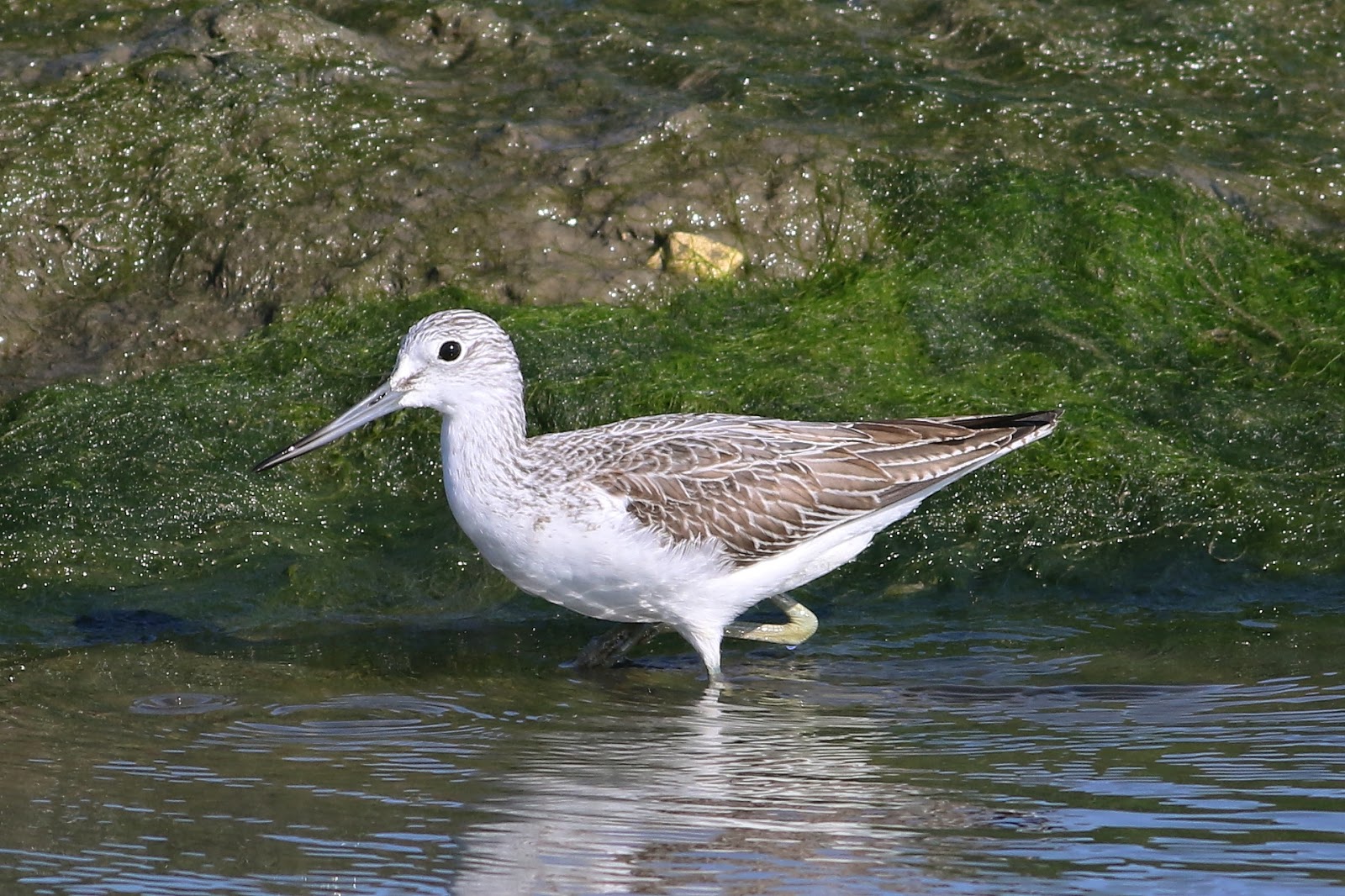
Greenshank, Higher Moors
Continuing to Higher Moors there was time for a chat with some birding pals from the mainland and, bird-wise, nothing more exciting than a small flock of Greenshank. My energy levels were flagging at this point and with just 90 minutes to go before last check-in on the Scillonian III, I figured a return to Hugh Town was probably my best option.
Male Brambling, St Mary's
Song Thrush, Old Town churchyard
At this point my phone alerted me to news of a Spotted Sandpiper on the islands - I assumed the St Agnes bird which I had failed to see the previous day had returned but on looking again this time it (or another) was at Watermill, a 15 minute walk from where I was standing. Quickening my pace, I took the direct route through Holy Vale, where we spent several happy October holidays when the children were younger, past the refurbished Borough Farm, and down Watermill Lane towards the cove where the Sandpiper had been reported.
Spotted Sandpiper, Watermill
Juveniles of this species resemble Common Sandpiper but have more yellowy legs, shorter tails and plain tertial fringes
As I approached the beach I heard a Sandpiper calling, and on reaching the strandline the birders assembled there informed me that this must have been the Sandpiper flying off around the corner to the next cove! With just 15 minutes to go before I had to leave to board the Scillonian, I was not optimistic about it returning, but after 14 minutes it did just that, giving me a minute to take some quick pictures before a brisk walk back to town. It was a poetic ending to the trip as this was the only target bird I had missed up to that point - and a reminder of the promise and beauty of the islands which provided many happy memories of my previous visits.
The Spotted Sandpiper picked insects off the rocks in the background
A good bird to end a successful trip

Monday, 19 June 2017

Waders high and low

There are few greater pleasures in life for me than photographing waders on a beautiful, empty Scottish beach. Our recent holiday near Gairloch providing a few opportunities to indulge:
Dunlin
This bird was singing - it sounds like a tiny bomb dropping
Another of a small flock of Dunlin on the beach at Red Point
Summer plumaged Sanderling is in stark contrast to the silvery birds we see in winter in Dorset... 
...the clockwork running motion is the same though!
Sanderling in flight
The flock was feeding in the seaweed on the beach
Ringed Plover were also on the beach at Red Point
Ringed Plover
In contrast to the waders at sea level, this Greenshank was up at about 1,800 feet on Beinn Eighe
I walked the Bein Eighe Mountain Trail one morning to find a pair up on the plateau near some boggy pools
Greenshank
A huge dune at Red Point - my sons can be seen for scale at the base

This shows why the area is known as Red Point after the colour of the sand
Ringed Plovers at Red Point

Monday, 17 April 2017

Operation Daymark

The Easter Bank Holiday weekend provides a unique opportunity for the lover of rare birds: an uninterrupted four day window at a promising time of year to stress out with the added attraction of heavy traffic. Whilst I had idly clocked news of a Rufous-tailed Rock Thrush on the Isles of Scilly, I hadn't really considered going to see it until, not for the first time this decade, a text message from David Bradnum gave me the kick in the rear I needed to start thinking about it.
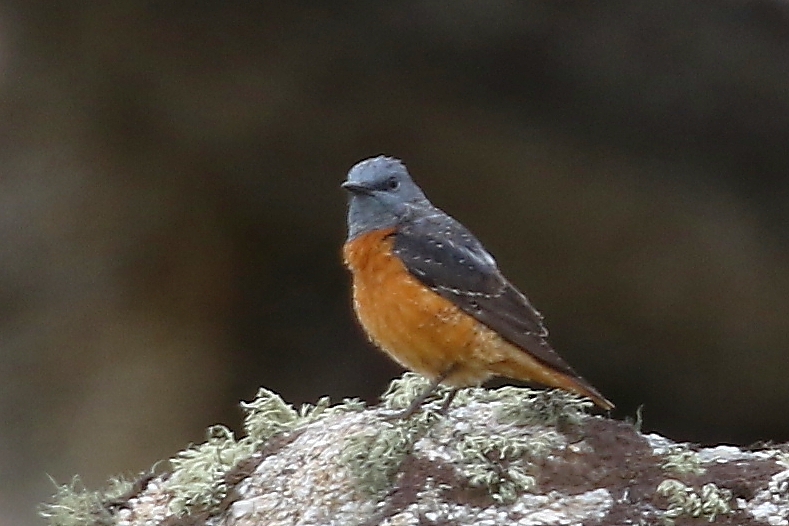
Rock Thrush, Bread and Cheese Cove, St Martin's
A red, white and blue riot of colour
Neither of us fancied day-tripping it, preferring an overnight stay to make the most of the islands and provide a second shot at seeing the bird if we were unsuccessful on the day of our arrival. Whilst not impossibly complicated, the logistics weren't straightforward: tickets for Scillonian III would be simple enough to procure, accommodation on Scilly during one of the busiest weekends of the year less so. But after just a few phone calls (Scilly's tourist industry has yet to get the hang of on-line booking), we managed to find a reasonably priced twin room.
The rufous tail seen clearly in flight
Note the white patch on the back of the Rock Thrush
That just left the small matter of getting from St Mary's to Daymark on St Martin's, where the Rock Thrush had spent the previous week. We were due to disembark the Scillonian at 1200 and an inter-island launch was due to leave for St Martin's at 1230, so that shouldn't be a problem either. All that remained was to secure permission to go from respective loved ones, and with that done, Operation Daymark was good to go.
Song Thrush: commoner than Rock Thrush on Scilly, and more confiding too
Daymark on St Martin's viewed from St Mary's
David arrived in Dorset from Essex for a few hours kip at our place and an 0400 start on Good Friday saw us arriving in Penzance in plenty of time to make the Scillonian. After possibly the smoothest crossing I have experienced, we made good time and shortly after midday were at the front of the queue on the quay for the boat to St Martin's. The latter island was hosting a music festival and we watched in dismay as suitcases, guitars and violin cases were unloaded carefully, and therefore excruciatingly slowly, from the Scillonian to a first, second, then third waiting boat - and all by hand. 1230 came and went, and when what appeared to be a drumkit appeared, it was too much for one enterprising birder who chartered a jetboat and offered us two seats on it. Once he had retrieved the hand we had bitten off, we were on our way.
Greenshank: the only wader present at Lower Moors on St Mary's
Wheatear: one of several on Peninnis
The advantage of the jetboat was not just the ability to jump the queue, but also to reduce the travel time and provide another half an hour on St Martin's before we needed to make the return journey. Unfortunately, the low tide meant that the disembarkation point was at the opposite end of the island to the cove where the bird was being seen.
White Wagtail on the quay at Hugh Town
Always a smart bird to see
The best part of half an hour later we arrived breathless and perspiring to catch up with more sprightly souls who had set a blistering pace across the island. Fortunately for all of us, islander Will Scott had the bird staked out in Bread and Cheese cove and shortly after arriving we were enjoying good views as the bird fed on the heather clad slopes and rocks around the cove.
Scilly Wren
This bird was singing on St Mary's
A few late-comers who had not joined us on the jetboat arrived even more breathless and sweaty, but they too enjoyed views of the bird before it headed to the other side of the cove. The walk back to the boat was altogether more relaxed and there was even time for a bit of birding back on St Mary's after the all the yomping around St Martin's.
Rock Pipit at Porthloo
Another songster

After the excitement of Good Friday, Saturday was uneventful but enjoyable on St Mary's. A few dozen Manx Shearwater and a single Common Dolphin provided interest on the way home. A fairly epic twitch then, with thanks to David for driving and providing the motivation to make the effort.
Manx Shearwater from Scillonian III

Rock Thrush - ordinarily at this time of year this bird would be breeding in southern European mountain range above the 1500m line - incredible to see it on a Scilly beach

Tuesday, 29 September 2015

Change of scene

Sunday saw me heading east over the border to Hampshire, Keyhaven Marshes to be precise. This is a great stretch of coastal lagoons and saltmarsh which has attracted some fine rarities over the years, and I have some fond memories of visiting here. Memorably, I chanced my arm to twitch a Lesser Sand Plover just two days before my eldest son was born. Fortunately, he didn't arrive early. The year before I saw my first Stilt Sandpiper here, and since then I have also caught up with Baird's Sandpiper and Semipalmated Sandpiper on the pools behind the seawall.
Long-billed Dowitcher: #225 for my photo yearlist
The Dowitcher on the deck
Kinder light than in the above flight shot
This was as close as the Dowitcher came while feeding, and it was always facing away unfortunately
With such a track record for American waders, the recent arrival of a Long-billed Dowitcher, one of our commoner trans-Atlantic visitors, was not a huge surprise. Needing to travel a bit further at this stage of the year to add to my photo year list gave me a good excuse to reacquaint myself with the area. Half a dozen Bearded Tits were pinging manically around the reedbed as soon as I stepped out of the car - a promising start.
Bearded Tit - male
Bearded Tit - female
The small flock would fly around before landing back in the reedbed
Here the male in flight
A short amble down the seawall to Keyhaven Lagoon brought the Dowitcher within view, and, when it woke up and moved from behind some other waders, within camera range. Grey Plover, Knot, Redshank, Black-tailed Godwit, Lapwing and Dunlin kept it company.
Black-tailed Godwit
Another Blackwit in winter plumage
Dunlin on the shore
Lapwing on the pools behind the seawall
My photos weren't terribly satisfying so I stuck around. It took an age for the Dowitcher to move, and I had returned to the car for lunch when it returned to the saltmarsh. This was enough to tempt me back and despite patiently waiting for a few more hours, the closest I got was when it flew over my head to commute between the lagoon and the saltmarsh.
Greenshank: why couldn't the Dowitcher show like this?
Greenshank in flight
The distinctive black armpit of Grey Plover
Grey Plovers on Keyhaven Lagoon
So, while the Dowitcher didn't quite perform as hoped, it was a still a day well spent on a fine stretch of the south coast. The Isle of Wight provides a dramatic backdrop across the Solent, and with so much good habitat there is always a sense of promise at Keyhaven. I'm sure I will be back again soon.
Meadow Pipit
Meadow Pipit
Stonechat - a male
Hurst Castle and Lighthouse from Keyhaven
Male Bearded Tit