Showing posts with label Gannet. Show all posts

Wednesday, 30 August 2017

Better late than never

Blogging appears a bit passé these days, what with Twitter and the like offering more instant gratification and immediate feedback for and from today's time-poor social media user. So passé, in fact, that I needn't feel remotely guilty about posting almost pre-historic news from a family holiday in Yorkshire earlier this month. Today the wonderful Bempton Cliffs RSPB reserve is playing host to two Greenish Warblers - one of a small number of species I have seen in Britain but not yet photographed. A couple of weeks ago there were no Greenish Warblers - but there were signs of early migration with a juvenile Cuckoo providing me with my best opportunity this lifetime to photograph a normally skittish species. Wheatears, Whitethroats and Wagtails were also in evidence in the fields behind the clifftops.
Cuckoo at Bempton Cliffs
Feeding on caterpillars in the long grass
Wheatear
Whitethroat
Yellow Wagtail
Bempton is world renowned for its Gannet colony - thousands were still on the cliffs, providing, in my humble opinion, about the best natural spectacle one can see in mainland Britain today. I now know I am not alone in holding this opinion - to quote another visitor overheard behind me at one of the many well-positioned viewpoints: 'That's, like, the most amazing nature I have ever seen. You know, with my actual eyes'. Quite.
Gannet
An imposing bird in an imposing setting
Note the pin-striped feet
Still much displaying taking place
A family party at Staple Newk
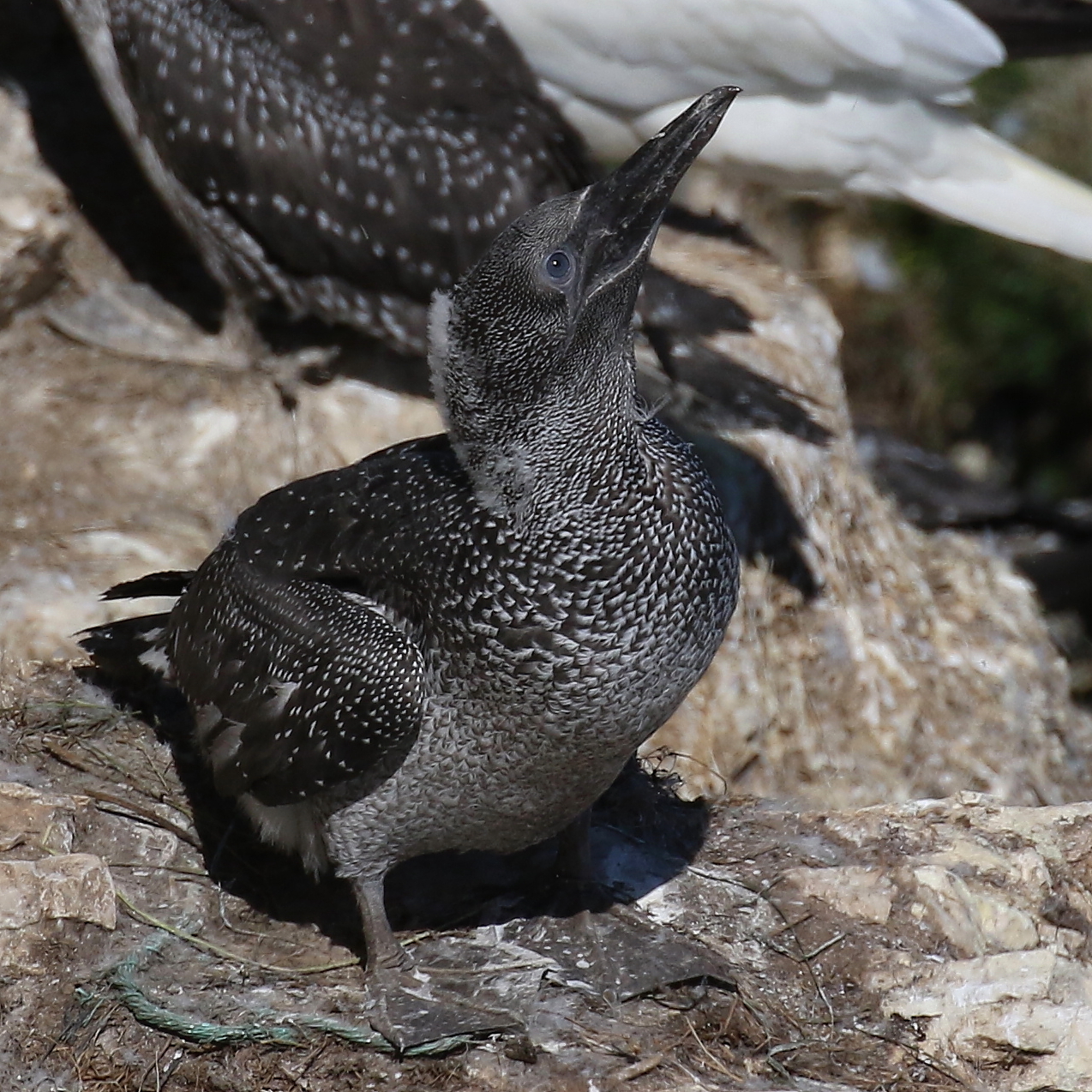
I had not been to Bempton at this time of year previously, so it was an opportunity to study Gannet chicks and fledglings at close quarters and in a variety of stages of advancement towards making their first flight. Some still looked like the plush toys in the RSPB shop, others were similar in proportion to the adults but their flecked grey-brown plumage was in complete contrast to the black, white and cream colours of the parent birds.
Gannet nestlings are prehistoric looking creatures
They breed so closely together that constant squabbling is the order of the day
Young birds can be viciously pecked by neighbouring adults if they cross an invisible line
Very young birds look like polar bears with dinosaur faces grafted on
They can get very large before the white down is replaced by feathers
Over 11,000 pairs of Gannet breed at Bempton, and at such a high density disputes between neighbours are inevitable - we winced as we watched young birds take quite a battering if they strayed into the wrong territory.
The rocky outcrop at Staple Newk is prime real estate for Gannets
A tiny fraction of the extensive Gannet colony
Gannet preparing to lunge off the sheer cliff
Gannet
It was quite difficult to isolate a single bird in the frame
The auks - Puffins, Guillemots and Razorbills - which are also a feature of Bempton in the summer had left their breeding ledges before our arrival in Yorkshire. But it wasn't just Gannets to admire - Kittiwakes were also still present in good numbers, and the Tree Sparrow flock around the visitor centre also appeared to be in good health.
Juvenile Kittiwake
Kittiwake on the rudimentary nest
Tree Sparrow
Tree Sparrow
Tree Sparrow
Tree Sparrow

Sunday, 20 August 2017

Feeding frenzies

There were massive seabird feeding frenzies seen from pelagic trips out of the Isles of Scilly the day before my arrival and the day after my departure for three trips out on the Sapphire earlier this month. I might have felt a bit cheated but for the fact that we encountered our own on the return journey on Scillonian III on the Sunday evening. We were approaching the mainland not far from the Wolf Rock lighthouse when Manx Sheawaters and Short-beaked Common Dolphins started appearing in large numbers.
Short-beaked Common Dolphin  - this one was taken on a pelagic on 5th August
Common Dolphin from Scillonian III
One from earlier in the day on the Sapphire
Views of Great Shearwater from Scillonian III were exceptional
A steady stream of Great Shearwaters crossed our bows as we headed for Penzance
There are five Great Shearwaters in this shot alone - the view for several hundred yards ahead of us was similar
Sooty Shearwater from Scillonian III
Manx Shearwater from Scillonian III
Cory's Shearwater from Scillonian III

Manx Shearwater
We disturbed several rafts of Manxies as we steamed through, and on close inspection some of the rafts appeared to contain more Great than Manx Shearwaters. The odd Sooty and Cory's were also present. There were birds on the water as far as the eye could see and when dolphins started to cause the surface of the water to boil it felt like we were approaching the centre of the action. This was confirmed shortly afterwards when a whale appeared to blow some distance ahead. I readied the camera as we approached the spot and managed to get a few shots of a Minke Whale surfacing close to the ship.
First view of the Minke was quite distant
A dolphin surfaces behind the Minke Whale as Manx Shearwaters track it in the air
The next time the Minke Whale surfaced it was much closer to the ship

Several flocks of Arctic Terns were seen at sea
Arctic Tern
Fulmar is a frequent companion on pelagic trips

Gannet with rising Moon behind
Great Skua was seen on all three pelagics
Close scrutiny of photos revealed this to be an adult Long-tailed Skua
Sooty Shearwater with Bishop Rock lighthouse behind

Friday, 29 May 2015

A few days away

Having spent two nights in a tent last weekend - to say 'sleeping in a tent' would be a bit strong -  I was granted permission for a few days away to indulge in some birding and photography. My original plan was to go to Scotland, but in the end I couldn't find the energy for the long drive, so headed for East Yorkshire and the seabird city of Bempton Cliffs instead. As regular readers will know, I enjoy seeing rare birds, of course, but a seabird colony takes some beating as birding experiences go. Bempton has accessibility going for it as well - no weather dependent or expensive boat rides to worry about. I arrived in late afternoon in perfect light and went back again the next morning. So if you don't like Gannets, look away now. And if you like Puffins, come back later.
Gannet, Bempton Cliffs
Gannet is the star bird at Bempton for me - the only mainland colony in England
This bird put on a fine display
Everything about this bird is smart - note the yellow trim on the webbed feet
The last thing you want to see if you're a fish
A carpet of Red Campion on the clifftop makes for an attractive foreground
Another displaying bird
And a pair here in evening light
Another pair the following morning
Gannet with Filey Brigg in the background
250,000 seabirds nest on the cliffs at Bempton
The clifftop is also a great location for flight photography
This bird was stalling as it came in to land
An immature bird
An adult in close-up


Many of the breeding locations look precarious...
..this at Staple Newk perhaps the most precarious of all