Showing posts with label Wheatear. Show all posts

Tuesday, 19 October 2021

Shetland Day 2: A Real Wild One

The forecast for Sunday 3rd October was foul. Like, proper wash-out, don't-bother-getting-out-of-bed foul. But we had waited a long time for this Shetland trip, and we weren't going to let a bit of rain stop us getting out. Or wind. Maybe hail and snow, but the forecast wasn't that bad. Bacon, on the other hand, could well delay the start of the birding day...

The result of 80mph gusts forecast on Shetland on 3rd October
News of the Semi-palmated Sandpiper (on which we dipped the previous evening) being relocated near Pool of Virkie broke pretty early and gave us the shot in the arm we needed to get moving. The wind was howling but reasonable scope views could still be obtained in the prone sniper position, even if anything but the most basic record shots were a challenge. It was hanging out with a flock of Dunlin and a bright Little Stint which provided a convenient comparison.
Poor shot of the Semi-palmated Sandpiper (right) with Dunlin, Pool of Virkie

An equally poor shot of Little Stint just for comparison
From there we trundled past the tumescent windsock on the Sumburgh airstrip around to Grutness, a spot I have always enjoyed visiting since a close encounter with an American Buff-bellied Pipit a few years ago. More lying down was required here to photograph a rather windswept Wheatear on the tarmac. Jono went for a stroll in a wet area nearby, if leaning into the wind at a 45 degree angle can be classed as a stroll, and put up a Jack Snipe. I joined him in trying to relocate it and we seemed to disturb a couple of chunky passerines which flew overhead calling. 
Windswept Wheatear at Grutness
Wheatear
Speculation over the crackling radios suggested possibly one of the scarcer Buntings, but within a few minutes, hidden from my view, they sat up on the rock armour in front of the rest of the team revealing themselves to be Shorelarks. A few pics were obtained by the others but they flew before I could point my lens at them. Although a small flock of this photogenic species showed well later in the week at Scatness, the ruthless tick-machine which is Bradders Birding Tours almost never goes back for seconds - hence stealing Howard's photo for this post! 

Shorelarks at Grutness (pic by Howard Vaughan)
Buffeted by the weather we headed back to Hoswick for a brew, then Sandwick where a couple of Purple Sandpipers were trying to be invisible on the shoreline, then Wester Quarff where we hoped that both we and a fistful of rarities might find shelter. The search for them was curtailed when news broke of a Bonelli's Warbler species a short way away, back on the main road, and we re-traced our steps to connect with it after a mercifully brief wait. Had it been an Eastern Bonelli's, it would have been a tick for two of us - but after a day of silent teasing it eventually called to reveal itself as Western - still a good bird, but no cigar.
Otter at Grutness

Purple Sandpiper at Sandwick
The twitch at the Bonelli's was the biggest we had seen all week, and freaked out by the crowd and the awful prospect of having to *socialise* we made our excuses and left to check out a few other sites, the best of which was Fladdibister, where Howard kicked up a Little Bunting which the rest of us missed. 
Western Bonelli's Warbler
Surely showing it facing the other way makes it an Eastern Bonelli's Warbler?
The hour was getting late, and the promise of Sunday roast - yours truly's main contribution to the culinary week - was calling. Fighting 50mph winds all day was by now taking its toll and when Bradders proposed one last stop at Orcaquoy in the near darkness for a Red-breasted Flycatcher, I confess to whining like a 6 year old who just wanted to get home before C-Beebies finished for the day. But I was persuaded to head once more unto the breach and, Bradders being Bradders, only went and booted up an Olive-backed Pipit on to a garden wall!
Loving those cotton white underparts
With our driver having scored another good find we were finally allowed home for some dinner and a well-deserved ale. Given that the day had been a potential write-off, the team had done pretty well. At a personal level there was some trauma, however, in discovering that what appeared to be an intermittent fault with my lens discovered whilst papping the pipit had now become permanent. Photographically, the trip was potentially over before it had barely begun and I sulked and burnt dinner until the offer of a loan of a spare by top bird photographer Gary Thoburn saved the day. We arranged to meet up the following morning so I could collect it, and I slept the sleep of the just. 
A wall-creeper, not a Wallcreeper: Olive-backed Pipit, Orcaquoy
OBP - another top find for BBT

Wednesday, 30 August 2017

Better late than never

Blogging appears a bit passé these days, what with Twitter and the like offering more instant gratification and immediate feedback for and from today's time-poor social media user. So passé, in fact, that I needn't feel remotely guilty about posting almost pre-historic news from a family holiday in Yorkshire earlier this month. Today the wonderful Bempton Cliffs RSPB reserve is playing host to two Greenish Warblers - one of a small number of species I have seen in Britain but not yet photographed. A couple of weeks ago there were no Greenish Warblers - but there were signs of early migration with a juvenile Cuckoo providing me with my best opportunity this lifetime to photograph a normally skittish species. Wheatears, Whitethroats and Wagtails were also in evidence in the fields behind the clifftops.
Cuckoo at Bempton Cliffs
Feeding on caterpillars in the long grass
Wheatear
Whitethroat
Yellow Wagtail
Bempton is world renowned for its Gannet colony - thousands were still on the cliffs, providing, in my humble opinion, about the best natural spectacle one can see in mainland Britain today. I now know I am not alone in holding this opinion - to quote another visitor overheard behind me at one of the many well-positioned viewpoints: 'That's, like, the most amazing nature I have ever seen. You know, with my actual eyes'. Quite.
Gannet
An imposing bird in an imposing setting
Note the pin-striped feet
Still much displaying taking place
A family party at Staple Newk
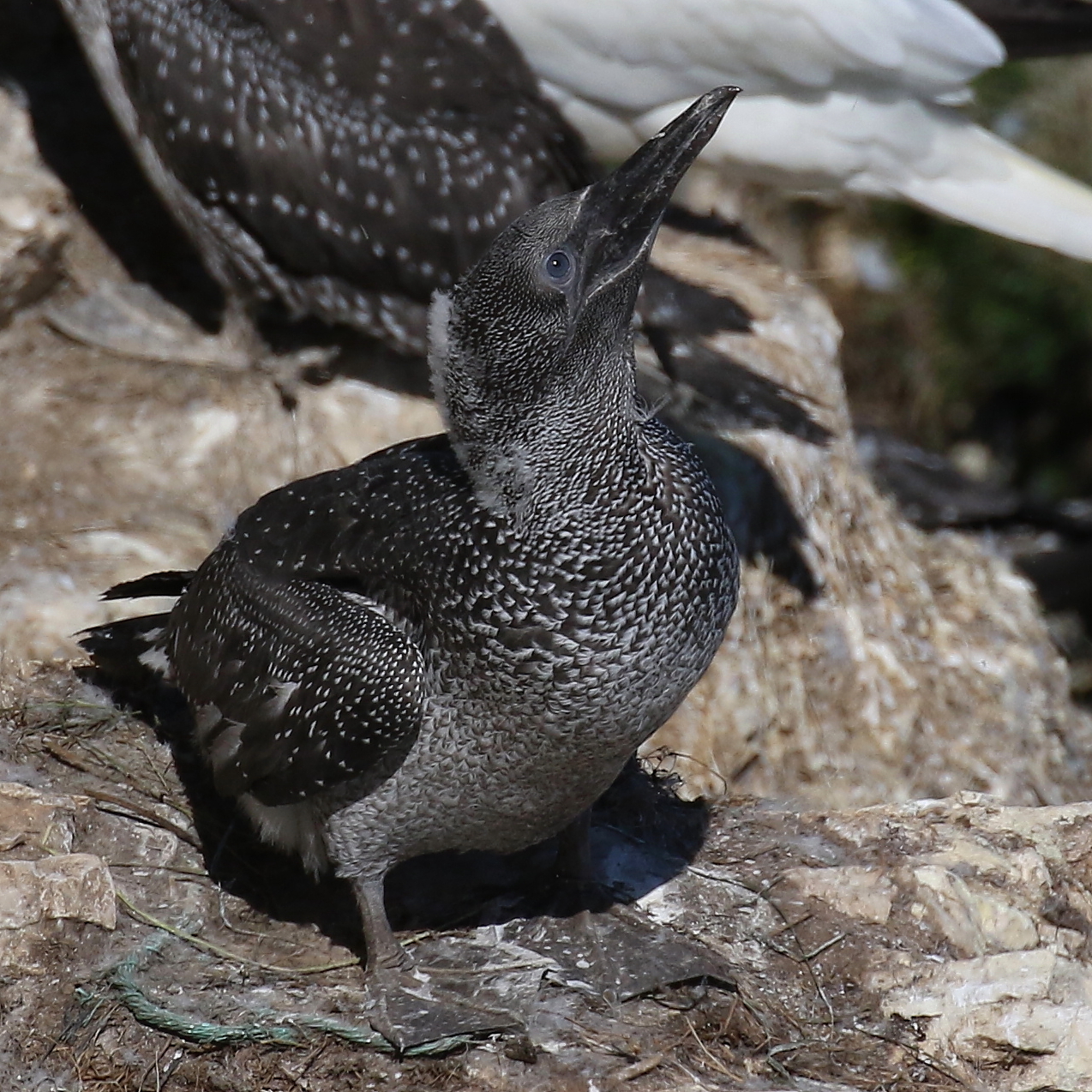
I had not been to Bempton at this time of year previously, so it was an opportunity to study Gannet chicks and fledglings at close quarters and in a variety of stages of advancement towards making their first flight. Some still looked like the plush toys in the RSPB shop, others were similar in proportion to the adults but their flecked grey-brown plumage was in complete contrast to the black, white and cream colours of the parent birds.
Gannet nestlings are prehistoric looking creatures
They breed so closely together that constant squabbling is the order of the day
Young birds can be viciously pecked by neighbouring adults if they cross an invisible line
Very young birds look like polar bears with dinosaur faces grafted on
They can get very large before the white down is replaced by feathers
Over 11,000 pairs of Gannet breed at Bempton, and at such a high density disputes between neighbours are inevitable - we winced as we watched young birds take quite a battering if they strayed into the wrong territory.
The rocky outcrop at Staple Newk is prime real estate for Gannets
A tiny fraction of the extensive Gannet colony
Gannet preparing to lunge off the sheer cliff
Gannet
It was quite difficult to isolate a single bird in the frame
The auks - Puffins, Guillemots and Razorbills - which are also a feature of Bempton in the summer had left their breeding ledges before our arrival in Yorkshire. But it wasn't just Gannets to admire - Kittiwakes were also still present in good numbers, and the Tree Sparrow flock around the visitor centre also appeared to be in good health.
Juvenile Kittiwake
Kittiwake on the rudimentary nest
Tree Sparrow
Tree Sparrow
Tree Sparrow
Tree Sparrow

Thursday, 14 April 2016

A big day out

It's traditional on our family holidays, if I pretend to be enjoying myself convincingly enough visiting shops, playgrounds, tea rooms etc, for me to be granted a day to myself to indulge in some wildlife watching and photography by way of a reward. And so it was last week in Scotland when I decided to try my luck on the rugged Morvern peninsula. The area enjoys high concentrations of both White-tailed and Golden Eagle, and there is also a good chance of Otter on the sea lochs.
Ringed Plover, Loch Sunart
Their presence given away by gentle, piping calls
Wheatear had been arriving in Dorset shortly before we left for Scotland - this one had done well to make it this far north
Having just caught the third Corran Ferry of the morning, my first stop was on the Ardgour side to check out the Black Guillemot colony in the rusty piers by the ferry slipway. I had seen plenty already in Oban but you can't have too much of a good thing and they did not disappoint.
Black Guillemot, Ardgour
A colony breeds on the rusty piers. Ten individuals are visible in this shot.
And when I say breed...

After Ardgour it was across familiar but still breathtaking territory to Strontian, stopping occasionally for photos of Great Northern Divers in Loch Linnhe from the roadside. From there I broadly followed an itinerary in Gordon Hamlett's Best Birdwatching Sites in the Scottish Highlands, along the southern shore of Loch Sunart for a chance of Otters and Eagles. I saw neither, but a close encounter with a pair of Ringed Plover and a fresh-in Wheatear were some reward.
Great Northern Diver moulting into breeding plumage on Loch Linnhe
Drake Goldeneye, Loch Arienas
Female Goosander, Loch Arienas

Then it was a long climb up Gleann Geal, pausing occasionally to scan for raptors, before dropping back down towards the Black Glen and the choppy waters of Loch Arienas. Pairs of Goosander and Goldeneye were the best I could manage there, so I retraced my steps to get back on the road to Lochaline. The guide book suggested scanning for Otter from the ferry slipway, so being the obedient sort that's what I did, and the first shape I 'scoped on the water turned out to be one. If only it were always that easy..
The best I could manage of the Otter at Lochaline
A slightly closer mammal in the form of a bold Red Deer stag near Kingairloch
Male Stonechat near Kingairloch
A scan with bins down the Sound of Mull caused a double-take when I saw the huge bulk of what could only be a White-tailed Eagle sitting on some distant rocks. I returned to the car to grab the telescope, only to find the bird gone by the time I had set it up! Very frustrating, it would have been a good telescope view, and despite much scanning I was left to conclude that it must have headed off to the south rather than in my direction.
Buzzard or 'Tourist's Eagle' as they are known in these parts
The sun rising over Loch Linnhe looking back to the Corran Ferry
View over Loch Sunart
No matter, I wasn't going to let it spoil my day, and by now it was already time to be heading back, which I did via Kingairloch and the coastal route along the shore of Loch Linnhe. An impressive stretch of highway pock-marked by rockfalls, it passes under a high cliff reminiscent of the road under the Gribun Rocks on Mull. Not a hugely productive day on the Eagle front, then, but an enjoyable trek through some outstanding landscapes all the same. Can't wait to go back.