Showing posts with label Ringed Plover. Show all posts

Tuesday, 16 October 2018

Shetland: part the first

At the turn of last month, David Bradnum, Howard Vaughan, Bob Vaughan and I reprised our 2017 Shetland adventure with a week based on Muckle Roe, in the west of Mainland.
Woodchat Shrike at Barns Ness
I don't think I could face writing a day-by-day account, let alone subject you poor innocents to it, so I'll try to wrap it up in just a few posts. Not that there weren't many highlights - there were plenty, and we saw a selection of birds that, had they been seen over the course of a week anywhere else in the country would have represented an excellent haul. But by Shetland's high standards it would be a lie to say that it wasn't just a wee bit anti-climactic.
The American White-winged Scoter at Musselburgh, flanked by two drake Velvet Scoter
White-winged Scoter (left) has a pink bill (yellow in Velvet) and a more prominent white 'uptick' over the eye
The main culprit for this was westerly winds: an almost constant stream of them preceded our arrival and they remained the dominant influence in the weather throughout our stay, depriving Shetland of the famous easterlies which have delivered so many beasts from the east over previous autumns.
One of a pair of Ringed Plover sheltering in tyre tracks on the beach near Busta House Hotel
And here's the other one of the pair
But I'm getting ahead of myself: first we had to get there. This involved me heading over to the east of the country to meet the rest of team who are London/Essex/Kent based. Our planned departure time of mid-morning gave me a couple of hours of daylight to head first to the Thames Estuary to scan for the Beluga Whale located a couple of days before. I failed to find it but it re-appeared an hour after I left - an inauspicious start.
A wind-swept Pied Flycatcher at Swining
A ditch-bound Common Snipe - one day it will be a Great!
There wasn't too much to divert us on the long road north - a Grey Phalarope at the well-appointed RSPB reserve at Old Moor and a party of Willow Tits on the Northumberland coast were barely a detour from the main drag, and we reached our first overnight stop in Berwick at a sensible hour. The following morning the Lothian coast offered a little more promise, with a Woodchat Shrike and Rose-coloured Starling at Barns Ness, plus a Pectoral Sandpiper and the long-staying American White-Winged Scoter at Musselburgh. We saw them all in beautiful light, the latter being my second encounter of the year with this bird after I caught up with in on a Scottish trip back in March.
This was the bird we initially identified as an Icterine Warbler based on the lead -grey legs...
...and apparent pale panel in the wing (we didn't get a good view of the primary projection)
A surprisingly calm crossing on MV Hrossey ended in a familiar sight: horizontal rain lashing the rock armour of Lerwick Harbour, though within minutes we had seen our first Otter and only Purple Sandpipers of the trip. Much of the rest of the day was a bit of a wash-out so we checked out our (plush) self-catering accommodation and gave the kettle its first workout of the week.
Later in the week we re-visited the re-identified Melodious Warbler
With better views the diagnostic short primary projection was more apparent
Melodious Warbler, Lunna
Undaunted we ventured out again later in the day to the picturesque Lunna Kirk, where we found what we took to be an Icterine Warbler. It was later re-identified as a Melodious - an even rarer bird for Shetland, making it a good if not entirely competent start to our birding week!
Howard channels Jesus at Lunna Kirk

Monday, 19 June 2017

Waders high and low

There are few greater pleasures in life for me than photographing waders on a beautiful, empty Scottish beach. Our recent holiday near Gairloch providing a few opportunities to indulge:
Dunlin
This bird was singing - it sounds like a tiny bomb dropping
Another of a small flock of Dunlin on the beach at Red Point
Summer plumaged Sanderling is in stark contrast to the silvery birds we see in winter in Dorset... 
...the clockwork running motion is the same though!
Sanderling in flight
The flock was feeding in the seaweed on the beach
Ringed Plover were also on the beach at Red Point
Ringed Plover
In contrast to the waders at sea level, this Greenshank was up at about 1,800 feet on Beinn Eighe
I walked the Bein Eighe Mountain Trail one morning to find a pair up on the plateau near some boggy pools
Greenshank
A huge dune at Red Point - my sons can be seen for scale at the base

This shows why the area is known as Red Point after the colour of the sand
Ringed Plovers at Red Point

Monday, 10 October 2016

Drive-through birding

I stopped in at the disused airfield at Davidstow on the way back from the Isles of Scilly last month, hoping to find an American wader on the closely cropped sward. There were none that day, but over the following few weeks it played host to a Buff-breasted Sandpiper, a Pectoral Sandpiper and an American Golden Plover, a species I saw here a few years ago. None of these was quite enough to tempt be back down to Cornwall, but a long staying Baird's Sandpiper, somewhat rarer than all the aforementioned species, was another matter, and as I had not previously photographed this species very well, I resolved to head down there on Sunday morning if the forecast was anything better than dire.
I decided on an early start in case the airfield was busy with model aircraft enthusiasts, but I had forgotten just how vast the site is, and even though model planes were buzzing around in one corner, there was still acres of ground for waders to feed in undisturbed. There are two useful rules for birding Davidstow: first, on arrival scan for stationary cars in the distance, and if you see one with a dirty great lens hanging out the window, head for it as it will probably be pointing at a rare bird. Second, stay in the car - the waders will tolerate a close approach from a vehicle, presumably viewing a slow moving car as some kind of lumbering livestock. Open the door, however, and you risk flushing whatever it is you are looking at.
An early morning view on the pool with Dunlin in the background
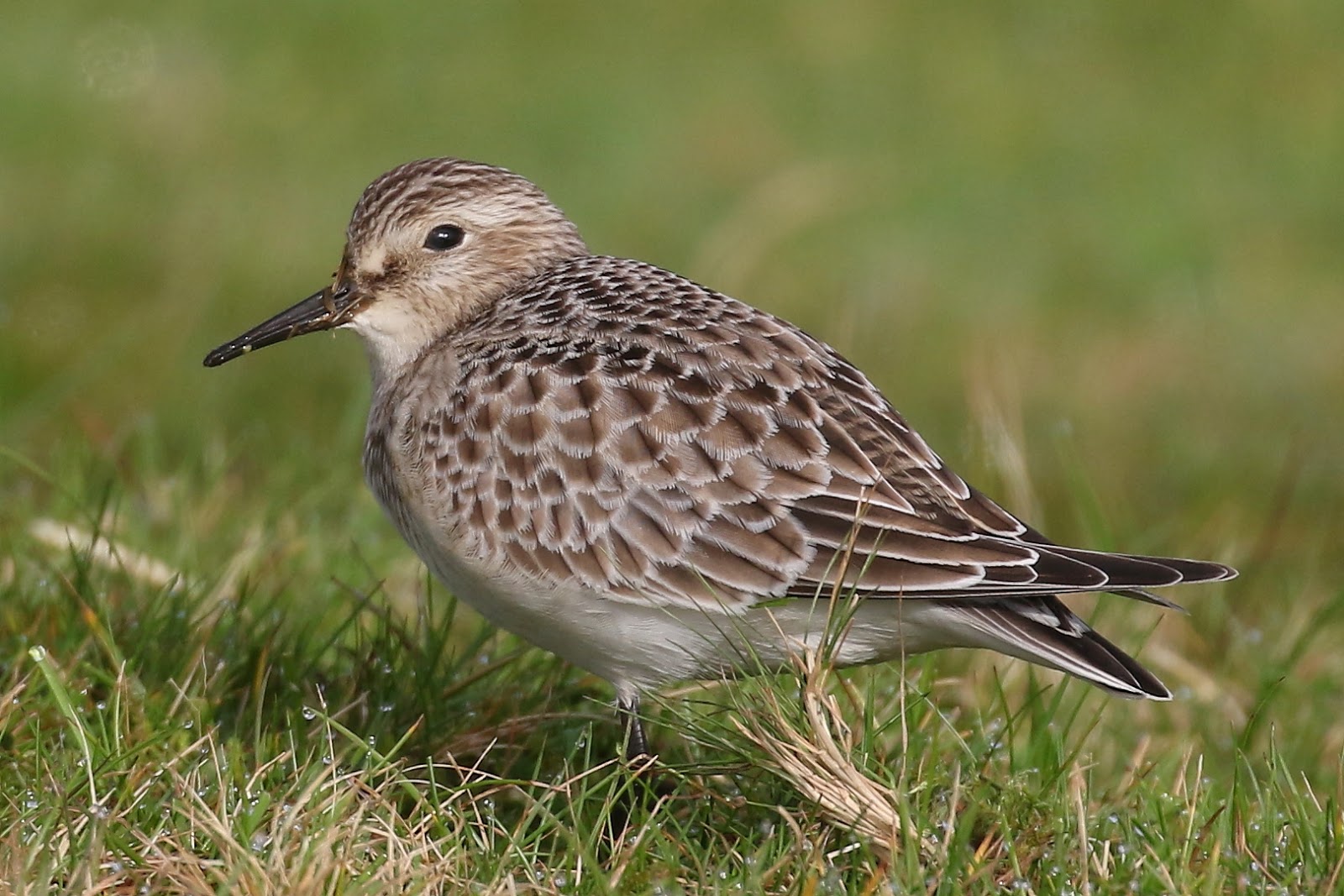
Baird's Sandpiper - the scaly back pattern makes this a juvenile bird
Note the buffy breast band and long primary projection
The bird was reported as being 'near the runway' - sometimes it was on the runway running between the cars!
Head on Baird's shows a flattened oval body shape
So with these rules in mind I arrived just after sunrise, drove up to a car parked in the middle of the capacious runway, and immediately saw the Baird's Sandpiper feeding on a small pool at close range. Eventually it, and the Dunlin it was with, had enough of the pool and headed off to feed on the grass with some Ringed Plover. A small and slightly comical convoy of vehicles tracked them as they fed along, and sometimes on, the pock-marked runway. I spent a couple of absorbing hours photographing the Baird's, by the end of which the sun had conveniently come out.
The Baird's was feeding initially with a few Dunlin
Later they joined up with a small flock of Ringed Plover
I couldn't find a Semi-P among them!
Ringed Plover with Baird's Sandpiper behind
Baird's Sandpiper

Tuesday, 30 August 2016

Wader therapy

When the full horrors of existence loom larger than my joie de vivre, which they did this weekend as a blissful fortnight's holiday with the family approached its end and a return to work beckoned, I go look for waders. Don't embarrass me by asking me to name them all, that's a cruel test. Especially since our second child arrived and there are now more of them to remember.
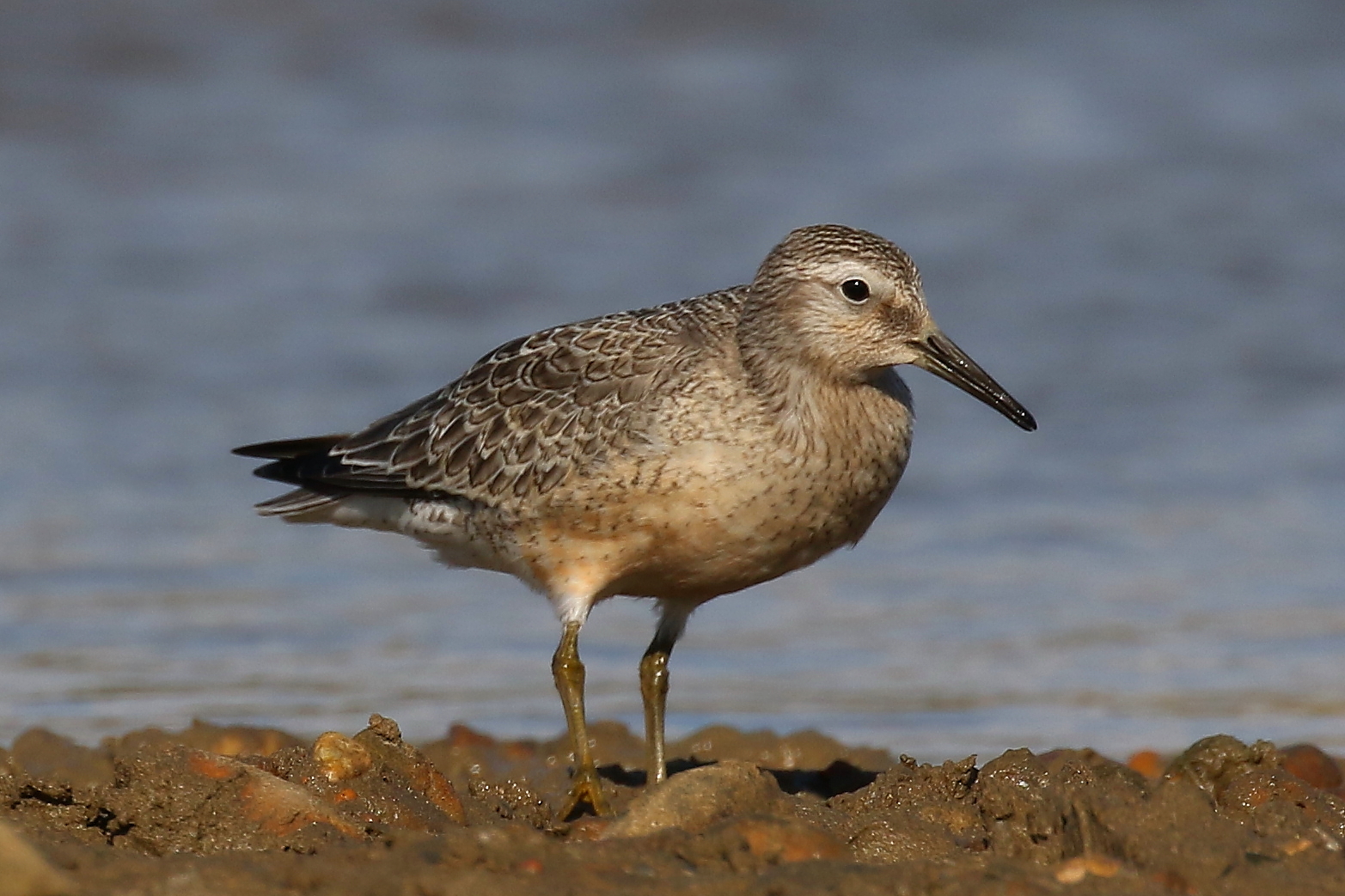
Knot, Ferrybridge
Knot, Ferrybridge
The waders, by contrast, were all utterly memorable. Even the common ones - Lapwings, Ringed Plovers, Blackwits - I find exquisite, and the rare ones when they turn up are also a delight, untainted, as they generally are, by thoughts of escapes, hybrids and so on associated with other bird families. The long weekend therefore saw me checking out some of Dorset's current wader hotspots - Lytchett Bay, Lodmoor and Ferrybridge. Oh, and of course Swineham, which was briefly a wader hotspot during the summer floods of 2012, but which hasn't offered much since bar some insolent Stilts which visited while I was elsewhere. No, I won't let that go.
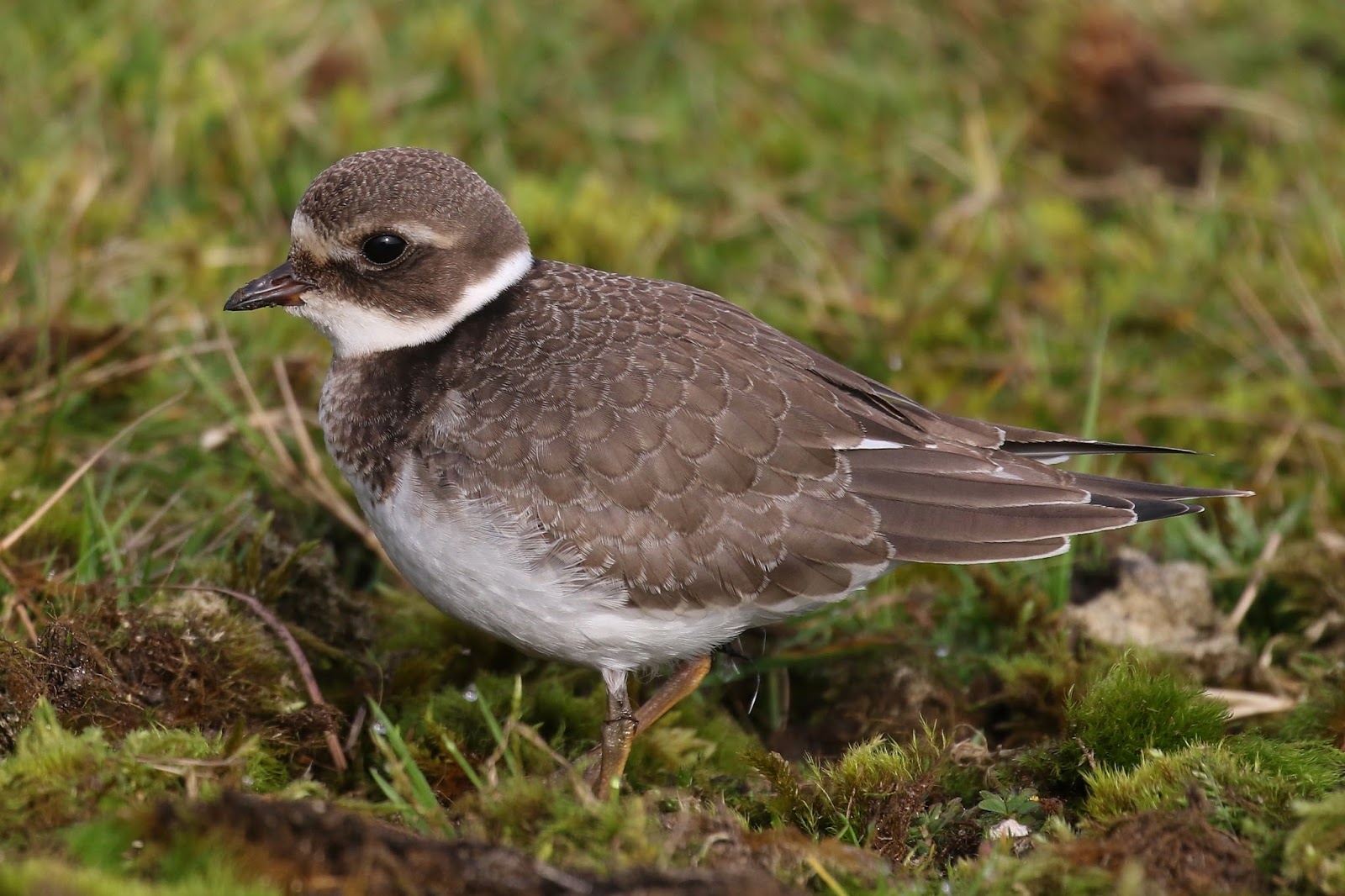
Ringed Plover, feeding with the Knot at Ferrybridge on a small muddy island by the car park
A juvenile bird with frosted feather edges
A Green Sandpiper and a Greenshank were about all Swineham had to offer on the wader front in three recent visits (though a few other migrants were around - more on that in a later post). Bank Holiday Monday visits to Ferrybridge and Lodmoor were more productive, presenting some good photo opps in perfect light. The former would have been even better but for the inability of members of an allegedly smarter species to read the signs urging them not to disturb feeding and roosting birds.
Black-tailed Godwit wading in deep water at Lodmoor
Even this juvenile Dunlin, the regulation wader of British shorelines, is a stunner in my eyes, despite not being quite as smart a plumage as the adult
I arrived at Lytchett a few days after reports of the fields teeming with waders had peaked to find them not exactly teeming, but still good. As top Lytchett Bay-City-Roller Shaun Robson remarked, the fact that a trio of Little Stints was a slightly disappointing highlight of my visit is really testament to just what a good site it has become. The other top Bay-City-Roller, Mr Ballam, who I also bumped into at the Lytchett Fields (of dreams?) viewpoint, was kind enough to comment on the absence of posts in this space. At least, I interpreted it as kindly as 'I thought you were dead' can be interpreted. So this post is dedicated to Ian: for noticing the silence, and appearing to care.
Little Stint, of which there were three at Lytchett Bay, and four at Lodmoor
This one was photographed at Seaton Marshes in Devon earlier in the month en route to our Dartmoor holiday cottage - more on that trip later
Speaking of readers, regular ones will no doubt be delighted to see the return of gratuitous jokes at the expense of my nearest and dearest to these pages (para 1, if you missed it). New ones may be shocked at the flagrancy of the familial abuse, so, to reassure, it is all in jest: Claire, George and, er, the other one all know I couldn't live without them.
Evening light showed off this Lodmoor Lapwing at its best
Common Sandpipers were at Lytchett and Lodmoor (this juvenile again from Seaton Marshes)