Showing posts with label Pacific Diver. Show all posts

Monday, 6 February 2017

The best laid plans

'Fail to plan, plan to fail' say the text books, an aphorism I sometimes find myself using when being unnecessarily pompous at work. Then when my own plans come crashing to the ground, I am reminded of the alternative philosophy posited by the well known management guru, Mike Tyson: 'Everyone has a plan - until they get punched in the face'.
Distant Pacific Diver at East Chevington: incapable of sticking to a perfectly good plan
Pacific Diver shows a vent strap, part of which is visible here
These conflicting truisms rather sum up my weekend before last. The plan was as follows: drive through the night to see the sun rise at Druridge Bay Country Park in Northumberland, where a Pacific Diver had been giving the definition of crippling views on Ladyburn Lake. I have seen the returning Cornish bird several times so while it would not have been a new bird for me, the opportunity to photograph a confiding major rarity is what makes me tick these days, so it seemed worth the effort. If the Diver was present, I would fill my photographic boots and be on the road south by 1000 at the latest, get down to North Yorkshire for noon, tick my first British Pine Bunting, and then take a birder's detour on the way home via another long-staying, photogenic diver, the Lincolnshire White-billed, to complete a remarkable rare double-diver day. And with luck, I would still be home in time to tuck the children in to bed.
Pacific Diver lacks the white flank patch of the commoner Black-throated Diver, and is generally a dinkier bird - as comparison with a Coot shows
Pacific Diver has a paler grey hindneck compared to Black-throated Diver
The perfect plan, then: all I needed to do was execute it. Originally I was going to go on Saturday, but a poorly wife, and a glance at the weather forecast, persuaded me to leave it until Sunday. I drove part way up on Saturday evening and stayed at a motel to make Sunday's driving less tiring, and pulled into an icy car park at Druridge Bay as the sun was rising. Julian Thomas from Somerset, a familiar face from the Portland scene, pulled up next to me and with no-one else around, we strolled to the lake in anticipation of a close encounter with the Pacific Diver. It soon became apparent that the Diver had gone - the first day in nine that it had not graced Ladyburn Lake with its presence. I resolved to check the pool at East Chevington, where the diver had been seen before it relocated to Ladyburn, and concluded it wasn't there either after a cursory scan of the pool - too cursory as it turned out, as a call from Julian relayed that it had been found at the far end of the pool by a more diligent observer.
A mixed flock of White-fronted and Pink-footed Geese flying over Druridge Bay
Another skein of Pink-footed Geese over East Chevington
A breathy canter to the far end of the pool enabled a few record shots to be taken, and excellent telescope views to be had, and while it was bitterly disappointing that the Diver had chosen today to not perform at close range, at least I had seen it. By the time I left, I was half-an-hour behind my original plan - an imperfect, but recoverable situation, or so it seemed at the time. A relatively smooth journey to Dunnington near York saw me arrive just after 1230, and as I made the short walk from the car to the paddock near where the Pine Bunting was showing, birders leaving told me that it had been seen just minutes earlier.

I spent the next couple of hours grilling a large feeding flock with which the Pine Bunting had hooked up, as birds flew from a weedy field to the surrounding trees. Yellowhammers, Corn Buntings, Reed Buntings, Tree Sparrows, Bramblings, Chaffinches, Greenfinches and Bullfinches came and went but no Pine Bunting. It had been seen on and off in previous days either here or in a nearby sheepfield, so with enough daylight left to still go for the White-billed Diver, I tried the sheep field, where a seeded area was attracting plenty of Yellowhammers. While there, the Pine Bunting showed briefly back at the paddock - too briefly for me to get back in time to see it unfortunately. It didn't show again before I left at 4. So no Pine Bunting, and no time for the White-billed Diver either.
Tree Sparrows are much easier to see in the north of England - they were present at Druridge Bay and the Pine Bunting site
Close, but no cigar: Yellowhammer is a near relative of the Pine Bunting, another bird which hadn't read the script
Unbroken rain accompanied the long journey home. By the time I reached Dorset I had rationalised it quite well with the usual guff about how it would be no fun if rare birds always did what they were supposed to etc etc, and consoled myself with the thought that I had the best views of Pacific Diver I have enjoyed to date. Pine Bunting becomes officially my bogey bird, having now dipped a few, though with several being found this winter, perhaps I will get another opportunity to see one before long. A Plan B, if you will.

Wednesday, 30 December 2015

Diver-sity

Since reports of the returning Pacific Diver off Newlyn started up again in November, I had been harbouring (no pun intended) thoughts of another trip to Cornwall to look for it, having first seen this bird back in 2011. James Lowen had hatched a plan to hook up with another Norfolk based birder, Nick Watmough, meeting up with Rob Williams in Somerset en route to Cornwall. Others had pulled out so there was room in the car for me, and we met on Monday morning for the onward trek to Penzance in the Exeter suburbs before the townsfolk had stirred.
Great Northern Diver, Newlyn Harbour
I had photographed the Pacific Diver very poorly in 2011, but seeing Ben Porter's photos from earlier this year I was hopeful that I might improve on my earlier efforts. The forecast was for high winds in Penzance but the journey down didn't seem too bad so I was optimistic that the sea state wouldn't make viewing conditions too difficult. I was about to voice this thought as we rounded the high wall of Penzance Harbour when a wave broke on the seawall and doused the car in heavy salt spray. Hmm, not ideal for finding divers, let alone one with only subtle differences from the more familiar Black-throated.

Great Northern Diver, Carnsew Pool

Great Northern Diver, Carnsew Pool
I have written before about the different dietary requirements which birders exhibit on a long day out. James is definitely a feeder, and the itinerary seemed to revolve around favoured eateries, with a bit of birding thrown in to break up our stately progress between them. A strategy I was not entirely unhappy with, as while not a big eater, early starts do bring out the glutton in me and require a regular intake of carbs. So with the benefit of a 'healthy' breakfast pre-dawn, we just had to while away a few hours birding until the pasty shops opened.
Pacific Diver - slightly smaller than Black-throated Diver - here showing a hint of a chinstrap
A white 'thigh' patch would be visible on Black-throated Diver
We headed first for Newlyn, and the first unidentified divers we saw through wind-battered scopes did nothing to dispel the sense that this wasn't going to be easy. Eventually, however, we got our eye in, found a reasonably sheltered viewpoint and with an improvement in the light were soon picking out Great Northern, Red-throated and Black-throated Divers in the heavy swell of St Mounts Bay.
Even in these distant shots a rounded head profile and small, spiky bill can be seen
The 237th species I have photographed in Britain in 2015
Making our way eastwards back to the Jubilee Pool, there was still no sign of our main target, and numbers of other divers also seemed to have tailed off, so we headed back west to the far side of Newlyn in the hope of improving our prospects. This proved an inspired move as after an extended period of scanning, during which an unseasonal Storm Petrel and a Great Skua were seen, Rob eventually pinned down the Pacific Diver. Fortunately it spent several minutes continuously on the surface, swimming towards us and roll-preening so everyone could get onto it. With a little imagination (and a 60x zoom), a chinstrap could be made out and, just as importantly, the white flank patch of Black-throated Diver was notable by its absence.
This fishing fleet in Newlyn Harbour
St Michael's Mount through the entrance of Newlyn Harbour
With four species of diver seen by lunchtime, there was time to potter around Cornwall in search of more photogenic fowl. A Great Northern Diver in the calm waters of Newlyn Harbour didn't quite play ball, but another in Carnsew Pool was more accommodating. We stumbled across this having taken a wrong turn into a new Asda (because, let's face it, another mega-supermarket is just what west Cornwall needs). We were, of course, searching for pastry, but the Diver offered some consolation. The onset of squally showers increased the urgency of finding a pasty shop, from whence we headed back up the A30 for a quick stop at Dozmary Pool and another returning rarity, a Lesser Scaup. Finding this remote spot completely devoid of a Greggs, we quickly photographed the Lesser Scaup and returned to the A30 to head home.
Drake Lesser Scaup at Dozmary Pool
#238 for the photo yearlist
So a pretty good day all told, with erudite company, fine dining and the added bonus of not having to drive all the way.
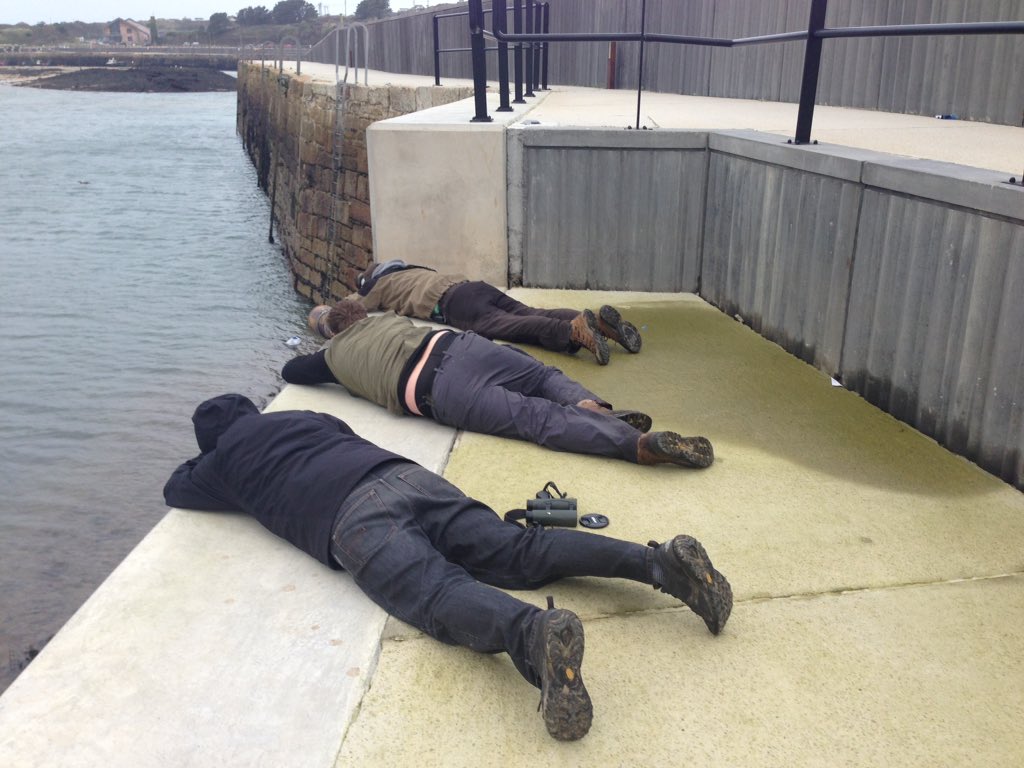
(From top to bottom: me, James, Rob. 'On your bellies for a loon' tweets Nick. 'But only the middle loon is showing flank patches' replies Rob. Photo copyright Nick Watmough. Thanks to all three for a great day.)

Sunday, 30 January 2011

Cornish Diver

It was a surprise to read that the Pacific Diver currently in Cornwall was thought to be returning for its 5th winter as it only seems like yesterday that the first for Britain was identified in Yorkshire. I hadn't seen any of the previous records so a good forecast and a clear day tempted me to Penzance. Plenty of Great Northern Divers were present during the morning but I could not locate the Pacific. Some locals familiar with the bird eventually picked it up in an apparently favoured area just off Marazion. Although distant at first it at least remained on the surface allowing the features to be studied - no white on the flanks; a shade paler grey on the back of the head and neck; more rounded head and smaller bill than Black-throated (see sub-record shot above). Although there was a hint of a neck strap, at that distance it was hard to distinguish from shadow. It came closer eventually but was diving by this point which made photography almost impossible. Much more obliging were the waders at the base of the St Michael's Mount causeway - a mixed flock of Bar-tailed Godwit (pictured), Sanderling, Dunlin, Ringed Plover and a single Purple Sandpiper (bottom picture) coming in with the tide and feeding on the seaweed below the sea wall.