Showing posts with label White-fronted Goose. Show all posts

Monday, 27 December 2021

Christmas is coming and the Geese are, well, everywhere

With the obvious exception of the Greylag, the other 'grey' geese - Pink-footed, White-fronted and Bean - are pretty scarce in Dorset, so after failing to see any of the three at the end of last winter, I didn't hold out much hope of adding them to the non-motorised year list. The week before Christmas changed all that though as geese starting appearing all over the place, presumably in response to colder conditions further east. 

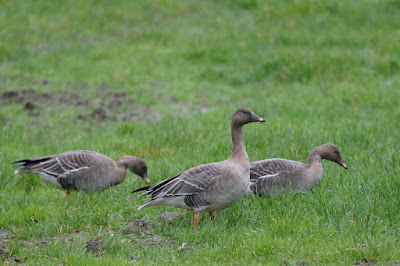
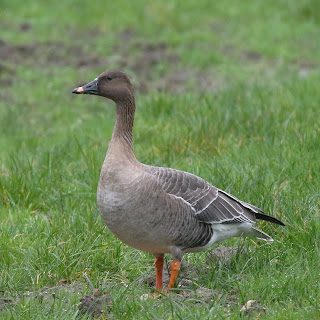
Tundra Bean Goose
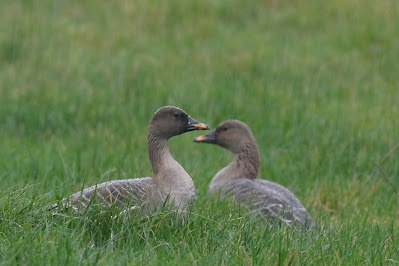
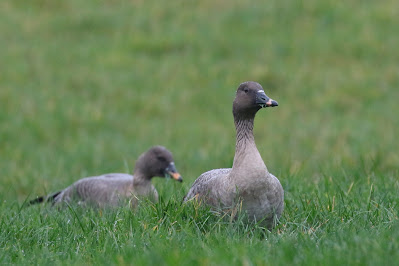
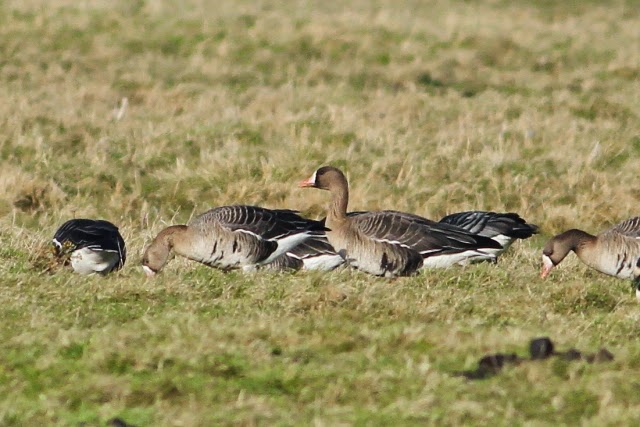
On Monday a flock of Russian White-fronts appeared at Hampreston, scene of my successful Whooper Swan twitch earlier in the month, while on Tuesday a trio of Tundra Bean Geese arrived even closer to home in Holes Bay. Fortunately both species lingered long enough for me to catch up with them, the Beans, a particularly desirable species in these parts, requiring an early start before work. 
Tundra Bean Goose
It's about seven miles to Upton Country Park where the geese had been seen, and on arrival, even in the dark I could recognise the familiar figures of Rob and James who clearly had the same idea as me to have 'Beans for breakfast'. We went to the field where the birds had been reported but it was disappointingly goose-less. Just as my deadline to return home was approaching, the Birdguides app reported that the birds were still there - but the directions pointed to the empty field we were stood next to. The mystery was soon solved though when a phone call from Phil Saunders confirmed the correct field (to the west of the one we were watching). After a short sprint and I was there to enjoy good views in the half-light.
The three Bean Geese together at Upton
I figured (correctly) that the geese might be the last additions to the non-motorised year-list before Christmas Day, by which time other priorities, like spending time with the much-neglected family, would finally take precedence after a year in which most of my spare time has been consumed with cycling around looking for birds. Unfortunately 'spending time with the family' took on a cruel twist when my wife tested positive for Covid-19 and had to spend the big day in isolation. 
Tundra Bean Goose
She remains there as I write, ordering refreshments via the 'Room service' whatsapp group set up by my eldest when he was 'pinged' and forced to isolate back in the autumn. My youngest son (who caught Covid earlier in the year) and I (who had a booster jab a week earlier than my wife) have been testing negative on a daily basis so fingers crossed it stays that way.
Tundra Bean Goose
So it's been a slightly odd festive season, preparing meals, snacks and drinks, leaving them on a tray outside the plague-room door, giving it a tap to let the inmate know that they are there, and then running away before the virus can escape the strict quarantine imposed on its reluctant host. I feel like a cross between a night porter and a beneficent cherry-knocker.
Tundra Bean Goose
As for herself, fortunately the symptoms have been very mild, consisting mainly of a new, continuous craving for Netflix and, judging by the Christmas music coming from the bedroom, a complete loss of taste. Plus she's getting five-star catering, has a cast-iron excuse not to see the in-laws and doesn't have to share a bed with me. So I suspect she's secretly delighted to the extent that I am starting to wonder just how reliable these 'positive' lateral flow tests really are...
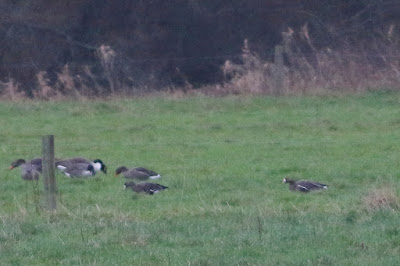
The Hampreston White-fronted Geese were a bit more distant than the Beans!
Anyway, there is precious little left of the 2021 and I'm not sure if I will be able to add to the yearlist, so there may not be many more of these breathless posts, which I'm reliably informed are almost as exhausting to read as the journeys on which they are based were to complete. So it's looking like the year may end on 221 (220 of which have been in Dorset). 222 would be a satisfyingly memorable number to end on of course, but not even Father Christmas can guarantee that!

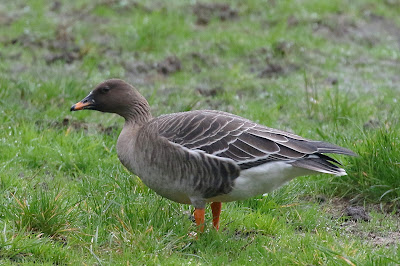
A view of the orange legs of the largest (male?) Tundra Bean Goose

Friday, 18 January 2019

Around the world

The head of the household was away recently leaving her offspring and I to make our way around the culinary world without the usual level of dietary guidance to constrain our choices. So Monday was Italian night (BBQ chicken pizza), Tuesday the turn of Mexico (Chilli con Carne), Wednesday a 'home' fixture in England (steak pie and three veg), while Thursday saw us indulge a taste of China (sweet and sour chicken). And lest anyone accuse me of undue sloth, I should point out that only one of these was procured in take-away form. When herself, a vegetarian, returned from a five day trip to New York with the Book Club (!) at the end of the week, we had to confess that Veganuary had not been going so well.
Ring-necked Duck, Radipole Lake
All this globe-trotting reminded me of a few visitors from afar which could be found in Dorset during the first few days of 2019. On New Year's Day I headed down to Weymouth with Steve Smith to see if one of them, a Ring-necked Duck from the Americas, was still present. I first saw this bird before Christmas when it was in a drab brown first winter plumage, but by the turn of the year it had smartened up somewhat and was starting to look more like an adult drake should. We located it at the end of the Radipole Lake nature reserve and enjoyed close views in the sunshine.
Bearded Tit, Radipole Lake
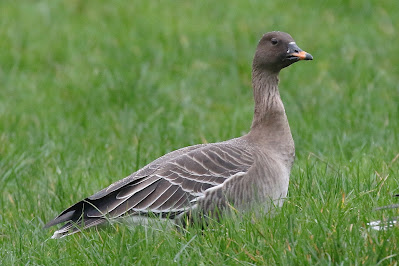
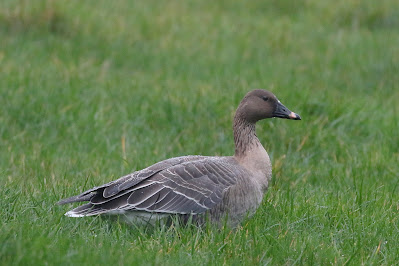
The other notable wanderer was a juvenile White-fronted Goose which took up with a flock of Greylags before Christmas and which had been seen periodically around my local patch at Swineham and Bestwall. Apart from Greylags, the other grey geese - White-fronted, Pink-footed and Bean - are all quite hard to catch up with in Dorset. Judging by the colouration of our wintering White-front, it will have come from the general direction of Russia, being of the sub-species albifrons. I had seen this bird distantly in flight with Greylags on a couple of occasions, identifiable by its small size compared to the rest of the flock, and eventually caught up with it on the deck at reasonably close range on nearby Bestwall.
White-fronted Goose, Bestwall

Monday, 6 February 2017

The best laid plans

'Fail to plan, plan to fail' say the text books, an aphorism I sometimes find myself using when being unnecessarily pompous at work. Then when my own plans come crashing to the ground, I am reminded of the alternative philosophy posited by the well known management guru, Mike Tyson: 'Everyone has a plan - until they get punched in the face'.
Distant Pacific Diver at East Chevington: incapable of sticking to a perfectly good plan
Pacific Diver shows a vent strap, part of which is visible here
These conflicting truisms rather sum up my weekend before last. The plan was as follows: drive through the night to see the sun rise at Druridge Bay Country Park in Northumberland, where a Pacific Diver had been giving the definition of crippling views on Ladyburn Lake. I have seen the returning Cornish bird several times so while it would not have been a new bird for me, the opportunity to photograph a confiding major rarity is what makes me tick these days, so it seemed worth the effort. If the Diver was present, I would fill my photographic boots and be on the road south by 1000 at the latest, get down to North Yorkshire for noon, tick my first British Pine Bunting, and then take a birder's detour on the way home via another long-staying, photogenic diver, the Lincolnshire White-billed, to complete a remarkable rare double-diver day. And with luck, I would still be home in time to tuck the children in to bed.
Pacific Diver lacks the white flank patch of the commoner Black-throated Diver, and is generally a dinkier bird - as comparison with a Coot shows
Pacific Diver has a paler grey hindneck compared to Black-throated Diver
The perfect plan, then: all I needed to do was execute it. Originally I was going to go on Saturday, but a poorly wife, and a glance at the weather forecast, persuaded me to leave it until Sunday. I drove part way up on Saturday evening and stayed at a motel to make Sunday's driving less tiring, and pulled into an icy car park at Druridge Bay as the sun was rising. Julian Thomas from Somerset, a familiar face from the Portland scene, pulled up next to me and with no-one else around, we strolled to the lake in anticipation of a close encounter with the Pacific Diver. It soon became apparent that the Diver had gone - the first day in nine that it had not graced Ladyburn Lake with its presence. I resolved to check the pool at East Chevington, where the diver had been seen before it relocated to Ladyburn, and concluded it wasn't there either after a cursory scan of the pool - too cursory as it turned out, as a call from Julian relayed that it had been found at the far end of the pool by a more diligent observer.
A mixed flock of White-fronted and Pink-footed Geese flying over Druridge Bay
Another skein of Pink-footed Geese over East Chevington
A breathy canter to the far end of the pool enabled a few record shots to be taken, and excellent telescope views to be had, and while it was bitterly disappointing that the Diver had chosen today to not perform at close range, at least I had seen it. By the time I left, I was half-an-hour behind my original plan - an imperfect, but recoverable situation, or so it seemed at the time. A relatively smooth journey to Dunnington near York saw me arrive just after 1230, and as I made the short walk from the car to the paddock near where the Pine Bunting was showing, birders leaving told me that it had been seen just minutes earlier.

I spent the next couple of hours grilling a large feeding flock with which the Pine Bunting had hooked up, as birds flew from a weedy field to the surrounding trees. Yellowhammers, Corn Buntings, Reed Buntings, Tree Sparrows, Bramblings, Chaffinches, Greenfinches and Bullfinches came and went but no Pine Bunting. It had been seen on and off in previous days either here or in a nearby sheepfield, so with enough daylight left to still go for the White-billed Diver, I tried the sheep field, where a seeded area was attracting plenty of Yellowhammers. While there, the Pine Bunting showed briefly back at the paddock - too briefly for me to get back in time to see it unfortunately. It didn't show again before I left at 4. So no Pine Bunting, and no time for the White-billed Diver either.
Tree Sparrows are much easier to see in the north of England - they were present at Druridge Bay and the Pine Bunting site
Close, but no cigar: Yellowhammer is a near relative of the Pine Bunting, another bird which hadn't read the script
Unbroken rain accompanied the long journey home. By the time I reached Dorset I had rationalised it quite well with the usual guff about how it would be no fun if rare birds always did what they were supposed to etc etc, and consoled myself with the thought that I had the best views of Pacific Diver I have enjoyed to date. Pine Bunting becomes officially my bogey bird, having now dipped a few, though with several being found this winter, perhaps I will get another opportunity to see one before long. A Plan B, if you will.
Tuesday, 24 February 2015

More from the Far East

A couple more posts should wrap up the remaining highlights from our recent East Anglian trip, and, what with it being so flat and wet an all, they are mostly in the waterfowl department. Geese are of course a Norfolk speciality but Suffolk has a few too - the highlight being the wintering flock of Russian White-fronted Geese (race albifrons) at North Warren. These birds sometimes hold a rarer Bean Goose though not this year it would seem. The White-fronts were accompanied by a flock of Barnacle Geese which are considered 'feral' - but then so are the Canadas and Greylags so I'm ticking them for the photo year-list!
White-fronted Goose, North Warren RSPB, Suffolk (#110)
Adult White-fronted Goose in flight
Juveniles lack the black belly markings
Juvenile White-fronted Goose

Part of the wintering flock
Barnacle Geese, North Warren RSPB, Suffolk (#111)
Barnacle Geese in flight
The Konik ponies which do such a good job of habitat management on Suffolk's RSPB reserves 
Marsh Harrier causing mayhem among the White-fronts
Pintail were very close in to the excellent new raised platforms which give improved views over North Warren 
This the female Pintail
A beautiful duck
Skylarks were in song at North Warren
Rook (#112) at Covehithe - we walked down to the beach through vast and whiffy pigfields but it was too windy and cold to look for Shorelarks so we retired to the excellent Southwold pier for refreshments
The faded glory of the church at Covehithe...
...this area faces rapid coastal erosion and a road I remember walking down to look for a White-tailed Eagle many winters ago is now closed as the tarmac is getting munched into the crumbling cliffs