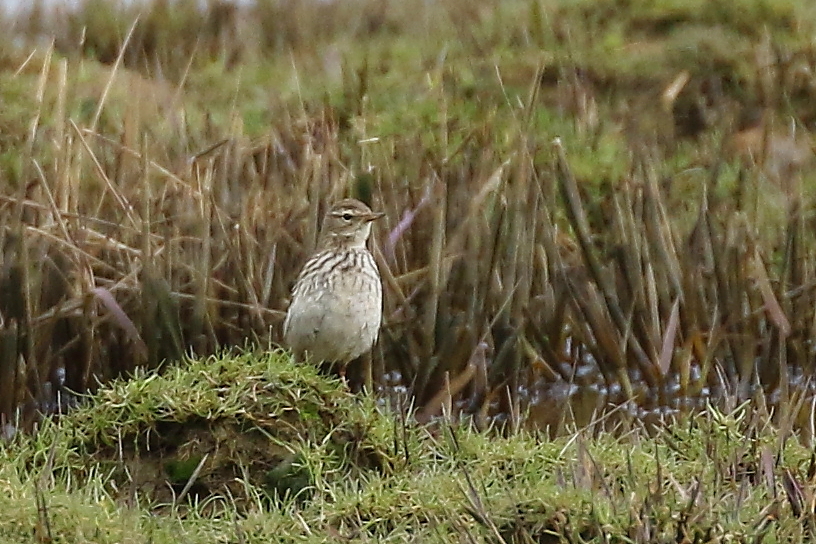
Showing posts with label Water Pipit. Show all posts

Tuesday, 9 November 2021

The hard yards

Lest recent scribblings in this space give the impression that life for me is a constant succession of perfectly planned, smoothly executed bike rides which end happily with me connecting with my target species, allow me to shatter the illusion. This weekend - a long one, as I had a day off on Friday - was earmarked for sweeping up a fistful of late autumn migrants and early winter arrivals. 

Water Pipit at Lytchett Fields (pic from 2016)
Friday dawned bright and clear but after working late the night before - the inevitable consequence of trying to take a day off - I didn't get out as early as hoped. With nothing in particular to chase, I thought I would start with a leisurely twirl around Swineham. No sooner had I left the door than news broke of a Ring Ouzel at Middelbere, 5 miles away, so, this being one of my top remaining targets for the 2021 yearlist, I turned tail, saddled up and headed straight there. The finder Garry Hayman was still on site when I arrived but the Ouzel, which had been with a fresh-in flock of Fieldfare, had done one. 

I spent the rest of the morning checking out every available Rowan tree in the vicinity, but despite coming across several flocks of winter thrushes, I couldn't relocate the Ouzel. It or another had been seen just over the channel at Arne the previous day, so I headed there to check out yet more Rowans on the Raptor Trail. Again, Fieldfare, Redwing, Blackbird, Mistle and Song Thrush were all gorging on berries - but no Ouzel. Consolation was sought in a double egg bap at the Arne cafe, before I headed back to Middlebere for another extensive but ultimately unsuccessful search. 

By the time dusk fell, over 20 miles had been cycled, and a few more walked - but no Ouzels had been seen. So a frustrating day off, with an untimely puncture at the end of it. I had at least resisted the temptation of more distant rarities and, even with the extra calories from the double egg bap, I had shed a few pounds, or at least achieved 'net zero' weight gain, to coin the phrase of the moment.

Frustrated with a day of berry bashing, I needed a safer bet on Saturday morning. Helpful updates from Shaun Robson and Ian Ballam suggested that wintering Water Pipits were now back in reasonable numbers at Lytchett Bay so, having made a couple of failed attempts to see this species earlier this year, I decided to give that another go. Garry had the same thought and, having met on site shortly around 0800, after not too many minutes we picked out one of the Stour Ringing Group's yellow colour-ringed Water Pipits. This somewhat short-circuited the usual identification challenges associated with distant pipit identification. 

As we watched the Water Pipits - at least two, possibly three, were present - we noticed that they seemed to spend more time standing sentry-like on little tumps looking around compared to the Meadow and Rock Pipits which were constantly fidgeting and feeding. A quick call to Shaun confirmed that this was indeed 'a thing' - so a good identification learning point as well as a welcome addition to the year list - bringing it to 210, and possibly the last round '10' I would reach in 2021. 

Buoyed with success I returned home for lunch, then back to Arne (via the cafe's chocolate cake counter) and on to Middlebere to see if the black-and-white berry eater had returned. Needless to say it hadn't. I ended the day with an equally unsuccessful search for a male Hen Harrier which has been seen several times in the area - and another puncture. 

On Sunday I was faced with the choice of confronting all the domestic chores I had neglected on Friday and Saturday, socialising with family or friends who had been neglected over the same period, or go in search of Redpoll, possibly the commonest species not yet on my yearlist. I say 'choice' but I think you can work out where this is going. I had heard a Redpoll giving a distant 'jit-jit-jit' flight call at Arne on Friday, but decided not to 'tick' it on the basis that I ought to be able to secure stronger evidence of another one as the winter progresses.

I yomped around Wareham Common and cycled to Bog Lane which has acres of suitable habitat but of Redpoll there was no sign. A movement in a Yew had me dreaming of Hawfinch - which would have battered Redpoll in a game of Bird Top Trumps - but it turned out to be nothing more exciting than a Nuthatch. After a pleasant but brief lunch back home with the family I was still restless, and was somehow drawn back to Middlebere for a beguiling couple of hours in the hide watching the comings and goings of waders and Harriers (three Marsh, one Hen) - but still no Redpoll or Ouzel.

Another puncture was somehow a fitting finale to the weekend, totals for which were: 63 miles cycled, 10 miles walked, three punctures in as many days and just the one addition to the non-motorised year list. So it's not all plain sailing this green listing lark - but with the dark nights drawing in and not many weekends left to add to it, I don't intend to give up yet. 


Wednesday, 22 August 2018

Alpine birding

Alpine birding is a case of quality over quantity at the best of times, but even more so on our recent family holiday. We made quite of bit of effort to get into the high mountains, but, with hindsight, probably not high enough to connect with some of the more sought after species like Wallcreeper, Alpine Accentor and Snowfinch. We still managed memorable encounters with some special birds of the area though - in addition to the raptors in my last post, some other highlights are below.
You have to get up high to see an Alpine Chough - but when you do they can be very confiding
Son George and I hiked up from the Col de la Colombiere at 1600m to a high ridge at 2300m to see these
First sign of an Alpine Chough is the distinctive call - even more high pitched and wheezy than its red-billed cousin which we get in the UK
Characterful birds
A pair were scavenging scraps from picnickers on the ridge
On the way up to the ridge we passed through the feeding area for the local Crag Martin colony
A difficult bird to photograph
Eventually captured on film after a close fly-past
A robust bird, bigger than the local House Martins
Black Redstart appeared to be the commonest bird in the Alpine pastures...
...followed closely by Water Pipit
Female Black Redstart
Unable to photograph a couple of Citril Finch which flew past at Col de la Colombiere, I had more success with this male Linnet
Despite gaining considerable height, this was as close as I got to a Griffon Vulture (Col de la Colombiere)
Alpine Chough gather in large flocks on the Alpine Peaks
Yomping up another slope above Col du Petit Saint Bernard on the French-Italian border (more on which in a later post), a Marmot's alarm call gave away the presence of an immature Golden Eagle - the second Eagle of the trip

Wednesday, 7 December 2016

February...

The second monthly instalment in my look back at 2016 comes, logically enough, from February. The most fruitful part of the month for wildlife photography was a few days half-term break in Cornwall. Our cottage near Marazion was only a short drive from the undoubted birding highlight of the month, a close encounter with a 1st winter Hudsonian Whimbrel near Perranruthroe. This bird, which first arrived the previous autumn on the Isles of Scilly in first winter plumage, made its way to the mainland and was still being reported within the last few days. Running a close second for photographic highlights was a very entertaining Pallas's Warbler, another long stayer, which spent some time near the Dorset village of Portesham. Six of the best photos from February:
This picture of the Hudsonian Whimbrel at Boat Cove in Cornwall was selected as Birdguides 'Picture of the Week' 
I think this is my favourite photo of it though, for the rocks and the background as much as the bird: my photo of the month and bird of the month for February
This Glaucous Gull in Newlyn Harbour was another highlight of February half-term in Cornwall
Back at home in Poole Harbour, Water Pipits in Lytchett Bay brightened up a few dull February mornings 
Running the Hudsonian Whimbrel a close second for bird of the month was this long-staying Pallas's Warbler
The Goldeneye in Poole Park were very photogenic in February - this the male...
...and this the female

Tuesday, 23 February 2016

Pipit puzzles

Proper birders aren't supposed to admit to finding Pipits a bit difficult. But, as we've established over the years, I don't profess to be one of them, so I can freely admit to finding Pipits a bit difficult. Every now and again an easy one comes along; but generally they are smallish, brownish, streakyish, skittish and non-descript. That doesn't mean they are not worth studying though. On the contrary, Rock, Meadow and Water Pipit can all be seen at my local patch at Swineham at this time of year, but seeing them well is hard and they are generally viewed only in flight when flushed from the saltmarsh.
 
So reports of several Water Pipit at Lytchett fields saw me heading 'north of the River' (Piddle) on Sunday in the hope of getting better views of these rare winter visitors on the deck. I wasn't disappointed, and although photography was difficult due to distance (a good feature for Water Pipits is that they are easily flushed if you get too close!), with the aid of teleconverters I was able to get some identifiable shots. 
Water Pipit shows cleaner white underparts with finer streaking compared to Rock Pipit. The supercilium is often more distinct and the bill shows a large amount of yellow.
A warmer brown rump also helps distinguish Water Pipit from Rock Pipit, which shows a greyer rump
The call of Water Pipit is subtly different to that of Rock Pipit, as you can hear from this photo.
Water Pipit shows whiter wingbars and white tail sides...
...and unstreaked upperparts compared to Rock Pipit
Another view of Water Pipit's sparsely streaked underparts, with fine streaking 
In spring and summer, the Scandanavian sub-species of Rock Pipit littoralis can look confusingly like summer plumaged Water Pipit, with grey head and upperparts and a salmon pink wash on the breast... 
However, littoralis, which I presume this to be, shows heavy streaking on the breast (Water Pipit little or none)...
...and a grey rump (warm brown in Water Pipit)
A regulation Rock Pipit at Baiter Park a few weeks ago, included for comparison
Meadow Pipit is altogether streakier than Water Pipit and a warmer brown colour
Meadow Pipit

Sunday, 3 February 2013

Sticking with it

A new bird for the patch this weeked in the form of a Water Pipit was a bit of a tonic after yet another week of a nagging cough. Not only does this scare away the birds, it's just a bit exhausting. It finally drove me to the Doctor on Friday, and having satisfied himself that it wasn't a chest infection his advice was, and I quote, 'stick with it'.
Gadwall - the most numerous duck at Swineham at the moment with 50-120 birds regularly present
I've been given this advice before when stuck on a crossword, but never before for a cough. Mind you, it beats the advice I got last time I went to a quack with a similar ailment - 'try not to cough' he said. I kid you not.
Shoveler: probably the most striking duck at Swineham at the moment.
So, in the spirit of sticking with it, and trying not to cough, I headed to Swineham yesterday for a quick look around. An uneventful scan of the pits produced the usual ducks in smaller numbers than recent weeks, but further on towards Swineham Point a large-ish pipit flushed from the wet grass and gave a call which narrowed it down to either Rock or Water.
Water Pipit: note the prominent pale supercilium and wingbars, extensively yellow bill and unstreaked mantle
I managed a few flight shots between convulsions which showed a prominent, flared supercilium, unstreaked mantle, clean white underparts with some fine dark streaks, and white outer tail feathers, all good features for Water Pipit.
This shot shows clean white, finely streaked underparts and white outer tail feathers.
The Pipit also went miles when flushed which I seem to remember was a characteristic of the birds we used to go and see at Rainham Marshes when I lived in Kent. The local Meadow Pipits, by contrast, tend to flit around you in a little circle and the Rock Pipits, when present, are generally a bit more approachable. Unless of course you are coughing your guts up on said approach.

Another shot of the Water Pipit showing several of the features described above.

Wednesday, 27 October 2010

Scilly Tuesday 26th October

Caught up with a distant Water Pipit (right) and much closer Water Rail from the hides at Lower Moors this morning in poor weather. Water Rail seem particularly prominent this year with 1-2 birds feeding in the open early mornings in the small pools just inside the entrance to Lower Moors. A quiet day subsequently with three Pale-Bellied Brent Geese, one of which is pictured right, and a Merlin at Porthloo being the only other birds of note.