Showing posts with label Shoveler. Show all posts

Monday, 4 July 2016

Knot on the beach

The weekend before the weekend before last (I've been busy, OK?) was my wife's 'birthday weekend'. Not birthday, you will note, which fell some days previously, but 'birthday weekend'. This phenomenon, like the 'birthday breakfast', and the 'birthday curry with the girls', is a privilege reserved, it appears, uniquely for the matriarch in our household at least. This year, however, it coincided with 'Father's Day weekend', necessitating a degree of compromise about how to mark both occasions.
Avocet at Titchwell RSPB, 18th June
Claire favoured hiring a campervan and heading for a south coast location. I favoured the home comforts of a hotel, preferably in Norfolk, given the presence of a long-staying adult Great Knot, a bird I had never before seen in Britain or anywhere in the world for that matter. The choice divided the family down the middle, with particularly strong views about migrants (by which I mean waders, of course) being expressed on both sides. Protracted negotiations, several tense stand-offs and a near complete breakdown in diplomatic relations ensued, until a compromise was reached involving, one might say, full access to the single market for campervans and the free movement of people to East Anglia.
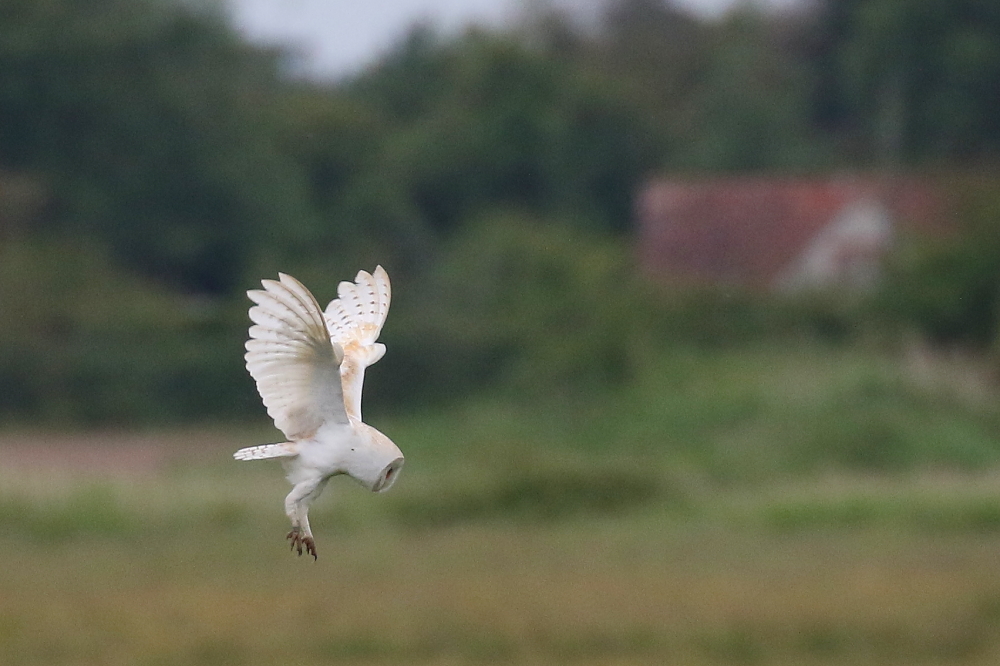
Barn Owl quartering the saltmarsh near Titchwell
The hire vehicle Claire procured was a monster - a converted Peugeot Boxer, which barely fitted into our parking bay at home but contained sufficient space and home comforts to accommodate four people, suitcases, camera gear, telescopes, board games, and all the other baggage which a family which never learnt the meaning of 'travelling light' could wish for. After packing said menagerie, our Friday night departure from Dorset was pretty late, and we could only make it as far as Cambridgeshire before the need to hook-up at a campsite became paramount.
You don't see that every day - Shoveler duckling at Titchwell
After an early start we headed straight to Titchwell, but sadly the Great Knot, which on several of the previous days had pitched up early morning to feed on the beach before retiring to an unknown roost, had already been and gone for the day. So there was nothing for it but to knock up a full English breakfast in the back of the van. Always my favourite part of camping, and this was no exception despite the disappointment of missing the Great Knot.
White van men: Rowan and George outside our 'hotel' for the weekend
Sated by bacon and eggs, we trudged to the wet and windy beach and put in a good shift for the rest of the day trying, but failing, to find the Great Knot. Never mind, there was still Sunday to catch up with it, I thought, as we headed for an idyllic campsite at South Creake. The problem was that rousing the family early on Sunday would be no easier than it had been on Saturday, raising the prospect of a groundhog day double-dip.
Huge numbers of Knot land on Titchwell beach
Fortunately, a chance encounter earlier in the Titchwell car park with Dave Bradnum, my companion on a recent Hebridean adventure, suggested that he might be trying again early on Sunday morning, so, to cut a long story short, I was able to blag a lift with him, see the Great Knot and get back to the campsite in time to rustle up another full English.
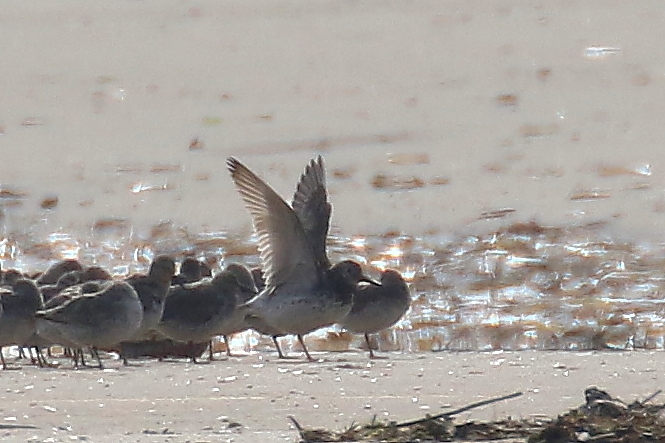
'See that flock of 5,000 Knot? It's second from the right' The Great Knot moves conveniently to the edge of the huge flock on the beach to show the de-curved bill, black chevrons on the flanks and Turnstone-like back pattern
This was only the fifth record of Great Knot in Britain, so a very rare bird indeed, and all the more notable for being my second British tick on consecutive Father's Days following last year's Terek Sandpiper.
The Great Knot stretches its wings emphasising its small-headed appearance and revealing a necklace of black streaking
Feeling gracious and conciliatory having got what I had hoped for from the weekend,  back at the van I announced that I was quite happy to do what everybody else wanted to do. And this time I meant it. The remainder of Father's Day was therefore spent meandering south via Oxburgh Hall, a National Trust tick for the whole family set in beautiful, wildlife-friendly grounds.
Red-eyed Damselfly, Oxburgh Hall, Norfolk

The boys and I dread places like this as their Mum diligently reads every word on the interpretation panels in every room, presumably in some kind of search for knowledge and self-improvement. We, by contrast, can only cope with so much information about the provenance of medieval dyes so after a quick whizz around the stately home, we made ourselves scarce and retired to the grounds. Damselflies in the moat and Grass Snakes on the lawn kept us entertained until Claire returned brimming with useless information about tapestry to entertain us throughout the four hour journey home. An excellent weekend, so a big thank you to my loving, tolerant family (and Dave) for making it so.
Grass Snake, Oxburgh Hall

Sunday, 5 April 2015

Ducking

Garganey is our only summer migrant duck, arriving in small numbers from wintering quarters in Africa, and as well as one of the first spring migrants, it is also one of the most attractive. We had several at Swineham last year but none so far this, so news of one at nearby Longham Lakes saw me heading there yesterday. The bird, a handsome drake, hugged the edge of the South Lake, keeping company with a family of Mallard, the female of which tweaked his tail a couple of times when he got too close to her newly hatched ducklings.
Drake Garganey, Longham Lakes (#137)
I stayed with this bird for a couple of hours as it fed in lakeside vegetation
This one even does impressions: here, the Sydney Opera House...
...and here Mick Jagger
Eventually it did flush when a stoopid poodle type almost jumped on it...
...fortunately it did a circuit and gave a close flypast
A more intimate shot in the vegetation
It was feeding intently but remained alert to passing joggers and dogs
The Garganey was close enough to hear it's distinctive call which is likened to a finger being run across a comb - and a bit like a Ptarmigan being played at the wrong speed, I reckon. Probably the smartest duck of the week, and also the closest, but a good selection of commoner species at Abbotsbury were also pretty obliging during my visit on Good Friday.
Drake Pochard
Drake Shoveler
Drake Wigeon
Drake Teal


Saturday, 21 February 2015

Minsmere

The RSPB's flagship nature reserve at Minsmere was conveniently close to our temporary home in Suffolk for the last few days so deciding what to do on our first full day was an easy choice. The bird life was plentiful if not spectacular, with the odd scarcity among the expected wildfowl.
A pair of Whooper Swan (#98) were on the flooded Konik pony field
A Redhead Smew was roosting on one of the scrapes...
...it later flew it front of the Island Mere hide
Shoveler (#99) were plentiful on the scrapes
Greylag Goose making it's first appearance on the blog this year (#100)
Ringed Plover ditto (#101)
Chiffchaff - a poor photo included solely for the purposes of grinding the photo year list on another meaningless notch (#102) - and in case I forget to post one later in the year
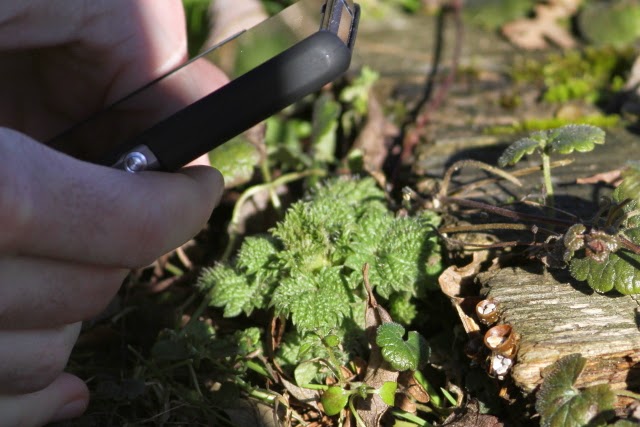
Despite seeing not much out of the ordinary, I did get one tick at Minsmere in the form of Bird's Nest fungus - named for how it looks rather than where it is found. There was a profusion of it on the boardwalk near the visitor centre but it was so small that I think we would have walked straight past it had it not been for someone else on their knees with a macro lens giving its presence away. 
The tiny and exquisite Birds Nest fungus
This picture gives some idea of scale
Marsh Harrier against the slightly incongruous backdrop of the Sizewell nuclear power station
This area is one of the strongholds of Marsh Harrier in the UK
There was precious little going on out at sea but a few Red-throated Divers (#103) were on the move
We stayed until dusk to watch to sun go down, and were rewarded with close views of feeding Common Snipe, a short Bittern flight, a couple of dozen Bewick's Swans coming in to roost and 3 Otter scudding distantly across the Mere.
The Whooper Swans dropped in to the Mere as the sun was setting


Common Snipe
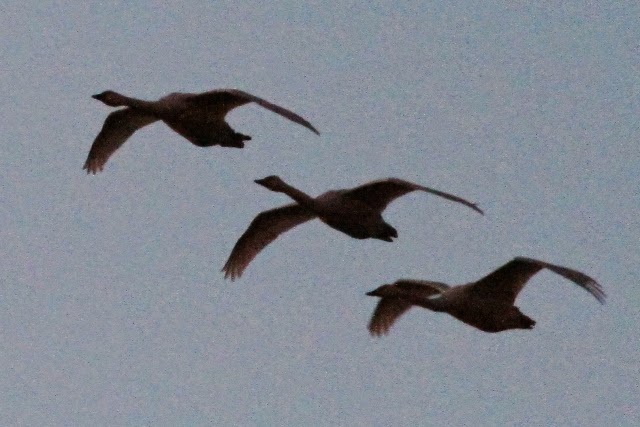
24 Bewick's Swans flew in to roost just as we were leaving for home
Dusk is a good time to see Bittern (#104) - this one just caught the last rays of the sun

The extensive reedbeds at Minsmere catching the evening sun
Marsh Harrier
Otters
Sunset at Minsmere


Saturday, 27 December 2014

And so this is Christmas...

...and what have I done? Well apart from over-indulging in a variety of victuals, solving seemingly intractable Lego-based challenges and spending way too much time with the family, there has been precious little in the way of birding. A quick trudge around a birdless patch therefore seemed in order today. I was hoping it would help me dredge up enough memories for a 'review of the year' post. Not quite, though it did serve as a reminder of all the good birds I have missed at Swineham in 2014. In fact, I managed to display spectacularly bad form in this regard, even by the low standards of my fickle patch-watching career.
A Grey Wagtail brought a dash of colour to Swineham this morning
It all started in April when a pair of Black-winged Stilts appeared no sooner than we had gone to Cornwall for a week's holiday. Others were seeing a Great White Egret in the area through the spring but I failed to connect despite several early morning and late afternoon vigils. The dipping continued into autumn when a White-winged Black Tern eluded me and I failed to connect with Marcus's Yellow-browed Warbler. The Neil Warnock-like run of bad luck finally came to an end in early December when Paul Morton's Bean Geese did the decent thing and stuck around long enough for me to catch up with them.
Shoveler: one of a 40+ flock at Swineham this morning
According to an erratically populated notebook, the Beans were one of only six patch ticks this year. The others - Garganey, Black-necked Grebe, Smew, Egyptian Goose and Turnstone (get in!) - all good patch fare if not exactly patch gold. Not a bad return though, given how little time I spent there: the first part of the year, any spare time I had seemed to be spent chasing around after rarities; the latter part, getting to grips with a new job which had quite an impact on the energy and time I had left for birding anywhere, including Swineham.
Little Grebe at Swineham
Throw in an apparent rise in the number of non-birding visitors (and four-legged ones), and the increase in the use of the gravel pits for water sports, and it seemed at times like I was not the only one who had forsaken the old patch: quite a lot of the bird life seemed to have too! Perhaps in 2015 foul weather, all year round floods and general lack of visitation will bring them back. Well, I can dream, can't I?
A belated Merry Christmas everyone and thanks for reading this year. No snow-covered cliché perches for the Swineham Christmas Robin: he much prefers to rest on expensive optics.

Tuesday, 9 April 2013

A rush of blood

I was out of county on Saturday on family business when two parties of Stone Curlews turned up on the West Dorset coast, and while I expected them to move on overnight, Sunday morning provided a slim chance to get this species on my Dorset list. I went for the pair at West Bexington which had shown well the previous evening, and eventually saw them in a stubble field with the help of the finder Alan Barrett and his fellow patch watcher Mike Morse. The birds were quite distant, but Mike had managed to check a colour ring combination which later revealed that at least one of them bred in neighbouring Wiltshire.

Skylark, Aust Warth
The plan for the rest of the day was to catch up with some other locally rare and scarce birds: Garganey at Radipole, Spoonbill at Lodmoor and Great Grey Shrike at Morden Bog. But then the pager reported a Killdeer in Lancashire. It is one of the iron laws of nature that a good bird will turn up just after my holiday comes to an end, but I thought I might have the jump on this one: it was just before 1100, and I reckoned I could be at the Killdeer site by 1530. Maps and crisp packets, along with reason and judgement, were swept off the dashboard and replaced with a satnav, which I set for Longridge and headed north.

Distant Stone Curlews at West Bexington, Dorset

A while later the pager reported that the bird had flown, but I ploughed on, and half an hour later it was back. I found myself uttering an involuntary 'Come on!'. Another half an hour and it was gone again, so it was clearly not a settled individual. At times like this, decisive action is required, so I pulled into the services on the M5 to procrastinate.

Short-eared Owl, Aust Warth
This second negative report saw my adrenaline levels plummet, the rush slowed and after a reflective cup of coffee I concluded that I might as well dip on Twite at nearby Aust Warth and save a tank of fuel as dip on Killdeer in Lancashire. So dip on Twite I did, and for a couple of hours. It was still a good decision as the Killdeer was not seen again all day, and at least there were Short-eared Owls to enjoy at Aust.
Shoveler, Ham Wall RSPB, Somerset
So with two sets of plans for the day not quite coming off, it was time for plan C: return home via the Somerset levels and try to photograph the long-staying Pied-billed Grebe. This was a bit more successful - the bird came quite close, albeit in poor light.

Pied-billed Grebe, Ham Wall RSPB, Somerset
More impressively, it repeatedly gave its distinctive call, a resonant yodel, puffing out a throat sac which seemed to double the thickness of its neck in the process.

The Pied-billed Grebe puffing its throat out and giving a haunting call
If the Little Bitterns return to breed on neighbouring Loxton Marsh this spring, you might be able to hear their distant dog-like booming at the same time as a Pied-billed Grebe calling - a collectors item for the sound recordists out there.

When wary, the Grebe would lie low in the water and not dive but submerge like a submarine with the body held horizontal - an interesting bit of behaviour
The penalty for all this tarting around was to miss a Red-throated Diver, one of my favourite birds, at home on Swineham Gravel Pits. While still present yesterday afternoon, it had gone by the time I got there at dusk, though a Barn Owl, a Marsh Harrier and a ringtail Hen Harrier were some consolation.

Me and the 'Peat Moor' centre on the Somerset Levels: made for each other
And so it was back to work today, secure in the knowledge that a full diary and an even fuller in-tray will prevent any further rushes of blood to the head, at least until the weekend.