Showing posts with label Barnacle Goose. Show all posts

Sunday, 12 March 2017

Winter highlights: the waterbirds

As the early spring migrants start to trickle in, it's time to look back at a few highlights of the winter. First up, some waterbirds and waders from around Dorset over the last few weeks.
Purple Sandpiper, Shell Bay Ferry Terminal
One of two Purple Sandpiper feeding on the ferry slipway at Studland yesterday
An engaging species to watch up close as it dodges the incoming waves
Much earlier in the winter a flock of Goosander spent some time fishing close in to Hamm Beach in Portland Harbour
Nine birds in the flock the day I was there
Red-breasted Merganser, also in Portland Harbour
Male Red-breasted Merganser
Also that day a trio of Pale-bellied Brent Geese were with their Dark-bellied cousins at Ferrybridge
Quite easy to pick out among the Dark-bellied Brents
Closer to home a Black Brant (far right) was at Middlebere with the Dark-bellied Brent flock
Again, easy to pick out when on its own; not so easy in with a flock of several hundred birds

Two of the eleven Barnacle Geese which spent much of the winter at Swineham
This Black-necked Grebe was in Shell Bay earlier in the winter...
...same species, same place, just a few weeks later


Sanderling dwarfed by a wave about to break on Studland beach
Purple Sandpiper

Friday, 30 December 2016

November...

This review of the year by instalments has become the blogging equivalent of Christmas turkey: I was sick of it after about the 5th portion, but I know it just has to be finished. So pour yourself another tot of Gaviscon, dear reader, and tuck in to my highlights for November - a rare month in that, for precious little effort invested, I saw some really good birds. Other than for work, I think I left the house on three occasions, which produced, in decreasing order of rarity:
A Forster's Tern in Essex, burying the decade-and-a-half old ghost of multiple dips on the same species in the same county - in those days I lived a lot closer in neighbouring Kent. An unexpected bonus tick late in the year and supporting evidence for my theory of the last few years that November is the new October. A straightforward choice for my bird of the month.
A waterlogged Desert Wheatear in neighbouring Devon - the first male of this species I have seen in Britain. Seen the day before twitching the Forster's Tern, so a good weekend in the year's litany of family neglect. 
And even closer to home a patch tick in the form of a flock of Barnacles at Swineham. Barely deserved in what I think was my only visit of the month.
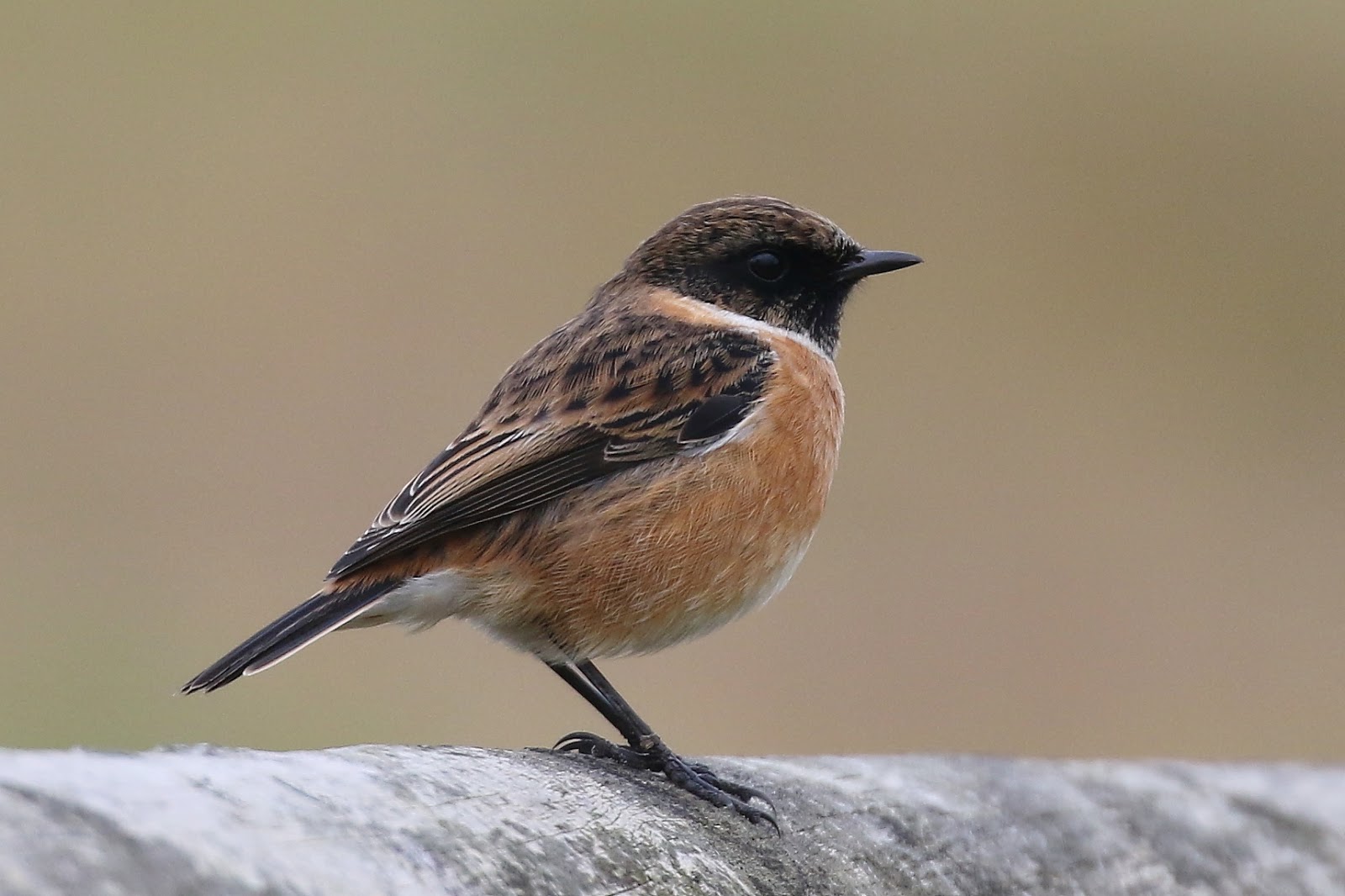
Picking a photo of the month was a bit of a challenge for November, on account of the dearth of candidates and the complete absence of sunlight. So it'll have to be this Stonechat from Swineham.

Monday, 28 November 2016

The shock of the new

It's been a long time since I added a bird to my Swineham patch list - mainly because it's been a long time since I've been there - but with a bit of wetter, colder weather recently I made the effort yesterday. To my great surprise I was rewarded with a flock of 22 Barnacle Geese which, unbeknown to me at the time, had been seen earlier in the day flying west past Hengistbury Head and through Poole Bay before pitching down on the gravel pit. The origins of such birds is inevitably moot - there are feral flocks elsewhere in Britain and on the near continent, as well as the wild populations from Greenland, Svalbard and high-arctic Russia. While one of the former seems the more likely explanation, I'm ticking them anyway!
A flock of Barnacle Geese pitch up at Swineham
A small, attractive goose, much smaller than the local Canada Geese
Male Stonechat at Swineham


Tuesday, 24 February 2015

More from the Far East

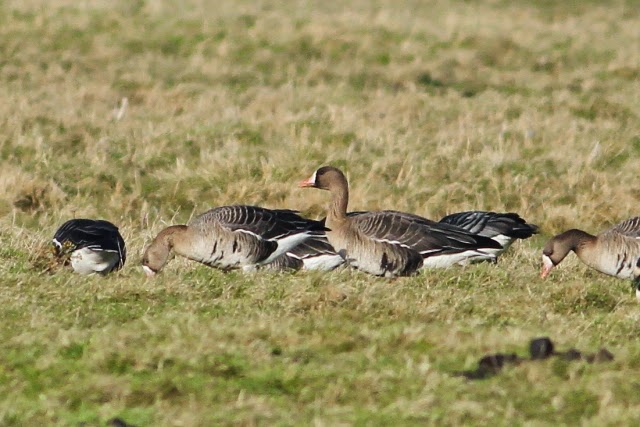
A couple more posts should wrap up the remaining highlights from our recent East Anglian trip, and, what with it being so flat and wet an all, they are mostly in the waterfowl department. Geese are of course a Norfolk speciality but Suffolk has a few too - the highlight being the wintering flock of Russian White-fronted Geese (race albifrons) at North Warren. These birds sometimes hold a rarer Bean Goose though not this year it would seem. The White-fronts were accompanied by a flock of Barnacle Geese which are considered 'feral' - but then so are the Canadas and Greylags so I'm ticking them for the photo year-list!
White-fronted Goose, North Warren RSPB, Suffolk (#110)
Adult White-fronted Goose in flight
Juveniles lack the black belly markings
Juvenile White-fronted Goose

Part of the wintering flock
Barnacle Geese, North Warren RSPB, Suffolk (#111)
Barnacle Geese in flight
The Konik ponies which do such a good job of habitat management on Suffolk's RSPB reserves 
Marsh Harrier causing mayhem among the White-fronts
Pintail were very close in to the excellent new raised platforms which give improved views over North Warren 
This the female Pintail
A beautiful duck
Skylarks were in song at North Warren
Rook (#112) at Covehithe - we walked down to the beach through vast and whiffy pigfields but it was too windy and cold to look for Shorelarks so we retired to the excellent Southwold pier for refreshments
The faded glory of the church at Covehithe...
...this area faces rapid coastal erosion and a road I remember walking down to look for a White-tailed Eagle many winters ago is now closed as the tarmac is getting munched into the crumbling cliffs

Friday, 30 May 2014

Ups and downs

A day of contrasting fortunes today. I resolved not to get up early for another crack at the Great White Egret which has been summering in Poole Harbour. An enigmatic bird this, it gets seen only by early birds or night owls, either flying up, or sometimes down the River Frome. Or sometimes the River Piddle. Or sometimes both. But never when I'm watching, it seems.

First summer Ross's Gull, Bowling Green Marsh RSPB, Devon
Having promised myself a lie in, however, no 2 son had other ideas and woke me up at 0400 shuffling into bed between his mum and I. Waking up is the hard bit, so thus stirred, I thought I might as well go and have a look for the Egret. No joy.
As well as the white head with a hint of a neck-ring, the Ross's Gull was slightly larger, longer-winged and longer-tailed than the Little Gulls I've been watching at Swineham recently
I went back to bed and fell into a sufficiently deep sleep to miss several texts informing me that a Bee-eater was at Durslton, less than 20 minutes away. Getting dressed for the second time today, I scooted off for another dose of disappointment. Mitchells Senior and Junior, dipping on Bee-eater for the second time this week, were also there. Just after they headed home, vowing to jack in birding and have their tripods/scopes etc melted down for scrap, things started to look up, for me at least: a flyover Serin jangled north overhead.
Here in flight with Med Gull (above right) and Black-headed Gull for comparison
Just as I was about to give up on the Bee-eater, Steve Smith called with the offer of a lift to Bowling Green Marsh in Devon to twitch a first summer Ross's Gull present for 9 days (!) but identified only this morning. I saw an adult years ago but the chance of seeing this High Arctic vagrant close to home and in a new plumage was not to be missed. I thought my luck might have turned for the day after the Serin but on arrival the Ross's Gull had just flown, leaving a breathless and satiated group of photographers looking visibly stunned at the close views they had enjoyed minutes before. Another dip in morale threatened, but legging it to the nearby estuary I relocated the Gull distantly on the mud and took what can only be described as an insult to record shots - my 400mm lens was woefully inadequate even with 2x converter.
Another view of the diamond-shaped tail and wing pattern
With the pressure to see the bird now off, we figured waiting for high tide to bring it back in would be a good plan, and this gave us a few hours to relocate the Gull again off Exton Station further down the Exe, and check out the facilities at nearby Darts Farm (Cotswold Camping, RSPB shop, posh loos, basically retail heaven for dudes just getting kitted out for a new career in birdspotting).

Also at Bowling Green Marsh, but not attracting quite so much attention...
It was then time to sit and wait. We did so until 1800 when the Ross's Gull flew in from the north east and landed in front of the robust, breeze block hide at Bowling Green Marsh. We were glad of this as the rain set in, and we discussed our longing for a similar structure at Swineham. The Gull gave a few brief fly-arounds, allowing the photos above to be taken showing the diagnostic diamond-shaped tail. It was said to have been 'masquerading as a Little Gull' the previous day when views were partially obscured, but with clear views today it was less a masquerade, more of a wholly unconvincing impersonation of a Little Gull. Honestly, these birders who need their tricky rarities re-identified for them...
Barnacle Goose

Wednesday, 23 February 2011

Barnacles at Mersehead

A week off provided the opportunity to head to Scotland for a birding trip and a chance to catch up with my brother in Stirling. My own family were staying with friends in Kent so after dropping them off on Sunday I started the long journey north on Monday morning. North of the Thames that is, to Rainham Marshes in the hope of seeing the Slaty-backed Gull which had been present for several weeks and for much of the previous day. It's a miracle it's lasted that long considering the stuff the gulls eat from the local landfill site - very stinky birding. Many Herring, Lesser and Greater Black-backed Gulls were present but no Slaty-backed. A female Hen Harrier and half a dozen Corn Bunting brightened up an otherwise dull day, and though picking through the gulls was educational, staring at a landfill site all day doesn't do much for the spirits.

After getting disappointing views of the Rufous Turtle Dove recently, and now no views of this, I was pretty raritied-out and ready for some proper birding. A dozen Waxwing on the hard shoulder of the M11 as I sat in a traffic jam heading north last night cheered me up, and Mersehead RSPB this morning provided further tonic. Barnacle Geese from the Svalbard population were fewer in number than nearby Caerlaverock, but whereas at the latter they are often quite distant, here the small flocks gave close views from the various tracks around the reserve. A Kingfisher and good numbers of Pintail were present along with more common waterbirds.