Showing posts with label Tree Pipit. Show all posts

Sunday, 22 October 2017

Shetland Day 7: far from the madding crowd

We decided on an off-island excursion on our 7th day on Shetland - to Unst, the most northerly inhabited island in the UK, where we could get away from the hordes of literally, er, tens of birders on the Mainland. The forecast, and a report of an Olive-backed Pipit, suggested that we should stop at the Kergord Plantation en route before leaving the Mainland, one of the largest areas of woodland on Shetland.
Otter on Yell while waiting for the ferry to Unst
The Otter surfaced with a fish then vanished
Seeing trees on both sides of the road is a rarity on Shetland: this is Kergord
Although Howard got a brief view of the OBP, the rest of us didn't see it, but compensation came when we each independently heard, and subsequently saw, another small group of Parrot Crossbills in the plantation. These attracted another massive crowd of at least three birders, so we set off again on the quest to get as far from the madding crowd as possible.
A female Parrot Crossbill to go with the males from the previous day
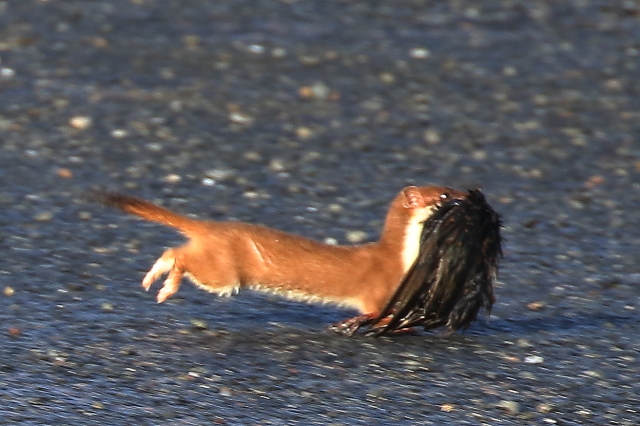
Stoat with Starling as we waited for the ferry to Yell
And this is the ferry to Yell
Speaking of Thomas Hardy, Rustic Bunting may sound like something the townsfolk hang out on May Day in one of his novels, but it is in fact an attractive vagrant from the east. News of one at Lower Voe persuaded us to make a short detour before heading for the ferry. Time was short, but the Bunting was feeding on the roadside as we arrived and was soon flushed by a passing car, assuaging our guilt at ticking-and-running.

Rustic Bunting at Lower Voe
Strikingly white underparts
Thus Ruff was feeding near the Otter
We then hit a lucky streak with Shetland mammals - first a Stoat surprised us by running across the road with a Starling in its mouth as we waited for the ferry to Yell, then an Otter surfaced holding a fish as we waited for the ferry to Unst.
A couple of Bonxies at Skaw on Unst
Curlew on Unst
The cliffs and sea at Skaw were carpeted with Shag. No pun intended.
The main target on Unst was a Red-throated Pipit which had been present for several days. We arrived as another carload of birders was leaving, and they advised us to comb the grassland above the beach at Skaw to search for the elusive pipit. A short distance from the car, a Pipit flushed out of the grass in font of us and sat up on a post.
An attractive graveyard on Unst
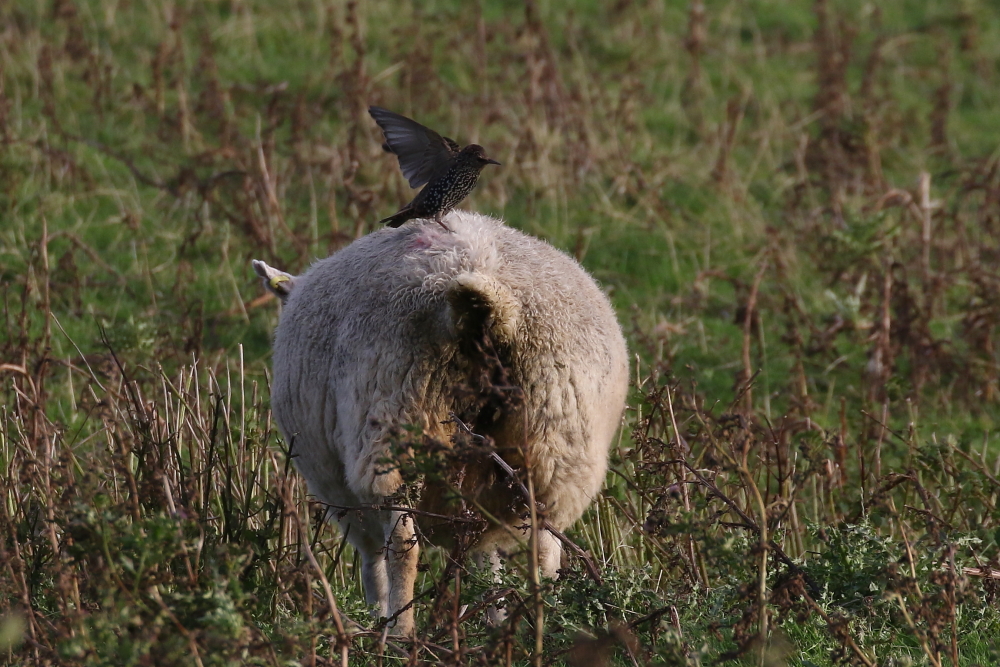
Well at least it's an anagram of 'Starling on sheep's ears' 
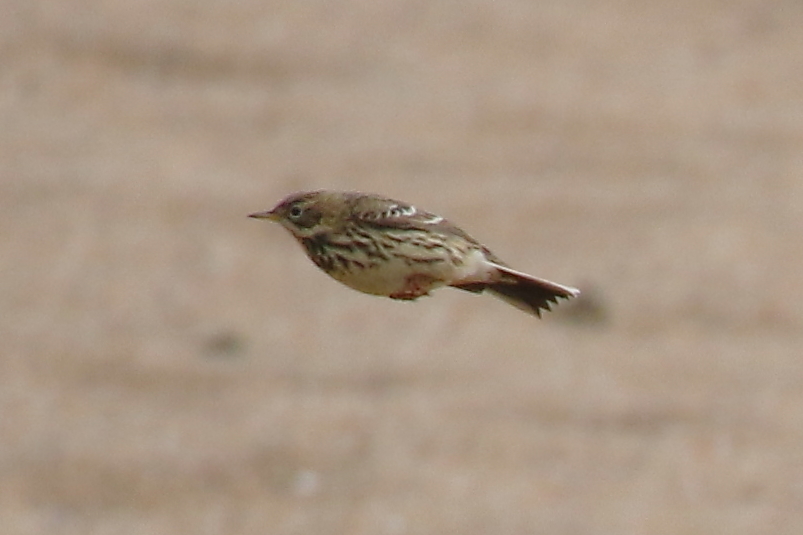
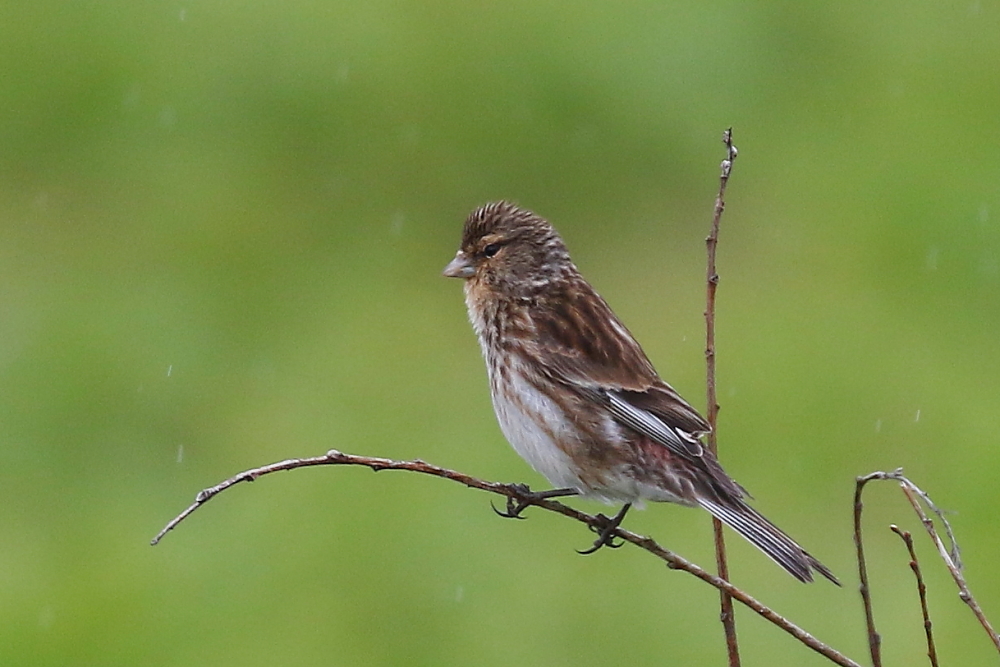
We stalked this Pipit at Skaw hoping it was the Red-throated, but photos revealed it to be a Tree Pipit
We instinctively raised our binoculars, expecting a Meadow Pipit, and had a good view at close range before it flew again. Then we all looked at each other: 'That had bright mantle stripes'. 'Yeah, and a yellow base to the bill'. 'Well that was it then!' Too easy! I kicked myself for not grabbing a photograph of the bird at point blank range, and though we attempted to refind it, it had flown beyond a wall into a private garden, and did not look like reappearing.
After burying itself in the grass the Red-throated Pipit eventually came out on the beach 
Clean whitish underparts
A better view of the pale mantle stripes and fine bill with yellow base
The weather had taken a turn for the worse by this point, and we turned to leave - no sooner had we done so than the Pipit reappeared. It was flighty but after sweeping the area with another group of visiting birders we eventually pinned it down for some photos on the beach and in the long grass beyond. 
A rear view of the pale mantle stripes
The best of a bad lot of Red-throated Pipit flight shots
Yet another Redstart - this the most obliging of the lot

The rest of the day was spent birding Unst, the highlight being a White-tailed Eagle which an observant soul had picked up perched on a distant hillside. A great excursion and a welcome bit of peace and quiet before returning to the seething metropolis of Hoswick.
The Popemobile: they pushed the boat out when His Eminence visited Shetland

Record shot of a very distant White-tailed Eagle
The long road home to Mainland Shetland

Wednesday, 14 June 2017

Some Scottish specialities

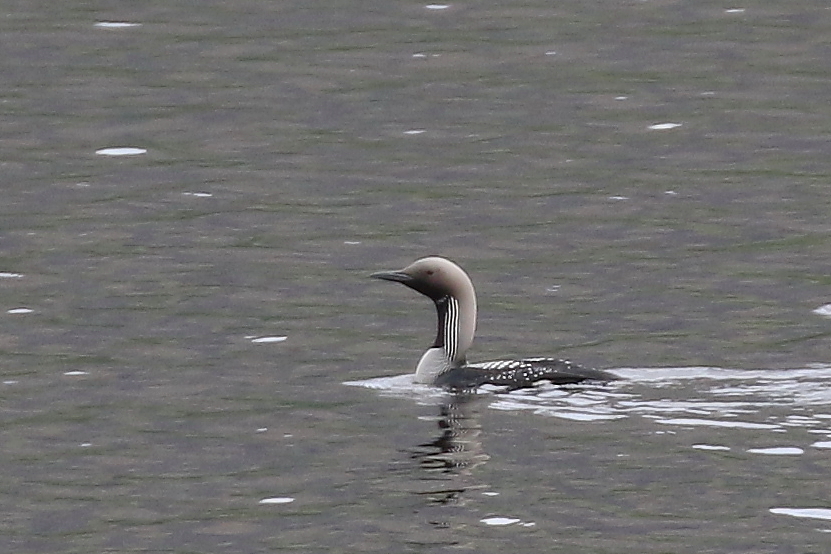
Before I was so rudely interrupted by a flurry of local and national rarities, I was regaling you with tales from our recent Scottish holiday. We'd done the star mammals and the cetaceans, so let's have a look at a few birds. I found a notebook recently from a childhood visit to Gairloch which recorded sightings of three species of diver - Red-throated, Black-throated and Great Northern. By the end of the first day of our recent trip there, I had seen all three species again in a short drive from our cottage on the southern shore of the sea loch to Red Point. Later I counted at least 10 individuals (mostly Red-throats) in one brief scan from the Big Sands campsite where we spent family holidays almost 40 years ago.
This immaculate Red-throated Diver was just off the beach of Red Point
Such a beautiful bird

Another Red-throat was just offshore at Big Sands 
Red-throated Diver flying past us at Red Point
Click to enlarge for a better view of the pinstriped neck pattern
Divers are one of my favourite bird families, combining sleek good looks with haunting calls and an exquisite choice of breeding habitats. It's bad form, not to mention illegal, to bother these protected birds during the breeding season too close to their nesting sites (typically islets on small lochans for Red-throated and on larger lochs for Black-throated), so my plan was to check out plenty of coastal and roadside habitat and hope for close views in areas where there was no risk of disturbance. An early morning visit to the vast shoreline of Loch Maree - the most important breeding site for Black-throated Divers in the country - produced very distant sightings of three birds, which nest on the large islands way out in the middle of the loch. A visit later in the day was equally unsuccessful as the lochshore was busy with kayakers - no chance of a close view in those circumstances.
A reasonably close view of not one...
...or two...
...but three Black-throated Divers on Loch Maree
You have to be a long way north to see Hooded Crow - this one was on the shore near Gairloch harbour
Twite was on my target list for the week - we saw just the one pair, in the rain along the north shore of Gairloch
On another day a couple Black-throats were snoozing close in to an inaccessible stretch of coast near Red Point. So despite good telescope views I was struggling for a photo of a breeding plumaged bird. Then a few days later, when at the south end of Loch Maree looking for dragonflies (more on that in a later post), in an area with few islands and therefore not where one would expect to see divers, not one, or two, but three Black-throated Divers sailed past, apparently too absorbed in each other to pay much attention to me as I fumbled with my camera settings on the shore.

Siskin in the garden of our holiday accommodation
Red-breasted Merganser flying over the sealoch
Skylark at Red Point
Repoll at Red Point - apparently we don't even have to worry about what flavour these days
Northern Wheatear with prey near Red Point
The Beinn Eighe National Nature Reserve, close to where we were staying, is home to another special bird I was hoping to see on our trip - Scottish Crossbill, the UK's only endemic species. A couple of quick visits to suitable habitat had produced nothing more than some distant calls, but a more leisurely stroll with the family around the woodland trail in the NNR was more successful: first a male Crossbill, then a pair. The various site guides I had suggested that Crossbills in this area ought to be Scottish Crossbill, but as I was not carrying sound recording equipment, I guess I can't really prove it. They were fairly chunky, and the calls sounded deeper to my ear than the Common Crossbills near home, so for the sake of argument and the want of a sonogram, let's just call them 'presumed' Scotsbill.
Presumed Scottish Crossbill
Scottish Crossbill has a chunkier more bull-necked appearance than Common
Tree Pipit, Beinn Eighe
I really enjoyed the general 'bumbling around' birding and bumping in to commoner species as well as seeing the local specialities - plenty of breeding Skylark, Siskin, Redpoll, Tree Pipit and Wheatear, all pictured above, were a delight to see. Stand by for one more post on the birds of Wester Ross and then we'll make our way down the food chain to the odonata and lepidoptera before closing the Scottish chapter at the very bottom of the ecological and moral web with an excoriating critique of the West Highland Midge...


Sunday, 6 September 2015

Late news from Portland

The Dorset Youth League under-13s (Division 2) football season started today (a 2-7 away win for newly promoted Wareham Rangers, since you ask, son George being responsible for only one of the opposition goals, trying to dazzle his way out of defence when simply getting rid would have been advisable), so we're back to that time of year when the scope for birding at the weekend becomes even more limited. So I'm already reminiscing about last weekend, when the kids were still away camping with their mum, leaving three days free for wall-to-wall birding.

Having thrashed Poole Harbour pretty thoroughly on our birdrace on the Sunday, after a lie-in on Bank Holiday Monday I fancied a change of scene and headed to Portland. A Rose-coloured Starling had been around the same houses as the one I saw last year, but when Dave Foot re-found a Wryneck at the Bill, I gave up on the Fawn Yawn and headed there instead. Rather like Greenlands the previous day, the bushes by the Pulpit Inn were buzzing with a similar cast of migrants - Wheatear, Whinchat, Tree Pipit, Whitethroat, Redstart, Spotted Flycatcher and, best of all, the Wryneck - my second in 2 days. This one showed a bit better and for longer than the star of the birdrace, and it was interesting to see one of the battered ant nests into which it had been poking its bill.
Wryneck on Portland
It's still there a week later
The cryptic plumage really is stunning
The wind is catching the crown feathers here creating a crested appearance
Note the striping under the chin
This Tree Pipit perched up nicely after flushing from almost underfoot
A smartly plumaged bird
Whinchat is another favourite migrant - always good to see one of these
Whitethroat
Spotted Flycatcher in the Pulpit Bushes
This bird was keeping quite a low profile...
...perhaps trying to avoid the attentions of the local Kestrels
Before heading to Portland, the day had started wet but well with a Hummingbird Hawkmoth on lavender in the garden