Showing posts with label Siskin. Show all posts

Saturday, 21 October 2017

Shetland day 6: of pies and pines

Seems like an age since I was on Shetland, so apologies for the time it's taking to wade through the old news and pictures - only four days to go...Day 6 began as had the previous couple with a twirl around Hoswick - best birds of that session were a pair of Red-throated Divers in the bay which I picked up out of the kitchen window while we were having breakfast. The incessant wind continued so we sought out sheltered spots in Scalloway, finding nothing more exciting than Brambling, before heading for the pie shop.
Parrot Crosssbill
Scissoring a cone from the tree with its powerful bill
A darker red male fed just below the more orangey bird above
Calls in flight were very different to our familiar Crossbills
Bird of the day on day 6
English convenience stores have a lot to learn from their Shetland counterparts: for £1.95 we could get a delicious, compact pie with a choice of fillings and heat it up in the shop's microwave - many days this was enough to tide us over until the mid-afternoon snack pangs kicked in. I fear my constant grazing was a bad influence on the rest of the team, and by the end of the week they were troughing in to an ever expanding snack bag like troopers. At least that meant I wasn't the only one...
Red-breasted Flycatcher, Dale of Walls
Looking a bit perkier than the one we saw in the rain on our first day
A very vocal bird which frequently cocked its tail
A good view of the white patches at the base of the tail
Separated at birth from Orville the Duck
Soon after we had all pied-up, news broke of a small flock of Parrot Crossbills in a conifer plantation near Sand - a major rarity on Shetland and a bird I had seen only once before in the UK. A consensus decision saw us heading there where we got excellent views of three male birds which were following our lead by chowing down on pine cones which they had ripped from the trees - a characteristic behaviour of the species.
The RB Fly flicks from a branch over Howard's shoulder
After giving us the run-around, the Great Grey Shrike at Dale of Walls had the decency to hover over-head
Hedgehog was an addition to the mammal list for the trip
We continued to bump into good numbers of Redstarts - here a male...
...and here a female
From Sand, we headed to Dale of Walls where a very obliging Red-breasted Flycatcher and a slightly less obliging Great Grey Shrike were the highlights, before ending the day with a selection of finches at Veensgarth. So another good day, of which the Crossbills were the undoubted highlight.
Mealy Redpoll, Veensgarth
Pied Flycatcher at Sand earlier in the day
Siskin at Veensgarth
Offshore waters continued to boil in the strong winds
A calmer image to end with of the Red-breasted Flycatcher

Wednesday, 14 June 2017

Some Scottish specialities

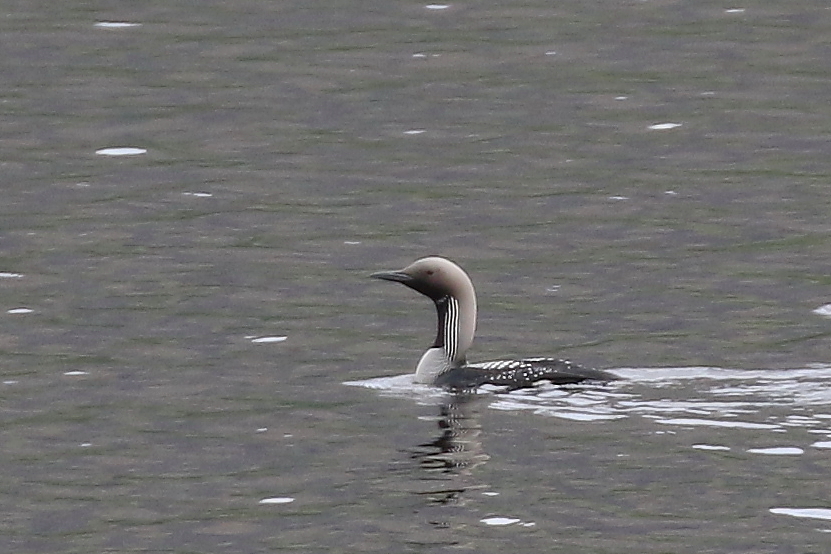
Before I was so rudely interrupted by a flurry of local and national rarities, I was regaling you with tales from our recent Scottish holiday. We'd done the star mammals and the cetaceans, so let's have a look at a few birds. I found a notebook recently from a childhood visit to Gairloch which recorded sightings of three species of diver - Red-throated, Black-throated and Great Northern. By the end of the first day of our recent trip there, I had seen all three species again in a short drive from our cottage on the southern shore of the sea loch to Red Point. Later I counted at least 10 individuals (mostly Red-throats) in one brief scan from the Big Sands campsite where we spent family holidays almost 40 years ago.
This immaculate Red-throated Diver was just off the beach of Red Point
Such a beautiful bird

Another Red-throat was just offshore at Big Sands 
Red-throated Diver flying past us at Red Point
Click to enlarge for a better view of the pinstriped neck pattern
Divers are one of my favourite bird families, combining sleek good looks with haunting calls and an exquisite choice of breeding habitats. It's bad form, not to mention illegal, to bother these protected birds during the breeding season too close to their nesting sites (typically islets on small lochans for Red-throated and on larger lochs for Black-throated), so my plan was to check out plenty of coastal and roadside habitat and hope for close views in areas where there was no risk of disturbance. An early morning visit to the vast shoreline of Loch Maree - the most important breeding site for Black-throated Divers in the country - produced very distant sightings of three birds, which nest on the large islands way out in the middle of the loch. A visit later in the day was equally unsuccessful as the lochshore was busy with kayakers - no chance of a close view in those circumstances.
A reasonably close view of not one...
...or two...
...but three Black-throated Divers on Loch Maree
You have to be a long way north to see Hooded Crow - this one was on the shore near Gairloch harbour
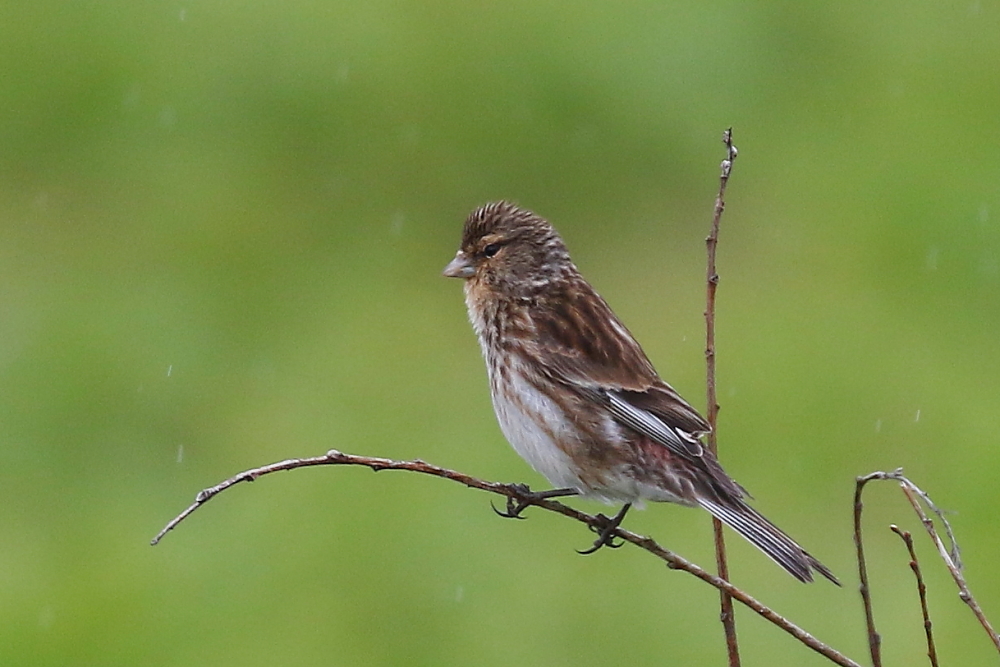
Twite was on my target list for the week - we saw just the one pair, in the rain along the north shore of Gairloch
On another day a couple Black-throats were snoozing close in to an inaccessible stretch of coast near Red Point. So despite good telescope views I was struggling for a photo of a breeding plumaged bird. Then a few days later, when at the south end of Loch Maree looking for dragonflies (more on that in a later post), in an area with few islands and therefore not where one would expect to see divers, not one, or two, but three Black-throated Divers sailed past, apparently too absorbed in each other to pay much attention to me as I fumbled with my camera settings on the shore.

Siskin in the garden of our holiday accommodation
Red-breasted Merganser flying over the sealoch
Skylark at Red Point
Repoll at Red Point - apparently we don't even have to worry about what flavour these days
Northern Wheatear with prey near Red Point
The Beinn Eighe National Nature Reserve, close to where we were staying, is home to another special bird I was hoping to see on our trip - Scottish Crossbill, the UK's only endemic species. A couple of quick visits to suitable habitat had produced nothing more than some distant calls, but a more leisurely stroll with the family around the woodland trail in the NNR was more successful: first a male Crossbill, then a pair. The various site guides I had suggested that Crossbills in this area ought to be Scottish Crossbill, but as I was not carrying sound recording equipment, I guess I can't really prove it. They were fairly chunky, and the calls sounded deeper to my ear than the Common Crossbills near home, so for the sake of argument and the want of a sonogram, let's just call them 'presumed' Scotsbill.
Presumed Scottish Crossbill
Scottish Crossbill has a chunkier more bull-necked appearance than Common
Tree Pipit, Beinn Eighe
I really enjoyed the general 'bumbling around' birding and bumping in to commoner species as well as seeing the local specialities - plenty of breeding Skylark, Siskin, Redpoll, Tree Pipit and Wheatear, all pictured above, were a delight to see. Stand by for one more post on the birds of Wester Ross and then we'll make our way down the food chain to the odonata and lepidoptera before closing the Scottish chapter at the very bottom of the ecological and moral web with an excoriating critique of the West Highland Midge...


Tuesday, 2 May 2017

Visitors from afar

Without wishing to give the impression I am an anti-social cuss, I try to encourage friends and family to avoid visiting me during the months of May and October, as these represent two of my favourite months for wildlife photography. I could of course expand this to cover the bird migration seasons of 'spring' (Feb-June) and 'autumn' (July-November) but that would seem unreasonable. In any case, as often as not they ignore this advice, in which case I am forced to fall back on the small print in the visitors contract which states that if they insist on coming (i) I can't promise I will be there and (ii) I can't promise to appear to be enjoying myself if I would rather be somewhere else.

This Bank Holiday weekend friends from Cornwall (Debbie and Alec) retaliated to my frequent visits to their house at convenient times of year for rare bird migration by arriving at mine. They were of course made very welcome, and a bit of birding had to be squeezed in on Friday night before their arrival, and Monday evening after their departure. And on the Saturday, when we took them to Arne. And a bit on Sunday when I dragged Alec to Portland for an early morning shift. Well it's not my fault if they didn't read the small print.

On Friday there was just time between plumping up the pillows in the spare room and rolling out the red carpet to nip up to Longham Lakes to see a Bonaparte's Gull which had spent a few days in the area, one of a number of this wanderer from the Americas to turn up in southern England in recent days. That was easy enough to find on the North Lake, either hawking insects or sitting out on a man-made island near the shore.
With our guests arriving late on Friday, the household succumbed to the temptation of a lie in on Saturday and after lunch at the Arne café, we took the long route around the reserve which took us away from the busiest areas. Highlights were a couple of Sand Lizards, one of which, to our surprise, sat out on the heather next to the path and didn't scarper as we made our way past. This was closely followed by an exquisite Small Copper and an equally exquisite male Siskin by the café.
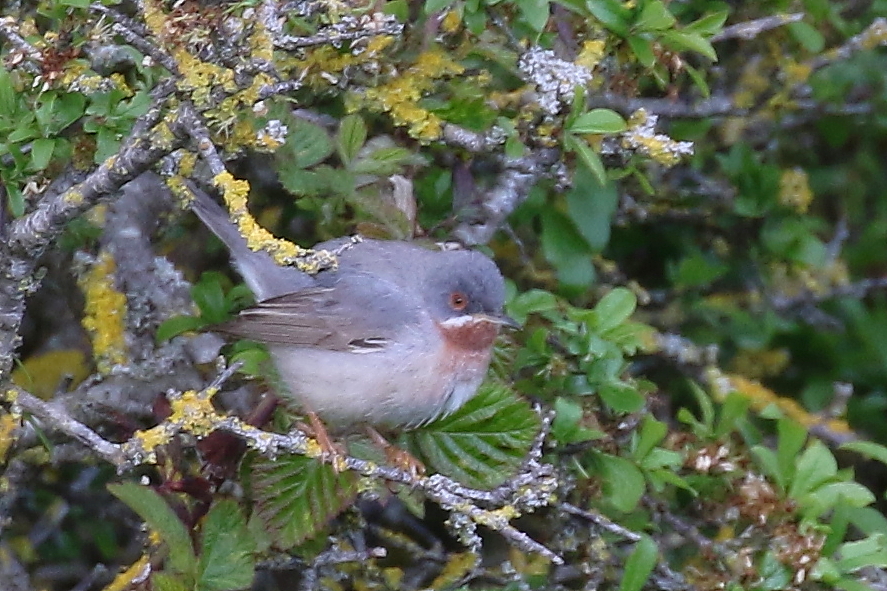
Dragging Alec down to Portland early on Sunday morning proved to be a bit of a disappointment bird-wise - a strong wind was blowing from the south east, migrants were thin on the ground (restricted to a few Yellow Wagtails, a couple of Turtle Doves and an Arctic Skua past the Bill) and we failed to see an Eastern Subalpine Warbler present at Cheyne Weares despite a near two hour vigil. Fortunately in view of the lack of birds, as a former Naval officer, Alex was happy to revisit former haunts around Portland.
Bank Holiday Monday saw us bidding farewell to our guests, and me heading back to Portland shortly afterwards for another crack at the Eastern Subalpine Warbler. In much more clement weather, this was successful, and it showed about as well as any Subalpine Warbler I have seen, feeding actively and singing in the late afternoon. Wheatears and Linnets at the Bill capped a thoroughly enjoyable weekend for visitors - avian and human. With apologies to my guests if my body language ever suggested otherwise!