Showing posts with label Broad-bodied Chaser. Show all posts

Monday, 4 June 2018

Tails and the unexpected

Swallowtail butterflies were the main target of my recent Bank Holiday weekend in the fens and I was not to be disappointed, seeing them shortly after my arrival at one of the most well-known and accessible sites for this species, Strumpshaw Fen near Norwich. I arrived mid-afternoon to find unexpected traffic chaos caused by a fair at the nearby Steam Museum, swelling the ranks of the Swallowtail admirers who head there at this time of year. The famous 'Doctor's garden', whose planted beds are a favourite haunt of the butterfly, was out of bounds but, having seen them on the somewhat gaudy flowers there some years ago, I was in any case hoping to see them in a more natural setting.
Swallowtail, Strumpshaw Fen
A wider angle showing more of the nectar source
A portrait crop which I quite like
After a short wait near the garden, a Swallowtail arrived, turned its nose up at more exotic plants, floated over the mown lawn and headed for an unkempt patch full of Red Campion. I enjoyed extended views as it sought nectar from almost every flower, some of which were close to the path. Due to the long grass it was difficult to get a clear photograph but with patience, and high ISO ratings in the gathering gloom of late afternoon, I was able to take a few opportunities to capture the butterfly in this habitat.
Swallowtail, Hickling Broad
Nectaring on Yellow Flag Iris, abundant around the Broad
A different individual, judging by the nick in the right forewing
I returned early the following morning to look for butterflies and dragonflies but, having found both in short supply, on the advice of a local butterfly enthusiast I headed a little further east to Hickling Broad, which had the added advantage of avoiding more steam fair related chaos arising from the ongoing festivities at Strumpshaw!
This pair appeared to be engaged in some form of courtship, with some elaborate parallel flying manoeuvres
Swallowtail must be one of the few butterflies large enough to photograph in flight distantly over a reedbed!
A close-up of the exquisite hindwing pattern and tails
This turned out to be good advice, as good numbers of Swallowtail were visiting a recently cut patch of reedbed in which Yellow Flag Iris were flourishing. Getting a clear photograph through vegetation was, again, difficult, but there was an uncluttered view of several flowers from a conveniently placed bench, so I made myself comfortable and waited. Eventually Swallowtails obliged by nectaring at the nearest flowers and then it was just a question of hoping that my chosen camera settings could capture the action of these restless, hyper-active insects.
The long tongue can be seen here searching for nectar
The mating pair - note the tails of the lower individual poking through the closed wings of the one above
Not something you see every day: Swallowtail threesome!
Sitting in the same spot for so long enabled me to become intimately familiar with the surrounding habitat, and eventually I noticed a pair of Swallowtail apparently mating low down in the reedbed. They were repeatedly bothered by a third individual, which seemed determined to get in on the action! The pair stayed bonded for at least half-an-hour before the indiscreet third party finally seemed to have ruined the moment for them, and they went their separate ways. Hopefully not before the seeds of the next generation were sown!
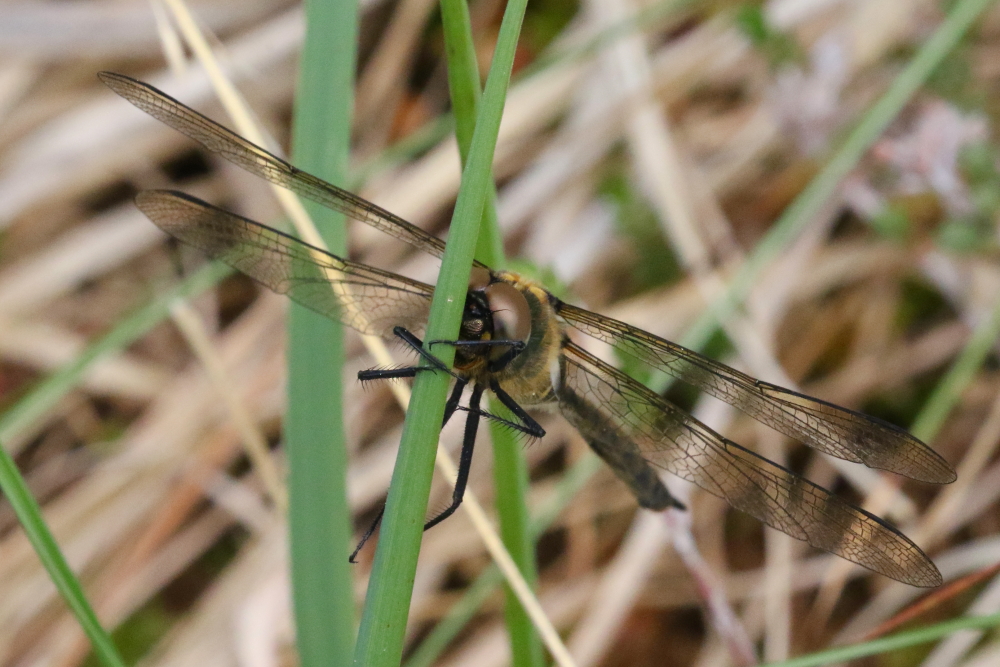
Hickling and Strumpshaw were also excellent for dragonflies - this a male Broad-bodied Chaser at Strumpshaw...
...a female Black-tailed Skimmer at Hickling...
...a Hairy Dragonfly at Strumpshaw...
...and, best of all, a Norfolk Hawker at Hickling
My view of this green-eyed monster was very restricted but made for a nice soft focus edge to this image 

Wednesday, 28 June 2017

Dragons' dens

Dorset is a something of a dragonfly hotspot but I have visited a few others on recent travels, including on our holiday to the north west of Scotland at the start of the month, an area which hosts a number of species with restricted ranges in the UK. Site guides old and new suggested that Bridge Of Grudie on the southern shore of Loch Maree would be worth a look. Not an easy site to cover with wellingtons being essential to get out to some boggy pools which I had read host the White-faced Darter, though I had almost immediate success with one of my targets on leaving the car and flushing a Northern Emerald in a forest clearing just behind where we had parked.
Northern  Emerald - a female judging by shape of the abdomen - compare to....

...a male Northern Emerald, which has a more 'waisted' appearance. Note also the calliper-shaped anal appendages. Call me puerile, but it's great to have an excuse to use the phrase 'anal appendages' on this blog again. It's been a while.
Lateral yellow spots on the frons also identify this as Northern Emerald - one is just visible here
I eventually located the pools, which can't be seen from the roadside, but unfortunately there were no White-faced Darters on them and I had to make do with several Four-spotted Chasers and a variety of Damselflies. James Lowen's A Summer of British Wildlife also suggested checking out a site in Slattadale Forest (where a tantalising glimpse of what was probably a female Azure Hawker left me slightly frustrated) and the Woodland Trail at the Beinn Eighe NNR where a brief but conclusive view of a male Azure Hawker in flight was more satisfactory. Annoyingly, despite heavy rain starting as it floated around a clearing, it just would not land to pose for a photo. Still, two new dragonflies in two days was good going.
Four-spotted Chaser, Bridge of Grudie
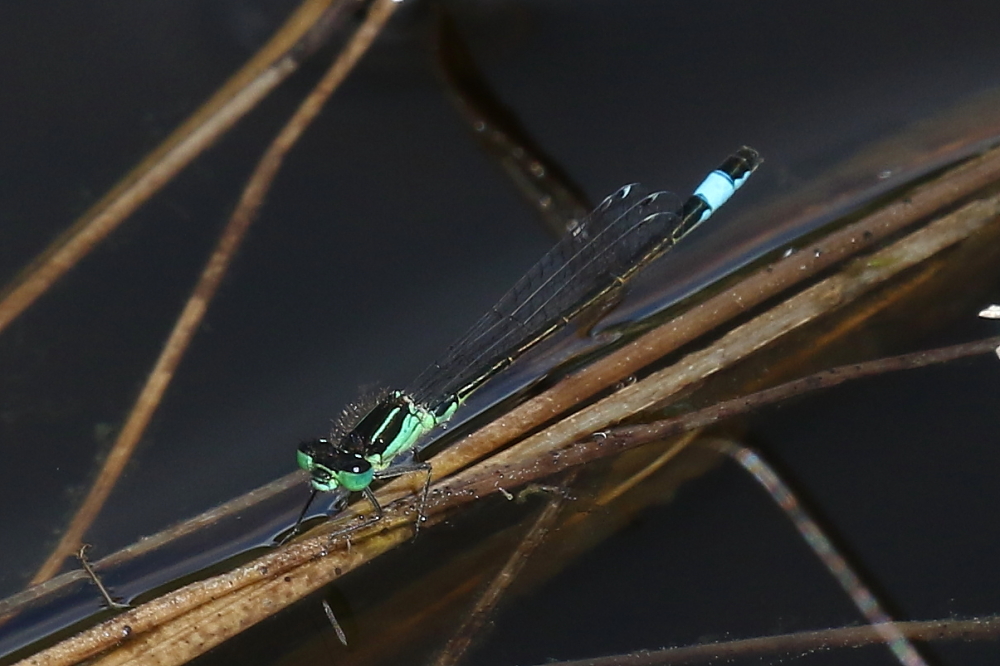
Blue-tailed Damselfly, Bridge of Grudie
Common Blue Damselfly, Bridge of Grudie
Within a week or so of returning home to Dorset from Scotland, the chance of seeing another new species arose when Olly Frampton discovered a couple of Lesser Emperor, a rare migrant to the UK, at nearby Longham Lakes. As it was during the recent heatwave, despite the lateness of the hour and some afternoon cloud cover, I felt it was worth a try after work to see if they were still on the wing.
Lesser Emperor, Longham Lakes - readily identified by the pale blue saddle behind the thorax.
This attractive Banded Demioselle was also on the wing at Longham
Female Emperor at Longham Lakes - during warm weather the normally green abdomen can turn blue
Sure enough, with the help of son George and the rest of the family who I had lured to Longham with the promise of pizza on the way home, we found one shortly before 8pm. It didn't settle, so I had to make do with a ropey flight shot as it sped past some lakeside reeds. This run of close encounters with rare dragonflies encouraged me to spend a bit more time photographing them on some recent walks in Wareham Forest - great habitat for odonata.
Female Black-tailed Skimmer, Wareham Forest
Emperor, Wareham Forest
Keeled Skimmer, Wareham Forest
On one tiny pool in the forest I came across three blue male dragonflies each of a different species - the impressive Broad-bodied Chaser, the slightly less chunky Black-tailed Skimmer and the sleek Keeled Skimmer - testament to how fortunate we are to have all this on our doorstep.
Broad-bodied Chaser, Wareham Forest
Black-tailed Skimmer, Wareham Forest
Keeled Skimmer, Wareham Forest

Monday, 18 May 2015

Finally, an enjoyable camping trip

Regular readers will be familiar with my loathing of life under canvas, but this weekend I actually found a way to enjoy a camping trip. Specifically, by just being a day visitor to the Sandy Balls tentopolis in the New Forest, where the rest of the family were spending a sleepless and scurvid couple of days. Hooking up with them on Saturday, after a good night's sleep, and leaving them to it that evening, just as the cold started to eat at those parts which the midges had yet to reach, was my kind of camping. Even better, I didn't even have to seek permission to be excused: I have become such an unhappy camper that this time I was instructed not to go. As an extra bonus, there was just time before setting off to meet them for a morning walk around Swineham, and I haven't managed that a lot lately. A single photo tick for the year was on offer in the form of a Little Gull.
Little Gull, Swineham (#178)
Little Gull is a regular spring visitor at Swineham
A Broad-bodied Chaser would be a bit of a mouthful for a Little Gull...
...Four-spotted Chaser only slightly less so
I think this is a female Azure Blue Damselfly. My field guide says best distinguished from similar species by 'examination in the hand of the posterior lobe of the pronotum'. I don't know my pronotum from a hole in the ground so that's not much use.
Goldfinch is less of an identification challenge
 A more dowdy juvenile suggests local breeding success
This Long-tailed Tit was also not long out of the nest
Surely one of the cutest of fledglings
And speaking of breeding, here's a Little Egret in full courtship garb - note the pink lores and reddish feet

Sunday, 22 June 2014

The energy crisis

No not that one, it's my own I'm talking about. Work is a bit manic; my social life is hectic by my anti-social standards; and the fine weather and (not-so-fine) hay-fever are all combining to make it all a bit, well, oppressive. I can barely summon up the energy to refresh these sunburnt pages. Just about managed to wave a white-hot lens in the general direction of some wildlife this weekend though, so perhaps I'll let the pictures do the talking.
This Buzzard made getting around look easy while I huffed and puffed and hid in the shade.
Willow Warbler at Morden Bog: a mixed singer, with bursts of Chiffchaff amid the normal song.
Keeled Skimmer, Morden Bog.
Four-spotted Chaser, Morden Bog.


Large Skipper, Morden Bog.
Silver-studded Blue, Morden Bog - many on the wing today.
Silver-studded Blue underside, Morden Bog.
A day at the beach yesterday was enlivened by a passing Mediterranean Gull, bringing its namesake climate with it.
Almost forgot about this one - Hooded Crow on Portland last weekend - an unexpected Dorset tick for high summer.
Broad-bodied Chase are also on the wing at the moment - this one at Swineham to which I was reminded I am particularly allergic at this time of year.