|
| Marsh Tit, Corfe Castle |
 |
| The much commoner Blue Tit at Corfe Castle |
 |
| This Coal Tit was seen earlier in the day at Bestwall |
 |
| Great Tit among the pines at Swineham earlier in the day |
 |
| Long-tailed Tit, from the family Aegithalidae, at Swineham |
|
| Marsh Tit, Corfe Castle |
|
| The much commoner Blue Tit at Corfe Castle |
|
| This Coal Tit was seen earlier in the day at Bestwall |
|
| Great Tit among the pines at Swineham earlier in the day |
|
| Long-tailed Tit, from the family Aegithalidae, at Swineham |
 |
| Little Gull, Swineham (#178) |
 |
| Little Gull is a regular spring visitor at Swineham |
 |
| A Broad-bodied Chaser would be a bit of a mouthful for a Little Gull... |
 |
| ...Four-spotted Chaser only slightly less so |
 |
| I think this is a female Azure Blue Damselfly. My field guide says best distinguished from similar species by 'examination in the hand of the posterior lobe of the pronotum'. I don't know my pronotum from a hole in the ground so that's not much use. |
 |
| Goldfinch is less of an identification challenge |
 |
| A more dowdy juvenile suggests local breeding success |
 |
| This Long-tailed Tit was also not long out of the nest |
 |
| Surely one of the cutest of fledglings |
 |
| And speaking of breeding, here's a Little Egret in full courtship garb - note the pink lores and reddish feet |
 |
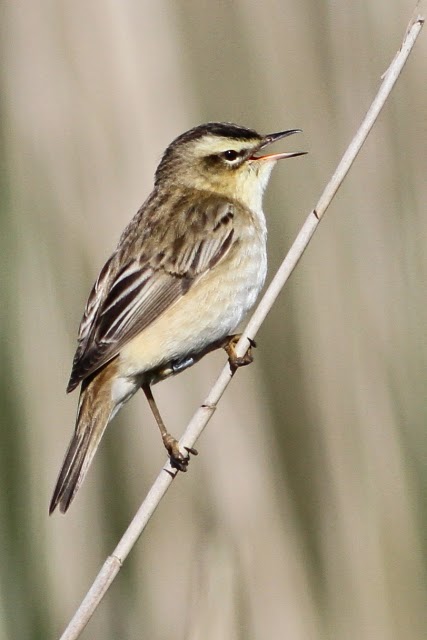
| Sedge Warbler: the song is often said to have a jazzy feel compared to the more rhythmic percussion of Reed Warbler. This one was also indulging in some enthusiastic song-flight. |
 |
| Reed Warbler: last week most of the singing Reed Warblers remained unseen. This week they were more showy - perhaps getting a bit more desperate among the fierce competition at Bestwall. |
 |
| Reed Warbler - backlit in the early morning light at Bestwall |
 |
| Male Blackcap |
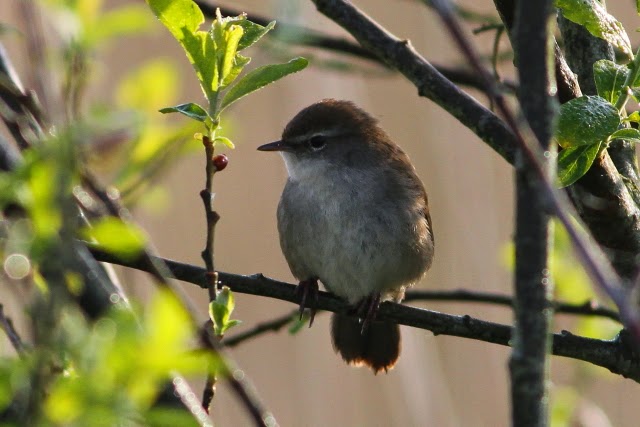 |
| Cetti's Warbler - defying the Cetti's Warbler rulebook by giving any view at all |
 |
| Whimbrel |
 |
| Reed Bunting also numerous at the moment - 10 singing males around Swineham |
 |
| This Long-tailed Tit was not long out of the nest |
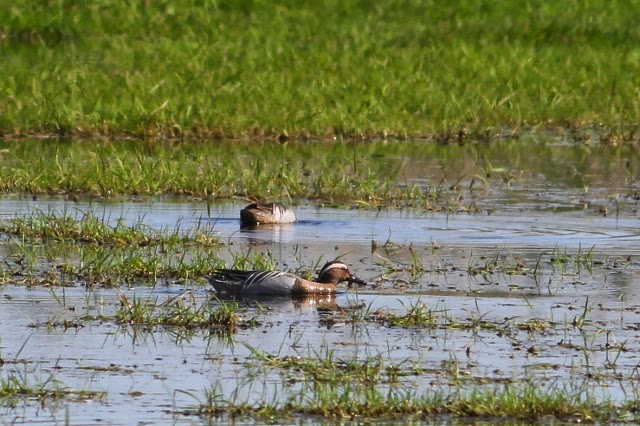 |
| A touch of class: two of three drake Garganey I saw at Swineham this weekend |
 |
| And a touch of trash: Egyptian Geese at Swineham |
 |
| I fancied finding a rare heron in the reedbeds this weekend - but Grey Heron and Little Egret were the only ones in evidence. |
 |
| I don't know my snails but this one has some intricate markings |
 |
| Sedge Warbler |
 |
| Meadow Pipit, Bestwall |
 |
| Pied Wagtail on a rooftop on Bestwall Road |
 |
| Male Great Spotted Woodpecker, Swineham |
 |
| Brambling - part of a small flock which has spent a few months on the outskirts of Wareham |
 |
| The Grey Squirrels (Prohibition of Importation and Keeping) Order 1937 makes it a criminal offence for a land owner not to notify Defra of the presence of grey squirrels on their land. It's true, look it up. I wonder if the owners of Bestwall House grassed this one up. |
 |
| Long-tailed Tit, Swineham |
 |
| Great Tit, Swineham |
 Walking around the rest of the Dorset Wildlife Trust on Brownsea today, there was plenty of evidence of breeding activity. Canada Geese had goslings on the lawn by the church, and a brood of juvenile Long-tailed Tit (top picture) were ca
 using a commotion near the villa. This male Reed Bunting posed briefly in front of the reedbed hide. Although conditions were slightly blustery, surprisingly few birders, or visitors of any kind, were on the island today for the time of year.