Showing posts with label Reed Bunting. Show all posts

Tuesday, 9 June 2020

Lockdown diaries: the patch (part 2)

I read a behavioural psychology piece during lockdown which suggested that the longer a new behaviour was adopted by necessity, the more likely it was to 'stick', even after the freedom to abandon it returned. Hopefully this will be the case for all those people who've been buying bikes to get around (I had been dithering about upgrading mine and now can't get one for love nor money!) - but it certainly seemed to apply in the case of my regular visits to my local patch at Swineham. Badly neglected over the last few years, birding there once again became a firm fixture of my weekly routine.
Reed Bunting, singing his heart out at Swineham
Sand Martins roosting in the Swineham reedbeds on one of the rare dull mornings of recent weeks
Whether it was the combination of reduced disturbance during lockdown, the consistently fine weather, the more frequent visits on my part or a combination of all three, birding at Swineham this spring seemed much more rewarding than other recent years. The late April glut of singing Reed and Sedge Warblers sustained well into May and, touch wood, both look set for a good breeding year. 
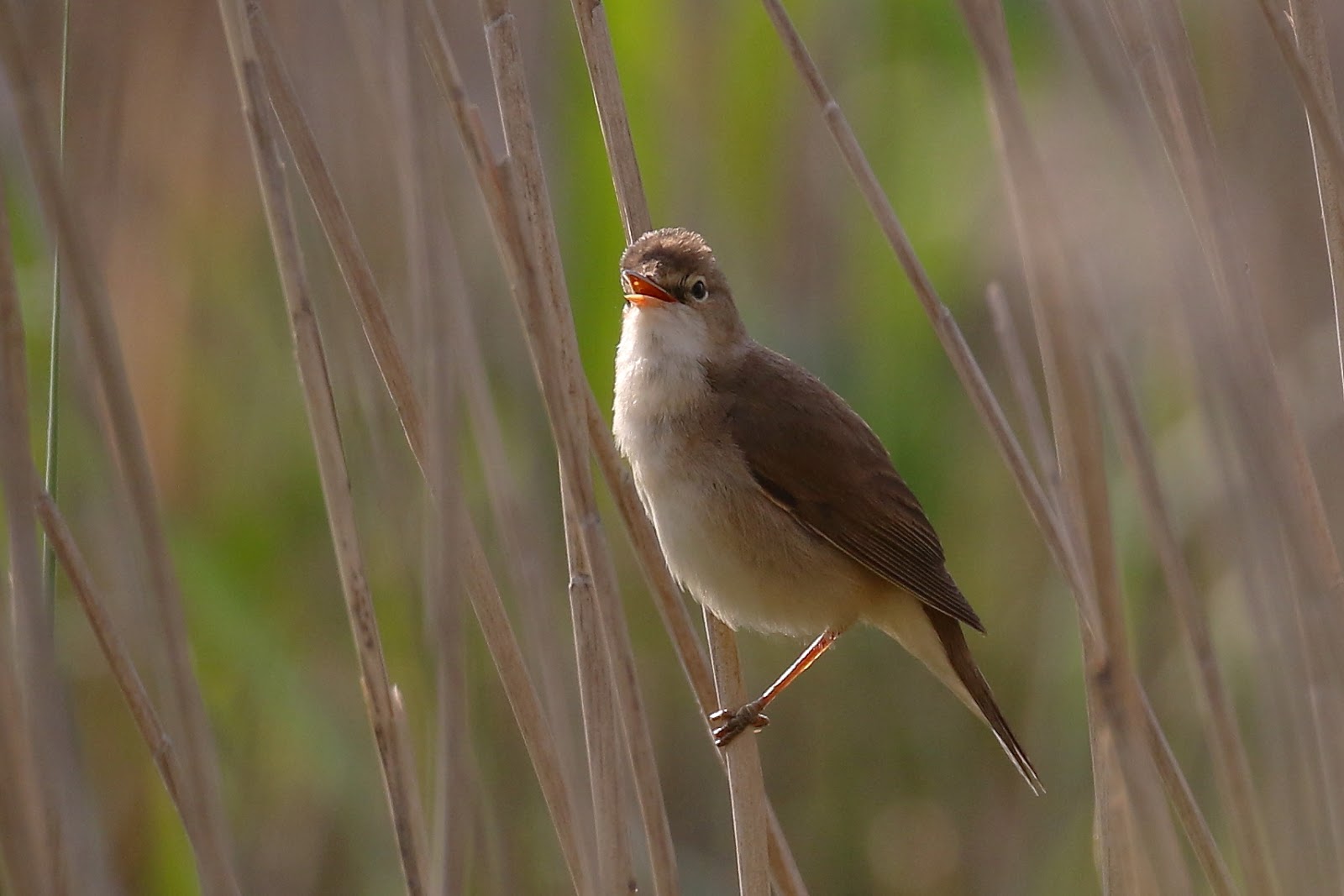
Reed Warbler - now much easier to see than when they first arrive in April
Reed Warbler
I enjoyed some rewarding morning walks along the river banks, more recently taking the 'long' route which follows the meanders of the River Frome from Wareham for a couple of miles before rounding the eastern end of the main Swineham gravel pit, then heading west up the Piddle Valley back towards town. I would normally follow this route anti-clockwise but on the morning of 29th May I went clockwise figuring it would be better to have the sun behind me as I approached the pool where I had found the Temminck's Stint a few weeks earlier. It was rapidly drying out but still held a Little Ringed Plover, a species which normally just passes through Swineham briefly in spring but which was seen either here or elsewhere around Wareham this year throughout April and May.
A couple of pairs of Sedge Warbler have stayed to breed this year - this one bearing a leg-ring
Stock Dove is often seen around Swineham - but rarely poses this well
I trudged back along the bank of the Frome, a little disappointed, and as I entered the avenue of small trees and bushes just before the churchyard in Wareham, which completes the circular walk described above, I heard a snatch of birdsong which stopped me in my tracks. It was difficult to pick out as the wind was tearing through the poplars above, but my instinct said Marsh Warbler, a rare migrant to Dorset and a species I had heard and seen well last year at Lodmoor in Weymouth. I phoned a couple of local birders to say that I thought I'd found a Marsh Warbler, and had the presence of mind to make a quick recording with the voice memo function on my phone. No sooner had I done so the bird went quiet and remained so for over the next hour.
Marsh Warbler in early morning light at Bestwall
Marsh Warbler in song at Bestwall
The recording wasn't very good and of several people I shared it with, some felt it sounded ok for Marsh Warbler, others favoured Reed Warbler. I was convinced it wasn't the latter so returned in the evening to find the bird still singing, audible more clearly now as the wind had died down. Fellow Swineham regular Trevor arrived and we both felt sure it was a Marsh Warbler. I circulated a better recording to Paul Morton, of Birds of Poole Harbour, who consulted other Sound Approach experts and the diagnosis was confirmed. We remained with the bird until almost dusk but despite singing almost constantly we didn't see it once.
Little Gull at Swineham on 1st June
My first Little Gull at Swineham for several years, possibly because I rather than they haven't been visiting
The following morning Paul was first on site making some fabulous recordings of the Marsh Warbler's varied repertoire of mimicry - over its four day stay it was heard to do Nightingale, Blue Tit, Great Tit, Blackbird, Green Woodpecker, Cetti's Warbler, Magpie, Goldfinch, Swallow, Wren, Chaffinch, Song Thrush, Jackdaw and Whitethroat. I was hoping for a few more patch ticks from it to be honest (Nightingale being the only one) but you can't have everything...
Thrilled to see Redshank breed successfully at Swineham this year
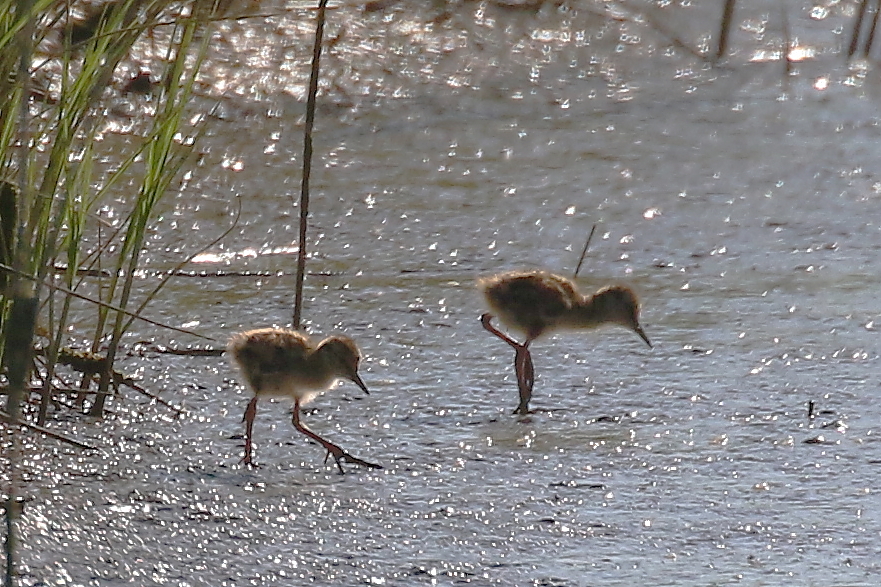
Two of three Redshank chicks at Swineham on 31st May
After the Temminck's Stint and Marsh Warbler I was on a bit of a roll so, following an early start with the latter, I spent the rest morning of the morning of 31sy May searching Swineham for a good 'hat-trick' bird. It came in the form of an unseasonal Short-eared Owl flushed from the path at the end of the gravel pit - not unheard of at Swineham, but very rare for the time of year. It landed on Swineham Point and stared at me for a few minutes before fleeing in response to repeated divebombing by a pair of protective Redshank looking out for their brood of youngsters which can't have been more than a few days old. My best day at Swineham of the spring was capped by capturing a distant image of the hepatic (rufous morph) female Cuckoo which I had seen several times but never for long enough to raise the camera.
Short-eared Owl at Swineham Point
An unexpected bird for late May
The following evening Phil Saunders, who'd come to listen to the Marsh Warbler, picked up a probable Caspian Tern flying up the Frome towards Poole Harbour. Finding that would have made for a superb hat-trick of Swineham spring rarities! Trevor and I headed to Swineham Point and although we couldn't relocate it, we were rewarded at dusk with a 1st summer Little Gull calling over the gravel pit and a Nightjar churring way across the water of the Wareham Channel on the Arne peninsular - a superb ending to a memorable month at Swineham.
Hepatic Cuckoo - a stunning bird
Orange Tip on Bluebells - another memorable moment from an excellent spring on the local patch


Saturday, 6 June 2020

Lockdown diaries: the patch (part 1)

Like that scene in The Hobbit when Thorin rekindles the furnaces under the Lonely Mountain, or, for the Marvel generation, the one where Thor reignites the star of Nidavellir to forge Stormbreaker, it's taken a monumental effort to stir this neglected corner of the internet into action. But desperate times call for desperate measures, and the empty space here has been nudging me to make an entry for several weeks now.
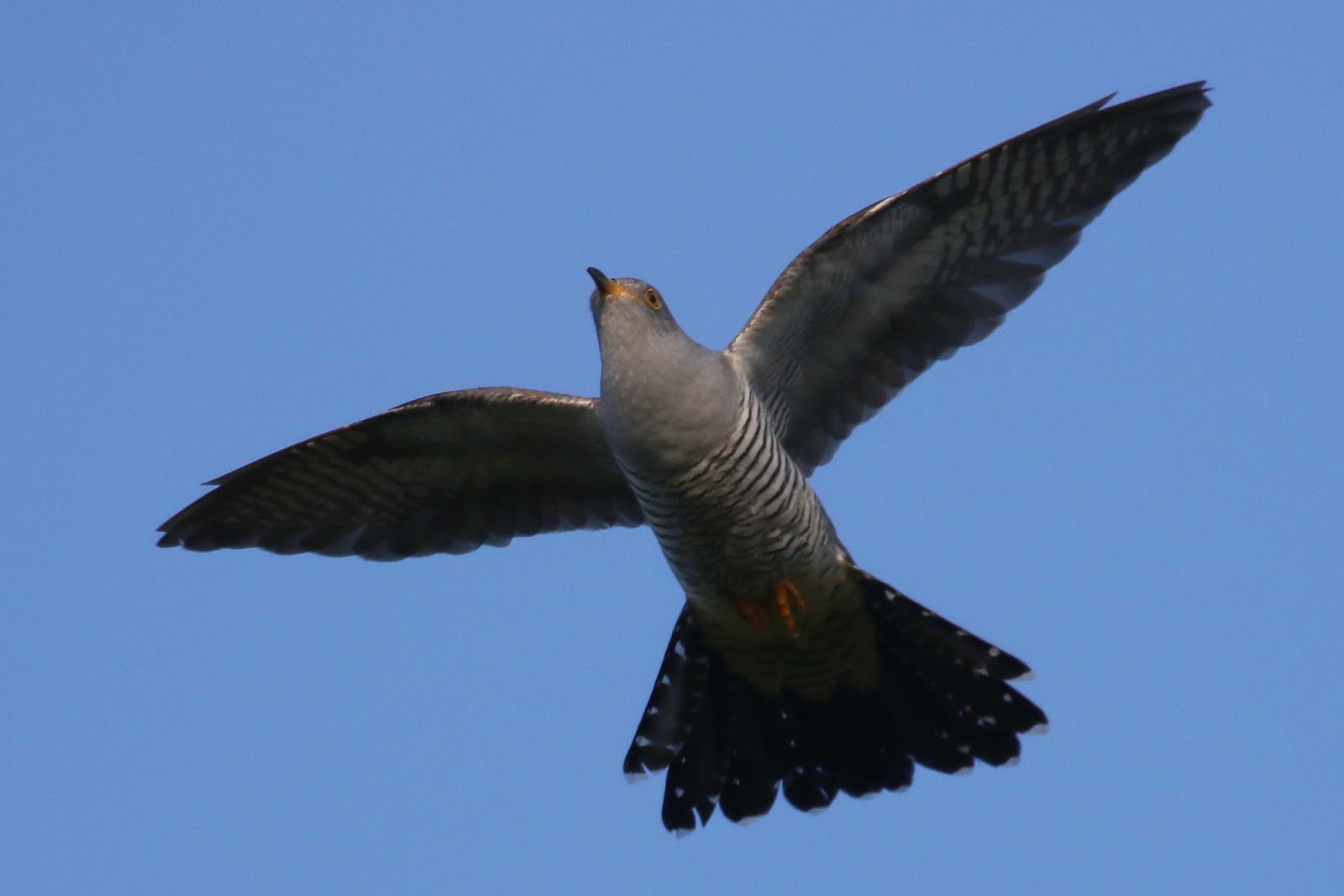
Cuckoo is an attractive bird when seen well - which is not often
Lockdown has, of course, been fertile territory for many an armchair scribbler - not through a surfeit of time in my case as, as a designated 'key worker' (very much at the non-heroic end of the spectrum, I hasten to add), work has been manic. Mucking in with unfamiliar roles, with the added inconveniences of working from home (small town broadband anyone?), and being some 80 miles from the office, has made it mildly stressful. Not that I'm complaining, I've been grateful to be gainfully employed and busy at a worrying time. Plus being at home rather than staying away mid-week as I normally do has provided the added bonus of being able to shout at the kids every day rather than just at weekends.
One of the two male Cuckoo sparring over Swineham
These birds gave what can only be described as Colin-esque views
Taken in lovely early morning light
One of my safe spaces during what we used to think of as the 'hard' lockdown phase, before it turned out to be somewhat optional for the governing classes, was my local patch at Swineham, a short walk from home in Wareham. I suggested to friends prior to the lockdown that enforced visits there to take my state sanctioned exercise ration was my idea of hell, but, conscious that many house-bound birders would have been glad to have ready access to such a high quality bit of greenspace so close to home, this was very much in jest. Those visits all felt a bit rushed though and with the more recent easing of restrictions enabling more leisurely visits, there has been more time to dwell with the camera.
There is usually a Cuckoo or two at Swineham every spring
To see four individuals this spring was exceptional
Some flies got in the way in this shot - but I don't do photoshop!
Note the bared talons which were waved vigorously in the direction of the other male bird
The days when April fades into May at Swineham are the best time of the year in my eyes, as the song of Acrocephalus warblers builds into a wall of sound along the banks of the River Frome. In a good year, I have counted over 60 Reed Warblers holding back-to-back territories, outnumbering the much scarcer Sedge Warbler by a ratio of 10:1 (and the resident Cetti's Warbler by 3:1). This year my high count was 57 Reed, 27 Cetti's and 7 Sedge - so a pretty good turnout by the standards of recent years.
A uniquely shaped bird, part raptor part pigeon
Two male birds continued their contretemps in the treetops...
...and were then joined by a third bird
The conflict got quite heated at times
The longer the breeding season goes on, the easier the warblers seem to be to photograph, as if desperate unpaired males need to take extra risks in showing themselves to attract a mate. So there has been plenty to photograph on recent visits.
Reed Warbler
Reed Warbler
Sedge Warbler
Sedge Warbler
Swineham can be hard work to watch regularly, with unsympathetic management of the dry bits and too much disturbance from leisure activities on the wet bits meaning that too many visits produce not much to write home about. But the creation of two new wader scrapes last winter has provided a greater incentive to visit. This spring they have attracted such goodies as a Green Sandpiper, a trio of Little Ringed Plover and, best of all, a diminutive Temminck's Stint which I stumbled across on 19th May - probably my best find at that point in the 10 year span of my 'on-off' relationship with Swineham. Well done to the local Natural England Team who negotiated the construction of the scrapes under a stewardship agreement with the landowner. Without them, the pool would undoubtedly have evaporated by now in the warm spring weather.
Sunset at Bestwall
Cetti's Warbler - difficult to see at Swineham but this one sat up nicely!
Cetti's Warbler
Goldfinch on the churchyard wall in Wareham - my route to Swineham takes me through here
If the Temminck's Stint was the highlight of the spring to that point, in view of its small size and great distance from me it was not the photographic highlight. That honour goes to a trio of Cuckoo which brawled for a couple of hours after dawn on the first weekend after lockdown eased over the hotly contested reedbeds on the banks of the River Frome. Two of these were so intent on each other that they barely noticed me as they sparred, talons bared, in mid-air just yards above my head.
The broken pectoral band helped identify this as a Temminck's Stint
A tiny wader - dwarfed by a Pied Wagtail
Note the spangled pattern on the back
Grey Heron - often seen at Swineham
Cuckoos seem to be having a good year, possibly some have suggested because lockdowns across the Med reduced the usual spring slaughter of migratory birds - a bittersweet theory if this needless ritual recommences in 2021. But whatever the reason, this is certainly the first year I have been able to confidently identify four individuals at Swineham - the three grey (presumed males) pictured here plus a hepatic (rufous-morph) female seen darting out of the reeds a couple of times.
Swineham is good for all the hirundines in spring - House Martin
Sand Martin
Swallows nest around both yacht clubs along the River Frome at Swineham, often perching on the rigging
Swallow
So while initially perturbed at the wing-clipping effects of lockdown, I came to embrace it and am now quite thankful for the fact that it reconnected me with the highs and lows of patch birding. I also used the car so little in 10 weeks that I almost forgot how to drive, and am thus far sticking with the habit of staying local, having not left Dorset since 12 March. I'm just mildly ashamed that it's taken a global disaster to get me back to the patch regularly and to move me to post an update here again. I'll try to post something else before the next global crisis erupts - though at the rate they are occurring I can't promise anything...
A pair of Egyptian Geese has been semi-resident at Swineham this spring
Common Seals sometimes come a long way up the River Frome - even further it seemed given the absence of leisure boats on the water
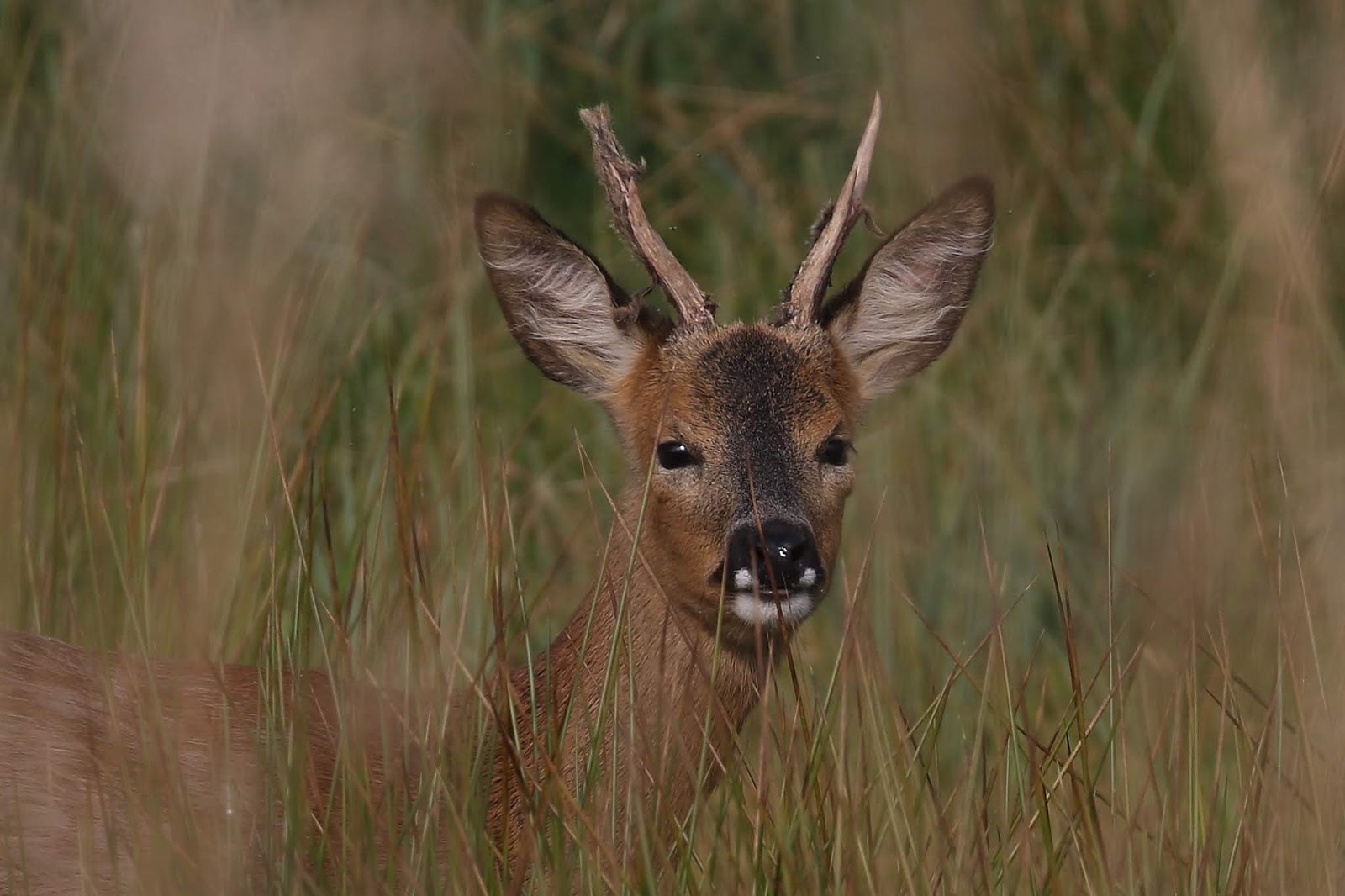
Roe Deer are often seen in the meadows around the gravel pits
Sandwich Terns sometimes fish on the River Frome
A few Whimbrel usually stop by on spring passage


Monday, 27 February 2017

Icelandic banker

Our recent half-term whistle stop tour of Cornwall saw me squeeze in some birding between visiting my god-daughter in Bodmin and friends in Falmouth, admiring the excellent National Maritime Museum at the latter among various other sights the county has to offer. One of the highlights was checking out a huge flock of gulls following the tractors of Polgigga as they made busy in the potato fields. Up to four Iceland Gulls had been reported in the area so I thought it would be a banker, but while I only caught up with one, at least it treated me to a close fly-past.
Iceland Gull at Arden-Sawah near Polgigga
I think a 2nd winter bird
Flying right overhead - note pale iris
Here with one of the tractors
It wasn't all as successful though. While at Bodmin, I nipped out to Dozmary Pool to see what I thought would be another banker - the long-staying, oft-returning drake Lesser Scaup. As you can see from the picture below, I couldn't see the pool, let alone the Lesser Scaup. A two hour wait by a hedge in the Nanjizal Valley looking for a Little Bunting was similarly unsuccessful, though at least there was no fog. Passing Choughs, a stunning male Hen Harrier and my first butterfly of 2017 - a Red Admiral - kept me entertained as I waited.
The sweeping vista of, er, fog at Dozmary Pool
Chough - one of a pair over Nanjizal
A male Hen Harrier hammered through Nanjizal
As is often the case it ploughed on without looking back
Red Admiral at Nanjizal
A bit of a rematch with another banker, the Hudsonian Whimbrel at Boat Cove, was successful, though it wasn't as close as on my visit this time last year. A few other waders were on the beach along with the mobile Whimbrel - soon to be downgraded from full species status as a result of changes to the British list.
Hudsonian Whimbrel at Boat Cove
Revealing the diagnostic all dark rump in flight
Grey Plover at Boat Cove
Curlew at Boat Cove
A couple of distant Red-throated Divers off Boat Cove
On the way home, after a bit of luck seeing an American Wigeon at Exminster without too much searching, there was just to time to take a short detour to look for a Little Bunting near Axminster. A couple of locals were looking for the Bunting when I arrived, and although it had been seen not long before, tales of them multiple dipping on this elusive bird did not leave me feeling very hopeful. The light was also fading, but with the rest of the family playing games on a variety of mobile devices in the car, I thought I would give it the last hour of daylight. After just half of this, a flock of previously unseen Reed Buntings flew up from the long grass, and as they alighted in the trees around me, one gave the distinctive ticking call of a Little Bunting. While it didn't exactly pose for a photo, I managed a couple of shots of it partially obscured by vegetation to cap off a good trip.
Little Bunting, Trinity Hill LNR near Axminster
It would not sit out in the open for me in a couple of brief views
This Reed Bunting was more obliging