Wednesday, 4 September 2013

Taking the Semi-P

A Semipalmated Sandpiper was found late on Sunday at Abbotsbury Swannery by Steve Groves and what was presumably the same bird relocated to Brownsea Island on Monday. This was possibly the first British rarity identified by webcam when Paul Morton picked it up on the well-positioned Birds of Poole Harbour camera in the Dorset Wildlife Trust reserve from his office in Poole. (Imagine the possibilities if I could rig one up at Swineham: I wouldn't even have to get up in the morning, I could just pan and zoom with a cup of tea in bed.)
Semipalmated Sandpiper
Back to the Semi-P, on which there was no news either way from Brownsea this morning, despite having Paul on webcam alert, so with the afternoon booked off I thought I had better go and look for myself in case it was skulking at the back of the lagoon and flew in to parade in front of the hide as it had done yesterday afternoon. As my foot touched the island's quay, and a cheery National Trust volunteer offered his greetings, the pager bleeped 'Dorset SEMIPALMATED SAND...'. Thoughts of 'Bingo!' were quickly dispelled when I read the rest of the message: '...Abbotstbury Swannery'.
Semipalmated Sandpiper with Dunlin behind - note size difference
I pressed on to the lagoon where I was able to satisfy myself that there was no chance of a second bird still on Brownsea, and resolved that an 'interesting small wader' which some visiting birders had been studying was a fairly regulation juvenile Dunlin. I considered baling and heading for Abbotsbury, concluding that to leave Brownsea on such a beautiful day would be criminal, and to then head to the other end of Dorset for a county-tick would just be ludicrous. Ludicrous, but not impossible...
Semi-P top left with Dunlin and Curlew Sandpipers
Arriving at one minute to four (last entry), I reasoned that it would be worth shelling out the entrance fee if the bird was in front of the Meadow Pool hide with the sun behind me, rather than viewing cheaply but distantly from the road into the sun. A good decision: it was walking directly in front of several grinning birders in the hide just as I walked in.

Curlew Sandpiper
 

Marine buoy

For reasons which remain unexplained, despite the passage of four decades, my older brother used to annoy the hell out of me at bedtime by singing the theme tune to popular '70s cartoon series Marine Boy over and over again. Observing the same dynamic at work in my own sons, I am forced to conclude that it was just for the sheer hell of annoying the hell out of me.

Sharing unresolved questions from childhood, however, was not why I lured you to this page. Rather, it was to impress upon you the fact that seabirds are not the only things to be seen from pelagic trips out of the Isles of Scilly, of which I sampled a few last month. I will attempt to illustrate this, in accordance with the custom and practice of this blog, via the medium of photographic images of variable quality, supported by captions with an equally variable likelihood of aiding your understanding of what they depict:
Ocean Sunfish: these large bony fish float just below the surface, sometimes weakly flapping a dorsal fin above the waterline, like a slightly inebriated, morbidly obese fish-damsel in distress 
Blue Shark: these are caught, tagged and released as part of a research project which has helped build a better picture of their highly migratory behaviour. This one was photographed as it was being landed...
...and here it is on deck. A Porbeagle Shark was also seen but not photographed unfortunately.
A pod of Common Dolphin was seen coming back into St Mary's one evening
A very difficult species to photograph as they move at such high speed - these my most successful efforts to date
Back on the beach at Porthcressa, this jellyfish stood out from the crowd - I think this is a Compass Jellyfish Chrysaora hysoscella
A pod of Bottle-nosed Dolphin crossed the path of the Scillonian III on the way out...


...and a pod of Common Dolphin, given away by a frenzy of plunge-diving Gannets, did the same on the way back, not far out of Penzance

Tuesday, 3 September 2013

YouTubenose

Millions of Egyptians concluded recently that democracy is not all it's cracked up to be. After the low turnout in my recent poll, it's tempting to agree with them. But then who am I to resist the will of the people who voted in their drove (singular) for more tales of seasickness and seabirds from my recent Scilly Pelagics out of St Mary's. So at the risk of subjecting the rest of you to the tyranny of the majority, here goes. Other posts to follow as promised.

Species of the trip has to be the Wilson's Petrel seen on Sunday 11th August. Bird of the trip though was probably this Great Shearwater which flew around the boat in good light and allowed a close approach thanks to some careful skippering by Joe Pender.
Difficult to get a sharp flight shot from a moving boat despite plenty of opportunity
This shot shows how the wing does actually shear the water
Shearwaters are meant to be seen in flight, but it was still good to get close to one sat on the sea
Note the pink legs which can be seen under the water
A close up of the elegant tubenose: shearwaters drink saltwater and therefore need to excrete excess salt, doing this via a salt gland which produces a saline solution that drips out of the nostrils, sometimes giving them a 'snotty-nosed' look. Not this one though, he'd just wiped.
I spent about 25 hours in total at sea on Sapphire, but it wasn't all snapping close-ups of Great Shearwaters. Long periods were spent steaming to likely locations or drifting and chumming while not much happened. As the boat sloshed around in the swell and the sun bore down I had a barely suppressible urge to start singing Farewell and Adieu to you Fair Spanish Ladies as per Robert Shaw in 'Jaws'...Next in the photo round-up, the three other species of Shearwater which were also seen.
Manx Shearwater - by far the commonest Shearwater encountered...
...Sooty Shearwaters were seen in small numbers, this one banking to reveal the silvery underwing...
...and Balearic Shearwater, taking off to reveal the typical pot-bellied profile
During one lengthy period of inactivity, I thought I must have imbibed too much seawater myself as I was sure I could hear the theme tune to 'Pirates of the Carribean' coming from the bows. Then someone punctured to hallucination: 'Phone's ringing, Joe'.
This Balearic was with a raft of Manxies just off St Mary's one evening
Balearic Shearwater
A Manx taking off from the same raft
And a Sooty in amongst the Manxies
Speaking of pirates, piratical is a word often used to describe members of the Skua family, two species of which were seen - Great and Pomarine. Only one Pom, but Greats often turned up when there were large flocks of Gulls to be harassed.
Great Skuas - a.k.a. 'Bonxies' - were seen fairly regularly
A bulky presence
Unfortunately this much rarer Pomarine Skua was almost past us before I got the camera on it - the 'spoon' on the tail can just be seen though
All told I thoroughly enjoyed the pelagics, and more than I thought I would. I'm an impatient seawatcher, but there's not much else to do when you're out there, so I was a captive audience for once.
Gannets often followed the Sapphire, especially when we dragged a bag of fish guts along behind
They would typically announce their arrival with a raucous call before stalling and plunge diving into the wake
Gannets of all ages and plumages were seen
We didn't see everything we had hoped to see - Cory's Shearwater being the main gap in the trip list - but we saw everything else very well and at least I have a good excuse to go again some time. The family also enjoyed being on St Mary's with all the shops, cafes and bars open - it's all got a bit 'ghost town' during our normal half-term holiday in October.
Fulmar - another tubenose, this one sporting the snot-nosed look to good effect
Fulmars were often alongside or following the boat
As these pictures suggests, we enjoyed a variety of light conditions, and I found a slightly flatter light better for many of the birds with contrasting dark and white plumages which might otherwise have been over-exposed by my sloppy technical abilities with the camera.
Great Black-backed Gulls were usually present among the larger flocks, although...
Lesser Black-backed Gulls were the commonest gull following the boat
Kittiwakes often followed the boat, most showing signs of moult and not at their usual smart best
I should close with a big thank you to tour leaders Bob Flood and Ashley Fisher, skipper Joe Pender, Higgo and other regulars whose names I didn't know but who helped out with chumming, bird-finding and all round general entertainment. These trips may not be for the faint hearted, but still come highly recommended.
Storm Petrels are closely related to Shearwaters...
..but much harder to photograph due to their small size and rapid, bat-like flight.


Sunday, 1 September 2013

Home Alone II

More photos from last weekend spent Home Alone. Like most sequels, shorter, and with an even thinner plot line. Ferrybridge is always worth a stop for waders:
Ringed Plover
Turnstone
Dunlin
Sanderling - a juvenile, photographed in evening light
Balearic Shearwaters have been moving past Portland Bill - this photo helps explain why I am such an impatient seawatcher
A Wasp Spider was doing what it says on the tin at Radipole Lake - despatching a wasp
Fancied a change of scene on Bank Holiday Monday so headed for Pennington Marshes in Hampshire where Curlew Sandpipers were among the waders I hoped to see - two were present
The Butts Lagoon is fringed with vegetation, but there is one small gap giving a clear view from the path to the exposed mud and shallows where waders were feeding, so I sat there and waited
Eventually the Curlew Sands - both scaly juvs - honed into view
While focused on the Curlew Sands I became aware of something closer in my peripheral vision - first one, then two previously unnoticed Little Stint had walked across the gap
This view shows the prominent white stripes down the back which help identify this as a juvenile Little Stint
A tiny wader, I don't think I've been this close to one before
Whimbrel was near the Keyhaven end of Pennington Marshes
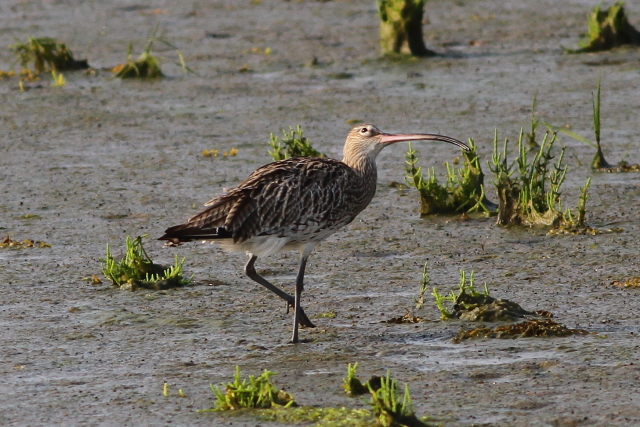
Whimbrel
Also a Curlew there...
...and a small flock of Black-tailed Godwit