Showing posts with label Curlew. Show all posts

Tuesday, 13 March 2018

A look back at the beast

In the excitement of blogging about patch Hawfinches, I almost forgot to recount everything else I saw during the cold snap in the Swineham/Wareham area a couple of weekends ago. In truth, there was nothing spectacular, but plenty of common or scarce species were turning up in unusual locations, some surprisingly easy to see as the harsh conditions forced them into gardens or otherwise into the open in the search for sustenance. The highlights were a Firecrest in my postage stamp of a town centre garden, and an icicle-clad Spoonbill on the main gravel pit at Swineham. Sadly, two of this last species were found dead in recent days in Dorset: one had presumably succumbed to the cold, the other, which had two broken legs, was thought possibly to have snapped them trying to free itself from ice. An illustration of the harsh impacts of the freeze which, judging by the death toll chronicled on social media, befell many individual birds over the course of a few days. And a reminder to put some food out for the garden birds if the coming weekend's forecast of snow materialises.
Adult Spoonbill - I have never seen one with icicles on the breast feathers.
Black-tailed Godwit, one of several hundred on the frozen fields at Bestwall.
A few dozen Curlew were also present.
Fieldfares were in the gardens of Wareham.
Redwings were everywhere, including my town centre garden and this one in the town's churchyard.
Blackbirds were among the other thrushes in the churchyard.
Normally shy Song Thrushes seemed unusually bold in the cold.
Not a great view of a Water Rail - but any view is a good view in the thick reeds at Bestwall. This was one of three of this species out in the open.
This was the only reasonably sharp photograph of the Firecrest in my garden I could manage, snatched through foggy glass with shaking hands!
The first time I have seen ice floes coming up the River Frome!
Swineham Point inundated by a very high tide - Redshanks, Skylarks, Meadow and Rock Pipits were attempting to feed on the ice here.

Within hours of the last snowflake, the onset of spring seemed to resume: temperatures were back up to double figures and this Dunnock was belting out song as if to declare it had survived the harsh conditions.

Monday, 23 October 2017

Shetland day 8: Buffy & The Damp Pie Slayer

While we were on Unst on 4th October, news had broken of an American Buff-bellied Pipit back at Grutness on the Mainland. On the morning of the 5th, after a mooch around Hoswick, we headed there for probably the closest and most extended views of any of the rare birds seen during our nine day stay. All the while Shetland entertained us with its unfamiliar place names, and we amused ourselves with word play around them when the birding was quiet. We checked out gardens at Gardins, got Parrot Crossbills at Gott, an Otter at Gutcher and nothing at Noness.
Here's Buffy: the American Buff-bellied Pipit at Grutness...
...and here's the Damp Pie Slayer: Howard at Gott. If the marketing folks at Swarovski Optic, or indeed the Scalloway Meat Company, would like to feature this guy modelling their wares, please contact me to discuss my commission.
The Pipit was sheltering from the strong winds in the lee of a low wall against which we were leaning
'Dark legs my arse' said a gruff voice beside me. It was Bob, passing a caustic comment on the Collins Guide description of Buff-bellied Pipit in winter plumage
We enjoyed amazing views down to about six feet
The settlement of Gord, of which there were two, provided particularly good value: every time we approached we had found Gord; every time we left we had forsaken Gord. When we stumbled across the second one we concluded that Gord moved in mysterious ways, and wondered how we would break the news to the devout that there was more than one true Gord. The pun-making threatened to get out of hand at times, and the less said about the anagram competition based on the 'Cunningsburgh Rustic Bunting', the better (we failed to see that bird on three occasions).
For those who like that sort of thing, the next few photos highlight some identification features as per Van Duivendijk: grey-brown upperparts with only faint streaking...
...complete pale eye-ring, pale lore and distinct supercilium
Centre of tertials and tail-feathers very dark and contrasting with rest of upperparts
Slender, Meadow Pipit-like bill

Breast well-marked with short, well-defined streaks
At a more culturally sensitive level, evocative names like Veensgarth and Halligarth were a reminder of Shetland's Old Norse heritage, while from more recent history, other road signs conjured up images of famous rarities which had graced the islands: the Levenwick Siberian Rubythroat, the Baltasound Cape May Warbler and of course the Uyaesound Siberian Thrush, co-found by my travelling companions the previous year.

One of the best birds seen in our nine day stay on Shetland

Snow Bunting at Sumburgh Head

Like the Pipit, the Bunting was being buffeted by strong winds


Snow Bunting against the dry stone walls of Sumburgh Head
After a couple of sessions watching the Buff-bellied Pipit at point blank range, we headed up to Sumburgh Head again where a Snow Bunting had been reported. A gale was seriously ruffling the feathers of this skittish bird, but we managed to photograph it from the car window. After a scan of the waders at Pool of Virkie, we ended another rewarding day with a trio of Slavonian Grebes at Boddam, home of the Pink Panther (Boddam. Boddam. Boddam, Boddam, Boddam, Boddam, Bodd-aaaaaaam-diddle-diddle-dam...).
Curlew at Sumburgh Head
Shag at Grutness
Slavonian Grebe - one of three at Boddam
The famous Sumburgh Head lighthouse

Sunday, 22 October 2017

Shetland Day 7: far from the madding crowd

We decided on an off-island excursion on our 7th day on Shetland - to Unst, the most northerly inhabited island in the UK, where we could get away from the hordes of literally, er, tens of birders on the Mainland. The forecast, and a report of an Olive-backed Pipit, suggested that we should stop at the Kergord Plantation en route before leaving the Mainland, one of the largest areas of woodland on Shetland.
Otter on Yell while waiting for the ferry to Unst
The Otter surfaced with a fish then vanished
Seeing trees on both sides of the road is a rarity on Shetland: this is Kergord
Although Howard got a brief view of the OBP, the rest of us didn't see it, but compensation came when we each independently heard, and subsequently saw, another small group of Parrot Crossbills in the plantation. These attracted another massive crowd of at least three birders, so we set off again on the quest to get as far from the madding crowd as possible.
A female Parrot Crossbill to go with the males from the previous day
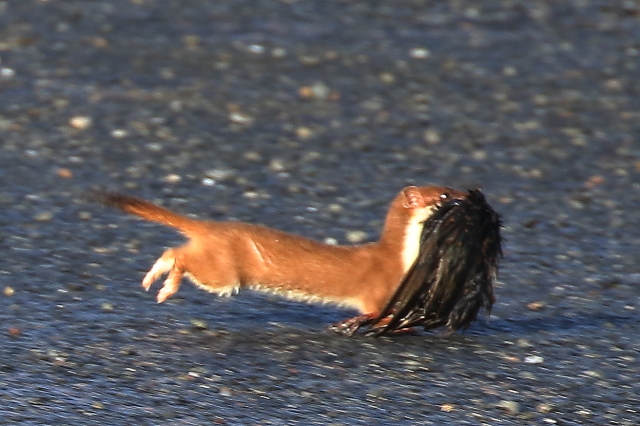
Stoat with Starling as we waited for the ferry to Yell
And this is the ferry to Yell
Speaking of Thomas Hardy, Rustic Bunting may sound like something the townsfolk hang out on May Day in one of his novels, but it is in fact an attractive vagrant from the east. News of one at Lower Voe persuaded us to make a short detour before heading for the ferry. Time was short, but the Bunting was feeding on the roadside as we arrived and was soon flushed by a passing car, assuaging our guilt at ticking-and-running.

Rustic Bunting at Lower Voe
Strikingly white underparts
Thus Ruff was feeding near the Otter
We then hit a lucky streak with Shetland mammals - first a Stoat surprised us by running across the road with a Starling in its mouth as we waited for the ferry to Yell, then an Otter surfaced holding a fish as we waited for the ferry to Unst.
A couple of Bonxies at Skaw on Unst
Curlew on Unst
The cliffs and sea at Skaw were carpeted with Shag. No pun intended.
The main target on Unst was a Red-throated Pipit which had been present for several days. We arrived as another carload of birders was leaving, and they advised us to comb the grassland above the beach at Skaw to search for the elusive pipit. A short distance from the car, a Pipit flushed out of the grass in font of us and sat up on a post.
An attractive graveyard on Unst
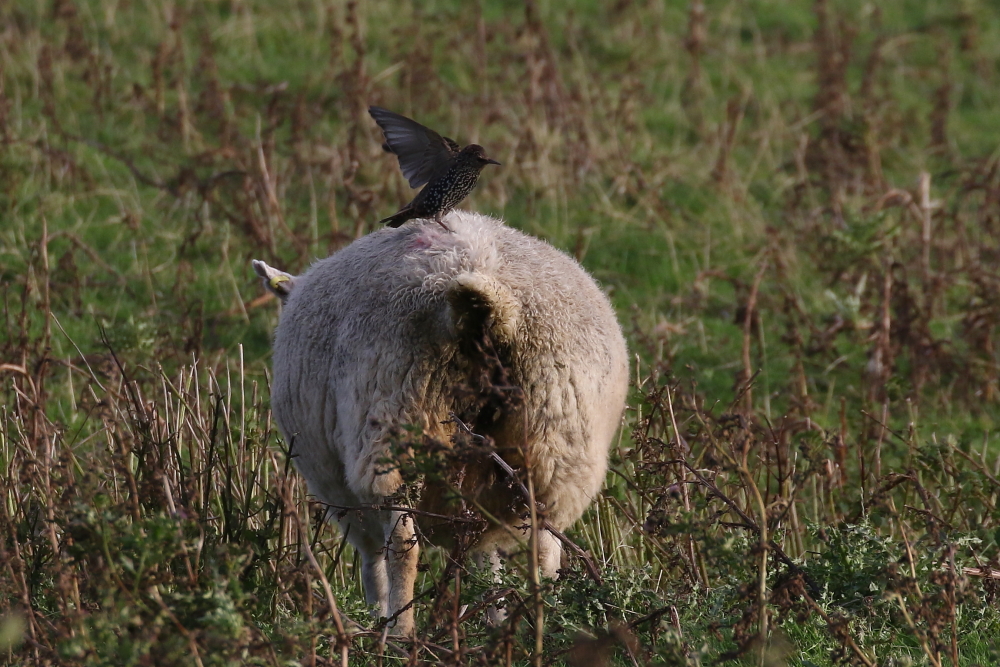
Well at least it's an anagram of 'Starling on sheep's ears' 
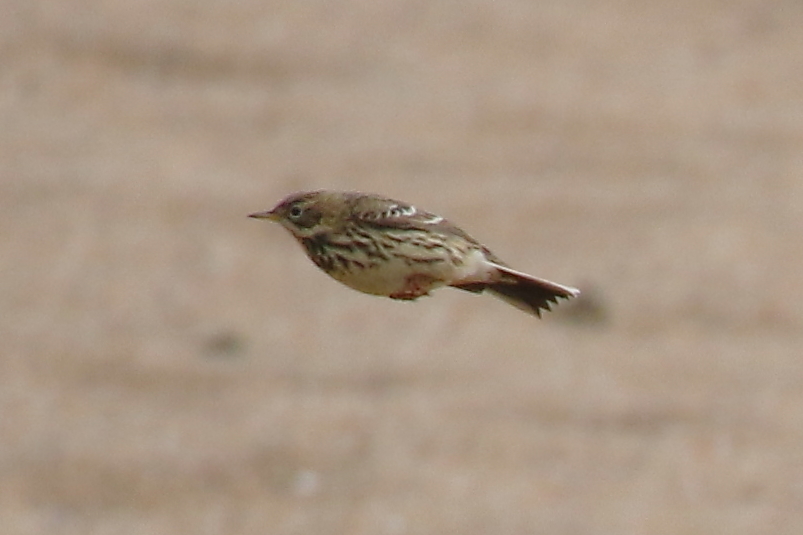
We stalked this Pipit at Skaw hoping it was the Red-throated, but photos revealed it to be a Tree Pipit
We instinctively raised our binoculars, expecting a Meadow Pipit, and had a good view at close range before it flew again. Then we all looked at each other: 'That had bright mantle stripes'. 'Yeah, and a yellow base to the bill'. 'Well that was it then!' Too easy! I kicked myself for not grabbing a photograph of the bird at point blank range, and though we attempted to refind it, it had flown beyond a wall into a private garden, and did not look like reappearing.
After burying itself in the grass the Red-throated Pipit eventually came out on the beach 
Clean whitish underparts
A better view of the pale mantle stripes and fine bill with yellow base
The weather had taken a turn for the worse by this point, and we turned to leave - no sooner had we done so than the Pipit reappeared. It was flighty but after sweeping the area with another group of visiting birders we eventually pinned it down for some photos on the beach and in the long grass beyond. 
A rear view of the pale mantle stripes
The best of a bad lot of Red-throated Pipit flight shots
Yet another Redstart - this the most obliging of the lot

The rest of the day was spent birding Unst, the highlight being a White-tailed Eagle which an observant soul had picked up perched on a distant hillside. A great excursion and a welcome bit of peace and quiet before returning to the seething metropolis of Hoswick.
The Popemobile: they pushed the boat out when His Eminence visited Shetland

Record shot of a very distant White-tailed Eagle
The long road home to Mainland Shetland