Showing posts with label Iceland Gull. Show all posts

Monday, 10 January 2022

We go again

Several friends have asked me 'what now?' after I put quite a lot of time and effort into a non-motorised year list in 2021. I doubt I will be able to repeat seeing 224 species in 2022 - only the combination of working mostly from home, neglecting domestic obligations, and benefitting from a belting spring for migrant birds in Dorset made that possible. But I certainly don't intend to stop birding locally by bike, and for several reasons. 

First, although I've never really had to watch my weight too much, as I edge closer to the next age range up on the census form (55-65), the exercise is proving necessary to keep it at a level I am comfortable with without having to make unwelcome changes to my diet (regular readers will be aware of my fondness for chips). Second, it's become an essential part of maintaining good mental as well as physical health - the endorphins really do kick in quickly when I get going these days, and the buzz of seeing a target species at the end of a long ride is surprisingly more satisfying compared to if I'd driven. Third, it's just become my preferred mode of birding locally: with some superb areas accessible by bike nearby but not by car, it takes me to places I might not otherwise get, giving a real sense of freedom. And I can't get the bike over the now locked gate at my Swineham patch any more, so cycling gives me a good excuse to neglect that as well ;-).

There are also the obvious environmental advantages compared to driving. I try not to bang on about them (I'll save that for the day job), but even if you aren't concerned about that low carbon/end-of-life-on-earth-as-we-know-it stuff there are other more direct impacts to worry about. To give just one example, on my travels at lower speeds last year I became visibly aware of the toll taken by vehicles in the form of roadkill. There were of course copious numbers of 'invasives' splattered on the roads - Grey Squirrels and, in these parts, Sika Deer, whose loss won't be mourned too much. But I also saw my first eared bat (of any kind, alive or dead) on the roadside, numerous thrushes, warblers and tits, a native Roe Deer and, most recently a dead Otter. So any reduction in that risk, however marginal, has got to be good too.

Anyway, as I say, I can't see myself reaching the dizzy heights of the 220s again this year in terms of the list - but with a few good wintering species lingering into the New Year in Dorset I thought I'd better sweep them up just in case. I'm nowhere near last January's total in terms of species, but while I clocked up about 120 miles in the first month of 2021, so far in 2022 I've done about 145 - so above par on that score at least. A few highlights of the year to date below.
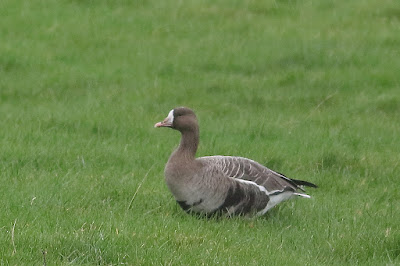
New Year's Day saw me heading west to Charminster, a very wet 40 mile round trip, to see a flock of 11 Russian White-fronted Geese

The Charminster White-fronts were a lot closer than the flock I saw at Hampreston in December - and accessible via one of the best bits of cycle path in Dorset!
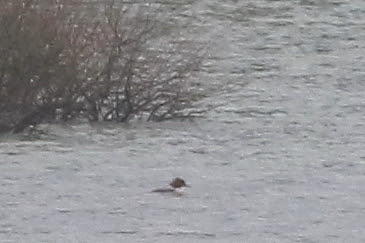
A short detour to Silverlake on the way home enabled distant scope views of a redhead Goosander - a species I didn't see until August last year. It was a long way off!
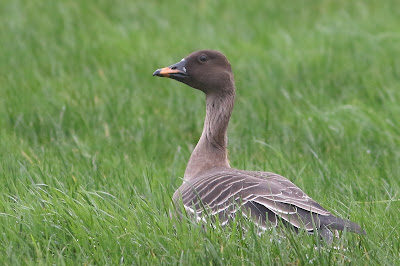
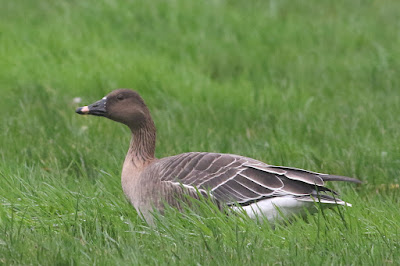
When I got back to Wareham from Silverlake, I knew the Tundra Beans were still at Upton - but for how much longer? I pressed on, adding another 15 miles to the journey, and saw them in fading light.
A good job I did - they were gone the next day
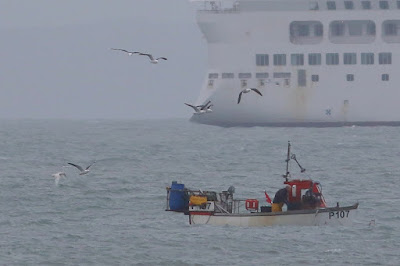
Iceland Gull as it should be seen: following a fishing boat miles out in a windswept bay (far left-hand bird). I really should have visited the Preston chippy on the way down and thrown some out to tempt it closer! Not the greatest of views, and not the nicest of journeys to Weymouth either, but a good bird to have under the belt in 2022. 

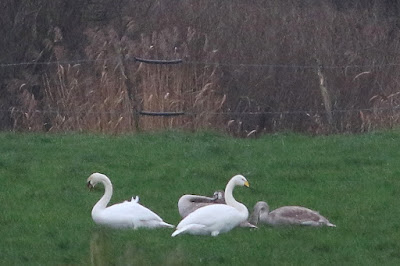
This Saturday took me back to Hampreston (another 30 miles in yet more foul weather) where the wintering Whooper Swan was still present
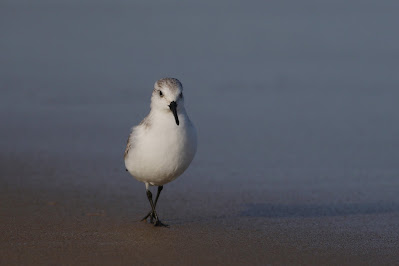
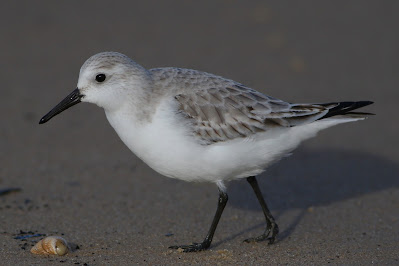
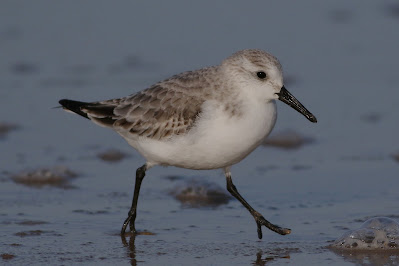
Sunday brought what felt like the first sunshine of 2022, and the lure of Studland proved irresistable despite heavy legs from the day before. Sanderling on the beach was my first of the year.
I like the shell adding a dash of colour to this picture
Studland also produced my first Scaup, Slavonian Grebe, Black-necked Grebe and Goldeneye of 2022

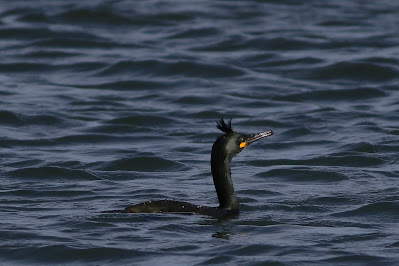
A bottle-green Shag looking glorious in the sunlight at Studland

Monday, 27 February 2017

Icelandic banker

Our recent half-term whistle stop tour of Cornwall saw me squeeze in some birding between visiting my god-daughter in Bodmin and friends in Falmouth, admiring the excellent National Maritime Museum at the latter among various other sights the county has to offer. One of the highlights was checking out a huge flock of gulls following the tractors of Polgigga as they made busy in the potato fields. Up to four Iceland Gulls had been reported in the area so I thought it would be a banker, but while I only caught up with one, at least it treated me to a close fly-past.
Iceland Gull at Arden-Sawah near Polgigga
I think a 2nd winter bird
Flying right overhead - note pale iris
Here with one of the tractors
It wasn't all as successful though. While at Bodmin, I nipped out to Dozmary Pool to see what I thought would be another banker - the long-staying, oft-returning drake Lesser Scaup. As you can see from the picture below, I couldn't see the pool, let alone the Lesser Scaup. A two hour wait by a hedge in the Nanjizal Valley looking for a Little Bunting was similarly unsuccessful, though at least there was no fog. Passing Choughs, a stunning male Hen Harrier and my first butterfly of 2017 - a Red Admiral - kept me entertained as I waited.
The sweeping vista of, er, fog at Dozmary Pool
Chough - one of a pair over Nanjizal
A male Hen Harrier hammered through Nanjizal
As is often the case it ploughed on without looking back
Red Admiral at Nanjizal
A bit of a rematch with another banker, the Hudsonian Whimbrel at Boat Cove, was successful, though it wasn't as close as on my visit this time last year. A few other waders were on the beach along with the mobile Whimbrel - soon to be downgraded from full species status as a result of changes to the British list.
Hudsonian Whimbrel at Boat Cove
Revealing the diagnostic all dark rump in flight
Grey Plover at Boat Cove
Curlew at Boat Cove
A couple of distant Red-throated Divers off Boat Cove
On the way home, after a bit of luck seeing an American Wigeon at Exminster without too much searching, there was just to time to take a short detour to look for a Little Bunting near Axminster. A couple of locals were looking for the Bunting when I arrived, and although it had been seen not long before, tales of them multiple dipping on this elusive bird did not leave me feeling very hopeful. The light was also fading, but with the rest of the family playing games on a variety of mobile devices in the car, I thought I would give it the last hour of daylight. After just half of this, a flock of previously unseen Reed Buntings flew up from the long grass, and as they alighted in the trees around me, one gave the distinctive ticking call of a Little Bunting. While it didn't exactly pose for a photo, I managed a couple of shots of it partially obscured by vegetation to cap off a good trip.
Little Bunting, Trinity Hill LNR near Axminster
It would not sit out in the open for me in a couple of brief views
This Reed Bunting was more obliging

Wednesday, 21 December 2016

April...

I'm not sure I am going to get through this review of the year at this rate, so expect increasingly frequent and more badly drafted posts from this point on as I seek to catch up. The highlight of April 2016 for me was a family holiday in Scotland, in a divine cottage on the shores of Loch Creran. Divers, Tysties and Eiders from the garden made for a special location, and a bit of Scottish nightlife was on show too thanks to the moth trap. Despite some typically dreich weather, the birdlife in Oban Harbour provided plenty to photograph:
Black Guillemot, Oban Harbour: my photo, and bird, of the month for April
Iceland Gull, Oban Harbour
Hooded Crow, Oban Harbour
On returning from Scotland, spring migration was in full flow in Dorset - I was able to photograph an approachable Hoopoe, a more elusive Bluethroat and a positively coy Western Subalpine Warbler on the same memorable day on Portland:
Hoopoe, Portland
Western Subalpine Warbler, Portland
White-spotted Bluethroat, Portland
Closer to home spring also produced some good birds around Purbeck: Nightingales returning to their traditional breeding site on the Corfe Ridge, Hobbies hawking over Stoborough Heath and, one of the patch highlights of the year, a strikingly summer-plumaged Bar-tailed Godwit at Swineham.
Nightingale
Hobby, Stoborough Heath
Bar-tailed Godwit, Swineham
 

Monday, 11 April 2016

Urban birding, Oban style

As I discovered when I lived there a few years ago, Poole can be pretty good for urban birding, but Oban in Agyll & Bute, from where we have just returned after a week's holiday, takes some beating. I stumbled across Black Guillemots breeding in the harbour wall there on my first visit many years ago, and have often detoured to look for them on trips up the west coast of Scotland ever since. They are invariably in the harbour somewhere, but not always close in to the harbour wall, this being seemingly dependent on the state of the tide, their mood and, judging by several visits last week, the prevailing levels of testosterone in the colony!
Weather also seemed to have an impact on whether the Tysties were close in to the harbour wall - or perhaps it was just that every time I visited it was hammering down! This added to the challenge of trying to get the correct exposure on dark birds with white wing patches on shimmering water, as if that wasn't challenging enough. But it was certainly fun trying and several wet hours were well spent doing precisely that. Lovely birds, in stunning plumages and full of character.
Oban harbour in winter is also a good place to find rarer gulls - I bumped into a Ring-billed Gull on an earlier visit, and this week a peek over the harbour wall was rewarded with eye-ball to eye-ball views of a 1st winter Iceland Gull. This seemed content to potter around in the shallows and wait for the fine-smelling produce to be dispensed from the local chip shop. I knew how it felt, and eventually dragged myself away to grab a bag of Oban's finest.
After the velvet Black Guillemot and snow white Iceland Gull, Oban's third good harbour bird was somewhere in between - the Hooded Crow. A small flock of these, now regarded as a separate species from the closely related Carrion Crown with which it shares a hybrid zone across parts of Scotland, was feeding on the beach. They were picking up molluscs, then taking off and gaining height before dropping them to break the shells and get at the soft meat inside. I spent a while trying to capture this interesting and intelligent behaviour on film.
A great location for urban birding, and Claire eventually became suspicious at my uncharacteristic and repeated suggestions that we pop into town for a spot of shopping.