Showing posts with label Shag. Show all posts

Monday, 10 January 2022

We go again

Several friends have asked me 'what now?' after I put quite a lot of time and effort into a non-motorised year list in 2021. I doubt I will be able to repeat seeing 224 species in 2022 - only the combination of working mostly from home, neglecting domestic obligations, and benefitting from a belting spring for migrant birds in Dorset made that possible. But I certainly don't intend to stop birding locally by bike, and for several reasons. 

First, although I've never really had to watch my weight too much, as I edge closer to the next age range up on the census form (55-65), the exercise is proving necessary to keep it at a level I am comfortable with without having to make unwelcome changes to my diet (regular readers will be aware of my fondness for chips). Second, it's become an essential part of maintaining good mental as well as physical health - the endorphins really do kick in quickly when I get going these days, and the buzz of seeing a target species at the end of a long ride is surprisingly more satisfying compared to if I'd driven. Third, it's just become my preferred mode of birding locally: with some superb areas accessible by bike nearby but not by car, it takes me to places I might not otherwise get, giving a real sense of freedom. And I can't get the bike over the now locked gate at my Swineham patch any more, so cycling gives me a good excuse to neglect that as well ;-).

There are also the obvious environmental advantages compared to driving. I try not to bang on about them (I'll save that for the day job), but even if you aren't concerned about that low carbon/end-of-life-on-earth-as-we-know-it stuff there are other more direct impacts to worry about. To give just one example, on my travels at lower speeds last year I became visibly aware of the toll taken by vehicles in the form of roadkill. There were of course copious numbers of 'invasives' splattered on the roads - Grey Squirrels and, in these parts, Sika Deer, whose loss won't be mourned too much. But I also saw my first eared bat (of any kind, alive or dead) on the roadside, numerous thrushes, warblers and tits, a native Roe Deer and, most recently a dead Otter. So any reduction in that risk, however marginal, has got to be good too.

Anyway, as I say, I can't see myself reaching the dizzy heights of the 220s again this year in terms of the list - but with a few good wintering species lingering into the New Year in Dorset I thought I'd better sweep them up just in case. I'm nowhere near last January's total in terms of species, but while I clocked up about 120 miles in the first month of 2021, so far in 2022 I've done about 145 - so above par on that score at least. A few highlights of the year to date below.

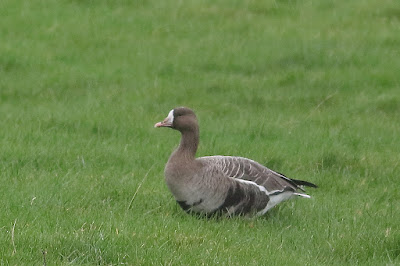
New Year's Day saw me heading west to Charminster, a very wet 40 mile round trip, to see a flock of 11 Russian White-fronted Geese

The Charminster White-fronts were a lot closer than the flock I saw at Hampreston in December - and accessible via one of the best bits of cycle path in Dorset!
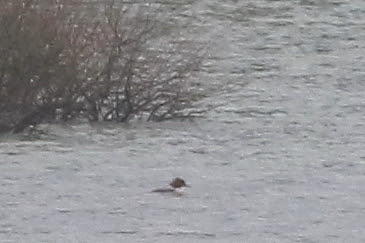
A short detour to Silverlake on the way home enabled distant scope views of a redhead Goosander - a species I didn't see until August last year. It was a long way off!
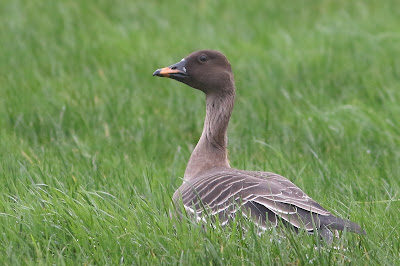
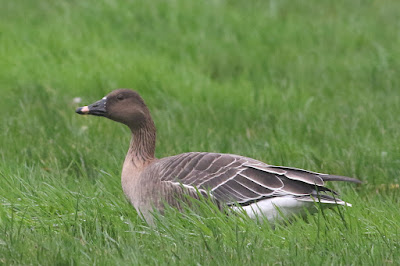
When I got back to Wareham from Silverlake, I knew the Tundra Beans were still at Upton - but for how much longer? I pressed on, adding another 15 miles to the journey, and saw them in fading light.
A good job I did - they were gone the next day
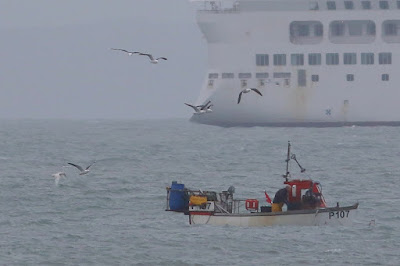
Iceland Gull as it should be seen: following a fishing boat miles out in a windswept bay (far left-hand bird). I really should have visited the Preston chippy on the way down and thrown some out to tempt it closer! Not the greatest of views, and not the nicest of journeys to Weymouth either, but a good bird to have under the belt in 2022. 

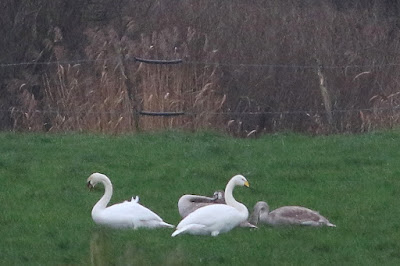
This Saturday took me back to Hampreston (another 30 miles in yet more foul weather) where the wintering Whooper Swan was still present
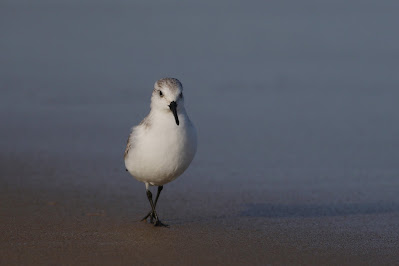
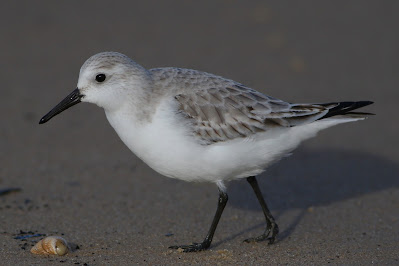
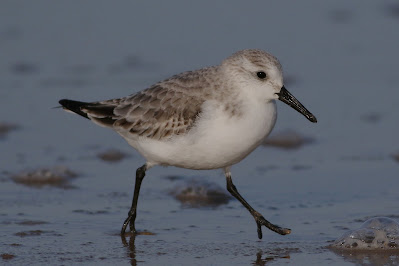
Sunday brought what felt like the first sunshine of 2022, and the lure of Studland proved irresistable despite heavy legs from the day before. Sanderling on the beach was my first of the year.
I like the shell adding a dash of colour to this picture
Studland also produced my first Scaup, Slavonian Grebe, Black-necked Grebe and Goldeneye of 2022

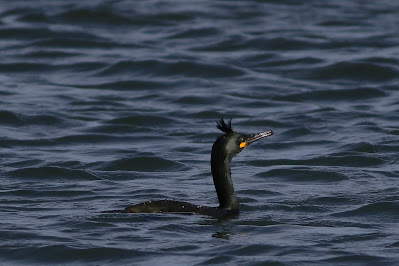
A bottle-green Shag looking glorious in the sunlight at Studland

Sunday, 22 October 2017

Shetland Day 7: far from the madding crowd

We decided on an off-island excursion on our 7th day on Shetland - to Unst, the most northerly inhabited island in the UK, where we could get away from the hordes of literally, er, tens of birders on the Mainland. The forecast, and a report of an Olive-backed Pipit, suggested that we should stop at the Kergord Plantation en route before leaving the Mainland, one of the largest areas of woodland on Shetland.
Otter on Yell while waiting for the ferry to Unst
The Otter surfaced with a fish then vanished
Seeing trees on both sides of the road is a rarity on Shetland: this is Kergord
Although Howard got a brief view of the OBP, the rest of us didn't see it, but compensation came when we each independently heard, and subsequently saw, another small group of Parrot Crossbills in the plantation. These attracted another massive crowd of at least three birders, so we set off again on the quest to get as far from the madding crowd as possible.
A female Parrot Crossbill to go with the males from the previous day
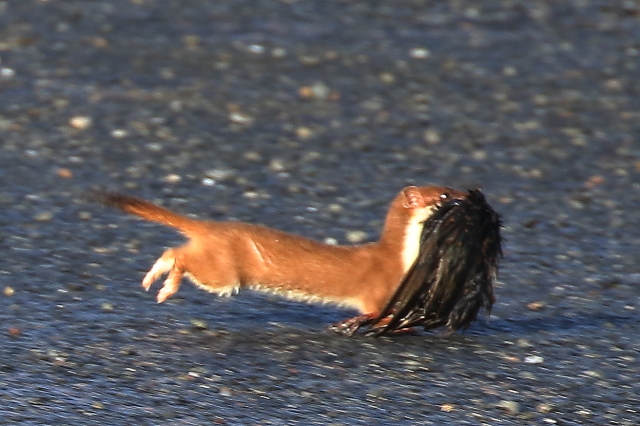
Stoat with Starling as we waited for the ferry to Yell
And this is the ferry to Yell
Speaking of Thomas Hardy, Rustic Bunting may sound like something the townsfolk hang out on May Day in one of his novels, but it is in fact an attractive vagrant from the east. News of one at Lower Voe persuaded us to make a short detour before heading for the ferry. Time was short, but the Bunting was feeding on the roadside as we arrived and was soon flushed by a passing car, assuaging our guilt at ticking-and-running.

Rustic Bunting at Lower Voe
Strikingly white underparts
Thus Ruff was feeding near the Otter
We then hit a lucky streak with Shetland mammals - first a Stoat surprised us by running across the road with a Starling in its mouth as we waited for the ferry to Yell, then an Otter surfaced holding a fish as we waited for the ferry to Unst.
A couple of Bonxies at Skaw on Unst
Curlew on Unst
The cliffs and sea at Skaw were carpeted with Shag. No pun intended.
The main target on Unst was a Red-throated Pipit which had been present for several days. We arrived as another carload of birders was leaving, and they advised us to comb the grassland above the beach at Skaw to search for the elusive pipit. A short distance from the car, a Pipit flushed out of the grass in font of us and sat up on a post.
An attractive graveyard on Unst
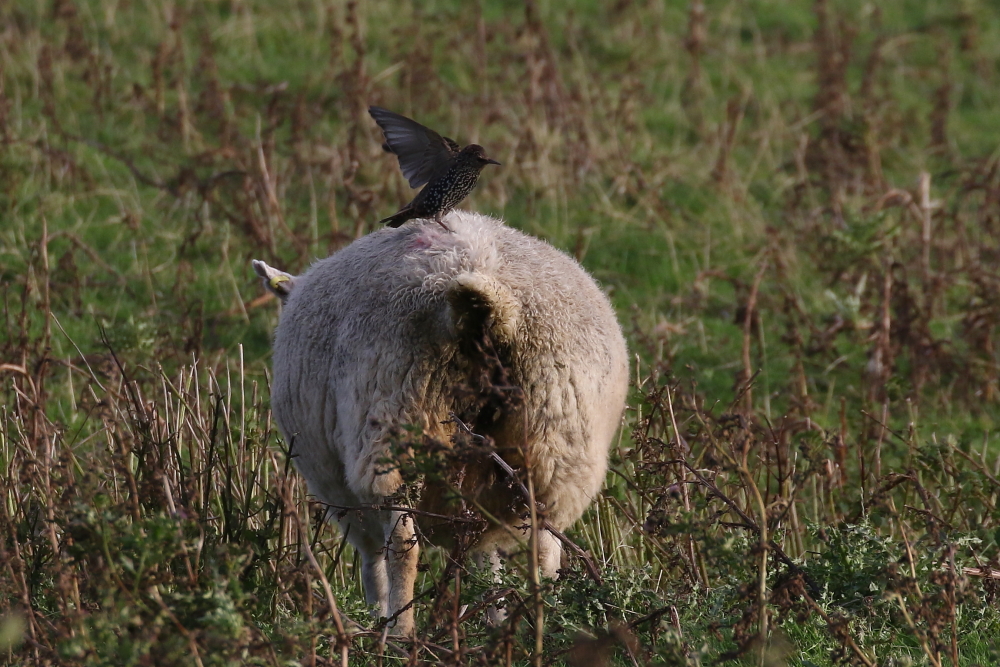
Well at least it's an anagram of 'Starling on sheep's ears' 
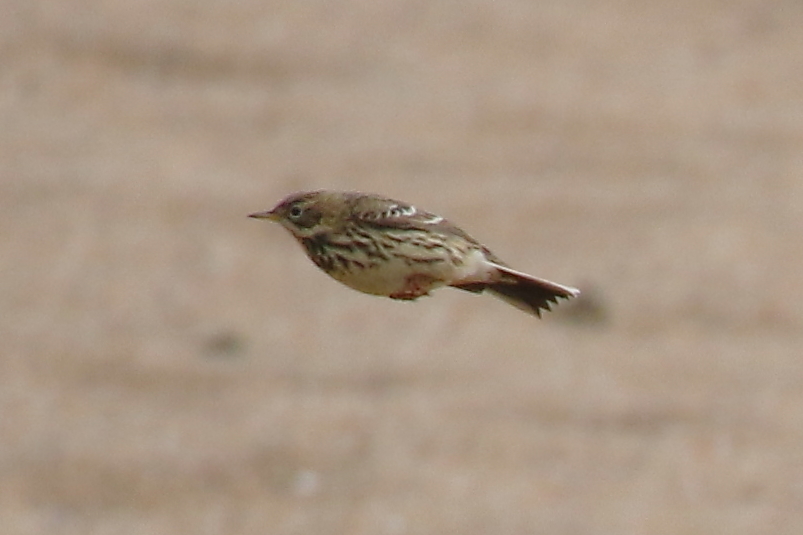
We stalked this Pipit at Skaw hoping it was the Red-throated, but photos revealed it to be a Tree Pipit
We instinctively raised our binoculars, expecting a Meadow Pipit, and had a good view at close range before it flew again. Then we all looked at each other: 'That had bright mantle stripes'. 'Yeah, and a yellow base to the bill'. 'Well that was it then!' Too easy! I kicked myself for not grabbing a photograph of the bird at point blank range, and though we attempted to refind it, it had flown beyond a wall into a private garden, and did not look like reappearing.
After burying itself in the grass the Red-throated Pipit eventually came out on the beach 
Clean whitish underparts
A better view of the pale mantle stripes and fine bill with yellow base
The weather had taken a turn for the worse by this point, and we turned to leave - no sooner had we done so than the Pipit reappeared. It was flighty but after sweeping the area with another group of visiting birders we eventually pinned it down for some photos on the beach and in the long grass beyond. 
A rear view of the pale mantle stripes
The best of a bad lot of Red-throated Pipit flight shots
Yet another Redstart - this the most obliging of the lot

The rest of the day was spent birding Unst, the highlight being a White-tailed Eagle which an observant soul had picked up perched on a distant hillside. A great excursion and a welcome bit of peace and quiet before returning to the seething metropolis of Hoswick.
The Popemobile: they pushed the boat out when His Eminence visited Shetland

Record shot of a very distant White-tailed Eagle
The long road home to Mainland Shetland

Wednesday, 7 June 2017

A fluke encounter

Whilst on holiday on the west coast of Scotland recently we pawned wedding rings and our first born to fund a whale watching trip out of Gairloch with the excellent Hebridean Wildlife Cruises. Within an hour we had made contact with a Minke Whale just beyond the mouth of the mighty sea loch.
The snout breaks the surface first in the Minke Whale's dive sequence
I didn't expect to be photographing Whale nostrils last week!
Then a long body roll...
...revealing the bulk of the animal and a sharply curved dorsal fin
A more distant view
A big beast, we could see the white sides as it came close to the boat
Minke Whale seen here with the mountains of Wester Ross in the background
The first sighting was distant, but the inquisitive Minke took everyone's breath away by surfacing just yards from the rib. A second individual was seen before we headed out across The Minch for a close look at the Shiant Islands.
A throng of Auks at the base of the cliffs on the Shiant Islands 
Over 60,000 pairs of Puffin breed on the Shiants...
...plus over 10,000 pairs of Razorbill...
...18,000 pairs of Guillemot (this one a Bridled Guillemot)...
...and 1,700 pairs of Shag
Razorbill in flight
Razorbill just getting airborne
I was fortunate enough to land here back in 1999, and although we could not leave the rib on this trip, it was great to return to find the huge colonies of Puffins and other auks apparently still doing well. The 'Enchanted islands', which are closer to Lewis than the mainland, hold approximately 10% of the UK's breeding Puffins and 7% of its Razorbills so they really are a vitally important location for seabirds.
A few pairs of Great Skua breed on the islands
A menacing presence for the other seabirds
Common Dolphin in The Minch
Grey Seals inspected our boat closely
A large Grey Seal on the Shiants
A large Kittiwake colony was also present
Small flocks of Manx Shearwater passed us in The Minch
Unfortunately the island also became home to over 3,000 non-native Black Rats which cause havoc with the ground-nesting birds. In recent years the RSPB, SNH and the Nicolson family, who own the islands, have been working together on an eradication programme. This appears to be bearing fruit as 2016 was a good breeding season for seabirds. While not too many Puffins were at their burrows during our visit, there were certainly thousands on the sea around the base of the cliffs.
The sole habitable dwelling on the Shiant Islands, once owned by Whisky Galore author Compton Mackenzie
Our vessel for the whale-watching trip
Basalt columns on the Shiants


Approaching the Shiant Islands with Lewis in the background
The mountains of Wester Ross from The Minch
Looking back to the mainland from The Minch
The view of Skye and the Old Mann of Storr from The Minch
My crewmates were happy but a bit saddle sore after 4 hours on the water
The long journey back was punctuated by the occasional passing Bonxie, small groups of Manx Shearwater and a small pod of Common Dolphin. A great experience in a memorable week for close encounters with mammals.
George is in there somewhere