Showing posts with label Redstart. Show all posts

Wednesday, 23 May 2018

Western woodlands

I grew up in the Forest of Dean but since my folks moved to Devon several years ago, my opportunities to go back have been few and far between. This means that once regular visits to Nagshead to see summer migrants in the oak woodlands have become a thing of the past. I failed to catch up with a Pied Flycatcher or a Wood Warbler on migration this spring in Dorset - it was a pretty poor year for both at our coastal watch-points - and only saw my first Redstart of the year when it was back on territory in Wareham Forest.
Male Pied Flycatcher, Yarner Wood
This male appeared to be bringing a caterpillar back for a female presumably sitting on eggs in a nestbox 
Photographing black and white birds in the dappled light of the wood was challenging to say the least. And when the light was good, the view was obscured!

So when a family camping trip last weekend left me surplus to requirements, I seized the opportunity of a Sunday drive to one of my nearest Pied Flycatcher breeding areas - Yarner Wood in Devon, on the eastern edge of Dartmoor, less than two hours from home. I had visited this area on a summer holiday a few years ago but the Pied Flycatchers had already shipped out. So I knew where to go but not exactly where the best areas for seeing the birds might be. I needn't have worried - the answer was just about everywhere! Every other nestbox seemed to host a pair, many choosing to set up camp right next to the path and chip aggressively at passers by.
Many of the Pied Flycatchers bore leg rings
Flycatcher doing what it says on the tin
A male in full song
In contrast to the apparent abundance of Pied Flycatchers, Wood Warblers seemed to be having a terrible year. I bumped into a chap who said he had seen one going into a nearby nestbox. This didn't sound quite right as Wood Warblers don't use nestboxes, and it would be singing almost constantly at this time of year. I returned to my friend to ask if he was sure about what he'd seen and he showed me a photo he had taken of a female Pied Fly. Okay, they're not the hardest species to separate but let's not be too judgemental, we all have to start somewhere...
Females were more elusive, generally sitting on eggs - but this one came out to stretch her wings
Just the one Spotted Flycatcher seen - but it was certainly making itself heard
This Redstart was one of several singing males
I wandered off again and it transpired that my friend had fallen foul of some numerical as well as avian confusion - he had been advised to look for a Wood Warbler near a numbered nest box ending in '13' but, when I eventually tuned in to the familiar cascade of shimmering notes from a singing Wood Warbler, and looked at the nearest nestbox, I realised he had misheard what must have been described to him as a '30'. One of the reserve staff came by soon after and broke the unhappy news that I had located the only singing Wood Warbler in Yarner Wood.
Wood Warbler
The Wood Warbler stayed high in the canopy
A lovely bird to hear and to watch in song - the whole body shakes with the effort
I could see bling on both of the Wood Warbler's legs which I assumed had been fitted when it was a nestling, but the warden explained that it had in fact only recently been colour-ringed and fitted with a geo-locator. Hopefully this can provide some insight into what might have gone wrong for its congeners on the long migration to tropical Africa to inform future conservation efforts.
Pearl-bordered Fritillary on the path at Yarner Wood - a male I think judging by the slim abdomen
One of our rarer species, getting a helping hand on Dartmoor via Butterfly Conservation's All the Moor Butterflies project
The beautiful underwing of the Pearl-bordered Fritillary
While the Wood Warbler tally was a tad depressing, Redstarts seemed to be doing okay with several singing males, and a Spotted Flycatcher also brightened up a glade which was otherwise full of its Pied cousins. A nearby clearing produced another highlight - a colony of Pearl-bordered Fritillary. Initially very active in the hot and sheltered micro-climate of the clearing, the sun went in just long enough to cause one to snap its wings shut to reveal the diagnostic - and very striking - underwing pattern. An uplifting spring day in western oak woodland - just what the doctor ordered.
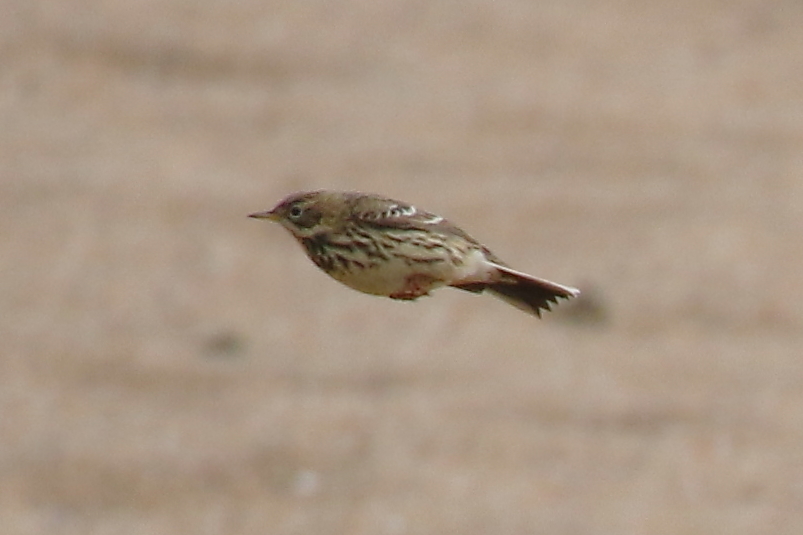
Out on the moor proper I could not find a Whinchat, but Meadow Pipits were plentiful
Small Copper on Dartmoor
The first Pied Flycatcher of the day in Yarner Wood

Sunday, 22 October 2017

Shetland Day 7: far from the madding crowd

We decided on an off-island excursion on our 7th day on Shetland - to Unst, the most northerly inhabited island in the UK, where we could get away from the hordes of literally, er, tens of birders on the Mainland. The forecast, and a report of an Olive-backed Pipit, suggested that we should stop at the Kergord Plantation en route before leaving the Mainland, one of the largest areas of woodland on Shetland.
Otter on Yell while waiting for the ferry to Unst
The Otter surfaced with a fish then vanished
Seeing trees on both sides of the road is a rarity on Shetland: this is Kergord
Although Howard got a brief view of the OBP, the rest of us didn't see it, but compensation came when we each independently heard, and subsequently saw, another small group of Parrot Crossbills in the plantation. These attracted another massive crowd of at least three birders, so we set off again on the quest to get as far from the madding crowd as possible.
A female Parrot Crossbill to go with the males from the previous day
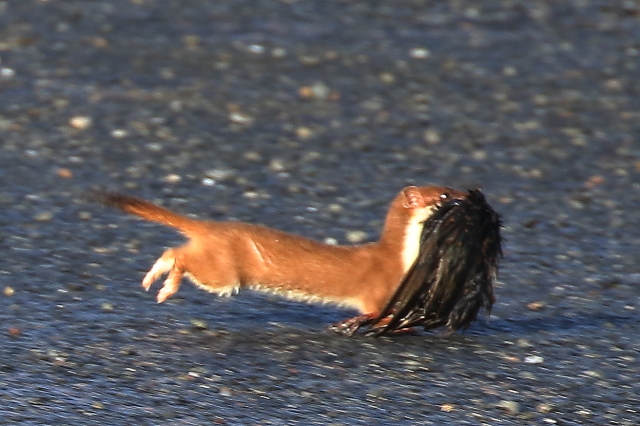
Stoat with Starling as we waited for the ferry to Yell
And this is the ferry to Yell
Speaking of Thomas Hardy, Rustic Bunting may sound like something the townsfolk hang out on May Day in one of his novels, but it is in fact an attractive vagrant from the east. News of one at Lower Voe persuaded us to make a short detour before heading for the ferry. Time was short, but the Bunting was feeding on the roadside as we arrived and was soon flushed by a passing car, assuaging our guilt at ticking-and-running.

Rustic Bunting at Lower Voe
Strikingly white underparts
Thus Ruff was feeding near the Otter
We then hit a lucky streak with Shetland mammals - first a Stoat surprised us by running across the road with a Starling in its mouth as we waited for the ferry to Yell, then an Otter surfaced holding a fish as we waited for the ferry to Unst.
A couple of Bonxies at Skaw on Unst
Curlew on Unst
The cliffs and sea at Skaw were carpeted with Shag. No pun intended.
The main target on Unst was a Red-throated Pipit which had been present for several days. We arrived as another carload of birders was leaving, and they advised us to comb the grassland above the beach at Skaw to search for the elusive pipit. A short distance from the car, a Pipit flushed out of the grass in font of us and sat up on a post.
An attractive graveyard on Unst
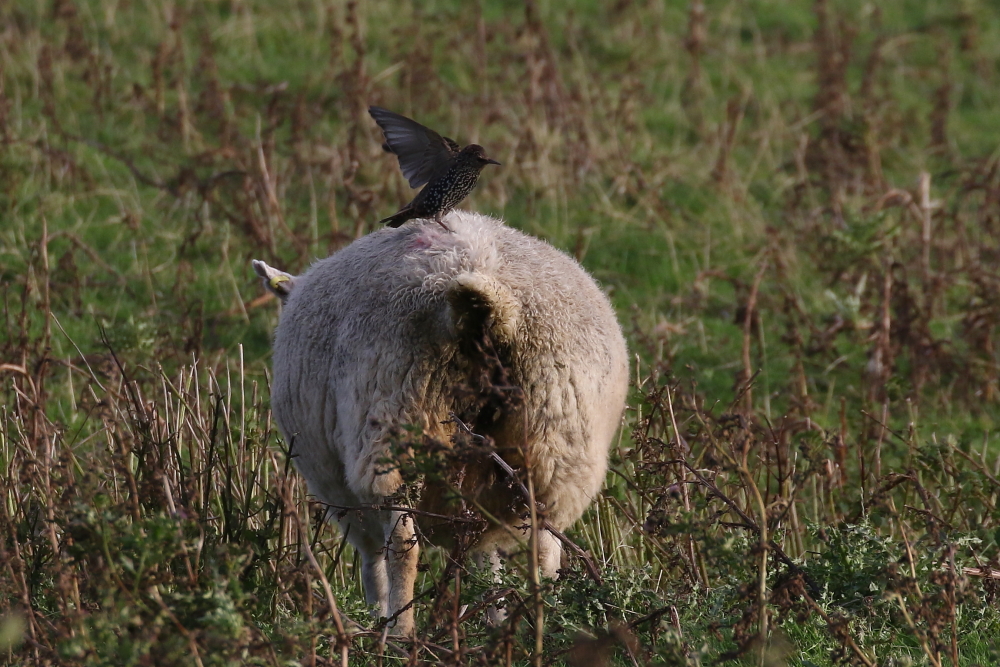
Well at least it's an anagram of 'Starling on sheep's ears' 
We stalked this Pipit at Skaw hoping it was the Red-throated, but photos revealed it to be a Tree Pipit
We instinctively raised our binoculars, expecting a Meadow Pipit, and had a good view at close range before it flew again. Then we all looked at each other: 'That had bright mantle stripes'. 'Yeah, and a yellow base to the bill'. 'Well that was it then!' Too easy! I kicked myself for not grabbing a photograph of the bird at point blank range, and though we attempted to refind it, it had flown beyond a wall into a private garden, and did not look like reappearing.
After burying itself in the grass the Red-throated Pipit eventually came out on the beach 
Clean whitish underparts
A better view of the pale mantle stripes and fine bill with yellow base
The weather had taken a turn for the worse by this point, and we turned to leave - no sooner had we done so than the Pipit reappeared. It was flighty but after sweeping the area with another group of visiting birders we eventually pinned it down for some photos on the beach and in the long grass beyond. 
A rear view of the pale mantle stripes
The best of a bad lot of Red-throated Pipit flight shots
Yet another Redstart - this the most obliging of the lot

The rest of the day was spent birding Unst, the highlight being a White-tailed Eagle which an observant soul had picked up perched on a distant hillside. A great excursion and a welcome bit of peace and quiet before returning to the seething metropolis of Hoswick.
The Popemobile: they pushed the boat out when His Eminence visited Shetland

Record shot of a very distant White-tailed Eagle
The long road home to Mainland Shetland

Wednesday, 18 October 2017

Shetland day 5: momentum

Success with the PG Tips, and a full Sunday roast with all the trimmings prepared by yours truly, sent us out into the field with a spring in our step on Monday 2 October. Part of the appeal of Shetland in autumn is that, due to the relatively high proportion of rarities to common birds on the islands at this time of year, and the relative paucity of observers, the visitor has a reasonable chance of finding their own good birds. Even a duffer like me could understand this, and that very morning I found my first Red-breasted Flycatcher in Swinister Burn, a short walk from our accommodation.
Little Bunting, Grutness
An attractive bird with a neat crown stripe
The Little Bunting showed during a welcome spell of sunshine...
...and provided brief but excellent opportunities for photographs
Red-breasted Flycatcher, Swinister Burn - my best 'find' of the week
Twite, Grutness
Splitting up to cover more ground whilst maintaining contact was an important part of our game plan, and in this we were greatly aided by the loan of a set of CB radios from Jonathan Lethbridge, better known on the interweb as the Wanstead Birder - thanks Jonathan. These marvellous bits of kit saved a lot of faffing with mobile phones and hedged against the risks of an often intermittent mobile phone signal on Shetland (in saying that, I'm not having a go Shetland, it's still better than my house in Wareham!).
Only on Shetland - I couldn't work out why the lens wouldn't focus on the RB Fly - it was being photo-bombed by a Yellow-browed Warbler!
Spotted Flycatcher, Swinister Burn

Several Redstarts were near the Sumburgh Quarries - this a male...

...and this a female
Twite at Grutness
Twite at Grutness
Not only did the CBs enable us to stay in constant contact, they proved a useful means of holding a verbal referendum on whether to keep thrashing the adopted patch, or knock it on the head and go look at other people's birds! So it was that when the Red-breasted Flyatcher refused to show for the rest of the team we quickly agreed to move on to pastures new. Specifically, to Grutness near Sumburgh Airport, where a Little Bunting had been seen. This sat out superbly for us in the sunshine on a lichen covered wall - a photographic highlight of the trip.
Chiffchaff, Grutness - one of several tired migrants which appeared to have just arrived, making them easier to approach
A nettle patch at Grutness was bouncing with migrants - including this female Blackcap...
...a male Blackcap...
and several Goldcrest
Taking the idea of the 'tyred migrant' too literally perhaps?

A House Martin was battling in the strong wind at Grutness
The wind was still whistling past nearby Sumburgh Head: too breezy and explosed for a seawatch but we still managed three Long-tailed Ducks and a pod of dolphin. Howard called them initially as Rissos's but revised the identification to Bottle-nosed as the characteristic body scarring of Risso's was not visible. I grabbed some record shots and while pretty convinced they were not Bottle-nosed, they didn't look like Risso's either - I expected that species to have a flatter front end rather than the stubby snout revealed by the pictures.
This Common Seal was just off the beach at Pool of Virkie...
...as was this much larger Grey Seal
Grey Plover, Pool of Virkie. Compare to...
Golden Plover, seen in roadside fields later in the day
Ringed Plover, Grutness
The spray here illustrates the strength of the wind
Posting the sighting as Bottle-nosed Dolphin that evening, Howard was contacted by Hugh Harrop who advised that this species would be a rare sighting in these waters. After an exchange of photos he confirmed they were indeed Risso's, a fact we could now see for ourselves when looking at pictures online of younger Risso's which show a stubby nose and a lack of body scarring, which is acquired by battling adults later in life. I had never seen Risso's Dolphin before, so with a new mammal to add to the new bird of the previous day it felt like we were on a roll. 
Turnstones, Pool of Virkie
Dunlin in the seaweed at Pool of Virkie
Ringed Plover, Poole of Virkie
A couple of Goosander were just offshore at Pool of Virkie
Risso's Dolphin, Sumburgh Head
The first Risso's Dolphins I have seen
The weather had taken a turn for the worse by this time, so we returned to birding from the car: Loch of Spiggie held a flock of elegant Whooper Swan; Loch of Hillwell an even more elegant and long-staying Common Crane; and a good selection of waders at Pool of Virkie included singles of Curlew Sandpiper, Grey Plover and Sanderling. Best wader of the day though was a Little Stint, discovered in the improbable location of a puddle in a farm entrance at Noss. An eventful day then, with a good find, a new mammal and an excellent supporting cast. The morning would see us chasing another Shetland rarity - come back soon to find out what.
Whooper Swans, Loch of Spiggie
Common Crane, Loch of Hillwell
Little Stint, Noss
Little Stint, Noss
These rusty rods became famous this time last year when Britain's first Siberian Accentor chose to perch on them in a Scousburgh Quarry
The runway at Sumburgh Airport - traffic lights stop cars on the main road when the runway is in use
A dramatic Shetland landscape
One more of the Little Bunting with a halo reflected from a passing plane at Sumburgh Airport