Showing posts with label Knot. Show all posts

Tuesday, 30 August 2016

Wader therapy

When the full horrors of existence loom larger than my joie de vivre, which they did this weekend as a blissful fortnight's holiday with the family approached its end and a return to work beckoned, I go look for waders. Don't embarrass me by asking me to name them all, that's a cruel test. Especially since our second child arrived and there are now more of them to remember.
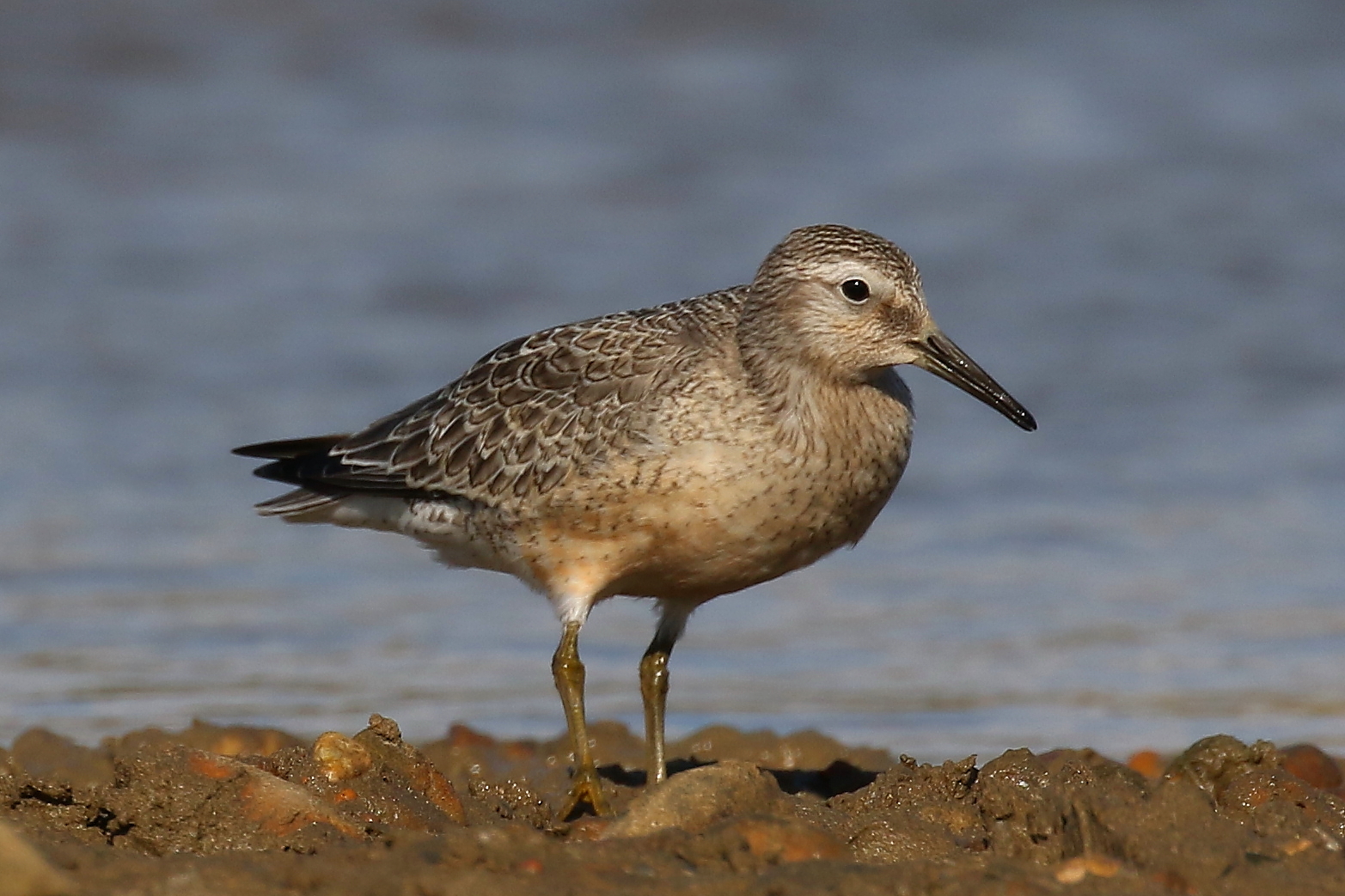
Knot, Ferrybridge
Knot, Ferrybridge
The waders, by contrast, were all utterly memorable. Even the common ones - Lapwings, Ringed Plovers, Blackwits - I find exquisite, and the rare ones when they turn up are also a delight, untainted, as they generally are, by thoughts of escapes, hybrids and so on associated with other bird families. The long weekend therefore saw me checking out some of Dorset's current wader hotspots - Lytchett Bay, Lodmoor and Ferrybridge. Oh, and of course Swineham, which was briefly a wader hotspot during the summer floods of 2012, but which hasn't offered much since bar some insolent Stilts which visited while I was elsewhere. No, I won't let that go.
Ringed Plover, feeding with the Knot at Ferrybridge on a small muddy island by the car park
A juvenile bird with frosted feather edges
A Green Sandpiper and a Greenshank were about all Swineham had to offer on the wader front in three recent visits (though a few other migrants were around - more on that in a later post). Bank Holiday Monday visits to Ferrybridge and Lodmoor were more productive, presenting some good photo opps in perfect light. The former would have been even better but for the inability of members of an allegedly smarter species to read the signs urging them not to disturb feeding and roosting birds.
Black-tailed Godwit wading in deep water at Lodmoor
Even this juvenile Dunlin, the regulation wader of British shorelines, is a stunner in my eyes, despite not being quite as smart a plumage as the adult
I arrived at Lytchett a few days after reports of the fields teeming with waders had peaked to find them not exactly teeming, but still good. As top Lytchett Bay-City-Roller Shaun Robson remarked, the fact that a trio of Little Stints was a slightly disappointing highlight of my visit is really testament to just what a good site it has become. The other top Bay-City-Roller, Mr Ballam, who I also bumped into at the Lytchett Fields (of dreams?) viewpoint, was kind enough to comment on the absence of posts in this space. At least, I interpreted it as kindly as 'I thought you were dead' can be interpreted. So this post is dedicated to Ian: for noticing the silence, and appearing to care.
Little Stint, of which there were three at Lytchett Bay, and four at Lodmoor
This one was photographed at Seaton Marshes in Devon earlier in the month en route to our Dartmoor holiday cottage - more on that trip later
Speaking of readers, regular ones will no doubt be delighted to see the return of gratuitous jokes at the expense of my nearest and dearest to these pages (para 1, if you missed it). New ones may be shocked at the flagrancy of the familial abuse, so, to reassure, it is all in jest: Claire, George and, er, the other one all know I couldn't live without them.
Evening light showed off this Lodmoor Lapwing at its best
Common Sandpipers were at Lytchett and Lodmoor (this juvenile again from Seaton Marshes)

Monday, 4 July 2016

Knot on the beach

The weekend before the weekend before last (I've been busy, OK?) was my wife's 'birthday weekend'. Not birthday, you will note, which fell some days previously, but 'birthday weekend'. This phenomenon, like the 'birthday breakfast', and the 'birthday curry with the girls', is a privilege reserved, it appears, uniquely for the matriarch in our household at least. This year, however, it coincided with 'Father's Day weekend', necessitating a degree of compromise about how to mark both occasions.
Avocet at Titchwell RSPB, 18th June
Claire favoured hiring a campervan and heading for a south coast location. I favoured the home comforts of a hotel, preferably in Norfolk, given the presence of a long-staying adult Great Knot, a bird I had never before seen in Britain or anywhere in the world for that matter. The choice divided the family down the middle, with particularly strong views about migrants (by which I mean waders, of course) being expressed on both sides. Protracted negotiations, several tense stand-offs and a near complete breakdown in diplomatic relations ensued, until a compromise was reached involving, one might say, full access to the single market for campervans and the free movement of people to East Anglia.
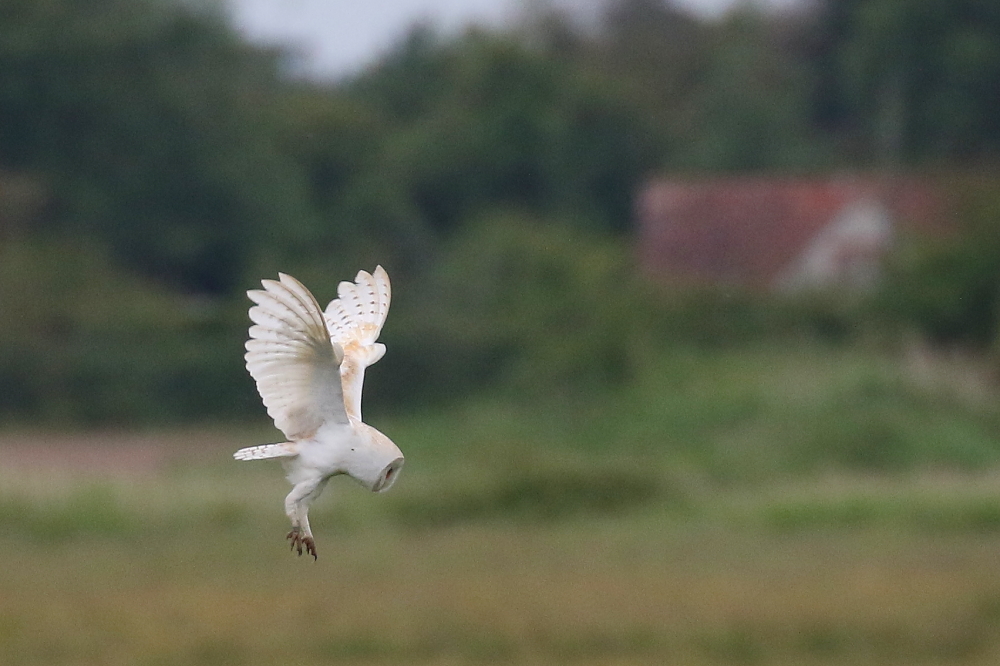
Barn Owl quartering the saltmarsh near Titchwell
The hire vehicle Claire procured was a monster - a converted Peugeot Boxer, which barely fitted into our parking bay at home but contained sufficient space and home comforts to accommodate four people, suitcases, camera gear, telescopes, board games, and all the other baggage which a family which never learnt the meaning of 'travelling light' could wish for. After packing said menagerie, our Friday night departure from Dorset was pretty late, and we could only make it as far as Cambridgeshire before the need to hook-up at a campsite became paramount.
You don't see that every day - Shoveler duckling at Titchwell
After an early start we headed straight to Titchwell, but sadly the Great Knot, which on several of the previous days had pitched up early morning to feed on the beach before retiring to an unknown roost, had already been and gone for the day. So there was nothing for it but to knock up a full English breakfast in the back of the van. Always my favourite part of camping, and this was no exception despite the disappointment of missing the Great Knot.
White van men: Rowan and George outside our 'hotel' for the weekend
Sated by bacon and eggs, we trudged to the wet and windy beach and put in a good shift for the rest of the day trying, but failing, to find the Great Knot. Never mind, there was still Sunday to catch up with it, I thought, as we headed for an idyllic campsite at South Creake. The problem was that rousing the family early on Sunday would be no easier than it had been on Saturday, raising the prospect of a groundhog day double-dip.
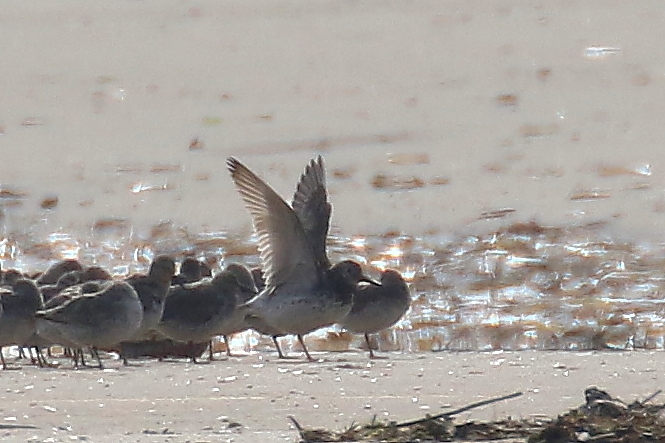
Huge numbers of Knot land on Titchwell beach
Fortunately, a chance encounter earlier in the Titchwell car park with Dave Bradnum, my companion on a recent Hebridean adventure, suggested that he might be trying again early on Sunday morning, so, to cut a long story short, I was able to blag a lift with him, see the Great Knot and get back to the campsite in time to rustle up another full English.
'See that flock of 5,000 Knot? It's second from the right' The Great Knot moves conveniently to the edge of the huge flock on the beach to show the de-curved bill, black chevrons on the flanks and Turnstone-like back pattern
This was only the fifth record of Great Knot in Britain, so a very rare bird indeed, and all the more notable for being my second British tick on consecutive Father's Days following last year's Terek Sandpiper.
The Great Knot stretches its wings emphasising its small-headed appearance and revealing a necklace of black streaking
Feeling gracious and conciliatory having got what I had hoped for from the weekend,  back at the van I announced that I was quite happy to do what everybody else wanted to do. And this time I meant it. The remainder of Father's Day was therefore spent meandering south via Oxburgh Hall, a National Trust tick for the whole family set in beautiful, wildlife-friendly grounds.
Red-eyed Damselfly, Oxburgh Hall, Norfolk

The boys and I dread places like this as their Mum diligently reads every word on the interpretation panels in every room, presumably in some kind of search for knowledge and self-improvement. We, by contrast, can only cope with so much information about the provenance of medieval dyes so after a quick whizz around the stately home, we made ourselves scarce and retired to the grounds. Damselflies in the moat and Grass Snakes on the lawn kept us entertained until Claire returned brimming with useless information about tapestry to entertain us throughout the four hour journey home. An excellent weekend, so a big thank you to my loving, tolerant family (and Dave) for making it so.
Grass Snake, Oxburgh Hall

Thursday, 3 September 2015

Wacky races

On Sunday last Steve Smith and I formed a two-man team to take part in a Poole Harbour bird race (read the official, totally ungloating write-up by a member of the winning team here). This was my first summer one since moving to Dorset in 2007 and while we made a respectable total of 114 species heard or seen between 0430 and 1900, when we met up with the other teams for a social, this was still only enough to earn us joint 4th place (out of 8). So where did it all go wrong? 
We saw three Osprey on the bird race, this one nearly took our heads off as it flew low over Brands Bay

Wryneck at Greenlands: bird of the day by common consent, and #217 on the photo yearlist
Steve obviously blames me for dawdling (momentarily, I should add) to add a few species to my photo yearlist as we went. Birdracers who take themselves far too seriously would not have allowed a camera to even be taken, let alone used, he pointed out. I obviously blame Steve for dawdling (momentarily, he would say) in the hope of adding Wryneck to his patch list for the year. He managed it, but only, I would argue, because I dawdled to add to my photo year list at Greenlands just long enough to give the Wryneck time to reappear.
Whinchat at Greenlands (#218)

Redstarts at Greenlands - two of about a dozen seen in the area on bird race day
We started well enough, bagging Tawny Owl and Nightjar in the dark, adding waders and terns at Pilot's Point at dawn and collecting most of the regular migrants at various hotspots of the Studland peninsular by mid-morning, before heading off to Brownsea over lunch. This was a good decision as it produced our only Spoonbill, Little Tern, Spotshank, Knot and Barwit of the day.
Spotted Flycatcher - five were in the same tree at Greenlands
Willow Warbler - in with a loose flock of Stonechat, Whinchat, Spot Fly and Redstart at Greenlands
The afternoon then became increasingly fraught as we realised we were going to have to dip on some potentially fruitful sites, and pay flying visits to others where it would have been preferable to linger. Hence not seeing the almost guaranteed Yellow-legged Gulls at Middlebere or a recently reliable family of Woodlark at Soldiers Road.

Wheatear - another Greenlands tick for the day
Yellow Wagtail - one of a flock of 20 on Ballard Down - thanks to Steve for the loan of his SX50 to take this, #219 for the photo yearlist. And yes, that is allowed - photographer has to be me, kit can be anyone's.
In the hardest choice of all, as we made our way clockwise around the harbour in the late afternoon, my own patch of Swineham was jettisoned in favour of Lytchett Bay, a treachery of which I remain thoroughly ashamed. Swallowing our pride and holding our noses we headed for this most inhospitable of sites, only to find it adorned with welcoming signs, well-positioned viewpoints, and, worst of all, wheeling flocks of waders over acres of muddy pools. The only thing missing was a visiting RSPB group carrying foil-wrapped sandwiches, a flask of weak lemon drink and a packet of bourbon biscuits, asking us if the local Oystercatchers were in fact Black Storks. Certainly not the Lytchett Bay I remember from our last bird race: they've really let the place go. But with 4 species added in less than 4 minutes of viewing, I have to concede it provided pretty good value for money.
Believe it or Knot, a photo year-tick (#220) on Brownsea
I thought I had missed Little Tern for the photo yearlist having driven past the colony at Ferrybridge several times without managing to stop - so this one on Brownsea was a bonus (#221)
The Wryneck was an undoubted highlight of the day and was seen by less than half of the teams - not even the winning team saw it with their record-breaking total of 130. Comparison of their list and ours, however, shows where we really slipped up. We did OK with quite a lot of scarcer or unpredictable species which can catch you out on a bird race - as well as the Wryneck, we added Marsh Tit, Lesser Whitethroat, Grey and Yellow Wagtail to the day list. But we failed to see several commoner birds like Mistle Thrush, Skylark and Lesser Black-backed Gull. Time pressure also cost us - taking in Swineham would probably have added Little Grebe, Gadwall, Cetti's Warbler, Tufted Duck and maybe Marsh Harrier, birds which remained conspicuous by their absence from our list at the close of hostilities. The winners, by contrast, saw just about everything you could hope to see with the right combination of good planning, good luck and a handful of time-saving parking violations (not that we're bitter).
And in an overdue return of the 'terrible photos of tiny waders' feature on this blog, here's a Little Stint (#222) at the Bay which shall not be named.
Continuing the terrible photos of tiny waders theme, Ruff (#223) was also at Lytchett, though this one was photographed at Middlebere as the ones at the Bay were too distant. It's not that good. 
As with our winter birdrace a few years ago, I made it through the day only by grazing constantly, barely surviving on the paltry ration of a cheese baguette, four doughnuts, three packets of crisps, two each of apple and satsuma, a Mars bar and a multi-pack of Jacobs Orange Club - not as much as it sounds due to the pervasive pressure of shrinkflation. Steve, by contrast, would have got by on half a cheese and onion pasty had it not been for the doughnut donated by yours truly. With so many birders up early in the field and snacking unhealthily, some care had to be taken with the 'heard only' rule due to the similarly between the call of the Little Bustard and the sound of distant flatulence carrying on the thin morning air. The risk of confusion, however, substantially reduced by the absence of Marcus this year.
Unless it was tinnitus, I was hearing Green Sandpiper all day, but Steve just couldn't tune in to them. Then 4 flew over Middlebere together and he couldn't fail to tick them. This one was photographed at the same site earlier in the week.
Spoonbill - so far I have a 100% record with this species on my Dorset birdraces. 15 were on Brownsea.
All the while Poole Harbour distinguished itself with its incredible birdlife and habitats. Migrants seemed to drip from the branches, and my attempts to immortalise them on film were constantly photo-bombed by the normally elusive Sparrowhawk (we saw five). Numbers of Spotted Flycatchers were such that it's a wonder there are any flies left. And we pretty much had to beat our way through flocks of Ospreys, removing their talons from our binoculars one by one and telling them to back the hell off so we could fit them in the frames of our cameras. The day total of 136 species seen by the teams collectively tells you all you need to know about the diversity of birdlife on offer in Dorset in early autumn. The event was organised by Shaun Robson with the skill which can only be honed by half a lifetime in local government, so a big shout out, as they say on the wireless, to him for taking the initiative, and to the other participants for making the day such a success.

Sunday, 3 August 2014

A week in waders

Waders dominated the last week's birding during a family holiday in Northumberland - twenty-one species in all without really trying too hard. Top marks for rarity went to a Collared Pratincole and a Stilt Sandpiper (which I never managed to photograph), but just as rewarding was time spent on various beaches with some less celebrated, but still very attractive species:
Sanderling: a characterful and beautiful bird in almost any plumage - this one sporting the rufous face of summer plumage
Sanderling: one of a small flock on the beach near Amble
Sanderling: a roosting bird
Sanderling: looking more like a spring-plumaged bird
Sanderling captured in motion - not easy given the speed at which they run
Sanderling: another one at a canter
A flock of Sanderling roosting on a rocky promontory - with patience I got pretty close and managed to leave the flock undisturbed. This almost cost me wet feet though as the tide came in behind me - just below the welly-tops fortunately
Sanderling close-up 
Part of a Sanderling flock in flight
A few Dunlin were with the Sanderling flock
This was as close as I got to a (Red) Knot - a small flock in flight with Curlew
Oystercatcher
Turnstone
Ringed Plover
Golden Plover - a small flock were on the beaches around Holy Island
Avocet in flight at Cresswell Ponds

Redshank
A Pacific Golden Plover in Staffordshire on the way home, just a four mile detour from our route, would have made it 22 waders for the trip. Unfortunately, it chose the hour before our arrival to disappear after having been a sitting duck for most of the previous week. Spooked, no doubt by the spectre of Mitchell and Son, who arrived to dip it too en route to Derby shortly before ourselves as we headed in the opposite direction. This Little Ringed Plover was one of several at Middleton Lakes RSPB where the Pacific Golden Plover had been seen.