Monday, 2 March 2015

Starcross lover

As February turned into March, I too felt like a change. And so to Devon on Sunday, and Darts Farm, where a trio of Penduline Tits has been entertaining the locals since last December. I have written before about the fancy retail park to which this tiny RSPB reserve is attached. None of the facilities were open when I arrived shortly after 0800, and although I was first on site, there was no sign of the birds for almost an hour. Then a thinly whistled call gave one away and I quickly located it in the small reedbed in front of the hide. It performed royally feeding on reedmace and was eventually joined by a second bird. By now a small group had gathered and the Pendulines flew towards us and into a small tree at the edge of the reedbed. They proceeded to call, preen, pick insects from the blossom and generally show off unexpectedly well.

Having filled a memory card, I decided to leave them to it and push my luck for a few more photo ticks for the year, heading around the Exe Estuary, one of my favourite areas for birding, through Starcross and Cockwood down to Dawlish Warren. I should probably have quit while I was ahead: there was no Bonaparte's Gull at Dawlish despite taking a really posh Darts Farm freshly baked loaf of bread to tempt it in; there were no Cirl Buntings at Exminster, admittedly in a half-hearted search; and I even dipped on Dippers in Lyme Regis on the way home. So only a Linnet and a Greenshank were added to the photo list - but after the show put on by the Pendulines there can be no complaints.
Penduline Tit, Darts Farm RSPB, Devon (species #121 photographed in 2015)
This bird was being described my some on site as 'the male' but I'm not so sure. From what I've read, males ought to have a larger mask, more grey on the nape (this has a grey forehead which changes to grey brown just behind the eye), and often show rufous markings on the breast which are absent here...
..but then they are said to be difficult to sex
The bird then flew towards me into a tree - it looked almost out of place
Never quite got a perfect side profile but this came pretty close
The bird above was then joined by this one - not quite as well marked, and with a stronger wingbar - but still, I think, a female for the same reasons given above.
This one did a fair bit of preening
This is the first bird again
A small flock of Black-tailed Godwits were also at Darts Farm...
...along with Curlew and Wigeon
Linnet for the photo year list (#122)
This colour-ringed Brent Goose was one of a large flock near Starcross. I bet they call it 'Arfur' (R-4)
Greenshank in the tidal creek at Cockwood - often good for waders (#123)
Penduline Tit
Penduline Tit


Saturday, 28 February 2015

Armchair ticking

The British Birds Rarities Committee, which assesses the voracity of reports of rare birds in this country, can take quite a while to pronounce with some complex and controversial cases taking years, even decades, to conclude. So it was a relief to see it take less than a year to rule on a couple of special birds which I saw in April last year. First of these was a Baikal Teal in Cambridgeshire. There could be no doubt about the identification of this bird, only the origin, but the Committee was clearly satisfied with its provenance, so my slightly superstitious decision not to add it to my Bubo list until it was deemed acceptable seems sort of vindicated. And now gives me the pleasure of adding that most effortless of things to my list, the armchair tick.
Baikal Teal, Fen Drayton, Cambridgeshire, 2nd April 2014
On the same day as it ruled on the Baikal Teal, the BBRC also accepted my own record of Northern Harrier on Portland, I think just the 7th accepted record of the hudsonicus sub-species of Hen Harrier in Britain. My footnote in Dorset birding history thus seems secure, and Ref No 5637 will forever have a place in my list of portentous numbers which I really should remember, but probably won't. My account of how it was found and identified remains far and away the most popular post to have appeared on this blog, with 1,800+ page views to date.
Male Northern Harrier, Portland, Dorset, 21st April 2014
Speaking of armchair ticks, after a recount, I have also gained another half dozen on the 2015 photo year list, by virtue of not counting birds photographed in an earlier post. Maths never was my strong point. On the up side, this brings the total up to 120. On the down-side, it means that the Waxwing loses its crown as the 100th species to appear on the blog this year, and has to hand it to a scabby Greylag Goose (or, if I recount in the strict chronological order the photos were taken, Bittern, which is a bit more respectable).

With no holidays planned for a few months though, a busy year ahead, and bearing in mind that when I have bothered to tot up a year list in the last few years I haven't breached the 250 barrier, realisation is already dawning that I am not going to be pulling up many trees, tally wise. Still, it's early days so I'll persevere, despite dipping on a local Great White Egret, re-re-re-re-refound and photographed very nicely by Steve Smith today. I scrambled, but it didn't hang around, hence returning to the comfort of the armchair.

Thursday, 26 February 2015

A rousing finale

We arrived back in Dorset last Saturday after a family holiday in Suffolk which left me free on Sunday morning to trawl Dorset for some minor rarities and photo ticks for the year list. The forecast was to turn nasty by mid-morning so I started reasonably early at West Bexington, hoping to see the 3 Cirl Buntings which had been reported on and off. I was fortunate to bump into Mike Morse on arrival who showed me to the right spot. The first bird we saw was a Sparrowhawk so that didn't bode well, but after not too long a wait the Cirls flew in to the far hedge as Mike had predicted. Birders are being asked not to use the permissive footpath which goes close to their favoured hedge so we watched from the coast path and I managed a few record shots from distance. Possibly the worst photo tick on this blog this year. But this is a top bird in Dorset, a county tick for me and, more to the point, it's identifiable so passes all the necessary tests for inclusion here.
Sparrowhawk, West Bexington (#116)
A very heavy crop of the male Cirl Bunting (#117) at West Bexington
Raven, Abbotsbury (#118)
Next stop was Abbotsbury where a Greenland White-Fronted Goose has spent much of the winter - not a photo tick this year on account of it being a race of White-fronted Goose, several of the nominate race of which I saw earlier in the week in Suffolk. But still a very good bird down here, and the first I had photographed of this species in Dorset. A Raven over provided an easy photo opportunity. The Black Guillemot in Portland Harbour was my next target, and I soon located it, still distant but closer than on previous visits, and certainly close enough to get a passable picture by the low standards I have set so far in this post.
Greenland White-fronted Goose, Abbotsbury
Now here's a test for the ethics of the photo year list: the white blob with black on top far right is a drake Scaup at Abbotsbury Swannery. The dark blob with white blaze on the face far left is a snoozing female Scaup. I know they're Scaup, you know they're Scaup, but should I 'count' them for the photo year list? No, even I have standards.
Black Guillemot, Portland Harbour (#119)
A close Pale-bellied Brent at Ferrybridge was nice, although the rain and wind had picked up by the time I got there. Again not a photo tick on account of it 'only' being a sub-species of Brent Goose. Finally, there was just time to catch up with the Golden Plover flock at Maiden Castle for one last photo year tick (also the first I have photographed in Dorset) before heading back to Wareham for Rangers' U-12s final game of the season. Although arch rivals Swanage and Ringwood have games in hand and on form should finish above Wareham, we look likely to conclude the season as top scorers and can finish no lower than third, so well done lads - and thank you for letting me have my weekends back.
Pale-bellied Brent Goose, Ferrybridge. Compare to...
...Dark-bellied Brent Geese
Golden Plover, Maiden Castle
Golden Plover, Maiden Castle (#120)

Wednesday, 25 February 2015

Buzzing around Norfolk

After a short break in Suffolk last week we made our way up to North Norfolk for a day before heading home to Dorset. I thought Pink-footed Goose would be a shoe-in for the photo list here but while quite a few were seen they were all too far off to photograph unfortunately, even at the normally reliable Lady Anne's Drive. I would surely have found some closer had I driven around the back lanes but after the long journey from Suffolk I feared a revolting family family revolt had I done so. So it was a stroll on the beach at Holkham followed by cake and coffee at Titchwell instead. En route from Holkham to Thornham (for the Twite) though we did stumble across a nice, close pair of Egyptian Goose. Non-native, but tickable.
Egyptian Goose, near Holkham, Norfolk (#113th species photographed in 2015)
Norfolk is a stronghold of this introduced species
Little Grebe on Holkham Park Lake (#114)
Muntjac Deer near Holkham
Earlier in the week when we were still in Suffolk I also nipped over the border to Norfolk look for a Rough-legged Buzzard which has been wintering on Halvergate Marshes. I had not been to this area before but thanks to some gen from James Lowen I found the right viewpoint. After a couple of hours I had seen nothing more exciting than a Marsh Harrier, and being on a deadline I was considering knocking it on the head when one last scan with the telescope revealed a large hovering raptor in the extreme distance. It dropped out of sight but it was enough to persuade me to stick around a while longer and not long after it re-appeared close enough for a few record shots.
Rough-legged Buzzard, Halvergate Marshes, Norfolk (#115)
Rough-legged Buzzard shows a white band across the tail
This bird caused me a bit of confusion when it flew over shortly afterwards - it was motoring on so not really in typical Buzzard/Rough-leg mode, and with a pale head and much white in the closed tail my initial impression was of Rough-leg...
...but on sharing the photos with more expert birders the conclusion is juvenile Common Buzzard. Note the dark 'comma' in the forewing, compared to the dark carpal patch on the Rough-leg, and the longer winged, more Harrier like appearance of the Rough-leg.
So that's the East Anglian trip wrapped up then: five nights, two Counties, and 21 species added to the photo year-list, including some potentially tricky ones - Rough-legged Buzzard, Waxwing, Hawfinch, Twite - all of which I could easily go the year in Dorset without seeing.
 

Tuesday, 24 February 2015

More from the Far East

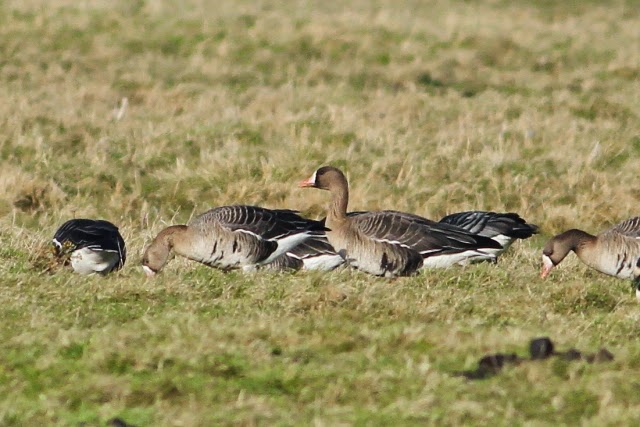
A couple more posts should wrap up the remaining highlights from our recent East Anglian trip, and, what with it being so flat and wet an all, they are mostly in the waterfowl department. Geese are of course a Norfolk speciality but Suffolk has a few too - the highlight being the wintering flock of Russian White-fronted Geese (race albifrons) at North Warren. These birds sometimes hold a rarer Bean Goose though not this year it would seem. The White-fronts were accompanied by a flock of Barnacle Geese which are considered 'feral' - but then so are the Canadas and Greylags so I'm ticking them for the photo year-list!
White-fronted Goose, North Warren RSPB, Suffolk (#110)
Adult White-fronted Goose in flight
Juveniles lack the black belly markings
Juvenile White-fronted Goose

Part of the wintering flock
Barnacle Geese, North Warren RSPB, Suffolk (#111)
Barnacle Geese in flight
The Konik ponies which do such a good job of habitat management on Suffolk's RSPB reserves 
Marsh Harrier causing mayhem among the White-fronts
Pintail were very close in to the excellent new raised platforms which give improved views over North Warren 
This the female Pintail
A beautiful duck
Skylarks were in song at North Warren
Rook (#112) at Covehithe - we walked down to the beach through vast and whiffy pigfields but it was too windy and cold to look for Shorelarks so we retired to the excellent Southwold pier for refreshments
The faded glory of the church at Covehithe...
...this area faces rapid coastal erosion and a road I remember walking down to look for a White-tailed Eagle many winters ago is now closed as the tarmac is getting munched into the crumbling cliffs