Sunday, 12 February 2017

A distinct lack of wax

A small flock of Waxwings graced Poole on Thursday and Friday - so desirable they even persuaded Ian Ballam to part company with Lytchett Bay for a while. I headed around the harbour at the first opportunity on Saturday morning to look for them but despite checking out every supermarket car park within five square miles, they could not be found. After several hours I conceded defeat and cruised around some more familiar hotspots in Poole Park and Holes Bay.
A Kingfisher on the railings of the model boat pond at the partially drained Poole Park Lake relieved an otherwise grey day
Note the chipped bill tip - if it was a Blue Rock Thrush, people would say it was an escape :-)
Drake Goldeneye displaying
Female Goldeneye
Little Egret fishing in the shallows of Holes Bay - lovely plumes
The redhead Smew was a bit closer than on my last visit...
 
 
...but not as close as this Spotted Redshank
The outflow from the PC World drain into Holes Bay is a reliable site for them in winter
One was loosely associating with a large flock of Blackwits
Spotted Redshank

Monday, 6 February 2017

The best laid plans

'Fail to plan, plan to fail' say the text books, an aphorism I sometimes find myself using when being unnecessarily pompous at work. Then when my own plans come crashing to the ground, I am reminded of the alternative philosophy posited by the well known management guru, Mike Tyson: 'Everyone has a plan - until they get punched in the face'.
Distant Pacific Diver at East Chevington: incapable of sticking to a perfectly good plan
Pacific Diver shows a vent strap, part of which is visible here
These conflicting truisms rather sum up my weekend before last. The plan was as follows: drive through the night to see the sun rise at Druridge Bay Country Park in Northumberland, where a Pacific Diver had been giving the definition of crippling views on Ladyburn Lake. I have seen the returning Cornish bird several times so while it would not have been a new bird for me, the opportunity to photograph a confiding major rarity is what makes me tick these days, so it seemed worth the effort. If the Diver was present, I would fill my photographic boots and be on the road south by 1000 at the latest, get down to North Yorkshire for noon, tick my first British Pine Bunting, and then take a birder's detour on the way home via another long-staying, photogenic diver, the Lincolnshire White-billed, to complete a remarkable rare double-diver day. And with luck, I would still be home in time to tuck the children in to bed.
Pacific Diver lacks the white flank patch of the commoner Black-throated Diver, and is generally a dinkier bird - as comparison with a Coot shows
Pacific Diver has a paler grey hindneck compared to Black-throated Diver
The perfect plan, then: all I needed to do was execute it. Originally I was going to go on Saturday, but a poorly wife, and a glance at the weather forecast, persuaded me to leave it until Sunday. I drove part way up on Saturday evening and stayed at a motel to make Sunday's driving less tiring, and pulled into an icy car park at Druridge Bay as the sun was rising. Julian Thomas from Somerset, a familiar face from the Portland scene, pulled up next to me and with no-one else around, we strolled to the lake in anticipation of a close encounter with the Pacific Diver. It soon became apparent that the Diver had gone - the first day in nine that it had not graced Ladyburn Lake with its presence. I resolved to check the pool at East Chevington, where the diver had been seen before it relocated to Ladyburn, and concluded it wasn't there either after a cursory scan of the pool - too cursory as it turned out, as a call from Julian relayed that it had been found at the far end of the pool by a more diligent observer.
A mixed flock of White-fronted and Pink-footed Geese flying over Druridge Bay
Another skein of Pink-footed Geese over East Chevington
A breathy canter to the far end of the pool enabled a few record shots to be taken, and excellent telescope views to be had, and while it was bitterly disappointing that the Diver had chosen today to not perform at close range, at least I had seen it. By the time I left, I was half-an-hour behind my original plan - an imperfect, but recoverable situation, or so it seemed at the time. A relatively smooth journey to Dunnington near York saw me arrive just after 1230, and as I made the short walk from the car to the paddock near where the Pine Bunting was showing, birders leaving told me that it had been seen just minutes earlier.

I spent the next couple of hours grilling a large feeding flock with which the Pine Bunting had hooked up, as birds flew from a weedy field to the surrounding trees. Yellowhammers, Corn Buntings, Reed Buntings, Tree Sparrows, Bramblings, Chaffinches, Greenfinches and Bullfinches came and went but no Pine Bunting. It had been seen on and off in previous days either here or in a nearby sheepfield, so with enough daylight left to still go for the White-billed Diver, I tried the sheep field, where a seeded area was attracting plenty of Yellowhammers. While there, the Pine Bunting showed briefly back at the paddock - too briefly for me to get back in time to see it unfortunately. It didn't show again before I left at 4. So no Pine Bunting, and no time for the White-billed Diver either.
Tree Sparrows are much easier to see in the north of England - they were present at Druridge Bay and the Pine Bunting site
Close, but no cigar: Yellowhammer is a near relative of the Pine Bunting, another bird which hadn't read the script
Unbroken rain accompanied the long journey home. By the time I reached Dorset I had rationalised it quite well with the usual guff about how it would be no fun if rare birds always did what they were supposed to etc etc, and consoled myself with the thought that I had the best views of Pacific Diver I have enjoyed to date. Pine Bunting becomes officially my bogey bird, having now dipped a few, though with several being found this winter, perhaps I will get another opportunity to see one before long. A Plan B, if you will.

Tuesday, 17 January 2017

Birthday treats

It was my birthday recently - a stuttering but undefeated innings of 48, in case you were wondering. To celebrate almost half-a-century of under-achievement I cleared my professional decks, booked the day off work and did some birding around Poole Harbour. The children were at school and Claire was at work, affording me the luxury of neglecting the entire family to go looking for birds without guilt.
Lesser Yellowlegs at Lytchett Bay
Green-winged Teal, just leaving Lytchett Bay
Redhead Smew distantly in Holes Bay
The once fierce competition between Lytchett Bay and Swineham as Poole Harbour birding locations, a fire stoked in these pages on more than one occasion in the past, has tailed off somewhat in recent years. Lytchett has gone from strength to strength under sympathetic management by the RSPB, being diligently scoured by Top 10 Patchwork Challengers (impressive, though I still think Patchwork Challenge sounds like a needlecraft contest). Swineham has gone downhill under a less wildlife-friendly regime, being wilfully neglected by feckless regulars like yours truly. So much so that I felt barely a flicker of shame in shunning the latter for the former to go looking for Lytchett's two long-staying winter rarities from the Americas: a Lesser Yellowlegs and drake Green-winged Teal.
Dark-bellied Brent Geese at Baiter Park
Coot, Poole Park
Drake Goldeneye and Red-breaster Merganser were out in the middle of Poole Park lake
The Yellowlegs was easy enough, sitting out nicely with a Redshank for comparison, the only two medium-sized waders on one of the pools. The Teal required a bit more luck: it flew off just after I arrived, but not before a kindly soul had let me have a quick squint at it through his scope, hence the dodgy record shot above, hurriedly snapped as it pelted away. Around the corner a returning redhead Smew was in Holes Bay for its third winter, while Poole Park held a few photogenic fowl as always. I caught up with a trio of Great White Egrets slightly further afield at Longham Lakes before heading over on the Sandbanks ferry to complete a circuit of the Harbour.
A lone Black-tailed Godwit was on the shore of Poole Park lake
Little Egret, Poole Park lake
Three Great White Egrets at Longham Lakes
The last hour of daylight was spent at Studland, where the raucous calls of a couple of Sandwich Terns were a cruel reminder of just how far away is spring, and the even more raucous calls of the local Ring-necked Parakeets were an equally cruel reminder of just how far away and warm is their native India.
Ring-necked Parakeet, Studland
Sandwich Tern, Studland
I would say watching the sun go down at Studland completed the day, but that wasn't really the end of it as on arriving home there was a birthday present to play with: the US Capitol building from the Lego Architecture range. Quite repetitive assembling the orderly lines of neoclassical columns and other fiddly bits, but ridiculously satisfying, a pure indulgence, and, I am reliably informed by the teenager of the house, substantially more socially acceptable than making an Airfix model. The perfect gift for the middle-aged man-boy in your life.
The US Capitol Building courtesy of the Lego Architecture range - George Washington laid the first brick. If you listen carefully this model makes a strange whirring noise: the sound of a miniature George turning in his grave.

Sunday, 15 January 2017

Man about town

Urban birding has become something of a habit lately, and we are fortunate in Dorset to have a number of good options in this regard. Last weekend saw me pottering around a few more of the county's birding hotspots between Portland and Dorchester. First stop was Fortuneswell and Chesil Cove at the southern end of Chesil Beach, where a pair of Black Redstarts were flitting on the rocks - same time, same place as a pair last year. A trio of Eider Duck were the highlight of a quick scan of Portland Harbour before lunch with the ducks and gulls at Radipole Lake in Weymouth. There was just time to twitch a first winter male Rose-Coloured Starling on the rooftops of suburban Dorchester before heading back to Purbeck to see about 10,000 of its more familiar cousin, the Common Starling, come in to a spectacular roost at Studland's South Haven.
Male Black Redstart, Chesil Cove
Black Redstart, Chesil Cove
Female Black Redstart, Chesil Cove
Rock Pipit, Chesil Cove
Meadow Pipit, Ferrybridge
Eiders in Portland Harbour
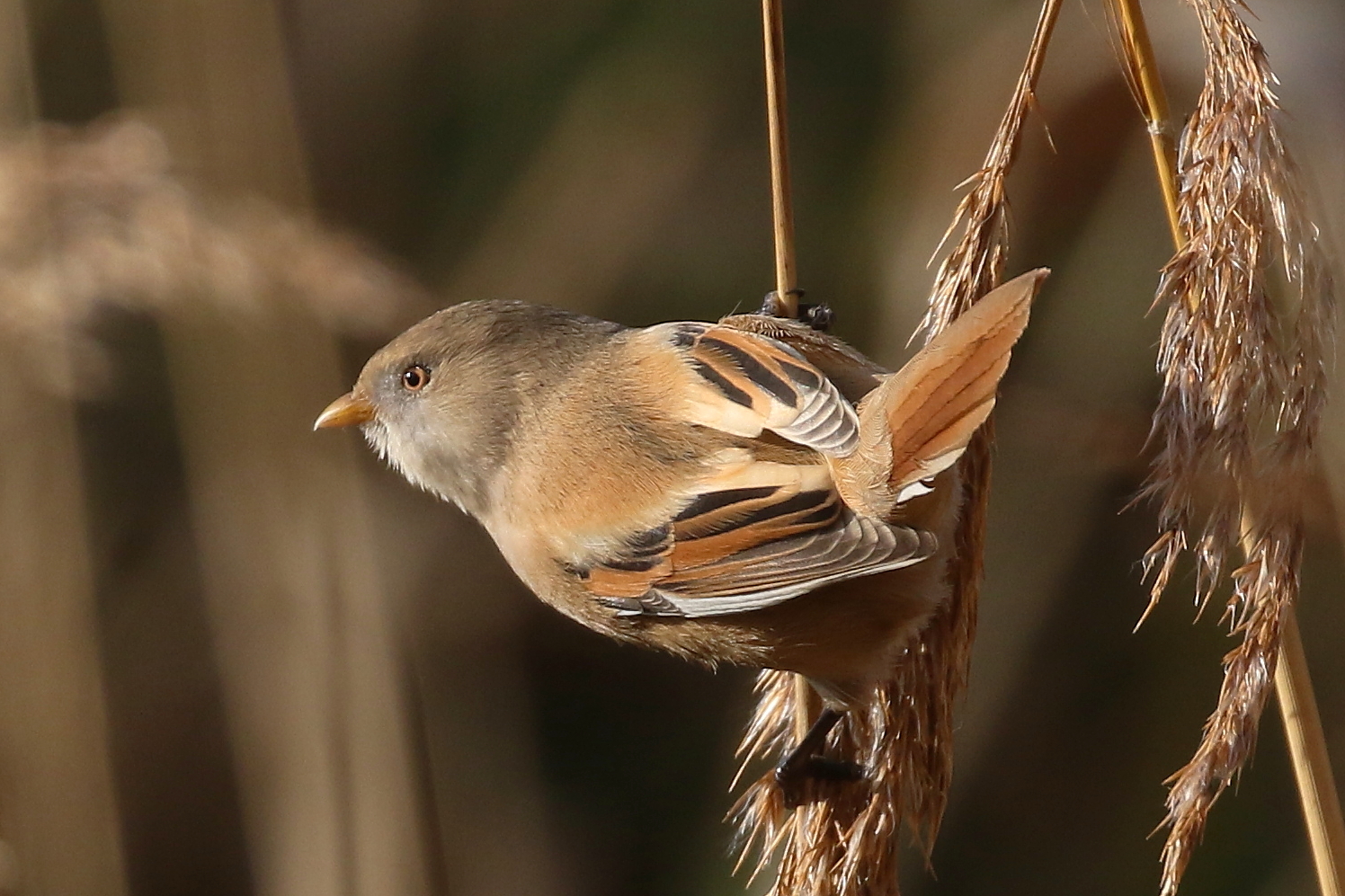
Bearded Tit, Radipole Lake
Blackbird, Radipole Lake
Carrion Crow, Chesil Cove
Dunnock, Radipole Lake
Shelduck, Radipole Lake
Black-headed Gull, Radipole Lake
Common Gull, Radipole Lake
Mediterranean Gull, Radipole Lake
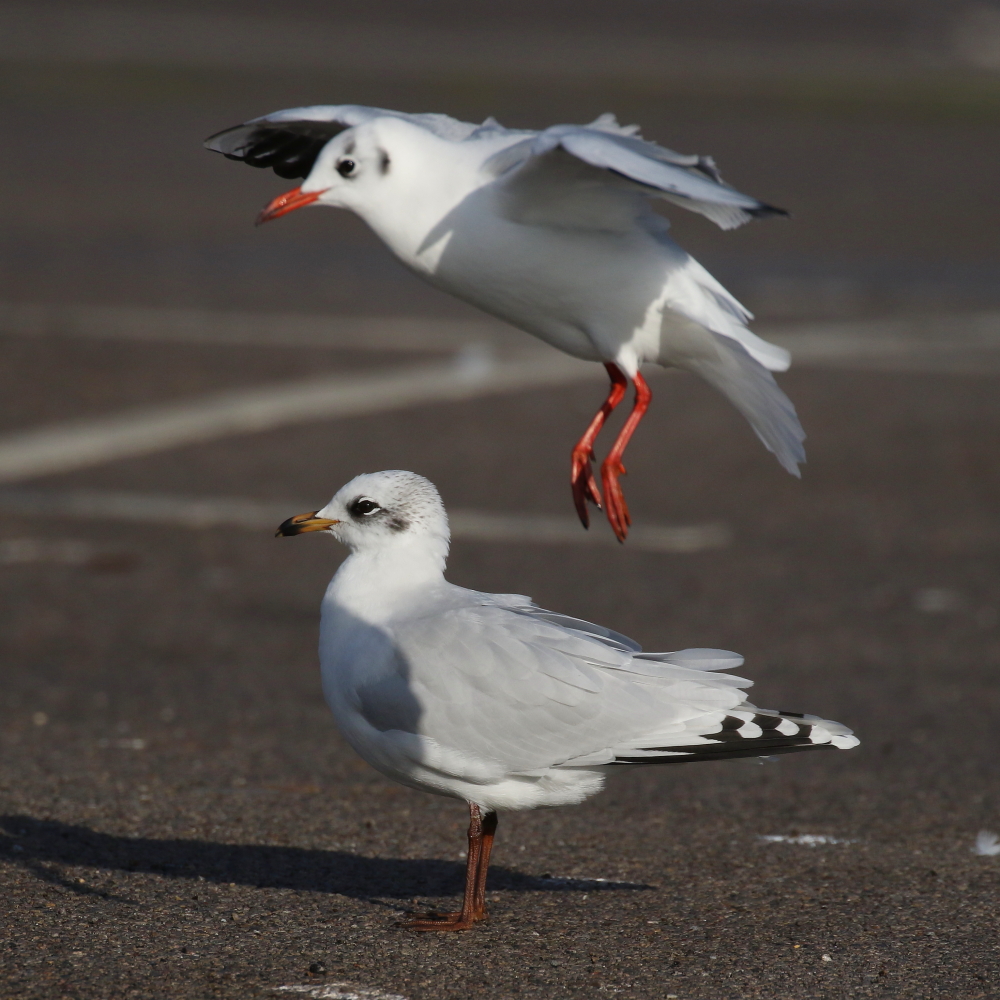
Med Gull with Black-headed Gull above
The drake Hooded Merganser still displaying at Radipole
Always a show-off

Male Marsh Harrier at Radipole
Moorhen, Radipole Lake
Feral Pigeon, Radiploe Lake
Rose-coloured Starling, Dorchester
Not looking so good after a bath
Starling murmuration at Studland