Showing posts with label Spoonbill. Show all posts

Tuesday, 13 March 2018

A look back at the beast

In the excitement of blogging about patch Hawfinches, I almost forgot to recount everything else I saw during the cold snap in the Swineham/Wareham area a couple of weekends ago. In truth, there was nothing spectacular, but plenty of common or scarce species were turning up in unusual locations, some surprisingly easy to see as the harsh conditions forced them into gardens or otherwise into the open in the search for sustenance. The highlights were a Firecrest in my postage stamp of a town centre garden, and an icicle-clad Spoonbill on the main gravel pit at Swineham. Sadly, two of this last species were found dead in recent days in Dorset: one had presumably succumbed to the cold, the other, which had two broken legs, was thought possibly to have snapped them trying to free itself from ice. An illustration of the harsh impacts of the freeze which, judging by the death toll chronicled on social media, befell many individual birds over the course of a few days. And a reminder to put some food out for the garden birds if the coming weekend's forecast of snow materialises.
Adult Spoonbill - I have never seen one with icicles on the breast feathers.
Black-tailed Godwit, one of several hundred on the frozen fields at Bestwall.
A few dozen Curlew were also present.
Fieldfares were in the gardens of Wareham.
Redwings were everywhere, including my town centre garden and this one in the town's churchyard.
Blackbirds were among the other thrushes in the churchyard.
Normally shy Song Thrushes seemed unusually bold in the cold.
Not a great view of a Water Rail - but any view is a good view in the thick reeds at Bestwall. This was one of three of this species out in the open.
This was the only reasonably sharp photograph of the Firecrest in my garden I could manage, snatched through foggy glass with shaking hands!
The first time I have seen ice floes coming up the River Frome!
Swineham Point inundated by a very high tide - Redshanks, Skylarks, Meadow and Rock Pipits were attempting to feed on the ice here.

Within hours of the last snowflake, the onset of spring seemed to resume: temperatures were back up to double figures and this Dunnock was belting out song as if to declare it had survived the harsh conditions.

Saturday, 24 February 2018

White-wingers in Weymouth

I have often wondered whether the island outside the Radipole Lake visitor centre has hosted more rare birds per square metre than any other piece of real estate in the country. If it didn't before today it took a step in the right direction when an exquisite adult Ross's Gull, present in the area since Wednesday, paid a visit. This high arctic species is a great favourite amongst British birders, making very occasional appearances on these shores. The last one I saw was in neighbouring Devon, a tatty juvenile bird, a contrast to today's dapper adult.
Ross's Gull as it flew from Radipole Lake towards Weymouth Bay
Ross's Gull breeds in Siberia, Greenland and northern Canada
Only the 3rd occurrence in Dorset and the first since 1974
Son George and I had been dropped off in Weymouth by his mum and had planned to get the train home so thanks are due to the Mitchells for getting us back to Wareham, and to the kind chap from London who gave us a lift from Lodmoor to Radipole when the Ross's Gull was relocated there in the early afternoon. George is not a huge fan of birding, but he enjoyed the people watching. Desperate twitchers screeched to a halt in the Radipole Car Park wild-eyed and breathless, muscling their way to a good view like sharp-elbowed parents getting their kids into the best schools. Within minutes of seeing the bird, he observed, they were transformed into grinning idiots, generously offering new arrivals a look through their telescopes and slapping the backs of their travelling companions.
Wing-stretching in the harsh light of mid-afternoon...
...followed by a yawn revealing a Black Guillemot style gape
Note the short red legs
Earlier at Lodmoor, while we had been jogging on the spot to keep the cold at bay, hoping the Ross's Gull would drop in there, a couple of rather more substantial white-winged gulls had provided some good practice for finding the right exposure with the camera: not that I'm complaining, it was lovely crisp weather, but white birds in dark landscapes in the midday sun? Not easy.
The whiter of the two Glaucous Gulls at Lodmoor - note the pale iris
This is the more mottled of the two Glaucous Gulls - note the beadier dark eye
And here both Glaucous Gulls together - the one on the left a particularly fine specimen
With Thayer's, Ring-billed, Caspian and Yellow-legged Gulls all being seen at Blashford Lakes just over the border into Hampshire, intrepid birders who left Weymouth in the early afternoon could have clocked up double figures in gull species in a single day. We were quite happy though to stick around Weymouth, enjoying a major Dorset rarity and a handsome selection of waders on display at Lodmoor.
Lapwing, Lodmoor
Common Snipe, Lodmoor
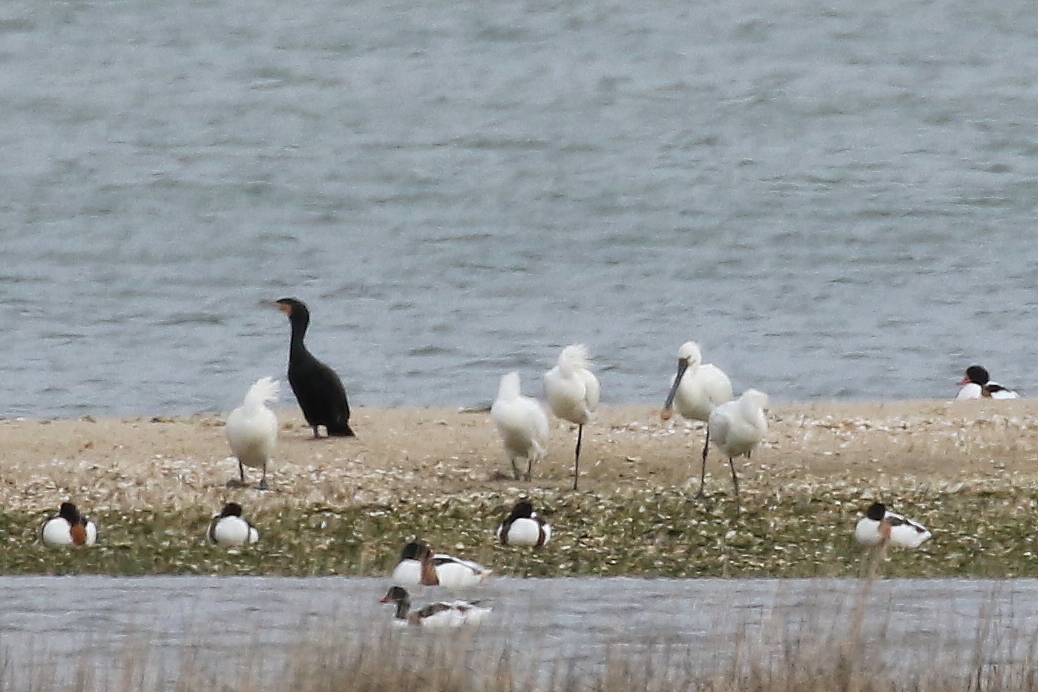
Spoonbills, including a Dutch-ringed Bird, Lodmoor
Ross's Gull, Radipole Lake


Monday, 4 September 2017

300 up

I come from a long-line of under-achievers so when it comes to listing, I try to keep my goals to a bare minimum to avoid disappointment. At this stage of mid-life, in fact, I have just two self-imposed targets - first, to see 300 species of bird in Dorset before reaching the age of 50 and, second, to see 500 species in Britain before I die. Daft these targets may be, but yesterday I ticked off the first of them by adding Baird's Sandpiper to my county list, and with a couple of years to spare.
Common Sandpiper was one of a number of migrant waders on Brownsea
300 species for Dorset is no big deal, of course - the top county listers are closer to 400 than 300, and the county list as a whole currently stands at 423, with at least 3 more species (Spectacled Warbler, Elegant Tern and Yellow Warbler) certain to be added when the 2017 record books come to be written. But having only moved here in 2007 I still think it represents a pretty good effort for a fully-employed father of two who can't always drop everything to chase rarities.
There weren't just migrant birds on Brownsea - this Painted Lady was also on the heath at the top of the island
Yesterday was a case in point: I wrote as recently as June how visits from family/friends were guaranteed to result in the appearance of a rare bird. This weekend the visit of my sister and sister-in-law threatened the same - the rare bird being the Baird's Sandpiper on Brownsea, found on Friday lunchtime by Paul Morton. Work commitments meant there was no chance of twitching it that day, and even though the bird went missing on the Friday afternoon and evening, a day trip to the island on Saturday seemed a good idea. Fortunately our visitors and the rest of the family agreed.
Redshank on the Brownsea lagoon
Soon after our arrival I was scanning the back of the lagoon for waders, and had a brief view of a bird with an obvious pectoral band, apparently smaller than the Dunlin with which it was associating. It was then lost to view in vegetation but I had seen enough to keep an eye on the same area. I was soon joined by Graham Armstrong and we simultaneously locked on to a bird which looked a good candidate, and similar to the one I had seen earlier.
The Spoonbill flock had risen to 26 birds by Saturday - they spent a lot of time in the air flushed by...
...the Red Arrows, in the area for the Bournemouth Air Show
Despite the heat haze and the considerable distance between us and the bird, we gradually pieced together the key features - the pectoral band in combination with otherwise pure white underparts, attenuated rear end, scalloping on the wings, shorter bill and legs, slightly paler and more concolorous upperparts compared to the more variable Dunlin it was with. It was often out of view behind vegetation, and re-locating it required some care due to the haze and the fact that a number of the Dunlin also showed relatively neat pectoral bands - but the latter invariably displayed scruffier underparts and larger heads and bills than the more diminutive Baird's.
In this record shot to end record shots, the bird on the left is the Baird's - even in this terrible image the impression of a slighter bird with a smaller bill, cleaner white underparts and more attenuated rear end is confirmed compared to the Dunlin on the right
Increasingly confident with the identification, we put the news out enabling several Dorset birders to catch up with the rare visitor in the afternoon. The rest of the day was then free to be devoted to touring Brownsea with the family and enjoying its exotic selection of non-native spongecakes and flans.
A slightly better comparison shot of Baird's Sandpiper (right) and Dunlin illustrates the key features mentioned above rather more clearly - this was taken last October at Davidstow Airfield in Cornwall

Sunday, 19 March 2017

Winter highlights: part II

Spring migrants continue to trickle in and while it's not quite a flood, it's a reasonably safe call to declare winter as being over. A few more highlights to look back on then:
Short-eared Owl on Portland - one of a number of wintering birds
This one was flying up the west cliffs
Peregrine, also on Portland
Peregrine
Marsh Harriers have been entertaining visitors to Radipole Lake in Weymouth
A Great Grey Shrike spent much of the winter in Wareham Forest
A late winter arrival was this Snow Bunting on Studland Beach
Great Spotted Woodpecker, Arne
Sika Deer at Arne
Male Siskin at Arne
Female Siskin, Arne
Spoonbills - 5 of 7 at Arne yesterday
And to close, as if to personally declare winter over, the first Wheatear of the year, on Studland beach last weekend.

Tuesday, 21 February 2017

A tale of two estuaries

A short break with the family over half-term in Cornwall gave me the chance to catch up with two species of American duck, both relatively rare on these shores. First on the Hayle, a Green-winged Teal, the American cousin of our Eurasian Teal. We were staying in Hayle, so I nipped out before breakfast to look for it. There are usually plenty of Teal to sift through out in the channel viewable from the causeway over the head of the estuary but on arrival I could see just half a dozen. To my surprise, the Green-winged was one of them and it fed quite close in the shallows on a rising tide.
Drake Green-winged Teal on the Hayle Estuary
This was the entire Teal flock - what chance that one of the six would be the Green-winged?
Green-winged Teal
 A bit of aggression between drakes of the two species
When the Green-winged Teal stood on the mud a metal ring was apparent
Do any ringers out there think this look like a bird band from a North American scheme?
My second American duck of the trip was seen on the way home - an American Wigeon at Exminster Marshes, at the top of the Exe Estuary and just a few miles detour from our route home up the M5. Several large Wigeon flocks were evident on arrival - a slightly daunting prospect to search through them all - but a tip-off from a local birder who was just leaving suggested the bird I was looking for might be in one of the closer flocks. And so it was, picked up with just about my first scan of the bins.
A Spoonbill was also at Hayle
A young bird with horn-coloured bill and some black in the wing tips
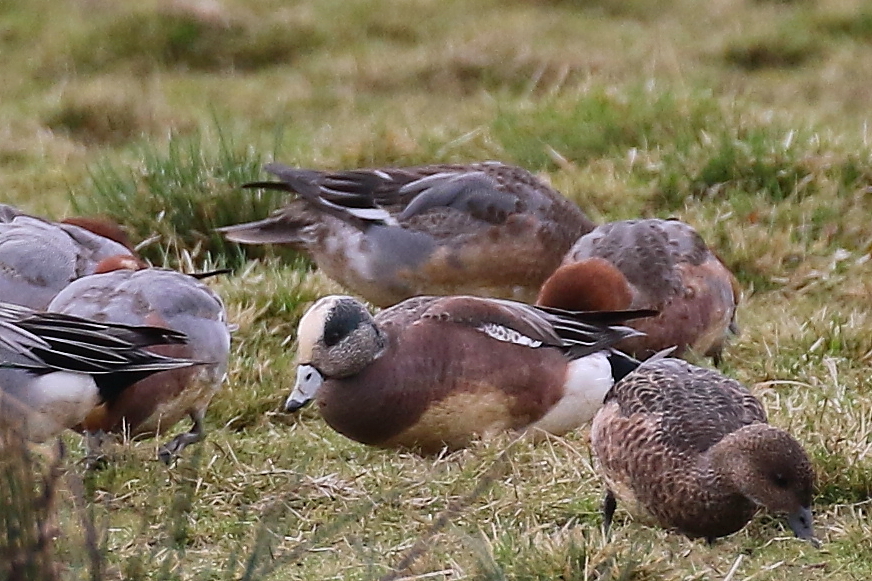
First winter drake American Wigeon at Exminster Marshes
The Wigeon flocks were much larger than the Teal flock on the Hayle...
...but the American Wigeon was quite easy to pick out being near the front of the nearest flock
The American Wigeon spent most of the time feeding intently - a rare view with the head raised here