Showing posts with label Redshank. Show all posts

Tuesday, 9 June 2020

Lockdown diaries: the patch (part 2)

I read a behavioural psychology piece during lockdown which suggested that the longer a new behaviour was adopted by necessity, the more likely it was to 'stick', even after the freedom to abandon it returned. Hopefully this will be the case for all those people who've been buying bikes to get around (I had been dithering about upgrading mine and now can't get one for love nor money!) - but it certainly seemed to apply in the case of my regular visits to my local patch at Swineham. Badly neglected over the last few years, birding there once again became a firm fixture of my weekly routine.
Reed Bunting, singing his heart out at Swineham
Sand Martins roosting in the Swineham reedbeds on one of the rare dull mornings of recent weeks
Whether it was the combination of reduced disturbance during lockdown, the consistently fine weather, the more frequent visits on my part or a combination of all three, birding at Swineham this spring seemed much more rewarding than other recent years. The late April glut of singing Reed and Sedge Warblers sustained well into May and, touch wood, both look set for a good breeding year. 
Reed Warbler - now much easier to see than when they first arrive in April
Reed Warbler
I enjoyed some rewarding morning walks along the river banks, more recently taking the 'long' route which follows the meanders of the River Frome from Wareham for a couple of miles before rounding the eastern end of the main Swineham gravel pit, then heading west up the Piddle Valley back towards town. I would normally follow this route anti-clockwise but on the morning of 29th May I went clockwise figuring it would be better to have the sun behind me as I approached the pool where I had found the Temminck's Stint a few weeks earlier. It was rapidly drying out but still held a Little Ringed Plover, a species which normally just passes through Swineham briefly in spring but which was seen either here or elsewhere around Wareham this year throughout April and May.
A couple of pairs of Sedge Warbler have stayed to breed this year - this one bearing a leg-ring
Stock Dove is often seen around Swineham - but rarely poses this well
I trudged back along the bank of the Frome, a little disappointed, and as I entered the avenue of small trees and bushes just before the churchyard in Wareham, which completes the circular walk described above, I heard a snatch of birdsong which stopped me in my tracks. It was difficult to pick out as the wind was tearing through the poplars above, but my instinct said Marsh Warbler, a rare migrant to Dorset and a species I had heard and seen well last year at Lodmoor in Weymouth. I phoned a couple of local birders to say that I thought I'd found a Marsh Warbler, and had the presence of mind to make a quick recording with the voice memo function on my phone. No sooner had I done so the bird went quiet and remained so for over the next hour.
Marsh Warbler in early morning light at Bestwall
Marsh Warbler in song at Bestwall
The recording wasn't very good and of several people I shared it with, some felt it sounded ok for Marsh Warbler, others favoured Reed Warbler. I was convinced it wasn't the latter so returned in the evening to find the bird still singing, audible more clearly now as the wind had died down. Fellow Swineham regular Trevor arrived and we both felt sure it was a Marsh Warbler. I circulated a better recording to Paul Morton, of Birds of Poole Harbour, who consulted other Sound Approach experts and the diagnosis was confirmed. We remained with the bird until almost dusk but despite singing almost constantly we didn't see it once.
Little Gull at Swineham on 1st June
My first Little Gull at Swineham for several years, possibly because I rather than they haven't been visiting
The following morning Paul was first on site making some fabulous recordings of the Marsh Warbler's varied repertoire of mimicry - over its four day stay it was heard to do Nightingale, Blue Tit, Great Tit, Blackbird, Green Woodpecker, Cetti's Warbler, Magpie, Goldfinch, Swallow, Wren, Chaffinch, Song Thrush, Jackdaw and Whitethroat. I was hoping for a few more patch ticks from it to be honest (Nightingale being the only one) but you can't have everything...
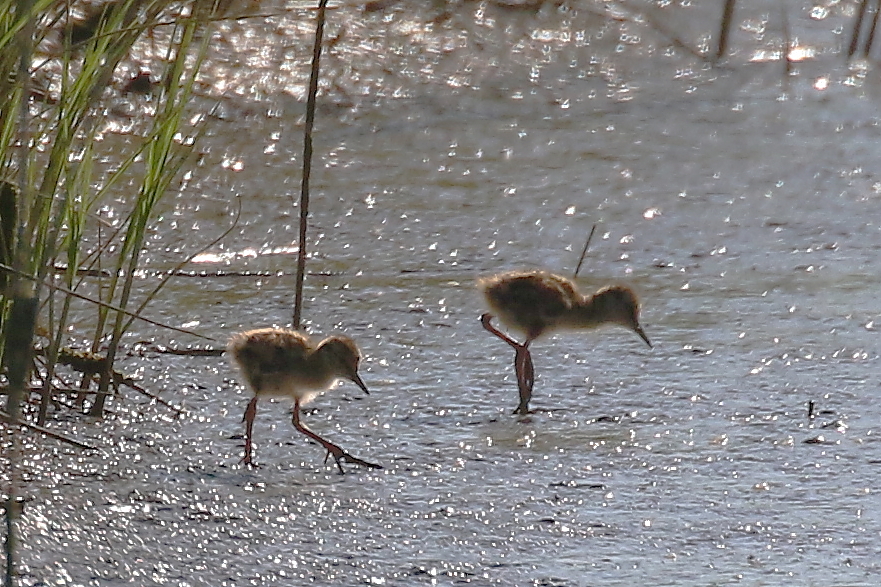
Thrilled to see Redshank breed successfully at Swineham this year
Two of three Redshank chicks at Swineham on 31st May
After the Temminck's Stint and Marsh Warbler I was on a bit of a roll so, following an early start with the latter, I spent the rest morning of the morning of 31sy May searching Swineham for a good 'hat-trick' bird. It came in the form of an unseasonal Short-eared Owl flushed from the path at the end of the gravel pit - not unheard of at Swineham, but very rare for the time of year. It landed on Swineham Point and stared at me for a few minutes before fleeing in response to repeated divebombing by a pair of protective Redshank looking out for their brood of youngsters which can't have been more than a few days old. My best day at Swineham of the spring was capped by capturing a distant image of the hepatic (rufous morph) female Cuckoo which I had seen several times but never for long enough to raise the camera.
Short-eared Owl at Swineham Point
An unexpected bird for late May
The following evening Phil Saunders, who'd come to listen to the Marsh Warbler, picked up a probable Caspian Tern flying up the Frome towards Poole Harbour. Finding that would have made for a superb hat-trick of Swineham spring rarities! Trevor and I headed to Swineham Point and although we couldn't relocate it, we were rewarded at dusk with a 1st summer Little Gull calling over the gravel pit and a Nightjar churring way across the water of the Wareham Channel on the Arne peninsular - a superb ending to a memorable month at Swineham.
Hepatic Cuckoo - a stunning bird
Orange Tip on Bluebells - another memorable moment from an excellent spring on the local patch


Thursday, 14 June 2018

A pinch of saltmarsh

My sons are both 'Kentish Men', born in the Garden of England west of the Medway, but since we left the county in 2007, visits back there have been a bit few and far between. The recent birthday of a former neighbour provided one such opportunity, and Sunday morning offered a chance to reacquaint myself with an old favourite, the Elmley Marshes Natural Nature Reserve on the Isle of Sheppey.
A breeding plumage Yellow Wagtail always brightens the day 

Yellow Wagtails are very leggy enabling them to stalk through the long grass of the grazing marsh
This unusually bold bird was strutting up the entrance track calling constantly
A wider angle view perched on thistle
Although it was a brief encounter, after my last few visits when breeding birds seemed a bit thin on the ground, it felt a bit like the 'old days' at the turn of the century when I first started going there: breeding waders like Lapwing and Redshank appeared to be doing well, as were the ground-nesting passerines - Yellow Wagtail, Corn Bunting, Meadow Pipit and Skylark.
Wonderful close-up views of Redshank from the car window
Juvenile Redshank
Marsh Harriers were very much in evidence...
...much to the chagrin of the breeding Lapwings
All the photographs in this post were taken using the car as a hide on the 2 mile entrance track to the reserve centre. Since the reserve management reverted from the RSPB to the private owner a few years ago, the area around the farm complex has undergone some reconfiguration, with more provision for paying guests and conversion of farm buildings. But if that's helping to pay for the conservation work, I'm certainly not complaining.
This adult male Lapwing was sporting a spectacular crest
Increased Lapwing chick productivity is one of the key management aims on the reserve: here's one they prepared earlier
Stunning iridescence on this roosting bird
My car's reflection can be seen in the eye of this Lapwing photographed at close range
I rediscovered an interest in the natural world relatively late in life, and it was a visit to Elmley back in the late 1990s which re-ignited a childhood fascination with birds which had been dormant while I was studying and working in London in my 20s. One of my earliest memories of the reserve was a Corn Bunting singing from a trackside bush - so I was touched to see another singing from the same bush on Sunday. The children haven't yet learned to share my pleasure at being on the grazing marshes and saltmarshes of Sheppey. Thankfully, for as long as good conservation management continues, there is still time.
Meadow Pipit
A flock of Stock Dove was nice to see
Skylark
Corn Bunting

Monday, 4 September 2017

300 up

I come from a long-line of under-achievers so when it comes to listing, I try to keep my goals to a bare minimum to avoid disappointment. At this stage of mid-life, in fact, I have just two self-imposed targets - first, to see 300 species of bird in Dorset before reaching the age of 50 and, second, to see 500 species in Britain before I die. Daft these targets may be, but yesterday I ticked off the first of them by adding Baird's Sandpiper to my county list, and with a couple of years to spare.
Common Sandpiper was one of a number of migrant waders on Brownsea
300 species for Dorset is no big deal, of course - the top county listers are closer to 400 than 300, and the county list as a whole currently stands at 423, with at least 3 more species (Spectacled Warbler, Elegant Tern and Yellow Warbler) certain to be added when the 2017 record books come to be written. But having only moved here in 2007 I still think it represents a pretty good effort for a fully-employed father of two who can't always drop everything to chase rarities.
There weren't just migrant birds on Brownsea - this Painted Lady was also on the heath at the top of the island
Yesterday was a case in point: I wrote as recently as June how visits from family/friends were guaranteed to result in the appearance of a rare bird. This weekend the visit of my sister and sister-in-law threatened the same - the rare bird being the Baird's Sandpiper on Brownsea, found on Friday lunchtime by Paul Morton. Work commitments meant there was no chance of twitching it that day, and even though the bird went missing on the Friday afternoon and evening, a day trip to the island on Saturday seemed a good idea. Fortunately our visitors and the rest of the family agreed.
Redshank on the Brownsea lagoon
Soon after our arrival I was scanning the back of the lagoon for waders, and had a brief view of a bird with an obvious pectoral band, apparently smaller than the Dunlin with which it was associating. It was then lost to view in vegetation but I had seen enough to keep an eye on the same area. I was soon joined by Graham Armstrong and we simultaneously locked on to a bird which looked a good candidate, and similar to the one I had seen earlier.
The Spoonbill flock had risen to 26 birds by Saturday - they spent a lot of time in the air flushed by...
...the Red Arrows, in the area for the Bournemouth Air Show
Despite the heat haze and the considerable distance between us and the bird, we gradually pieced together the key features - the pectoral band in combination with otherwise pure white underparts, attenuated rear end, scalloping on the wings, shorter bill and legs, slightly paler and more concolorous upperparts compared to the more variable Dunlin it was with. It was often out of view behind vegetation, and re-locating it required some care due to the haze and the fact that a number of the Dunlin also showed relatively neat pectoral bands - but the latter invariably displayed scruffier underparts and larger heads and bills than the more diminutive Baird's.
In this record shot to end record shots, the bird on the left is the Baird's - even in this terrible image the impression of a slighter bird with a smaller bill, cleaner white underparts and more attenuated rear end is confirmed compared to the Dunlin on the right
Increasingly confident with the identification, we put the news out enabling several Dorset birders to catch up with the rare visitor in the afternoon. The rest of the day was then free to be devoted to touring Brownsea with the family and enjoying its exotic selection of non-native spongecakes and flans.
A slightly better comparison shot of Baird's Sandpiper (right) and Dunlin illustrates the key features mentioned above rather more clearly - this was taken last October at Davidstow Airfield in Cornwall

Friday, 23 December 2016

May...

Donald Trump said yesterday that he thinks the USA needs to tool up with more nukes. Well, greetings of the season of peace and goodwill to you too, Mr President-elect. With 2016 being seriously discussed among historians as a candidate for 'the worst year ever', the ominous tweet seemed almost designed to underline how little there is to look forward to in 2017 for those on the lunatic fringe who think nuclear holocaust a very bad idea. A good excuse to look back, then, to a time before democracy proved it's not all it's cracked up to be - to spring, and to May in particular, whose turn it is in my review of the year, as migrant birds arrived in their millions to distract us from the grim realities of existence.

The first half of the month was enlivened by some rare and scarce visitors to my adopted home county of Dorset - Kentish Plover, Black-winged Stilt and Red-rumped Swallow were all good birds, but top billing went a to dashing female Red-footed Falcon at nearby Morden Bog and a Great Spotted Cuckoo on Portland - a Dorset tick for me and many others. It gorged on Brown-tail moth caterpillars, which can be found in huge numbers at Reap Lane, for several weeks.
Red-footed Falcon, Morden Bog: my photo of the month for May
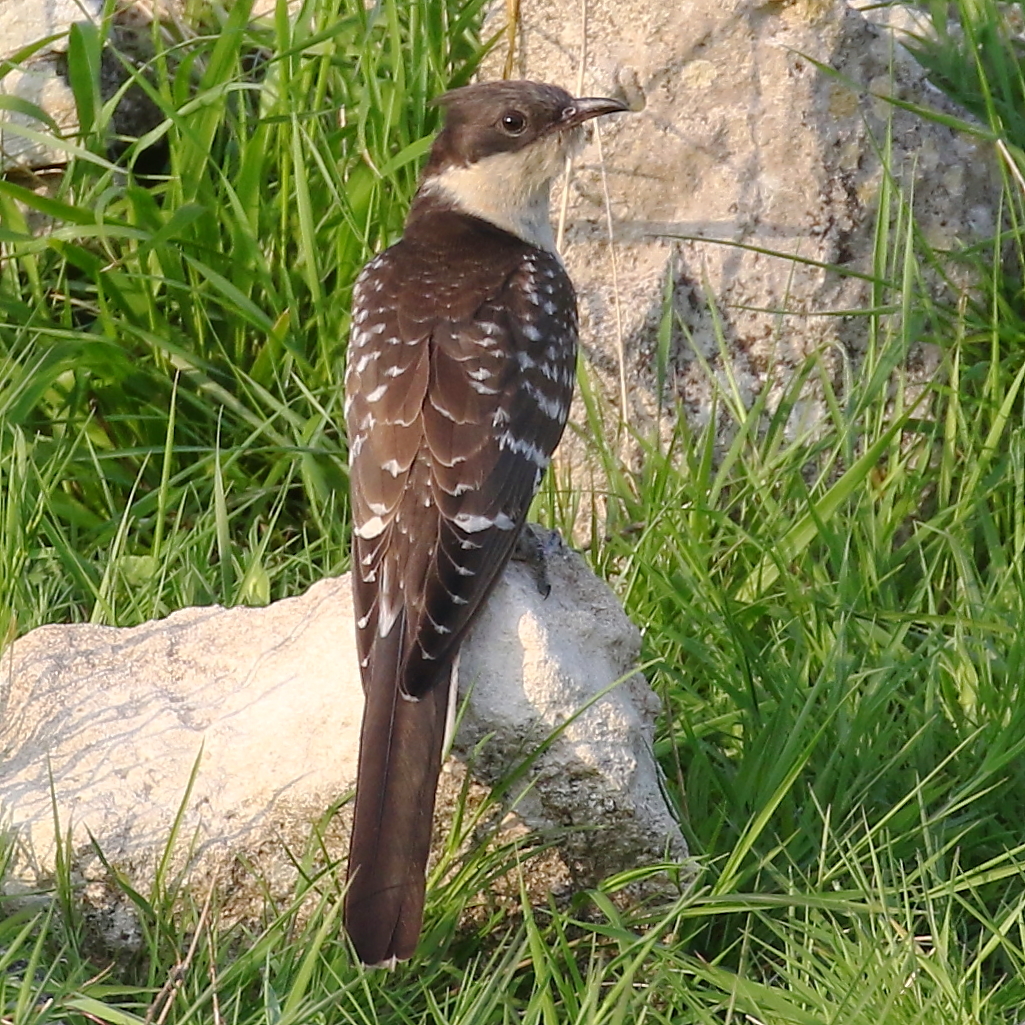
Great Spotted Cuckoo, Portland
Red-rumped Swallow, Lodmoor
Kentish Plover, Ferrybridge
Lepidoptera loomed quite large in my life in 2016: as well as being the first spring in which I had the opportunity to put my new lens through its paces photographing these smaller subjects, I steered an Action Plan for Pollinators through to adoption at Dorset County Council - a small but important attempt to boost the prospects of our declining butterflies, moths and other pollinating insects. Later in the year, some wildflower verges we had created as part of this got a hugely positive reaction from the public - the first time in my twelve year career in local government when the compliments in my inbox have outstripped the complaints! But back to May, which saw the emergence of many sought after species around Dorset's butterfly hotspots:
Duke of Burgundy, Cerne Abbas
Green Hairstreak, Cerne Abbas
Small Blue, Portland
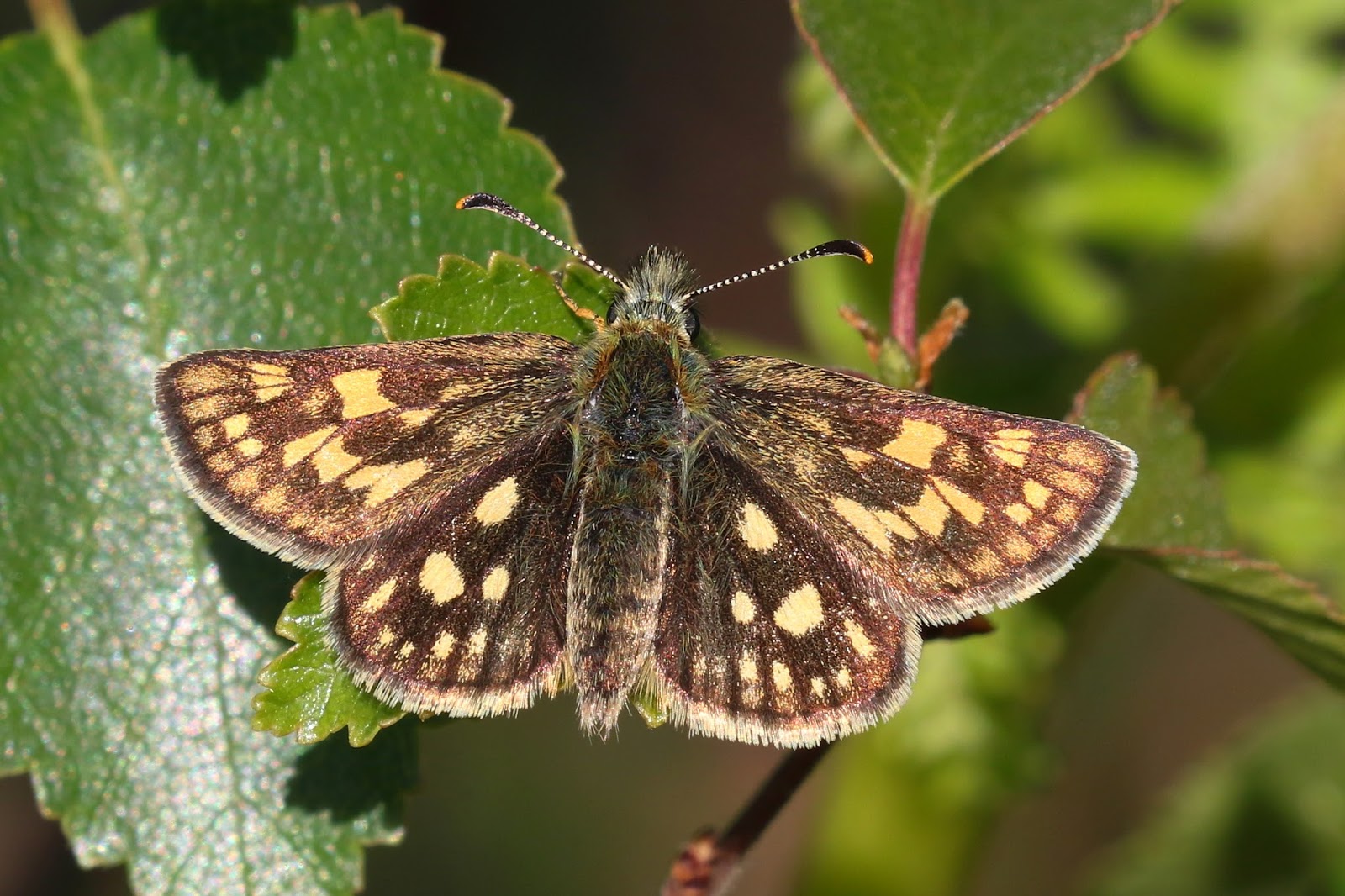
Chequered Skipper - a rarity in Britain restricted to a few sites in north west Scotland - we visited one at Allt Mhuic on the way south from a trip to the Outer Hebs
May ended with one of my most epic and enjoyable adventures of 2016 - a three day trip to the Outer Hebrides with David Bradnum and Paul Welling. We made this mammoth journey to pay homage to the unprecedented spring occurrence of a Black-billed Cuckoo from the Americas and, having done so, to appreciate the dramatic landscapes, the breeding waders and other wildlife of North Uist, South Uist and Benbecula:
Black-billed Cuckoo, North Uist: bird of the month for May
Corncrake, North Uist
Redshank, Outer Hebrides
Female Red-necked Phalarope, Outer Hebrides
One of the highlights of the year and the furthest I travelled in 2016. Fortunately it came at the start of a week off providing for a leisurely stay to appreciate the breeding birds on the Hebrides as well as the vagrant Cuckoo - I would have had neither the energy nor the inclination to just 'smash and grab' the rarity in such a memorable location. And no, Mr Trump, it would not be a good place for a golf course...