Showing posts with label Short-eared Owl. Show all posts

Tuesday, 9 June 2020

Lockdown diaries: the patch (part 2)

I read a behavioural psychology piece during lockdown which suggested that the longer a new behaviour was adopted by necessity, the more likely it was to 'stick', even after the freedom to abandon it returned. Hopefully this will be the case for all those people who've been buying bikes to get around (I had been dithering about upgrading mine and now can't get one for love nor money!) - but it certainly seemed to apply in the case of my regular visits to my local patch at Swineham. Badly neglected over the last few years, birding there once again became a firm fixture of my weekly routine.
Reed Bunting, singing his heart out at Swineham
Sand Martins roosting in the Swineham reedbeds on one of the rare dull mornings of recent weeks
Whether it was the combination of reduced disturbance during lockdown, the consistently fine weather, the more frequent visits on my part or a combination of all three, birding at Swineham this spring seemed much more rewarding than other recent years. The late April glut of singing Reed and Sedge Warblers sustained well into May and, touch wood, both look set for a good breeding year. 
Reed Warbler - now much easier to see than when they first arrive in April
Reed Warbler
I enjoyed some rewarding morning walks along the river banks, more recently taking the 'long' route which follows the meanders of the River Frome from Wareham for a couple of miles before rounding the eastern end of the main Swineham gravel pit, then heading west up the Piddle Valley back towards town. I would normally follow this route anti-clockwise but on the morning of 29th May I went clockwise figuring it would be better to have the sun behind me as I approached the pool where I had found the Temminck's Stint a few weeks earlier. It was rapidly drying out but still held a Little Ringed Plover, a species which normally just passes through Swineham briefly in spring but which was seen either here or elsewhere around Wareham this year throughout April and May.
A couple of pairs of Sedge Warbler have stayed to breed this year - this one bearing a leg-ring
Stock Dove is often seen around Swineham - but rarely poses this well
I trudged back along the bank of the Frome, a little disappointed, and as I entered the avenue of small trees and bushes just before the churchyard in Wareham, which completes the circular walk described above, I heard a snatch of birdsong which stopped me in my tracks. It was difficult to pick out as the wind was tearing through the poplars above, but my instinct said Marsh Warbler, a rare migrant to Dorset and a species I had heard and seen well last year at Lodmoor in Weymouth. I phoned a couple of local birders to say that I thought I'd found a Marsh Warbler, and had the presence of mind to make a quick recording with the voice memo function on my phone. No sooner had I done so the bird went quiet and remained so for over the next hour.
Marsh Warbler in early morning light at Bestwall
Marsh Warbler in song at Bestwall
The recording wasn't very good and of several people I shared it with, some felt it sounded ok for Marsh Warbler, others favoured Reed Warbler. I was convinced it wasn't the latter so returned in the evening to find the bird still singing, audible more clearly now as the wind had died down. Fellow Swineham regular Trevor arrived and we both felt sure it was a Marsh Warbler. I circulated a better recording to Paul Morton, of Birds of Poole Harbour, who consulted other Sound Approach experts and the diagnosis was confirmed. We remained with the bird until almost dusk but despite singing almost constantly we didn't see it once.
Little Gull at Swineham on 1st June
My first Little Gull at Swineham for several years, possibly because I rather than they haven't been visiting
The following morning Paul was first on site making some fabulous recordings of the Marsh Warbler's varied repertoire of mimicry - over its four day stay it was heard to do Nightingale, Blue Tit, Great Tit, Blackbird, Green Woodpecker, Cetti's Warbler, Magpie, Goldfinch, Swallow, Wren, Chaffinch, Song Thrush, Jackdaw and Whitethroat. I was hoping for a few more patch ticks from it to be honest (Nightingale being the only one) but you can't have everything...
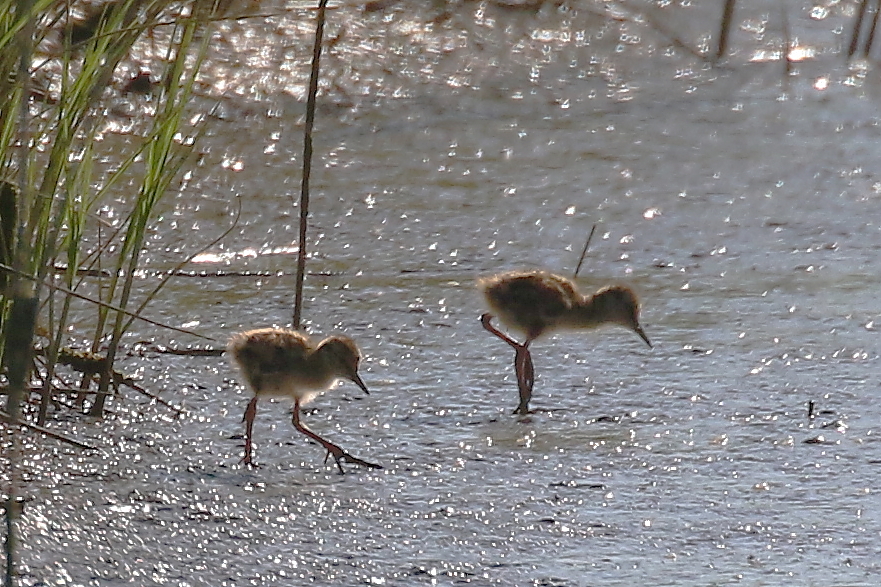
Thrilled to see Redshank breed successfully at Swineham this year
Two of three Redshank chicks at Swineham on 31st May
After the Temminck's Stint and Marsh Warbler I was on a bit of a roll so, following an early start with the latter, I spent the rest morning of the morning of 31sy May searching Swineham for a good 'hat-trick' bird. It came in the form of an unseasonal Short-eared Owl flushed from the path at the end of the gravel pit - not unheard of at Swineham, but very rare for the time of year. It landed on Swineham Point and stared at me for a few minutes before fleeing in response to repeated divebombing by a pair of protective Redshank looking out for their brood of youngsters which can't have been more than a few days old. My best day at Swineham of the spring was capped by capturing a distant image of the hepatic (rufous morph) female Cuckoo which I had seen several times but never for long enough to raise the camera.
Short-eared Owl at Swineham Point
An unexpected bird for late May
The following evening Phil Saunders, who'd come to listen to the Marsh Warbler, picked up a probable Caspian Tern flying up the Frome towards Poole Harbour. Finding that would have made for a superb hat-trick of Swineham spring rarities! Trevor and I headed to Swineham Point and although we couldn't relocate it, we were rewarded at dusk with a 1st summer Little Gull calling over the gravel pit and a Nightjar churring way across the water of the Wareham Channel on the Arne peninsular - a superb ending to a memorable month at Swineham.
Hepatic Cuckoo - a stunning bird
Orange Tip on Bluebells - another memorable moment from an excellent spring on the local patch


Sunday, 19 March 2017

Winter highlights: part II

Spring migrants continue to trickle in and while it's not quite a flood, it's a reasonably safe call to declare winter as being over. A few more highlights to look back on then:
Short-eared Owl on Portland - one of a number of wintering birds
This one was flying up the west cliffs
Peregrine, also on Portland
Peregrine
Marsh Harriers have been entertaining visitors to Radipole Lake in Weymouth
A Great Grey Shrike spent much of the winter in Wareham Forest
A late winter arrival was this Snow Bunting on Studland Beach
Great Spotted Woodpecker, Arne
Sika Deer at Arne
Male Siskin at Arne
Female Siskin, Arne
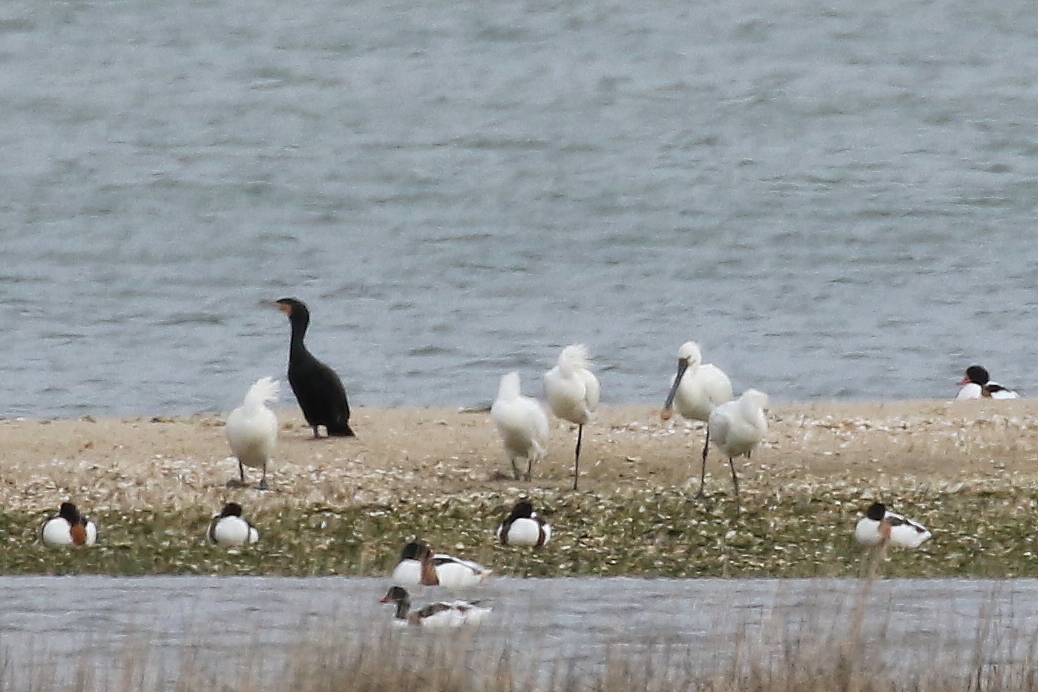
Spoonbills - 5 of 7 at Arne yesterday
And to close, as if to personally declare winter over, the first Wheatear of the year, on Studland beach last weekend.

Monday, 19 October 2015

Owling on Portland

Sandwiched between close encounters with a Red-backed Shrike, I spent yesterday afternoon on Portland looking for owls. I would say 'owling' but, according to the trusty Urban Dictionary, rather than 'looking for owls', this apparently now means perching owl-like on a variety of objects and photographing one's self before tweeting (hooting, surely?) the results out on the internet. Kids today.

Short-eared Owls had been coming in off the sea all weekend and while I was unable to stay 'til dusk, which would have provided the best chance of seeing multiple birds hunting and going to roost, I was reasonably confident about seeing one as they are the most likely owl to be seen flying in the daytime. In the end I saw just one, flushed from a field edge as I walked along the west cliffs - it flew directly away and dropped out of sight so I was only able to get a rear view record shot. Frustrating, but they all count for the photo yearlist. Much more compliant were the Portland Bill Little Owls, catching some rays in the afternoon sun. Also the first time I have photographed this species in 2015.
Little Owl, Portland Bill (#228)
I spent a happy 10 minutes photographing the Little Owls before an over-enthusiastic photographer bounded up behind me - at this point they decided they didn't want that big an audience and retired to their crevices
'No more photos!'
The wrong end of a Short-eared Owl (#229)
Northern Wheatear against the backdrop of Portland Bill's Top Fields
Windswept grass, sea, sky - and birds: Portland in October

Tuesday, 8 October 2013

Book of the month

Some while ago now I promised a shameless plug for a new book in which I have some photos. As I said at the time, I'm not on commission or the plug would be more shameless, and on more widely read media, than this. But during a week in which I am unlikely to get out with the camera, it's also a good excuse to dust off the originals of pictures which appear in various guises in 52 Wildlife Weekends, the latest offering from veritable polymath and all round good sort, James Lowen.

I got to know James through a mutual friend in Geneva who always said 'you should get in touch with James, he's into birdspotting and that'. But it took a White-tailed Plover at Rainham Marshes for me to actually bump into him. Since then we have religiously made no effort whatsoever to meet up, in the certain knowledge that Dusky Thrushes and Black-bellied Dippers will appear with monotonous regularity, providing opportunities for chance encounters.
This handsome Short-eared Owl appears in a chapter on the Dee Estuary
If you buy the book, which you obviously should, you will find squeezed within its 234 pages a year's worth of ideas on how to enjoy some of the best wildlife encounters Britain has to offer. It was meticulously researched by a process which must have been an incredible hardship for the author, trudging around Britain, forcing his weary eyes to be clapped upon wildlife spectacle after tedious spectacle, barely able to summon up the enthusiasm to raise his camera and take pictures. On the subject of which, it's nicely illustrated, not by my modest efforts I mean, but by proper photographers whose names you'll recognise like David Tipling, Rebecca Nason and Hugh Harrop, as well as the author himself.

52 Wildlife Weekends will at the very least give you some additional ideas on how to get the most out of a trip you may have in mind anyway, but should also take a lot of the hard work out of planning a short wildlife break. 'Ah', I hear you say, 'but planning the trip is part of the fun for me'. If so, don't worry, it doesn't, like, book the hotel for you, or pack your suitcase or anything. It's just a book, for God's sake.
This Bottlenosed Dolphin illustrates a chapter on Invernesshire.
Just a book, maybe, but one which has something for everyone. If you're an inexperienced wildlife watcher, buy it for a tantalising menu to get your teeth into. If you like a challenge, buy it and try to do them all in a single year to see which comes first: bankruptcy or divorce. And for the keen but narrow-minded bird lover, buy it to broaden your horizons to other critters which, but for a twist of evolution, might still be tickable.

For the hardcore wildlife know-all inclined to snort 'pah, I don't need a book to tell me where to watch wildlife', buy it to tick off all the places you've already 'done' to confirm your sense of superiority over people with commitments, families, friends and stuff. And if you're so rich that you don't even have to wait for the weekend to go watch wildlife, then...well, I dunno, hire some of the rest of us to work as Sherpas or something, just don't rub it in. It sounds like you can afford to buy it whatever and at £14.99, probably less on Amazon, it's barely the price of a pint of milk. No need to check that with the nanny, it's true.

This Chough appears on the contents page. Taken at South Stack a few years ago.
So really there's no excuse not to buy it, except perhaps grinding poverty, a total lack of access to all good bookshops, or a complete disinterest in wildlife and/or weekends. Well done James for getting the right balance between entertaining prose and useful information. And thanks also for the idea for my own book: 1000 Birding Hotspots To Visit At Someone Else's Expense Before They Die. Coming soon to the bargain basket of a remaindered bookstore near you. Pre-order for next year's Birdfair and I might even write it.
The author James Lowen sporting what his mates describe as 'full camo gear' at the Dusky Thrush twitch, May 2013

Tuesday, 9 April 2013

A rush of blood

I was out of county on Saturday on family business when two parties of Stone Curlews turned up on the West Dorset coast, and while I expected them to move on overnight, Sunday morning provided a slim chance to get this species on my Dorset list. I went for the pair at West Bexington which had shown well the previous evening, and eventually saw them in a stubble field with the help of the finder Alan Barrett and his fellow patch watcher Mike Morse. The birds were quite distant, but Mike had managed to check a colour ring combination which later revealed that at least one of them bred in neighbouring Wiltshire.

Skylark, Aust Warth
The plan for the rest of the day was to catch up with some other locally rare and scarce birds: Garganey at Radipole, Spoonbill at Lodmoor and Great Grey Shrike at Morden Bog. But then the pager reported a Killdeer in Lancashire. It is one of the iron laws of nature that a good bird will turn up just after my holiday comes to an end, but I thought I might have the jump on this one: it was just before 1100, and I reckoned I could be at the Killdeer site by 1530. Maps and crisp packets, along with reason and judgement, were swept off the dashboard and replaced with a satnav, which I set for Longridge and headed north.

Distant Stone Curlews at West Bexington, Dorset

A while later the pager reported that the bird had flown, but I ploughed on, and half an hour later it was back. I found myself uttering an involuntary 'Come on!'. Another half an hour and it was gone again, so it was clearly not a settled individual. At times like this, decisive action is required, so I pulled into the services on the M5 to procrastinate.

Short-eared Owl, Aust Warth
This second negative report saw my adrenaline levels plummet, the rush slowed and after a reflective cup of coffee I concluded that I might as well dip on Twite at nearby Aust Warth and save a tank of fuel as dip on Killdeer in Lancashire. So dip on Twite I did, and for a couple of hours. It was still a good decision as the Killdeer was not seen again all day, and at least there were Short-eared Owls to enjoy at Aust.
Shoveler, Ham Wall RSPB, Somerset
So with two sets of plans for the day not quite coming off, it was time for plan C: return home via the Somerset levels and try to photograph the long-staying Pied-billed Grebe. This was a bit more successful - the bird came quite close, albeit in poor light.

Pied-billed Grebe, Ham Wall RSPB, Somerset
More impressively, it repeatedly gave its distinctive call, a resonant yodel, puffing out a throat sac which seemed to double the thickness of its neck in the process.

The Pied-billed Grebe puffing its throat out and giving a haunting call
If the Little Bitterns return to breed on neighbouring Loxton Marsh this spring, you might be able to hear their distant dog-like booming at the same time as a Pied-billed Grebe calling - a collectors item for the sound recordists out there.

When wary, the Grebe would lie low in the water and not dive but submerge like a submarine with the body held horizontal - an interesting bit of behaviour
The penalty for all this tarting around was to miss a Red-throated Diver, one of my favourite birds, at home on Swineham Gravel Pits. While still present yesterday afternoon, it had gone by the time I got there at dusk, though a Barn Owl, a Marsh Harrier and a ringtail Hen Harrier were some consolation.

Me and the 'Peat Moor' centre on the Somerset Levels: made for each other
And so it was back to work today, secure in the knowledge that a full diary and an even fuller in-tray will prevent any further rushes of blood to the head, at least until the weekend.

Wednesday, 24 October 2012

The joy of flex

One of the small comforts of my job is a flexi-time system which makes the odd twitch possible without eating into precious family holidays. So a Daurian Shrike on Portland was all the justification I needed to book a couple of hours off this afternoon. The bird had been on the Bill Road yesterday, but as I walked down from Southwell it was ominously quiet, save for a bloody-billed Kestrel. Hopefully not Shrike-blood, I thought...
Kestrel on the Bill Road
Turning off the road past Culverwell, I eventually caught up with the Shrike at the far end of a large paddock. A photographer who was packing to go advised me to keep an eye on a nearby bush to which the bird had returned on several occasions.

Daurian Shrike
Sure enough, within ten minutes it did just that to give superb views of a very attractive rarity. October has been pretty quiet for me so far, but with a week on the Isles of Scilly coming up (note: this is one of those 'precious family holidays' of which I spoke earlier), a Dorset tick of such quality was a good way to whet the appetite.

The Shrike heads off to hunt...
After an hour or so the Shrike appeared to go to roost in a bush right next to the path. I had to pass this on the way back to the car so my last view of it was a badly obscured one as it moved around low in the bush, but only about 6 feet away. Talk about close to greatness.

...successfully!
Lower hanging fruit for my County list was also available this evening in the form of a Ring Ouzel, which I have somehow managed to avoid in Dorset despite almost five years of residency. This is obviously not a bird you are going to twitch, and I was sure I would just stumble across one one day, but it just hadn't happened until today. 'Too much twitching' chided Hamish Murray - Dorset birding's Gandalf to my Peregrine Took - when I confessed this to him recently. He's got a point, but I'd like to think that bad luck, habitual over-sleeping and sheer incompetence have also played their part.

Short-eared Owl: one of eight reported on Portland today
Anyway, as if to prove what a bogey bird this had become, I didn't even see my first Dorset Ring Ouzel - as the picture below shows, one was captured just in the frame when I took my initial very distant record shot of the Shrike. The one I actually saw came from a different angle a few minutes later. Doh!

First view of the Shrike on the green post. Unlike me, you can no doubt spot the Ouzel...