Showing posts with label Painted Lady. Show all posts

Thursday, 22 September 2022

July-lights

The post-before-last recounted my longest bike ride of the year to date which saw me cross the Hampshire border for the first time in 2022. A successful venture which made me feel like I had got my cycling mojo back after the frustrations of June. A few days after the Hampshire marathon my legs were still feeling it but a gentle stroll down to the patch was enough to add Yellow-legged Gull to the yearlist. Four adults were present on one of the scrapes which have been a reliable site for this species in recent late summers, and the number rose to 10 later in the week. 

Painted Lady, Tarrant Rushton 17 July

Painted Lady, Tarratn Rushton, 17th July

By the 24th of the month the legs had recovered enough to repeat another summer pilgrimage from last year: a ride to Portland to look for Balearic Shearwater - one of the rarest species in global terms to grace our shores. The journey down cycling into the wind starting at 0530 was challenging, but ultimately successful - a couple of distant 'probables' were followed by a few Balearics close enough to photograph, plus two Arctic Skua and half-a-dozen Manxies.

Corn Bunting, Tarrant Rushton, 17th July

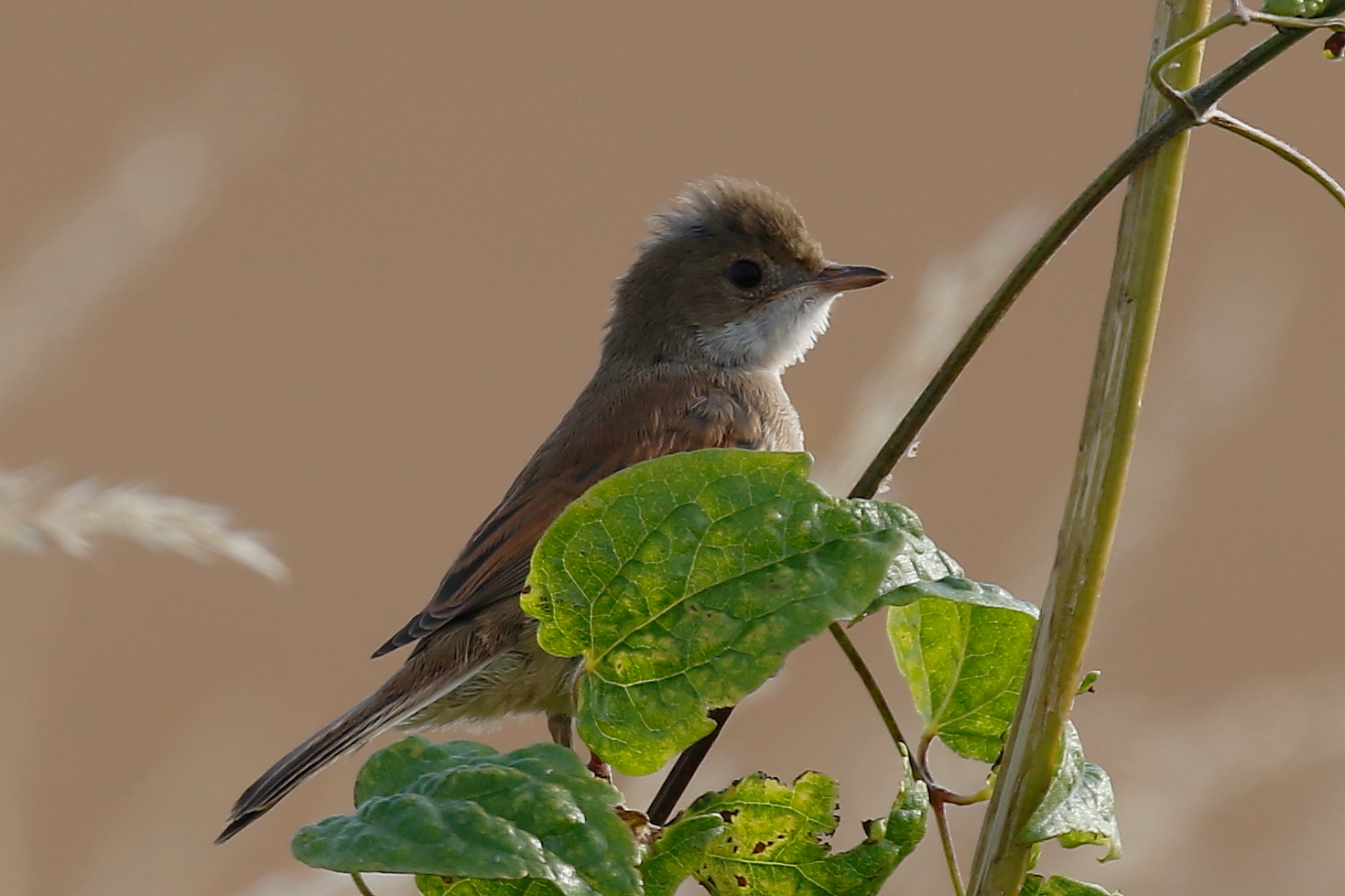
Whitethroat, Tarrant Rushton, 17th July

When I started the 2021 non-motorised yearlist I decided to include 'heard only' species but in the end managed to see everything, including the normally elusive Quail. This year I adopted the same rule which made a visit to Tarrant Rushton airfield, a reliable site for hearing if not seeing Quail, a good option. After dipping on 17th I managed to hear at least 3 calling males at the second attempt on the evening of the 29th. The month saw 6 new species added to bring the yearlist to 192 (compared to 198 at the same point in 2021). 318 miles had been cycled, my second highest total for a month in 2022 after May.
Balearic Shearwater, Portland Bill, 24th July

Balearic Shearwater, Portland Bill, 24th July

Thursday, 19 July 2018

Out for the Count

Well it's Big Butterfly Count time of year again, and unlike in previous years when the obligation on me to promote it via this neglected corner of the internet was purely moral, happily I am now professionally obliged to big it up. Not that it needs much help from me of course: it is already the world's biggest butterfly survey and the data gathered represents one of our finest examples of  'citizen science'.  Spending 15 minutes in a sunny spot - and there have been plenty of those around lately - is all it takes, and it's good for you too, so there's no excuse not to join in really. Even if you don't see much, it's still important to record it. So, off you trot. And if that's not encouragement enough, here are a few pictures to whet your appetite, highlights from many happy moments photographing butterflies over the last few months.
Painted Lady: this pristine migrant brightened up the weekend on the Purbeck coast
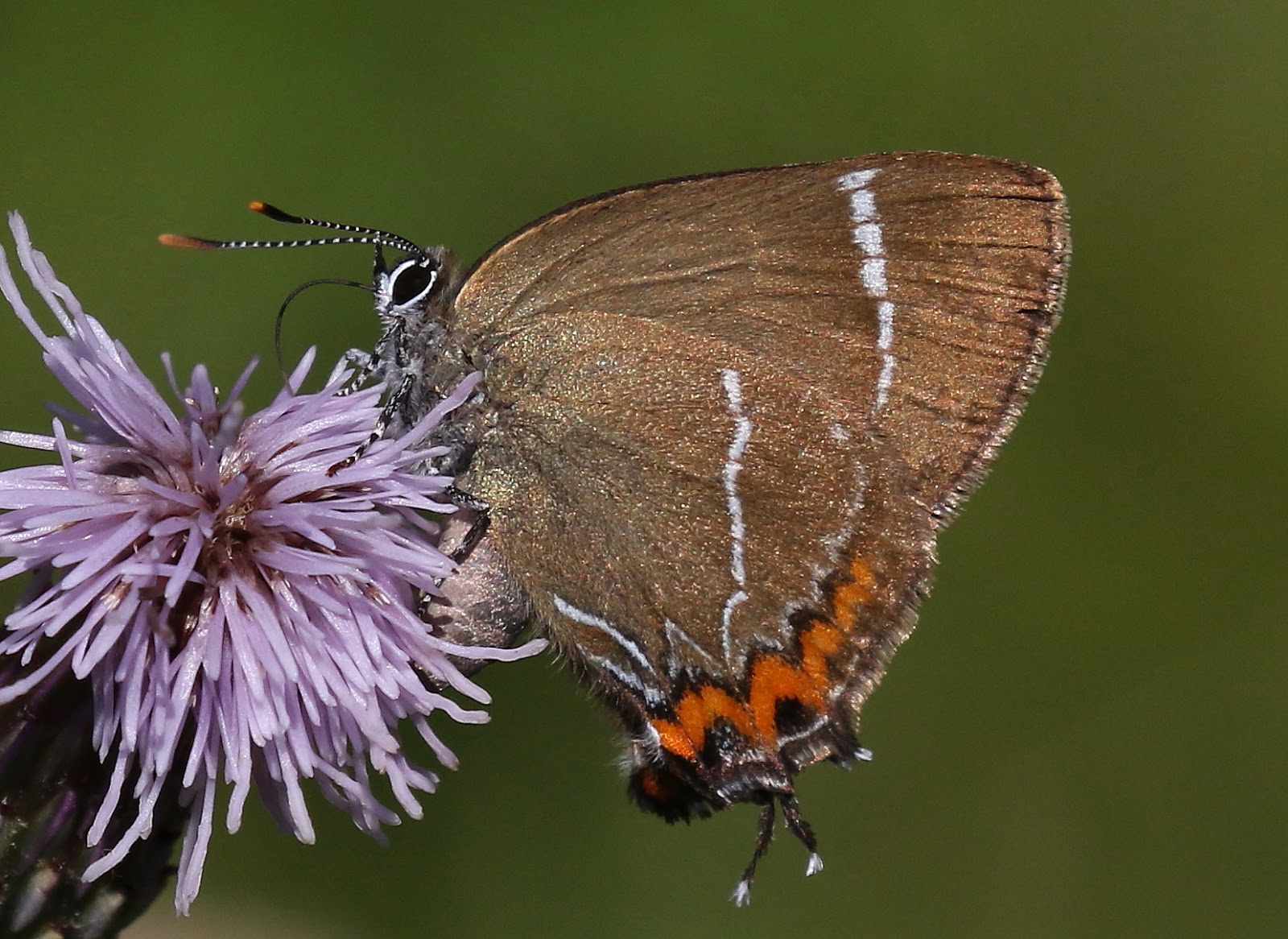
This White-letter Hairstreak was also in good condition - my first in Purbeck (14 July) 
The underwing of this Silver-washed Fritillary reminds me of  the iridescent lining of a mollusc's shell (Purbeck, 14 July)
An Essex Skipper in my tiny town centre garden was a surprise
The antennae tips look dipped in ink with black undersides
Attracted into the garden by our fine display of drought-resistant lavender
Silver-studded Blues emerged in good numbers on the Dorset heaths this year - this a male...
...and this a female (Studland, 24th June)
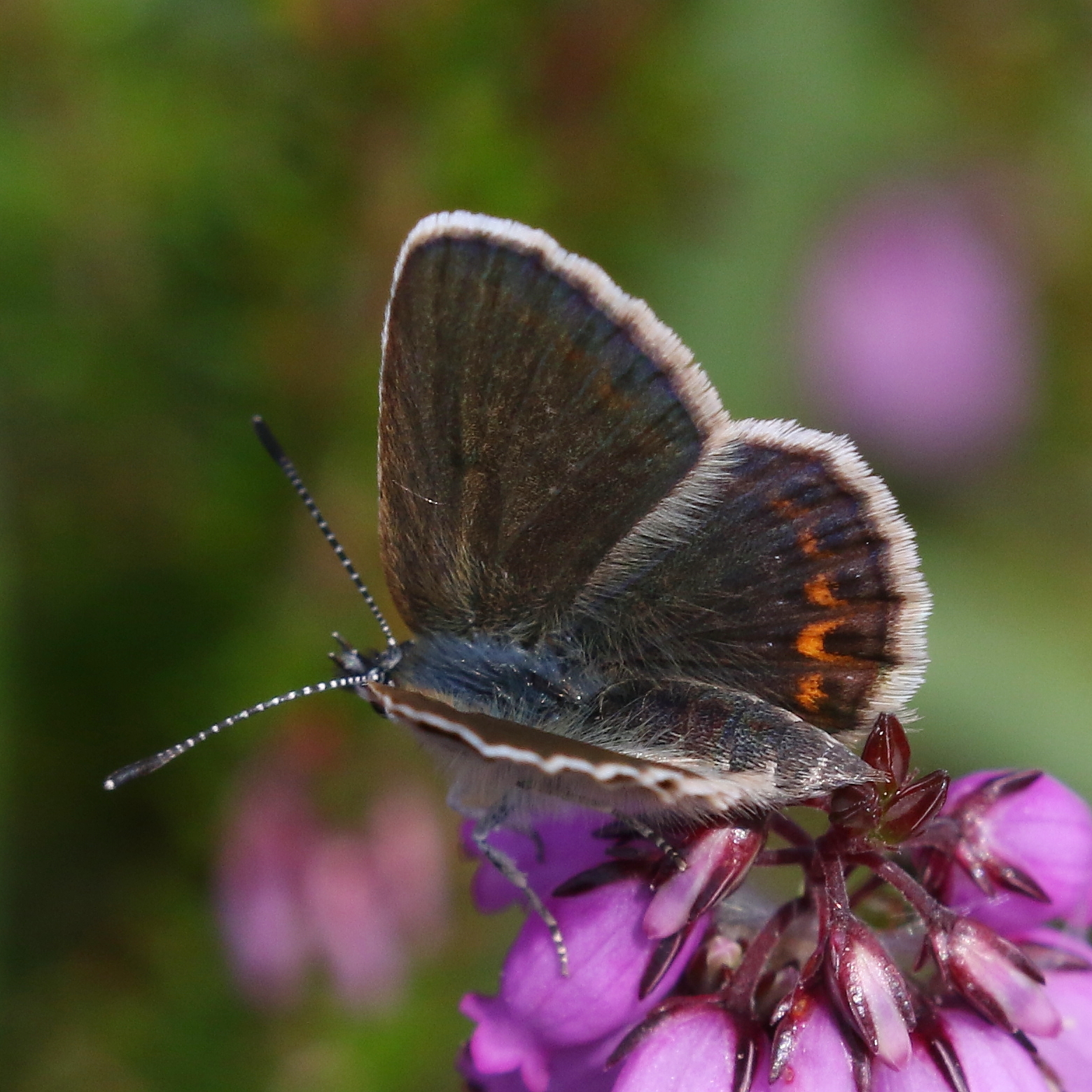
Silver-studded Blues have also been dispersing to non-traditional sites, presumably a function of the heatwave
Note the silver studs on the hind-wing of this female
White Admiral also appears to have had a good summer - this one was at Queen's Copse near Wmborne (23 June)
I visited there shortly after the White Admirals had emerged
'Who doesn't love a White Admiral underwing' I asked on Twitter. 114 kind souls agreed!
A business trip to Northern Ireland provided my first opportunity to see the Cryptic Wood White - having seen all the other regularly occurring species in the UK, this was a highlight of the year for me
There was a good colony at Craigavon Lakes, a grassland site well managed for the butterfly by Craigavon Borough Council (8 June)
We even saw a Cryptic Wood White egg-laying - I don't carry a macro lens so this photograph came out surprisingly well
An evening visit to the extraordinarily beautiful Murlough NNR enabled us to catch up with the Irish form of Marsh Fritillary (7 June) - this an iPhone photo
Adonis Blue at Dancing Ledge on 1 June - a species which doesn't cope well with drought conditions
And here's the English form of Marsh Fritillary (Cerne Abbas, 26 May)
Possibly my favourite fritillary underwing - Marsh Fritillary at Cerne Abbas on 26 May
Marsh Fritillary, Cerne Abbas
A fresh Brown Argus at Cerne Abbas (19 May)
Duke of Burgundy, Cerne Abbas (19 May)
The Duke is another species for which there is concern that the foodplant may be suffering in the drought, causing problems for the caterpillars
Small Blue was doing well this spring on the Weymouth Relief Road verges - more good local authority management by my former employer Dorset County Council
The Small Blue colony is thought to be one of the largest in England - and there were none there at all in 2011 (photo taken 18 May)
So the warm weather has certainly been kind to some species - but there are growing concerns about the impact of drought on the next generation: all the more reason to submit your records for the Count.

Sunday, 10 September 2017

Ragged royalty

Barra for an American Redstart would have been a bridge too far this weekend: Brighton was a more practical destination to see a new species for me in Britain: a Queen of Spain Fritillary butterfly. It's difficult to believe that almost eleven years have passed since I saw my last new British butterfly. That was a Monarch, one of which was just around the corner from a Long-tailed Blue I found earlier in the day on the Isles of Scilly back in October 2006. A few days after that, a Queen of Spain Fritillary was also seen on the islands near the Trenoweth flower farm but despite much searching I was unable to find it.
Male Queen of Spain Fritillary - it looks like it survived a bird attack judging by the state of hind-wing on the right hand side
A slightly more flattering photograph of the fritillary showing the most intact hind-wing
Details of a sighting of three of these rare migrants at Halcombe Farm near Piddinghoe first emerged two weekends ago and was immediately of interest. Unfortunately, the news broke the day before the gloriously sunny Bank Holiday Monday - not the sort of day you want to be driving along the south coast, and I couldn't get away in any case. Last weekend was equally compromised, as being on call for emergencies meant that I was unable to leave Dorset.
The species is known for spending much of the time basking on the ground: this one was no exception
A brief bout of nectaring provided one of the few opportunities to get a shot of the bold silver spots on the underwing
Discussing the survival chances of the fritillaries with Phil Sterling during the week, he was pretty convinced that unless the weather turned really foul, they would still be present this weekend. So with one eye on the forecast, and the other on Butterfly Conservation's excellent Sussex branch website, I resolved to go on Saturday as full sunshine was promised throughout the morning. Internet updates suggested that two individuals were still present on Thursday, both looking more than a little worn, and that was enough to persuade me to make the effort of an early start to beat the traffic yesterday morning.
This Clouded Yellow was one of 15 butterfly species on view at Halcome Farm
Comma
I arrived at Halcombe Farm around 0900 and began combing the area around a bonfire which was being used as a lek site by the fritillaries - all three having been identified as males. As the morning warmed up, a Clouded Yellow landed nearby but there was no sign of the fritillaries. Other butterflies, and then another butterfly watcher, arrived. We split up and shortly before 1000 he gave me a shout to indicate he had found one.
A female Adonis Blue was lying low in the grass
A male Common Blue was easier to see
Queen of Spain Fritillary is reasonably common on the near continent but still very rare in the UK with just a few hundred records and a small number of unsuccessful attempts at colonising documented. So despite the slightly ragged appearance of the visiting royalty, I was very glad I got to see one of the trio before their inevitable demise, particularly as the famous bonfire is apparently scheduled to go up in smoke within a matter of days.
Small Copper
Small Heath
Well done and thanks to the diligent transect walker, Dave Harris, who first discovered them, to Neil Hulme for getting the news and directions out to the wider world, and to the landowner Colin Appleton for allowing access to the site which has provided a lot of pleasure to many visitors over the last fortnight.
Brown Argus
Painted Lady - another migrant at Halcombe Farm
The bonfire adopted by the Queen of Spain Fritillaries

Monday, 4 September 2017

300 up

I come from a long-line of under-achievers so when it comes to listing, I try to keep my goals to a bare minimum to avoid disappointment. At this stage of mid-life, in fact, I have just two self-imposed targets - first, to see 300 species of bird in Dorset before reaching the age of 50 and, second, to see 500 species in Britain before I die. Daft these targets may be, but yesterday I ticked off the first of them by adding Baird's Sandpiper to my county list, and with a couple of years to spare.
Common Sandpiper was one of a number of migrant waders on Brownsea
300 species for Dorset is no big deal, of course - the top county listers are closer to 400 than 300, and the county list as a whole currently stands at 423, with at least 3 more species (Spectacled Warbler, Elegant Tern and Yellow Warbler) certain to be added when the 2017 record books come to be written. But having only moved here in 2007 I still think it represents a pretty good effort for a fully-employed father of two who can't always drop everything to chase rarities.
There weren't just migrant birds on Brownsea - this Painted Lady was also on the heath at the top of the island
Yesterday was a case in point: I wrote as recently as June how visits from family/friends were guaranteed to result in the appearance of a rare bird. This weekend the visit of my sister and sister-in-law threatened the same - the rare bird being the Baird's Sandpiper on Brownsea, found on Friday lunchtime by Paul Morton. Work commitments meant there was no chance of twitching it that day, and even though the bird went missing on the Friday afternoon and evening, a day trip to the island on Saturday seemed a good idea. Fortunately our visitors and the rest of the family agreed.
Redshank on the Brownsea lagoon
Soon after our arrival I was scanning the back of the lagoon for waders, and had a brief view of a bird with an obvious pectoral band, apparently smaller than the Dunlin with which it was associating. It was then lost to view in vegetation but I had seen enough to keep an eye on the same area. I was soon joined by Graham Armstrong and we simultaneously locked on to a bird which looked a good candidate, and similar to the one I had seen earlier.
The Spoonbill flock had risen to 26 birds by Saturday - they spent a lot of time in the air flushed by...
...the Red Arrows, in the area for the Bournemouth Air Show
Despite the heat haze and the considerable distance between us and the bird, we gradually pieced together the key features - the pectoral band in combination with otherwise pure white underparts, attenuated rear end, scalloping on the wings, shorter bill and legs, slightly paler and more concolorous upperparts compared to the more variable Dunlin it was with. It was often out of view behind vegetation, and re-locating it required some care due to the haze and the fact that a number of the Dunlin also showed relatively neat pectoral bands - but the latter invariably displayed scruffier underparts and larger heads and bills than the more diminutive Baird's.
In this record shot to end record shots, the bird on the left is the Baird's - even in this terrible image the impression of a slighter bird with a smaller bill, cleaner white underparts and more attenuated rear end is confirmed compared to the Dunlin on the right
Increasingly confident with the identification, we put the news out enabling several Dorset birders to catch up with the rare visitor in the afternoon. The rest of the day was then free to be devoted to touring Brownsea with the family and enjoying its exotic selection of non-native spongecakes and flans.
A slightly better comparison shot of Baird's Sandpiper (right) and Dunlin illustrates the key features mentioned above rather more clearly - this was taken last October at Davidstow Airfield in Cornwall