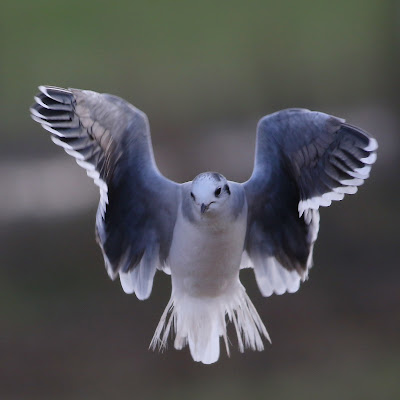
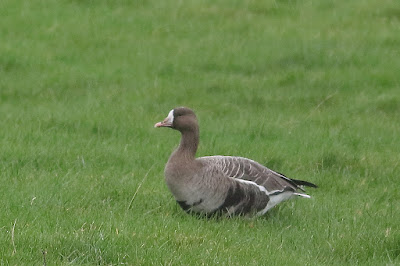
I haven't kept a 'year list' for decades having come to the conclusion that driving around to see birds I'd already seen was a bit of a waste of time, money and fuel. Attempting a 'green' year list - walking and cycling only - might still be said by some to be a waste of time, but money and fuel at least were not required. It has, however, been sufficiently rewarding to make me feel that, although it did indeed take an awful lot of time - 14.58 days in the saddle excluding birding stops based on 3,500 miles at a notional average of 10 mph - 'waste' would most definitely not be the way to describe it.
I've been very touched by the reaction from friends and Twitter followers to my attempts to build the list over the last year, which became more apparent to me as 2021 approached its end. But although I was pushing the pedals, if it weren't for those who found and shared news of the birds I was able to pursue it wouldn't have been much of a list at all. Birders get a bad press from time to time but in pursuing the 224 species I saw in 2021, I encountered, with literally one sole exception, nothing but good will and generosity from the many birders who shared news and gave advice on where and how to see my main target species, including the 40-odd species found by others which I 'twitched'.
It would be a high risk strategy to try to name them all as I am bound to miss someone out, plus the names of the finders of some of the rarer birds remain unknown to me in any case. But mother always made me send thank you notes as a child after Christmas, and old habits die hard, so here goes. Rather than just a long list of names, and to avoid any suggestion of favoritism, I've tried to weave my acknowledgements to these helpful souls into a review of the year in roughly chronological order. As a result, it's a bit long, so pour yourself a drink, sit back and prepare to be thanked for your help/offended by your omission accordingly. Errata will be published as comments at the end of this post as memory permits and any gaps are pointed out!
January (119 species, 120 miles cycled)
I hadn't set out to do a 'big year' in 2021 and it was only after I clocked up 94 species on a New Year's Day non-motorised bird race that curiosity about just how many species I could see in a year travelling under my own steam started to get the better of me. Dave Foot's discovery of two local Ring-necked Ducks provided the first minor rarity of the year - a lockdown-friendly 3 miles from home, they later relocated to my local patch at Swineham. Top find Dave!
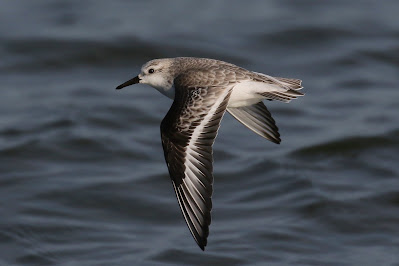 |
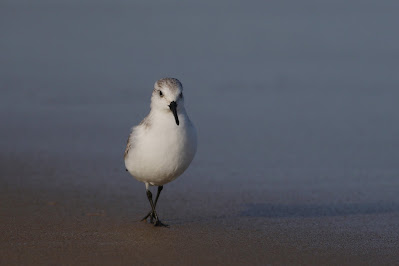
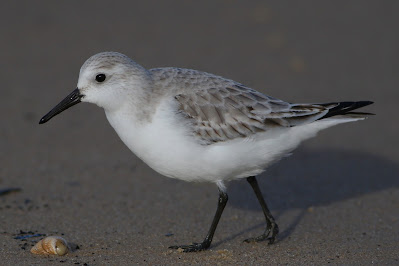
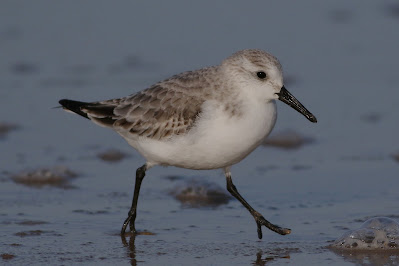
| January photo of the month: Sanderling at Studland - one of three trips in January which added Long-tailed Duck, Scaup, Black-necked and Slavonian Grebe to the year list |
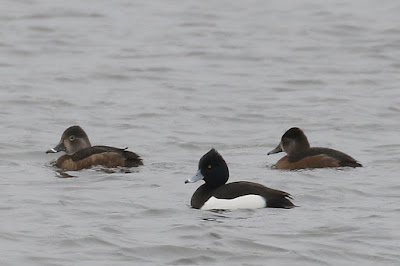 |
| January bird of the month: two female Ring-necked Ducks, found by Dave Foot, taken after they relocated to Swineham |
February (12 species, 164 miles)
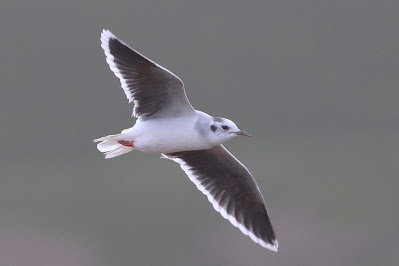
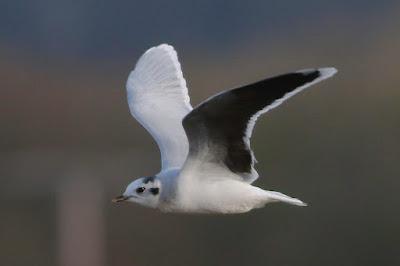
My neighbour and fellow Swineham regular Trevor Warwick, who was doing a 5km from home list in 2021, shared news of numerous good local birds early in the year, notably in February with my only Little Gull of the year which spent over a week in the Piddle Valley. This was just one of a number of species which might not have made it on to the list but for timely info from Trevor. I tried to return the favour but despite numerous visits to Swineham throughout the year I couldn't repeat the success I had in 2020 of finding minor rarities there - sorry Trev, and thanks for the news!
Also in February Garry Hayman and family found one of the patch birds of the year in the form of a Red-throated Diver on the River Frome. At other times during the course of the year I was grateful to Garry for helping me connect with several species including Long-tailed Duck and Velvet Scoter. Marcus Lawson's excellent discovery of a Golden Plover flock at Holton Lee during a February cold snap was an important one in that it was one of the first to make me think a big total for the year might be possible.
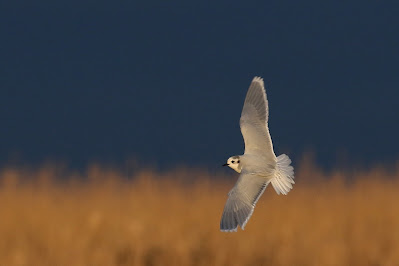 |
| February photo of the month: Little Gull, found by Trevor Warwick, a short walk from home in the Piddle Valley |
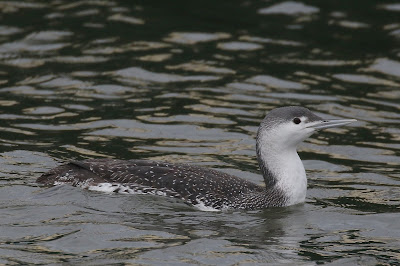 |
| February bird of the month: Red-throated Diver found by Garry Hayman and family - also a short walk from home on the River Frome |
March (10 species, 245 miles)
Somehow I had not met cousins Rob Johnson and James Leaver, local birders from Church Knowle, before our first encounter on Stonehill Down on 1st March watching a mighty (but untickable) White-tailed Eagle from the Isle of Wight reintroduction scheme, but I seem to have bumped into them every other weekend since. Their information and encouragement was greatly appreciated, and they literally cheered me on on several occasions as I wheezed towards a target species which they had already seen! They also helped me connect with several tricky species in a local context including Marsh Tit.
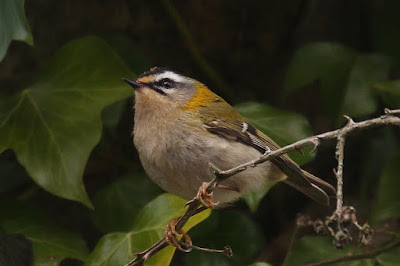 |
| March photo of the month: I heard three singing Firecrests on a short bike ride from home in March - this one was at Holme Lane |
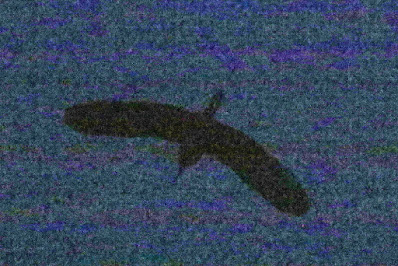 |
| March bird of the month: Bittern leaving Swineham in the dark on the 9th |
April (30 species, 360 miles)
With Phil Saunders' recent record of good finds at St Aldhelm's Head, I was pleased when he agreed to meet up there one bright April morning which added no less than seven new birds to the year list. The best of them was a Red-rumped Swallow picked up by Phil coming 'in-off' and watched by just three of us - myself, Phil and Steve Smith, on whom more later. Phil was also present for quite a few of the 15 hours I spent over a period of three days that month (not including 9 hours spent travelling to and from) looking for a Glaucous Gull in the grim surroundings of Alderney water works. So cheers to Phil for being a good companion in 2021.
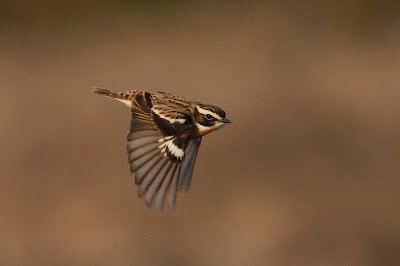 |
| April photo of the month: Whinchat on Stoborough Heath |
The Glaucous Gull was eventually seen on the way back from my first 50+ mile excursion of the year for a
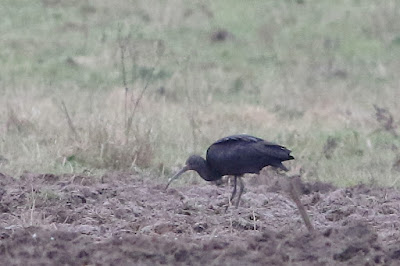
Glossy Ibis at Stanpit and Purple Sandpiper at the very tip of Hengistbury Head, after which local birder Jan Toomer helpfully gave me a tour of a few good locations. The month ended with my first post-work twitch to Weymouth to see a pair of
Black-winged Stilts - a trip which helped make April my most energetic month of the year in terms of miles cycled, as well as the second most productive after January in terms of species added. Not for the last time during 2021, Pete Coe and John Wall were on hand to point out the birds and show me their superb photos making me wonder why I had bothered to lug my own camera around in a pannier bag!
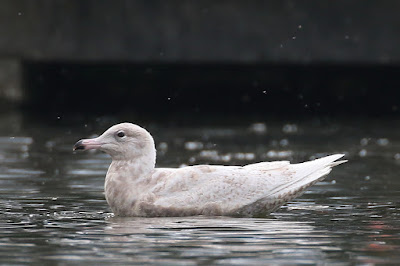 |
| Bird of the month for April: the Alderney Water Works Glaucous Gull - chosen not for its looks or its surroundings, but for the sheer effort put in to see it and the good company provided by Phil Saunders, Marcus Lawson, Shaun Robson and others while I waited. And waited. In all weathers... |
May (16 species, 355 miles)
May began with a Bank Holiday weekend and the first of six bike rides to Portland over the course of the year. This produced another seven-tick day including the two 'easy' Skuas - but no Pom which were thin on the ground last year. The following weekend was one of the most epic of the year, with my dipping the Whiskered Tern at Abbotsbury by an hour, struggling against gale force winds to press on to Cogden for a Tawny Pipit, a 66 mile day in total, then doing another 28 by way of a warm-down the following day when the Whiskered Tern was relocated by George Green and others at Longham Lakes.
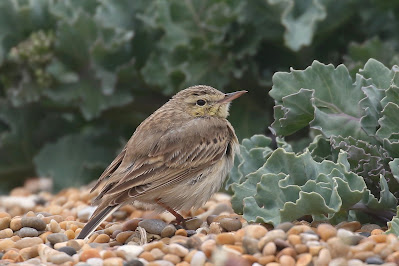 |
| May photo of the month: Tawny Pipit at Cogden, chosen as it looks like we both felt - a bit windswept huddling from a gale at the back of Chesil Beach |
On this and other occasions Steve Groves, Joe Stockwell and the rest of the team at Abbotsbury Swannery provided invaluable advice and showed me to various hides secreted around the reserve - the fact that I saw none of my target species from said hides on three visits to the Swannery was clearly not their fault, and I caught up with all three species (Little Stint, Whiskered and Roseate Tern) elsewhere eventually. I was also grateful to Cliff Smith, Chris Griffin, Paul Welling and son Zach for pointing me in the right direction for the Tawny Pipit in fading afternoon light.
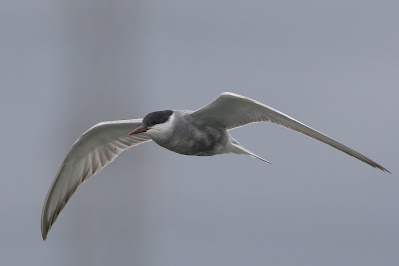 |
| May bird of the month: the Whiskered Tern at Longham Lakes - the day after I dipped it at Abbotsbury Swannery |
The light evenings made a couple of after work twitches possible, adding
Woodchat Shrike (thanks to Mike Gibbons for directions), Iceland Gull and Bonaparte's Gull to the yearlist, the latter after somewhat recklessly cycling to Weymouth in the face of 50-60mph SW winds. The journey back by was a laugh though, I barely had to touch the pedals.
June (5 species, 295 miles)
June kicked off with my longest bike ride of the year on the 1st of the month - an 88 mile odyssey to Lyme Regis, during which I clocked up my top speed of the year (37.6 mph on the way down to Bridport), and came as close to being frightened to death as it's possible to be without actually dying. Never again will I attempt to get anywhere by bike via the A35! The trip produced, however, my only Dipper and Eider of the year so clearly worth the near death experience. Not just hearing but seeing a Quail near Kingston Lacey in June was another massive bonus for the year list.
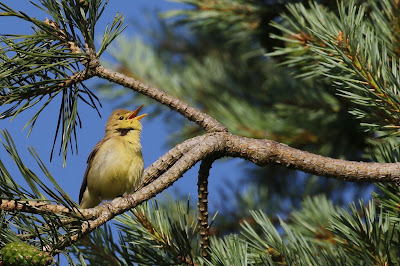 |
| June photo of the month: the Middlebere Melodious Warbler, singing its heart out a short bike ride from home - seen thanks to early morning calls from Paul Morton and Steve Smith |
Steve Smith, who met his own personal non-motorised target of walking the equivalent of Scilly to Shetland in search of birds in 2021, was a font of useful information and moral support throughout the year. His perseverance in scoping the islands in Poole Harbour for Golden Pheasant gave me the inspiration to do likewise for an unlikely addition to the year list this month. Steve also played a key role in building my leg strength in the early part of the year, sending me yomping around various boggy parts of Studland where he promised (falsely, as it turned out) there would be a Woodcock. But all that is forgotten and the Studland Velvet Scoters were just one of a number of species I would not have seen without Steve's diligent scouring of the Studland peninsula - thanks Steve.
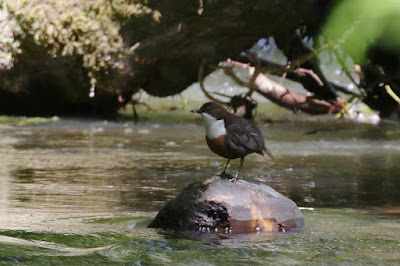 |
| Bird of the month for June: a Lyme Regis Dipper - not a bird I would have dreamt of adding to my bike list at the start of year - it took an 88 mile bike ride to see it |
Paul Morton and the rest of the Birds of Poole Harbour team were another reliable and frequent source of news throughout the year. On 1st June I had just crested the steep hill above Chideock on the bike, 40 miles from Wareham, when Paul called with news of a Golden Oriole at Rempstone, just a few miles from home. Unfortunately it didn't hang around - not that a u-turn was really an option at that point! It was also an early morning call from Paul which got me out of bed to see a singing Melodious Warbler before work one muggy morning at Middlebere. Paul, Mark and Mo Constantine also shared news from the Carey estate which added a few species to the list for which I was grateful.
July (5 species, 323 miles)
July is supposed to herald the start of the summer doldrums but I kept the list ticking over with my 3rd longest distance cycled of any month in 2021. An early start to Weymouth was rewarded when Chris Courtaux skilfully picked out a Roseate Tern at Lodmoor. I stumbled across another at Ferrybridge en route to tick Balearic Shearwater at Portland Bill. The 19th saw me make my first successful out-of county twitch by bike, and one of the most memorable for one of my favourite species: a Black Guillemot in Hampshire. 57 miles in a heatwave on a Monday night with work the next day was quite a challenge!
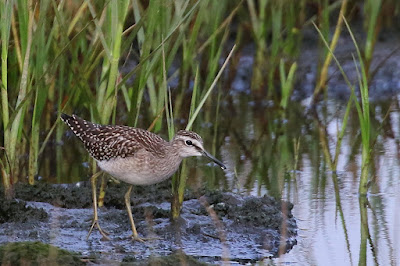 |
| July photo of the month: Wood Sandpiper at Lytchett Fields - I think found by Ian Ballam! |
I was indebted to Olly Frampton for helping me connect with the Tystie and indeed the other three species I saw from over the border in Hampshire during 2021. Olly also saved me the bother of a long trip to Ripley by confirming that an apparently settled Green-winged Teal had moved on overnight - so many thanks are due Olly.
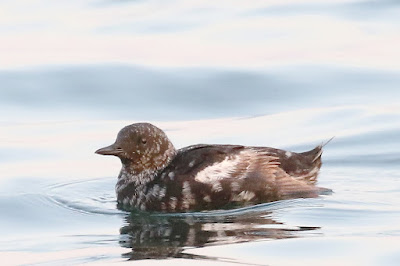 |
| July bird of the month: the Barton-on-Sea Black Guillemot - the first of four out-of-county bike trips to Hampshire |
July also heralded the start of autumn wader migration, and the first of a run of good birds at Lytchett Bay which required my attention. I was very grateful to the Lytchett crew, particularly Ian Ballam and Shaun Robson, for setting aside patch rivalries to help me connect with such desirable species as
Wood Sandpiper at the end of the month, plus Pectoral Sandpiper,
Curlew Sandpiper, Hoopoe and Water Pipit in the weeks and months to follow.
August (5 species, 246 miles)
August is another theoretically slow month for birds. With a 2 week family holiday in Northumberland in the middle of the month, that was ok with me, but I still clocked up almost 250 miles on the bike in August either side of that. While away the only thing I missed was a Spotted Crake which did the decent thing and reappeared on the day we got back. I finally saw it at the second attempt having stood in the rain with Julian Thomas on the first attempt before getting the train home. The penultimate day of the month saw me finally catch up with Goosander at Silverlake thanks to news from Geoff Upton, though I would later see one at Middlebere and on the patch at Swineham. Paul Harris also very kindly helped me out with invaluable info during the month.
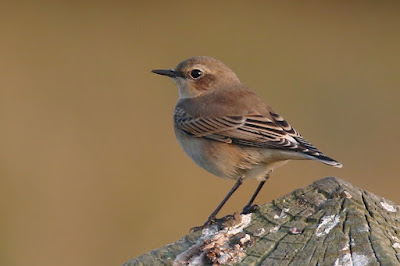 |
| August photo of the month - Wheatear seen on a productive walk around Wareham with Trevor Warwick on 26th which also produced Tree Pipit and flocks of Spotted Flycatcher |
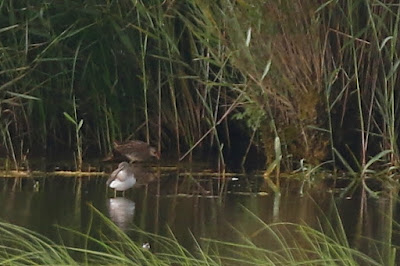 |
| August bird of the month: Spotted Crake (behind the Green Sandpiper) at Lodmoor was the 200th species for the non-motorised year list in 2021. I clocked up 2,000 miles for the year on the way home from seeing it. |
September (2 species, 276 miles)
September turned out, unexpectedly, to be my least productive month in terms of additions to the list - and it was not for want of trying with 276 miles cycled, including an unsuccessful 50 mile trip over the border to Blashford Lakes for a couple of Black Terns which re-apppeared only after I got home - my biggest dip of the year. But progress was still made, notably with a Friday night jaunt to
Portland for a Wryneck. On this and other occasions Martin Cade at the Portland Bird Obs provided invaluable news and updates.
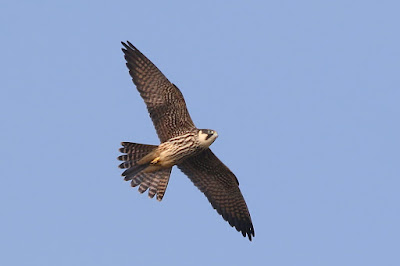 |
| September photo of the month: Hobby at Swineham |
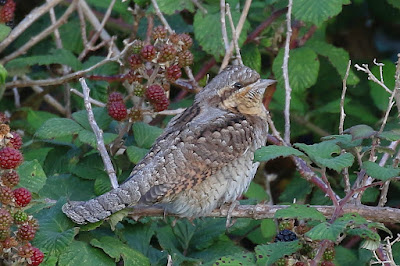 |
| September bird of the month: Wryneck at Portland Bill |
October (5 species, 211 miles)
Special thanks are due at this point to the proprietor and fellow clients of Bradders Birding Tours (David Bradnum, Jonathan Lethbridge and Howard Vaughan) for sparing my aching quads by whisking me to Shetland for a week in early October. Fortunately their threat of sending me first into the iris beds never materialised and that particular joy was evenly shared. Had anything more than a Grey Phalarope turned up while I was away I might never have forgiven them, but in the end that was about all that I missed. More to the point, we had a memorable time and saw some wonderful birds, including the Yorkshire Long-toed Stint just a few miles detouring from our route home down the M1.
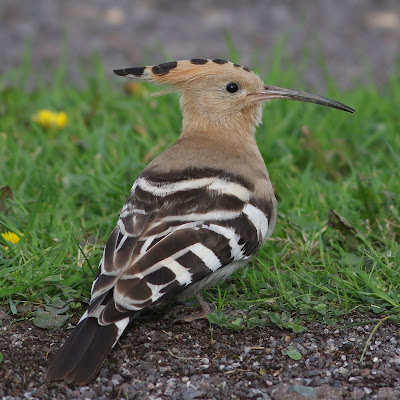 |
| October photo of the month: the Lytchett Bay Hoopoe - thanks to more news via Shaun Robson |
On my return I needed a bit of luck to pick up the pace again which materialised in the form of a
Snow Bunting at Durlston, found by Martin Warren, and a Hoopoe at Lytchett Bay on consecutive days. I enjoyed point blank views of the Bunting late one evening with Garry Hayman, Steve Smith and Andy Millar, one of the highlights of the year. The Hoopoe was also memorable, causing an about turn when I was half-way to Portland, a change of bikes back at home due to a broken spoke and a breathless arrival at Lytchett Bay allotments to the amusement of the assembled crowd.
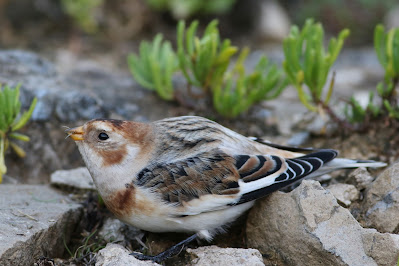 |
| October bird of the month: the Durlston Snow Bunting |
November (6 species, 276 miles)
Water Pipit was belatedly added the list in early November thanks to Ian Ballam, Shaun Robson and the Stour Ringing Group who thoughtfully decorated one in bright yellow bling for me and Garry Hayman to pick out one morning. Another good weekend followed mid-month with Durlston again coming up trumps with a Pallas's Warbler, relocated by Rob, James, Steve and Phil shortly before my arrival. The next day Paul Morton's prompt sharing of news of a Red-necked Grebe at Studland provoked a mad dash through Rempstone to tick if after a quick look through Steve's scope as I had left mine at home.
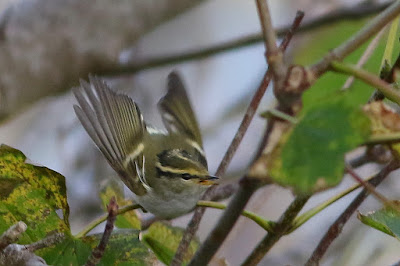 |
| November photo of the month: Pallas's Warbler at Durlston |
The best was yet to come though with two trips to Weymouth to see the delightful
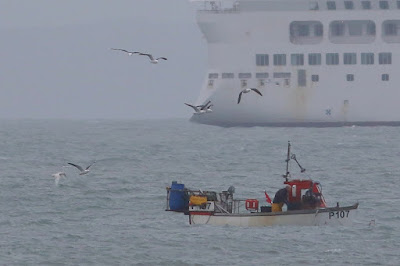
Little Auk, one of the birds of the year, skilfully relocated on the morning of my first trip by my ex-colleague Tom Brereton from a survey vessel as it was about to leave the harbour - he kindly relayed news via the miracle of a Twitter.
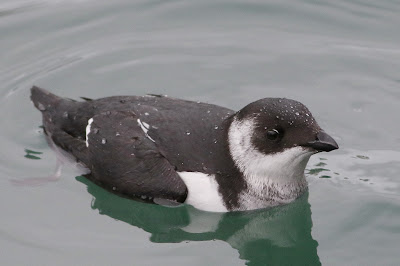 |
| November bird of the month: the Weymouth Little Auk |
December (9 species, 261 miles)
I had limited cause to head west of Portland during the course of the year but kudos to Mike Morse and Al Barrett for finding, sharing news of, and laying on breakfast for the Cirl Bunting at West Bexington, which provided some real quality for myself and Phil Saunders to add to our respective year and county lists in early December.
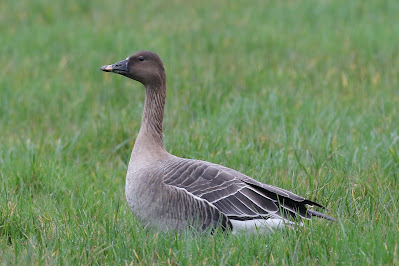 |
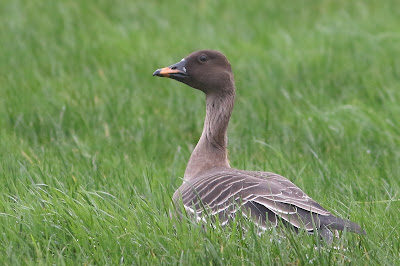
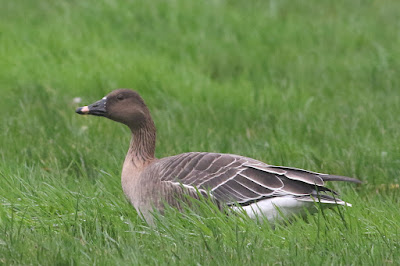
| December photo of the month: one of the three very obliging Tundra Bean Geese at Upton |
Woodcock remained stubbornly absent from the year list until December, to the extent that I was on the point of begging Paul Morton to meet me somewhere with his night vision goggles and a torch to fine one - but I eventually saw one locally thanks to Dorset Bird Club Secretary Jol Mitchell who had been almost running them over on a nightly basis in the same spot.
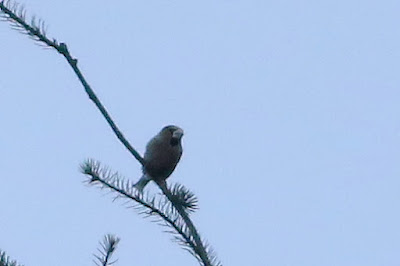 |
| December bird of the month: a New Forest Hawfinch - a lovely species to end the year and the 224th seen travelling under my own steam in 2021 |
I was grateful for Jol's constant encouragement throughout the year, and he was the closest thing I had to a coach for the duration. If I had a pound for every time he said 'I think you're mad, but you probably have to go for it', as he did when I was contemplating a 28 mile round trip for a Whiskered Tern the day after the marathon to Cogden, I would have, well, approximately five pounds. And if I had a pound for every time he said 'you should write a book about this' I would have considerably more money that I would make if I ever wrote a book about this.
Jol's particular speciality was breaking the bad news when big-hitting East Anglian 'green' listers had chalked up another species and edged ahead of me in the Bubo green-listing mini-league (a niche league if ever there was one). I'm not generally competitive, but these unwelcome nudges from Jol often spurred me on to greater efforts. Whether or not his intention was to push me to more extreme lengths, or he just enjoyed breaking bad news, only he knows. But it worked!
My final Dorset species of the year - Tundra Bean Geese - was like a greatest hits of many of the friends mentioned above with news first relayed by Paul, bumping into Rob and James in the dark the following morning to try to relocate them, before Phil and Ian Ballam did so in a neighbouring field. But the year wasn't over, and Olly Frampton again came up trumps with news from the east enabling me to connect with Red-crested Pochard, Ferruginous Duck and Hawfinch in the same 73 mile triathlon (well, it was pretty wet) over the border in Hampshire.
That pretty much brought the birding year to an end, and an incredibly enjoyable one it proved to be all told. Many more people than those mentioned above helped me out in some way: Peter Robertson, Martin Wood, Adam Day, Steve Carey, Chris Chapleo, Mark Wright, Brett Spencer, Verity Hill, James Lowen, James Lowther, Roly Pitts and Rosy White all provided information and/or encouragement at various times. My travels also enabled me to meet various folks from the Twitter-verse for the first time in real life including Mark Eggleton, Steph Murphy and Rob Murphy.
No such post would be complete without paying tribute to my ever-tolerant family: no doubt they were glad to see the back of me, and their almost complete lack of interest in the whole listing thing kept my feet firmly on the ground if I was ever in danger of taking it all too seriously. Despite everything I say on this blog, life wouldn't be worth living without them.
A final thank you must be reserved for that special someone who was always there for me when I was most in need; who looked after me without judgement when I walked in soaked to the skin with rain or perspiration; and who kept me fed and watered at critical moments when I was close to expiring. I mean of course the proprietor of the Preston chippy, without whose deep-fried creations I might never have made it up that big hill out of Weymouth. To them, everyone else mentioned above and anyone I've forgotten - sincere thanks for the help, info and companionship!
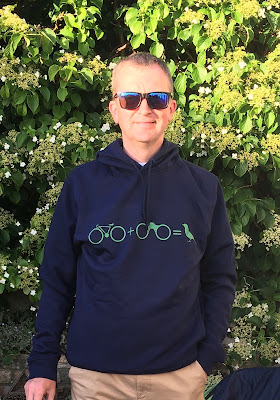 |
| Possibly the first time I have appeared on this blog but my former Kent birding buddy, now resident of Stewart Island, NZ, Matt Jones, and his partner Jules had been following the progress of my year list. One day in June a package arrived from them which nicely captured the spirit of the exercise. Bike + bins = bird sums up the year pretty well - cheers guys! |