Tuesday, 23 August 2022

June Blues

June 2022 plumbed new depths in my career of birding by bike through a combination of self-imposed wounds and misfortune. The first week of the month was never going to see anything added to the yearlist as we had planned a family holiday to visit our nephew in Norway. I'm not a fan of international travel, being content to spend my holidays in the UK where there are plenty of places I have yet to visit and plenty more I am happy to go back to. But with the children getting older and developing a bit of wanderlust, every now and then I lose the family plebiscite and have to succumb to the will of the majority. 

Arctic Skua - one of the cool birds I saw in Norway while missing even better ones at home

A breeding pair of dark-morph Arctic Skua
On arrival in Oslo I got to use my new blue passport for the first time but was disappointed to find it didn't spirit me through Norwegian immigration and in fact consigned us to a very long queue. This caused us to miss the last train of the night, for which we had already paid, and shell out over £100 for a taxi to get to our accommodation.
The Norwegians don't muck about when it comes to bridges and tunnels

This one was on the Atlantic Highway
Not that going to Norway was exactly a hardship otherwise - we had a lovely week in amazing landscapes, did one of the great railway journeys from Oslo to Bergen, and even saw a few decent birds. But on the day we left the UK an Eleonora's Falcon was located in my former home county of Kent - a bird which in all honesty would have tempted me into the car had it been an option! Then to rub salt in, two days later a Gull-billed Tern appeared in Weymouth - it stuck around long enough that, had I been at home, I almost certainly would have had time to cycle there for a quality bike tick. Not to worry, I would just have to redouble my efforts on my return. 
Great Skua on Runde Island, a great seabird colony on Norway's Atlantic coast

One of several breeding pairs on Runde Island
The first opportunity to do so arose just two nights after my return when a Quail was reported within walking distance of home on Wareham Common. As I headed out there on a breezy evening (no sign of the Quail, though I did hear one on Runde Island in Norway) I thought my hayfever was unusually severe, but after a rough night it became clear I was suffering with something more than hayfever, and a positive Covid test the next morning confirmed my suspicions. 48 hours of headaches and delirium were followed by over a week of various flu symptoms, and it was the 18th of the month before I felt well enough to tentatively head out for a local bike ride. 
Puffin on Runde Island

Ring Ouzel on Runde Island
A second local bike ride the following day repeated last year's success with 'scoping Golden Pheasant on Furzey Island from the Studland peninsula. Another attempt the following weekend to scope a bird on a Poole Harbour island from the mainland (Roseate Tern on Brownsea from Evening Hill) was much less successful. Equally unsuccessful was a mid-week ride to Weymouth one evening later in the month in the hope of seeing an Arctic Tern - though at least that meant I could get the train home and save my legs and lungs which were still not back to full strength after the enforced lay off.
White-tailed Eagle - one of at least 5 seen on Runde

A juvenile bird looking a bit sorry for itself on a rainy day on the island
Then June was pretty much over - a meagre 80 miles cycled, my lowest monthly total since December 2020, and just 2 species added to the yearlist, my worst month since September 2021. Still, I had survived the disease which 180,000 of our fellow citizens did not, with apparently no lasting damage, and had a great family holiday before being laid low, and for that I guess I should be grateful. 
Kittiwake colony in Alesund

Icterine Warbler - fairly common around Forde where we stayed on our last night in Norway

Wednesday, 20 July 2022

Friday night's alright for biking

With a title like that you might be hoping this post features rock n' roll exploits such as heavy drinking and drug-taking, but unless you count copious amounts of water and hayfever tablets, disappointment awaits. I confess to doing coke, but just the one can, to wash down fish and chips at Stanpit last Friday night. 

But this particular story starts two days before on Wednesday when work took me to Reading for a couple of days. Thanks to a post-pandemic flexibility on the part of my employer, a presence in the office is only required for things which are best done face-to-face, which translates to being there roughly once or twice a week. They are long days by train but productive, providing concentrated work time and the ability to manage the inbox thanks to the now ubiquitous onboard wifi. 
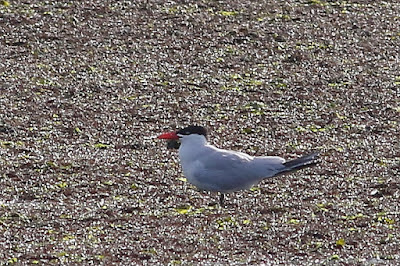
Caspian Tern, Stanpit, 15 July
Despite being relatively infrequent, however, these visits seem to have an uncanny habit of coinciding with the arrival of rare birds back in Dorset which would otherwise have been within cycling distance. This year alone I have missed Red-necked Phalarope, Rose-coloured Starling and Alpine Swift when in Reading, though I did at least manage to catch the Swift at the second attempt. Wednesday's visit provoked the arrival of a Caspian Tern at Stanpit Marsh. Its appearances were erratic but it was seen early and late on the Wednesday, causing me to wonder if I could get home on Thursday night in time to go for it.

My train was due to arrive back in Wareham at about 1900, and google maps suggested that if I got a shift on I could complete the 21 miles to Stanpit by 2045, assuming the journey home went smoothly. It did so until Bournemouth when, for reasons best known to themselves and their shareholders, South Western Trains decide that the westbound service to Weymouth would no longer stop at Wareham or anywhere else for that matter, rendering it useless for 95% of the hot and frustrated passengers turfed off at Bournemouth. 
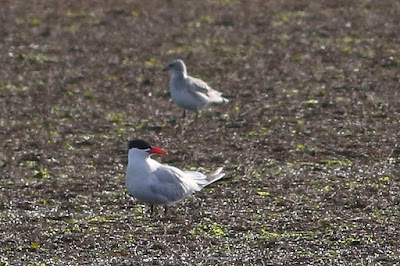
Caspian Tern with juv Med Gull in the background
To compound the problem they simultaneously appeared to come to the conclusion that passenger information about the timing of any later trains was entirely superfluous. The line was clearly in some chaos and a taxi home seemed like the best option - but certainly not the cheapest! Despite my best efforts to persuade others in the queue to share, they all seemed to be travelling on business expenses and not interested, so I arrived home at 1920, £45 lighter in the wallet.

I had pretty much given up hope of making it to Stanpit, but info from Olly Frampton reminded me that it was 2125 before the bird had appeared the night before, so I decided to go for it against my better judgement. I made good time in the cool of the evening and arrived at Fisherman's Bank in Stanpit, from where the best views had been obtained, just after 2100. One other birder was present and we 'scoped the area in vain for the next 40 minutes before reluctantly giving up. Checking the live departure boards for the trains online I was surprised to find that order had been restored so, having dipped, I was at least able to take advantage of the unused portion of my ticket from the earlier journey to complete the Christchurch-Wareham stretch to home.

I put the Caspian Tern from my mind and hit the sack exhausted, rising bright and early for work the next morning feeling surprisingly fresh. Reports of the Tern still being present on and off throughout the day got me thinking about a re-match. The sensible thing to do might have been to leave it until the weekend, but that would have meant cycling into the rising heat of what was forecast to be one of the warmest days of the year. In this context, heading out on Friday evening as soon as work allowed was the better option, and with the bike already packed from the night before I made a prompt getaway, cutting the corner off the flatter but longer coastal route to climb up to the Wallisdown Road some 12 miles from home before dropping gently down the remaining 9 miles to Stanpit.

Arriving shortly before 1830 there was no sign of the Tern but I passed the time chatting to Charles Stubbs, editor of the Christchurch Harbour Ornithological Group's annual bird report. He had been out of the country, making him one of the last locals not to have seen the rare visitor. 

Charles mentioned that he had to leave at 1900 for a pre-ordered meal from the chip shop on the corner. The mere mention of food reminded me of the need to eat, and Charles kindly agreed to watch over my bike and optics while I ran to grab some sustenance. We exchanged numbers 'just in case', and after a bit of a delay to my order I was heading back in his direction, supper in hand. As I was about 100 yards away my phone started to ring and I could see Charles holding his mobile to his ear, obviously watching the bird in his telescope. 'On my way!', I yelled, quickening my pace.

Within seconds I was enjoying good views of the Tern as it rested on the mud in front of Fisherman's Bank. Charles suggested I might consider heading further east, over the border into Hampshire to add the Lesser Yellowlegs at Normandy Marsh to my bike list. Whilst the possibility had occurred to me, I hadn't given it serious consideration, but was now starting to do so. I resolved to make a decision by 1900 which would still leave plenty of daylight to get to Normandy. 

Charles headed off for dinner with my expressions of gratitude hopefully ringing in his ears while I stuck around for a few record shots. Another birder then arrived and after getting him onto the bird, and a jolly exchange of the 'are you that bloke on Twitter who cycles everywhere to see birds?' variety, I made the decision to go for the double. Although Normandy Marsh is 'just along the coast' from Stanpit for the driver, to the cyclist it meant another 13 miles worth of pedalling in the heat, followed of course by a 34 mile journey pedalling home.

Although I could have done without even the gentle ups and downs en route, I made reasonable progress to Normandy arriving around 2015. There was no sign of the bird on its preferred lagoon so I headed for a couple of birders - the only birders - further along the sea wall. Fortuitously, their telescopes were pointing out towards the Solent - and straight at the Lesser Yellowlegs! The gamble had paid off and for the second time that evening I found myself being grateful to fellow birders for making it so easy for me. We had a lovely chat as Little Terns, Redshanks and Oystercatchers bombed around and I even added a bonus Eider to the year list thanks to a small flock on a distant mudbank. My new friends seemed a bit incredulous that I had cycled from Stanpit, even more so when I told them that I started the journey in Wareham, and would be returning there later that night!
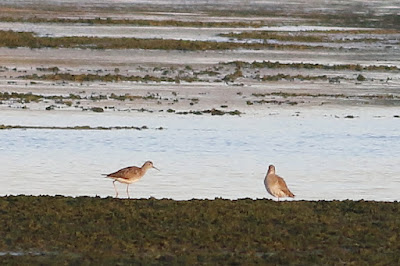
The Lesser Yellowlegs was a long way out but the telescope enabled good views of the legs, needle-thin bill and other features
It was a beautiful evening with the Isle of Wight as a backdrop, but as dusk was approaching I needed to get on the road. Retracing my steps as far as Stanpit, I then turned south to the coast to take advantage of the flat run home via Bournemouth seafront. Although hard going into a stiffening breeze, it was an enjoyable journey, the highlight of which was a huge moon, reddened by Saharan sand, just above the horizon as I passed the pier. 

I arrived home half an hour after midnight with 68.63 miles on the clock, shattered but content. Moreover, I had added two species not just to the non-motorised year-list (moving it on to 189) but also my non-motorised life list. The latter now stands at 247, offering the tantalizing prospect of attaining the landmark of 250 before 2022 draws to a close.

The closest of half-a-dozen Eider on the Solent

Saturday, 25 June 2022

May's birding by bike

May's birding by bike got off to a flyer: after a bimble through Wareham Forest on the first of the month which added Redstart and Tree Pipit to the year list, on the 2nd I returned to Portland to look for Little Tern and other spring migrants. Although the day produced nothing spectacular it was a fruitful one as I still had some 'easy' species to catch up with - in the end I notched up Common Tern, Garden Warbler, Spotted Flycatcher, Ringed Plover, Bar-tailed Godwit, Common Sandpiper and Red-throated Diver as well as the Ferrybridge Little Terns.

Redstart (female), Wareham Forest, 1st May
Redstart (male), Wareham Forest, 1st May
I was back on Portland the following weekend, this time to twitch a minor rarity in the form of a Woodchat Shrike. I made the same journey last spring for a Red-backed Shrike - the Woodchat was about 2 fields away from where the Red-backed was - and on both occasions the birds did the decent thing and stuck around long enough for me to get there.
Little Tern, Ferrybridge, 2nd May
Common Scoter past Portland Bill, 2nd May
An evening trip to Evening Hill in the hope of seeing a pair of reported Barnacle Geese on Brownsea proved predictably unsuccessful, as did a Durlston seawatch with Steve Smith in the hope of catching a Pomarine Skua which proved few and far between this year.
Iceland Gull at Lodmoor on the way back from Portland, 2nd May
Iceland Gull, Lodmoor, 2nd May
Mid-month saw the first of a run of frustrations when an overnight stay for work away from home made it impossible for me to see one of the best birds of the year: a Red-necked Phalarope which hung out until dark with a wader flock on Studland Beach. A Squacco Heron in Weymouth and two Black-winged Stilts at Abbotsbury either didn't stick around long enough or were too far from home to attempt a mid-week twitch. 
Hobby, Morden Bog, 7th May
Later in the month a possible Monty's Harrier tempted me down to St Adhelm's Head, but turned out to be 'just' a Hen Harrier, and a reported Black Guillemot enticed me back to Dancing Ledge, but turned out to be just a rumour. I'm not sure which was worse, being unable to go for good birds or going for good birds which turned out to be something else - but probably the former as at least the latter gave me some exercise!
Woodchat Shrike, Portland, 8th May
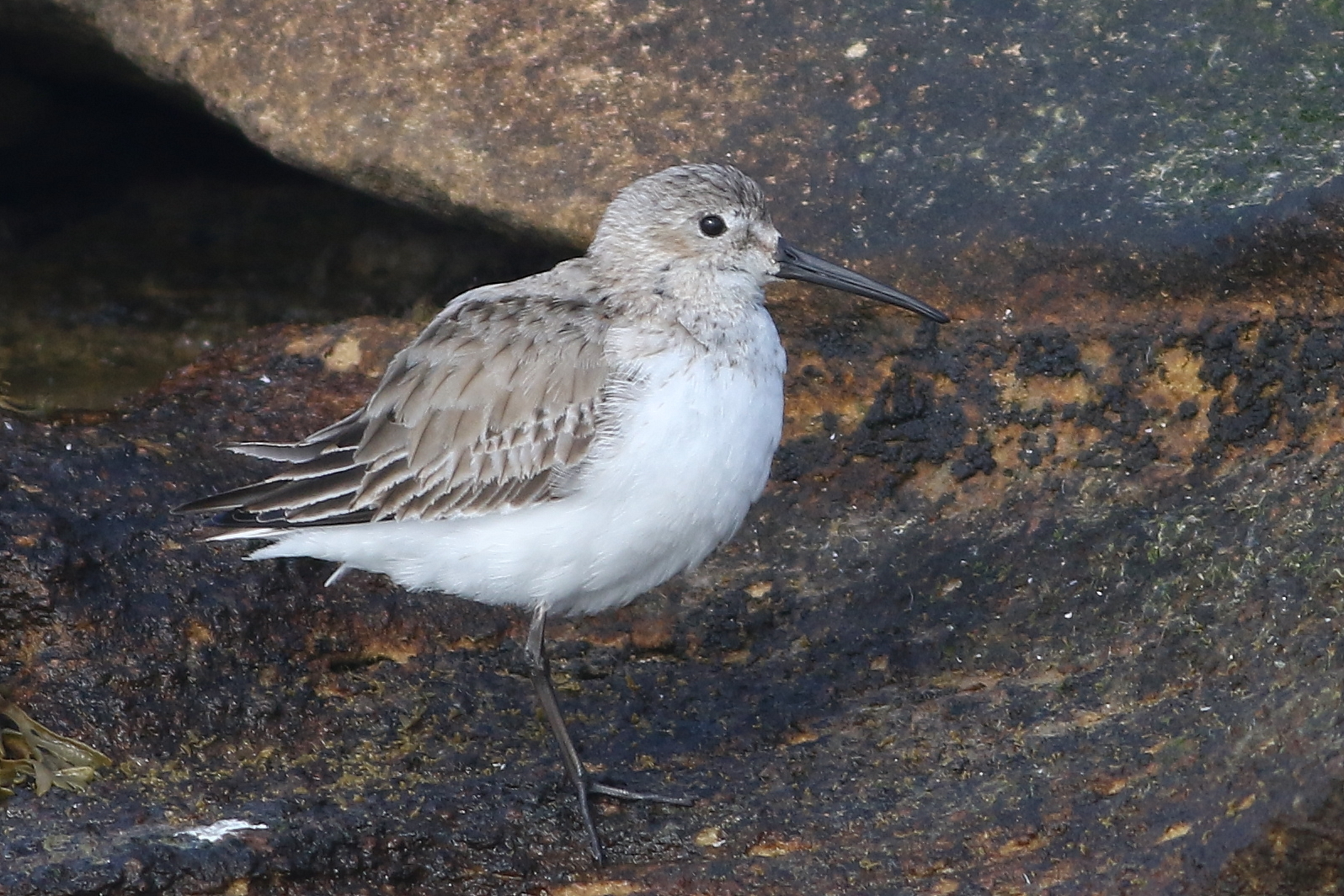
Dunlin, Pilot's Point, 12th April
As the month's end approached we were preparing for a family holiday to Norway where our nephew is studying. I thought my run of bad luck might be coming to an end as whilst on the train back from Reading an Alpine Swift was reported showing superbly well on Ballard Down - there ought to be just enough light for me to get home, saddle up and cycle the 10 miles see it. I pushed myself hard on the way there but when just 15 minutes away news came through that it had vanished. I took the news badly and it seemed to symbolise my rotten luck for the month!
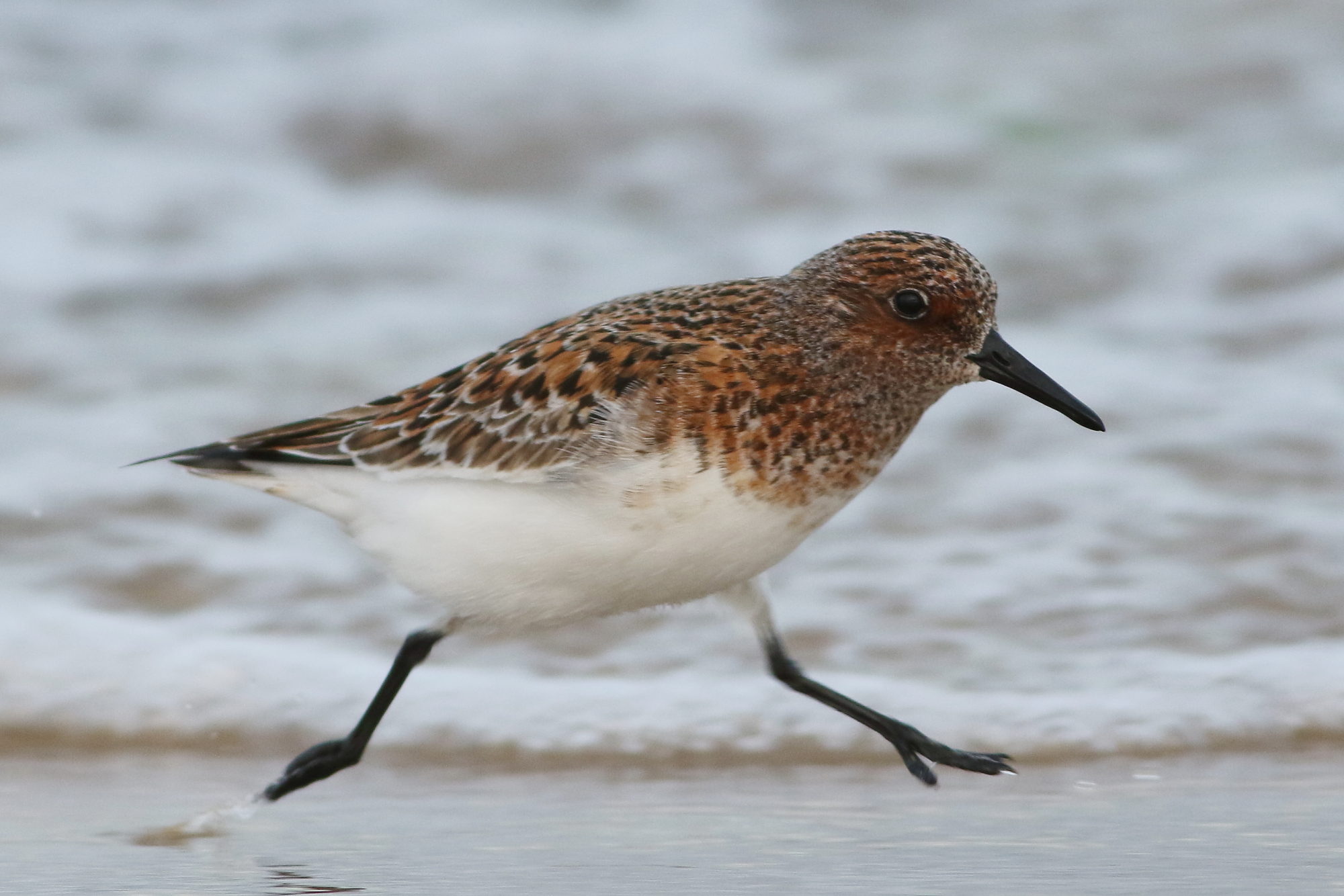
Sanderling, Pilot's Point, 12th April
Sanderling, Pilot's Point, 12th May
There was one last chance to see the Alpine Swift but it would be a slim one: head back early before work the next morning and hope it had roosted on the cliff overnight. I rose early and thought better of it at first. But it was a fine morning, and I really wanted to add Alpine Swift to my bike list so changed my mind and went for it. 
Hen Harrier, St Aldhelm's Head, 20th May
Grey Partridge, St Aldhelm's Head, 20th May
I made good time travelling light (if the bird was there, there would be no need for a telescope) and arrived to find a lone birder looking a bit forlorn. I joined him on the cliff edge and asked if he had seen the Swift: 'no sign in the last 20 minutes' was the unwelcome response. 'What's this then?' I found myself saying as a giant brown and white cigar-shaped torso with scything wings loomed up the cliff face to eye level! The gamble had paid off, and I returned for the morning's work with a spring in my step.
Puffin, Dancing Ledge, 22nd May
Any thought that my luck had finally turned was banished when Britain's first twitchable Eleonora's Falcon arrived in Kent on the day we headed for Norway, meaning I had to turn down several offers of a lift from friends who were going to see it, and an eminently cyclable Gull-billed Te
rn was found at Radipole on the first weekend that we were away. Memories of the successful Alpine Swift twitch were sufficiently fresh, however, to apply a soothing balm to these psychological wounds!
Alpine Swift, Old Harry, 27th May
By the end of the month I had clocked up 342 miles on the bike - a creditable total and the biggest of any month so far in 2022 - for a return of 16 species added to the yearlist, exactly the same as the tally for May 2021.
Alpine Swift, Old Harry, 27th May

Sunday, 19 June 2022

Off the bike

Easter saw me take an enforced break from cycling with a long-planned family holiday to Scotland finally happening after being cancelled in 2020 and 2021 due to Covid restrictions. We first booked Capercaillie Cottage near Rogart in Sutherland back in 2019 so we had waited a long time to get there. Before doing, so, however, a couple of stopovers were planned to visit old friends on the way.

Black-browed Albatross, Bempton, 11th April

Partly obscured views improved as the Albatross nudged its way into view
The Albatross attempting to land on Staple Newk
A magnificent bird
The first of these saw us heading for East Yorkshire and the giant chalk cliffs of Bempton where, among the throng of native seabirds, the Black-browed Albatross had returned for its third or fourth summer. Seeing it is a bit hit and miss, and arriving late afternoon it looked like it might be a miss after I had stood on a windy Staple Newk viewpoint for an hour with no sign. Then someone pointed out that the Albatross's shoulder could just about be seen from further along the viewpoint.
The Albatross can go missing for days at a time...

...so I was fortunate to enjoy such good views

A huge and impressive wingspan

Not quite so elegant when dropping off the cliff to take flight!
The Staple Newk viewpoint is a robust wooden balcony built on the clifftop and despite being able to hold about 30 people, there were only about 2 places where a sliver of the bird's shoulder could be viewed from. Sharpening my elbows I got in position and hoped for it to do something to reveal a better view. After a while it began to preen and stretch and I could piece together views of this most magnificent and unusual of birds. Suddenly it was all gangly wings and open bills as a Gannet started giving it a hard time and it dropped off the ledge to reveal the full glory of its vast wingpsan. 
Those wings!
A good view of the 'eye-liner' look
Gannet

Puffin
After soaring around for a few minutes it became apparent that the Albatross wanted to land on Staple Newk and I hoped it would do so out in the open for some unobscured photos. It tiptoed onto the ledge a couple of times but on each occasion the sharp-billed Gannets would not let it settle, so I had to make do with some action shots of the bird unsuccessfully trying to fold its massive wings and get comfortable.
Razorbill

Guillemot

Razorbill

Staple Newk
After success with the Albatross and a night in Brid, it was time to press on to see the second old friend of the trip. Rosy lives in a dreamy self-build eco-home on the Isle of Skye's Sleat (pronounced slate) peninsula, best accessed via the old Mallaig-Ardvasar ferry rather than the 'new' bridge at Kyle of Lochalsh. We arrived in good time to make the last boat of the day and were soon settling it to warm hospitality and spectacular views back over the sound to the mainland.
Great Northern Diver, Mallaig Harbour waiting for the ferry to Skye
Wheatear, Sleat, Skye
Snipe drumming, Sleat, Skye
Hooded Crow, Portree
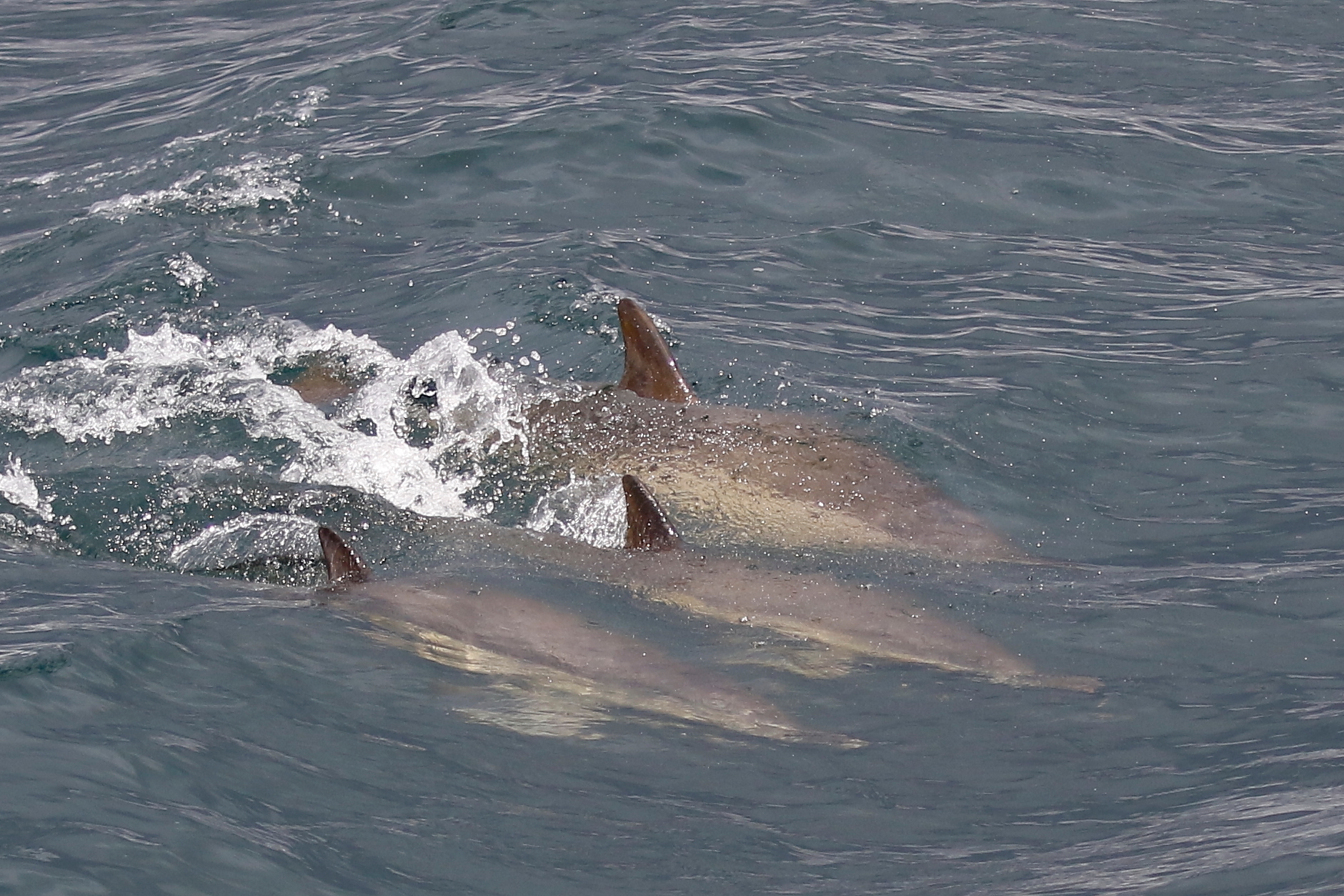
We wasted no time exploring Skye, booking a boat trip out of Portree the next day to take advantage of a decent forecast, during which we saw Red-throated Diver, Great Northern Diver, Black Guillemot, Otter, Common Seal, White-tailed Eagle and a very lively pod of Common Dolphin. The Eagle sat in a tree above our boat and would not be tempted down even when the skipper threw in a fish. The Dolphin were more co-operative, bow-riding and breaching as if to perform for the cameras.
Common Dolphin, Portree

White-tailed Eagle, Portree

White-tailed Eagle, Portree
Skye is a beautiful island but also a large one - as usual I probably tried to cover too much ground in our few days there, but in the process managed to locate Skye's first Ring Ouzel and Common Sandpiper of the spring, a few Wheatear and dozens of drumming Snipe on the moors above Ardvasar. The Ring Ouzel was on the scree slopes near The Quiraing, where a migrant flock of Pink-footed Geese were also noted. A family visit to Kilt Rock was slightly spoilt by a contretemps with a drone operator, clearly ignoring the signs asking him to desist so as not to disturb cliff-nesting birds. It was not the last time on the trip that irresponsible drone use caused my blood to boil, and it does seem to be an increasing nuisance in some sensitive environments.
Ring Ouzel, The Quiraing
Golden Eagle, Skye

Common Sandpiper, Sleat peninsula

After a few enjoyable but damp days with Rosy on Skye it was time to head across the country to Rilochan, a farmstead near Rogart in Sutherland, for the second week of Easter. The cottage was close to Loch Grudie, which a few weeks later would play host to a very rare Short-toed Eagle. I didn't see that species of course but had great views of both White-tailed and Golden Eagles over the course of the fortnight, with Red Kite also regular over the cottage.
White-tailed Eagle, Portree
Black Guillemot, Portree

Portree
Loch Fleet wasn't far from the cottage so on our first evening, while the family settled in, I headed down to the mouth of the Loch to look for a long-staying drake King Eider. It wasn't easy to pick out from thousands of Common Eider, but it was there and I enjoyed reasonable views of it, as well as the spectacle of vast Eider flocks diving for food in unison. 
King Eider at the mouth of Loch Fleet, 16th April
Thousands of Eider at the mouth of Loch Fleet, 16th April (click to enlarge)
This very dark pheasant at the cottage caused a double-take
Wheatear in the garden at the holiday cottage
This was just about the furthest north we had been for a family holiday so as well as the obligatory day trip to John O'Groats, we were able to check out the impressive sea stacks and auk colonies at Dunnet and Duncansby Heads, the former including a few Puffin. The cottage itself was an idyllic location with Curlew, Oystercatcher, Wheatear and Grasshopper Warbler all singing in the garden.
Treecreeper
Black-throated Diver
Impressive stacks at Duncansby Head
Auk colonies at Duncansby Head

Duncansby Head
I was keen to explore some of the excellent mountain roads around the cottage. In doing so I was pleased to discover a local Black Grouse lek, a pair of Golden Eagle, a ringtail Hen Harrier, summer plumage Slavonian Grebe, several Osprey and all three divers in breeding plumage. The loop from Loch Fleet past Loch Bruidhe down to Bonar Bridge was particularly scenic.
Great Northern Diver, Scrabster
Black Guillemot, Scrabster
Black Grouse
Male and two female Black Grouse
Tower Hide at Forsindard RSPB
Pink-footed Goose nr Forsinard
I made a solo pilgrimage to the RSPB reserve at Forsinard and while birds were few and far between it was good to appreciate the landscape of the Flow Country. A 4 mile walk around the nature trail at Forsinain was similarly birdless but walking on stepping stones as they gurgled and bubbled on the spongy sphagnum moss was an unusual experience. 
Red Kite, Rogart
Osprey, Bonar Bridge
Hen Harrier
Golden Eagle
Golden Eagle
Golden Eagle
More successful bird-wise were a couple of evening trips to Embo pier, which produced Long-tailed Duck, Common Scoter, Bonxie and a small flock of Purple Sandpiper with the commoner waders, and a trek out to Tarbat Ness - another amazing landscape where migrating Red-throated Divers were passing almost overhead. 
Red-throated Diver
Long-tailed Duck, Embo Pier
Common Scoter, Embo Pier
Dunlin, Embo Pier

Purple Sandpiper, Embo Pier
This was the first time in many years that we'd taken two weeks off at Easter, and it was well worth it to see some familiar and new parts of the Highlands and Islands. A final stop to meet up with my brother and nephews at Edinburgh Castle broke up the long journey home where the bike awaited me - and there was work to do to renew the effort to build the non-motorised yearlist. 
Red-throated Diver, Tarbat Ness
Kittiwake, Tarbat Ness
Yellowhammer, Tarbat Ness
Yellowhammer, Tarbat Nes
Yellowhammer, Tarbat Ness