Showing posts with label Eider. Show all posts

Wednesday, 19 June 2024

Building the bike list in 2024: the story so far

My plan, hatched in January, to concentrate this year on new birds for the non-motorised life list (as opposed to yearlisting) has one significant limitation - namely, the appearance of birds which I haven't already seen. With the list standing at 267 species at the end of 2023, most of the 'easy' stuff, quite a few minor rarities and even a couple of 'megas' were already on the list, and the options obviously narrow with each new species seen. The first sniff of a new bird in 2024 - a Little Bunting at East Morden on 4th February - evaporated no sooner than it had been discovered, and I had to wait almost until the middle of that month for the opportunity to get to 268. 

Red-breasted Goose, Normandy Lagoon, 10th February
The target was a Red-breasted Goose on the Hampshire coast at the Keyhaven/Pennington complex of coastal lagoons. I was therefore up bright and early on the 10th to take advantage of a reasonable forecast for the 35 mile trek to the east. Despite most of it being on tarmac I thought the new mountain bike would be a good option to negotiate the sand covered stretches of Bournemouth seafront and the gravel tracks of Keyhaven, and it did indeed perform pretty well on both without being too sluggish on the roads.
Red-breasted Goose, Normandy Lagoon, 10th February
With tubeless tyres the risk of punctures was negligible, and the ability to raise and drop the saddle from a lever on the handlebars - a new feature to me which I thought at first would be a gimmick but which has turned out to be a game-changer - meant that I travelled in comfort as well as style. The omens were good with reports of the Goose being present on Normandy Lagoon coming through as I headed along the coast. Although this meant a couple of extra miles would be added to the journey to get to the eastern end of the complex of lagoons, the main thing was that the bird was there, and it gave excellent views as soon as I arrived. 
Red-breasted Goose, Normandy Lagoon, 10th February
Red-breasted Goose is one of my favourite species, and this individual performed wonderfully, showing aggression towards nearby Brents, and eventually giving a close fly-past before heading west. This was my cue to head home, but not before adding Eider, Spoonbill, Ruff and a smart drake Scaup to the non-motorised year list. It would be difficult for the rest of February to top that experience, but it came close on 24th when news of a Yellow-browed Warbler in Dorchester broke sufficiently early in the day for me to complete the 34 mile round trip, adding a bonus Redpoll to the year list at Thorncombe Wood on the way home. The Warbler was not a bike tick, as I saw this species on a long trip to Bridport in 2022, but still a good bird this early in the year.
Pintail, Pennington Marshes, 10th February
Scaup (drake), Pennington Marshes, 10th February
Wigeon, Pennington Marshes, 10th February
Yellow-browed Warbler, Dorchester, 24th February
Redpoll, Thorncombe Wood, 24th February
It was another two months before the next opportunity for a 'bike tick' arose and it felt high risk: on the evening of Friday 19th April a Marsh Sandpiper was located on exactly the same lagoon as the Red-breasted Goose - but would it be there in the morning? I gambled, setting off early the next morning, and, re-tracing my steps from February's trip, was again pleased when news of the bird's continuing presence was reported as I made my way along Bournemouth seafront. My photographs weren't brilliant looking into the low morning sun, but telescope views of this delicate wader - the first of this species I had seen in 20 years - were very good.
Marsh Sandpiper, Normandy Lagoon, 20th April
The next opportunity to add to the bike list came with the start of passage of Pomarine Skuas past Dorset's coastal headlands in late April and early May. I've done plenty of seawatching on bike trips to Portland Bill over the last few years but have not managed to connect with this species so made a plan to head for Portland on Saturday 4th May - peak Pom season in theory. It felt like a really early start would be advisable to get in position at the Bill, so I set off in the dark at around 0400, flushing a Tawny Owl from the roadside just outside of Wareham. It got light much earlier than I anticipated and I started to wonder if I should have left even earlier. 
Avocet, Pennington, 20th April
Eider pair off Normandy Lagoon, 20th April
Great Crested Grebe, Pennington, 20th April
Rolling along the cycle path at Ferrybridge I passed Debbie and Pete Saunders but didn't stop to ask if they'd seen anything. I immediately regretted this and remembered that they post sightings on the Bluesky app so quickly checked it out. At the top of my feed was a post from Joe Stockwell: 'Dark morph Pom Skua slowly east off the Chesil'. The post was timed just after 0600 - and it was just after 0600! I had Joe's number in my phone and called immediately - it turned out that I had already overshot his position on Chesil Beach with Paul Harris, as I was already near the skate park at the southern end of that stretch. Retracing my steps would surely mean missing the bird and urgency was added when Joe reported that a second Pom was now in view.
I know I've cycled a long way when I can see the Isle of Wight ferry - 35 miles from home
Greenshank at Baiter Park on the way to the Marsh Sandpiper

The Needles from Pennington Marshes, 20th April
Following Joe's advice I headed up onto the the crest of Chesil Beach at the earliest opportunity - easier said than done as the heavily laden bike sank into the shingle and my body, tired from the early start and the 22 miles already on the clock, was quickly exhausted. Once there, telescope, tripod and binoculars had to be retrieved from panniers, assembled and de-steamed before I could start scanning the distant horizon. No Poms were in view but after another call to Joe who described their location relative to a distant buoy, their position was soon triangulated and I was treated to the glorious sight of a pale and a dark morph Pom, both sporting ridiculously long, spoon-shaped tail feathers, floating slowly towards, and eventually beyond, Portland's west cliffs.
Lesser Whitethroat at Stanpit on the way home from the Marsh Sandpiper
Wheatear at Stanpit, 20th April
After this triumphant start to the day, I pressed on the the Bill, sure that even more Poms would filter past. As I approached Culverwell I could hear an unfamiliar warbler song and tuning in eventually concluded it was probably a Subalpine Warbler. A poor signal led to a garbled phone call to Martin Cade but before I could try again a ringer pulled up and confirmed that I was right to suspect I could hear a Subalp - but wrong to think it was coming from a bird as it was in fact coming from one of his tapes! 
The Poms were too far out to photograph and this Arctic Skua wasn't much closer (Portland Bill, 4th May)
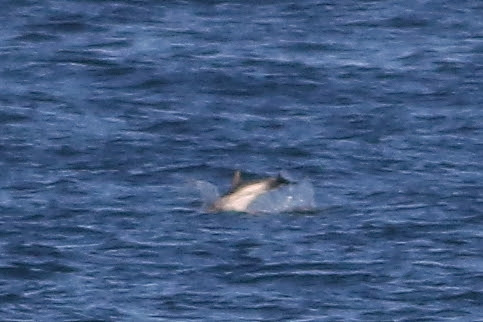
My second sighting of Common Dolphin off the Bill (4th May)
Another good bird distantly off the Bill - Puffin (4th May)
I was not best pleased, particularly as this was wasting valuable seawatching time, but when I finally got to the Bill there wasn't much to write home about: a couple of Arctic Skua and a lone Puffin were the highlights of the next few hours staring at the ocean. I started the long journey home but not before a quick look in the Observatory garden for a reported Spotted Flycatcher. The Flycatcher didn't show but the ringers redeemed themselves by pulling a stunning male Hawfinch out of a net. This was a huge bonus on top of the Poms especially as it will save me contemplating a long, cold trip to a New Forest roost site come the winter.
Bar-tailed and Black-tailed Godwits, Lodmoor, 4th May
Hawfinch, Portland Obs, 4th May
Hawfinch (male), Portland Bill, 4th May
Three new birds for the non-motorised list at the mid-point of the year then - let's see what the autumn brings.


Wednesday, 20 July 2022

Friday night's alright for biking

With a title like that you might be hoping this post features rock n' roll exploits such as heavy drinking and drug-taking, but unless you count copious amounts of water and hayfever tablets, disappointment awaits. I confess to doing coke, but just the one can, to wash down fish and chips at Stanpit last Friday night. 

But this particular story starts two days before on Wednesday when work took me to Reading for a couple of days. Thanks to a post-pandemic flexibility on the part of my employer, a presence in the office is only required for things which are best done face-to-face, which translates to being there roughly once or twice a week. They are long days by train but productive, providing concentrated work time and the ability to manage the inbox thanks to the now ubiquitous onboard wifi. 
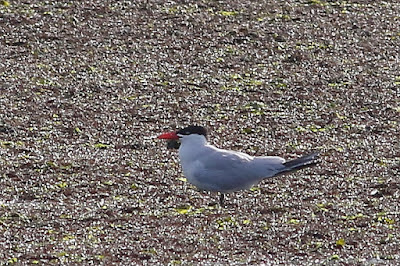
Caspian Tern, Stanpit, 15 July
Despite being relatively infrequent, however, these visits seem to have an uncanny habit of coinciding with the arrival of rare birds back in Dorset which would otherwise have been within cycling distance. This year alone I have missed Red-necked Phalarope, Rose-coloured Starling and Alpine Swift when in Reading, though I did at least manage to catch the Swift at the second attempt. Wednesday's visit provoked the arrival of a Caspian Tern at Stanpit Marsh. Its appearances were erratic but it was seen early and late on the Wednesday, causing me to wonder if I could get home on Thursday night in time to go for it.

My train was due to arrive back in Wareham at about 1900, and google maps suggested that if I got a shift on I could complete the 21 miles to Stanpit by 2045, assuming the journey home went smoothly. It did so until Bournemouth when, for reasons best known to themselves and their shareholders, South Western Trains decide that the westbound service to Weymouth would no longer stop at Wareham or anywhere else for that matter, rendering it useless for 95% of the hot and frustrated passengers turfed off at Bournemouth. 
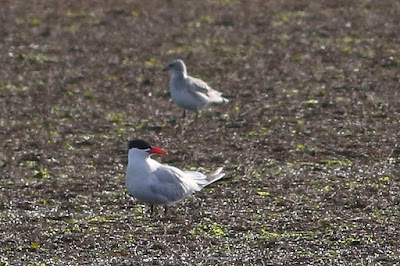
Caspian Tern with juv Med Gull in the background
To compound the problem they simultaneously appeared to come to the conclusion that passenger information about the timing of any later trains was entirely superfluous. The line was clearly in some chaos and a taxi home seemed like the best option - but certainly not the cheapest! Despite my best efforts to persuade others in the queue to share, they all seemed to be travelling on business expenses and not interested, so I arrived home at 1920, £45 lighter in the wallet.

I had pretty much given up hope of making it to Stanpit, but info from Olly Frampton reminded me that it was 2125 before the bird had appeared the night before, so I decided to go for it against my better judgement. I made good time in the cool of the evening and arrived at Fisherman's Bank in Stanpit, from where the best views had been obtained, just after 2100. One other birder was present and we 'scoped the area in vain for the next 40 minutes before reluctantly giving up. Checking the live departure boards for the trains online I was surprised to find that order had been restored so, having dipped, I was at least able to take advantage of the unused portion of my ticket from the earlier journey to complete the Christchurch-Wareham stretch to home.

I put the Caspian Tern from my mind and hit the sack exhausted, rising bright and early for work the next morning feeling surprisingly fresh. Reports of the Tern still being present on and off throughout the day got me thinking about a re-match. The sensible thing to do might have been to leave it until the weekend, but that would have meant cycling into the rising heat of what was forecast to be one of the warmest days of the year. In this context, heading out on Friday evening as soon as work allowed was the better option, and with the bike already packed from the night before I made a prompt getaway, cutting the corner off the flatter but longer coastal route to climb up to the Wallisdown Road some 12 miles from home before dropping gently down the remaining 9 miles to Stanpit.

Arriving shortly before 1830 there was no sign of the Tern but I passed the time chatting to Charles Stubbs, editor of the Christchurch Harbour Ornithological Group's annual bird report. He had been out of the country, making him one of the last locals not to have seen the rare visitor. 

Charles mentioned that he had to leave at 1900 for a pre-ordered meal from the chip shop on the corner. The mere mention of food reminded me of the need to eat, and Charles kindly agreed to watch over my bike and optics while I ran to grab some sustenance. We exchanged numbers 'just in case', and after a bit of a delay to my order I was heading back in his direction, supper in hand. As I was about 100 yards away my phone started to ring and I could see Charles holding his mobile to his ear, obviously watching the bird in his telescope. 'On my way!', I yelled, quickening my pace.

Within seconds I was enjoying good views of the Tern as it rested on the mud in front of Fisherman's Bank. Charles suggested I might consider heading further east, over the border into Hampshire to add the Lesser Yellowlegs at Normandy Marsh to my bike list. Whilst the possibility had occurred to me, I hadn't given it serious consideration, but was now starting to do so. I resolved to make a decision by 1900 which would still leave plenty of daylight to get to Normandy. 

Charles headed off for dinner with my expressions of gratitude hopefully ringing in his ears while I stuck around for a few record shots. Another birder then arrived and after getting him onto the bird, and a jolly exchange of the 'are you that bloke on Twitter who cycles everywhere to see birds?' variety, I made the decision to go for the double. Although Normandy Marsh is 'just along the coast' from Stanpit for the driver, to the cyclist it meant another 13 miles worth of pedalling in the heat, followed of course by a 34 mile journey pedalling home.

Although I could have done without even the gentle ups and downs en route, I made reasonable progress to Normandy arriving around 2015. There was no sign of the bird on its preferred lagoon so I headed for a couple of birders - the only birders - further along the sea wall. Fortuitously, their telescopes were pointing out towards the Solent - and straight at the Lesser Yellowlegs! The gamble had paid off and for the second time that evening I found myself being grateful to fellow birders for making it so easy for me. We had a lovely chat as Little Terns, Redshanks and Oystercatchers bombed around and I even added a bonus Eider to the year list thanks to a small flock on a distant mudbank. My new friends seemed a bit incredulous that I had cycled from Stanpit, even more so when I told them that I started the journey in Wareham, and would be returning there later that night!
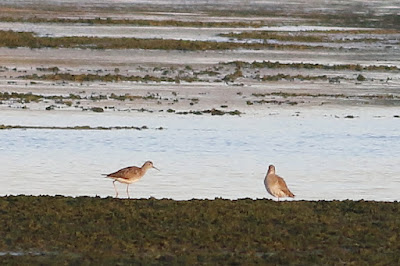
The Lesser Yellowlegs was a long way out but the telescope enabled good views of the legs, needle-thin bill and other features
It was a beautiful evening with the Isle of Wight as a backdrop, but as dusk was approaching I needed to get on the road. Retracing my steps as far as Stanpit, I then turned south to the coast to take advantage of the flat run home via Bournemouth seafront. Although hard going into a stiffening breeze, it was an enjoyable journey, the highlight of which was a huge moon, reddened by Saharan sand, just above the horizon as I passed the pier. 

I arrived home half an hour after midnight with 68.63 miles on the clock, shattered but content. Moreover, I had added two species not just to the non-motorised year-list (moving it on to 189) but also my non-motorised life list. The latter now stands at 247, offering the tantalizing prospect of attaining the landmark of 250 before 2022 draws to a close.

The closest of half-a-dozen Eider on the Solent

Wednesday, 2 June 2021

Lyme and soda

I didn't intend to go to Devon when I set out yesterday morning, it's just how it panned out. After surviving Cogden in a gale, I had come round to the idea of cycling to Lyme Regis where Dipper is reliably seen on the River Lim. So with a week off, and good weather ahead, putting a day aside to make the 40 mile journey seemed like a good option. So the plan was: (i) avoid the bank holiday weekend traffic (ii) go early the next available day (iii) spend rest of week recovering. Tuesday looked ideal with a sunny day forecast and a fresh easterly breeze to push me there and cool me down on the return journey.

Grey Wagtail (juv), Lyme Regis

Psychologically, I had broken the journey down into thirds - home to Dorchester via Tincleton would, I knew, be a quiet first 15 miles. And indeed it was - 2 Lesser Whitethroat and a couple of singing Woodlark cheered me along the Puddletown Road. The middle third (Dorchester-Bridport) would be a more challenging 15 miles on what I hoped would be a relatively quiet A35. It was indeed fairly quiet, and while lorry and bus drivers were invariably considerate, a few car and van drivers came close enough and fast enough to cause some discomfort. Camper van drivers seem particularly oblivious to the width of their vehicles, perhaps being car drivers mid-week they 'forget' the extra foot or two of girth they are packing at the weekend. 

Anyway, once I had reached the zenith of this stretch at Askerswell Down with spectacular views of the Jurassic Coast, the long descent into Bridport was a breeze. I clocked a respectable 36.7 mph with the following wind on the steepest part, ticking Corn Bunting and Yellowhammer for the day list in the process.

The final third (Bridport-Lyme Regis) was the shortest at 10 miles but also the most daunting - it would be later in the day and the hills up to and out of Chideock, and the final push up Raymond's Hill to Lyme Regis, would be a struggle in the rising heat. And so they were, though there was just enough 'hard shoulder' to push the bike where needed and feel reasonably safe on the narrowest parts. 

Having left at 0500, I arrived on the outskirts of Lyme Regis just after 0900. The obvious thing to do was start at the 'top' of the river and make my way down through town, a strategy that usually doesn't fail to produce a Dipper. It did on this occasion unfortunately, but no matter, I thought, I will just go back up that way having first paid a visit to the Harbour for the chance of another year tick: the long-staying drake Eider. 

I knew this bird was still around following recent news from another Purbeck resident, Garry Hayman. Sure enough, he was, sitting on a dinghy, and I enjoyed a late breakfast/early lunch in his company whilst catching my breath and contemplating my strategy for the return journey. I had hoped to see Dipper fairly promptly and be away by 1000, but it was already that time so I decided to head back up the river slowly towards Uplyme, for as long as it took to see this river-dwelling speciality.

Eider, Lyme Regis Harbour

It was now a pleasant morning but warming up rapidly so I was glad of the shade by the river and the smell of wild garlic added a spring-like feel. Juvenile Grey Wagtails called from the banks but of Dipper there was no sign. I continued on up and realised I had gone too far, literally and metaphorically, when I came across a sign saying - 'No cycling: Devon County Council'! I crossed the border, mainly so I could say I cycled to Devon in a blog post, and headed back down.  

Coming to Lyme Regis and not seeing Dipper would have been a disaster, so although I knew it was only a matter of time, I also had my eye on the clock and half a mind on the gruelling return journey. Garry had seen Dipper by a small footbridge above town, away from the crowds, which had been a Dipper-free zone on the way down and up, so as I reached this point for the third time I resolved to stake it out until one appeared. As I walked to the centre of the bridge and looked upstream a tiny bow wave in the water caught my eye. Then through the wave broke the unmistakeable shape of a Dipper. It sat up on a rock mid-stream, bill full of prey, bobbed as if to curtsey after a bravura performance, then flew literally underneath me downstream to where I presume young birds were waiting to be fed. Success!

Dipper, Lyme Regis

To add Dipper and Eider to the list now required one more small thing: get back in one piece. National cycle route 2 is the 'official' cycle route for this part of the south coast, but the stretch from Lyme Regis to Bridport involves a fairly massive detour, so I thought I would retrace my steps on the A35 and see how it went before rejoining route 2 there for a quieter journey home. The Charmouth bypass was easy enough - a broad hard shoulder felt like a luxury - but I knew the road would narrow on the long climb to Morecomblake. I needn't have worried though as traffic was by now at a standstill and I was able to crawl past in first gear! A few motorists gave me dirty looks, as if I, not they, was the cause of the congestion. Remember chaps: you're not stuck in traffic, you are traffic.

Not the best way to see a Weasel but it was on the road next to...

...a Field Vole. I presume the Weasel killed the Vole but got run over whilst dragging it across the road.  I avoided the same fate by only snacking in lay-bys on the A35.

Steaming down the hill into Chideock, I realised I needed more water and fizzy drinks (there you go, if you were wondering where the title of this post fitted in) before the hellish ascent out of the village. The local shop for local people had run out of big bottles of water, so a Lucozade Sport (downed in one) and a Lemon Fanta had to suffice. Traffic was again crawling up the steep incline, and while I did my best to keep pace the early start was taking its toll, and I had to take advantage of the only pull in half way up to let a truck past. It was more of a drain than a lay-by, just about big enough to get the bike off the road, but an appreciative double thumbs up and blast on the air horn from the driver made me smile. Once at the top, I rolled down into Bridport and knew that the worst - in terms of traffic if not distance - was behind me.

The start of cycle route 2 east from Bridport involved another massive detour so I followed a likely looking shortcut on a bridleway from Bothenhampton to Shipton Gorge. This started well enough, but the bridleway was not one of those nice gravel jobs, rather a proper horse track, deeply pitted with hoofprints, and petered out into a footpath which was barely more than a dry stream bed overgrown with vegetation. I pressed on and was relieved to reach the bright lights of Shipton Gorge soon after. Route 2 from then on was a delight - although a bit up and down, it avoided the fierce climb up to Askerswell Down, and took me past inviting country pubs and the chocolate box villages of the Bride Valley. An idyllic place that should be full of purring Turtle Doves and jangling buntings, it was slightly depressing to find it relatively birdless.

Portland from the Hardy Monument

After a final long climb up to the Hardy Monument, I knew the worst really was behind me now and I could take the rest of the journey easy. One more quick stop in Dorch was required for additional soda intake and I was home shortly after 1830. 88 miles had been travelled, 10 hrs 40 mins in the saddle, with a monster elevation gain of 7,710 - the equivalent of going up Snowdon twice from sea level. I consumed about 3 litres of fluids and almost as much sun block, knowing that dehydration and sunburn were probably my two greatest health risks, after getting mown down on the A35 of course. I'll probably never do it again, at least not via the A35, though I'm glad I did!

In a previous job I had the pleasure of looking after the Dorset AONB team - one of their many successes was bidding to get these monster pylons removed from the landscape. It's taken many years but work is now underway - the 'scar' on the right shows the route of what will now be the underground power lines. Taken near Black Down.
 

Sunday, 15 January 2017

Man about town

Urban birding has become something of a habit lately, and we are fortunate in Dorset to have a number of good options in this regard. Last weekend saw me pottering around a few more of the county's birding hotspots between Portland and Dorchester. First stop was Fortuneswell and Chesil Cove at the southern end of Chesil Beach, where a pair of Black Redstarts were flitting on the rocks - same time, same place as a pair last year. A trio of Eider Duck were the highlight of a quick scan of Portland Harbour before lunch with the ducks and gulls at Radipole Lake in Weymouth. There was just time to twitch a first winter male Rose-Coloured Starling on the rooftops of suburban Dorchester before heading back to Purbeck to see about 10,000 of its more familiar cousin, the Common Starling, come in to a spectacular roost at Studland's South Haven.
Male Black Redstart, Chesil Cove
Black Redstart, Chesil Cove
Female Black Redstart, Chesil Cove
Rock Pipit, Chesil Cove
Meadow Pipit, Ferrybridge
Eiders in Portland Harbour
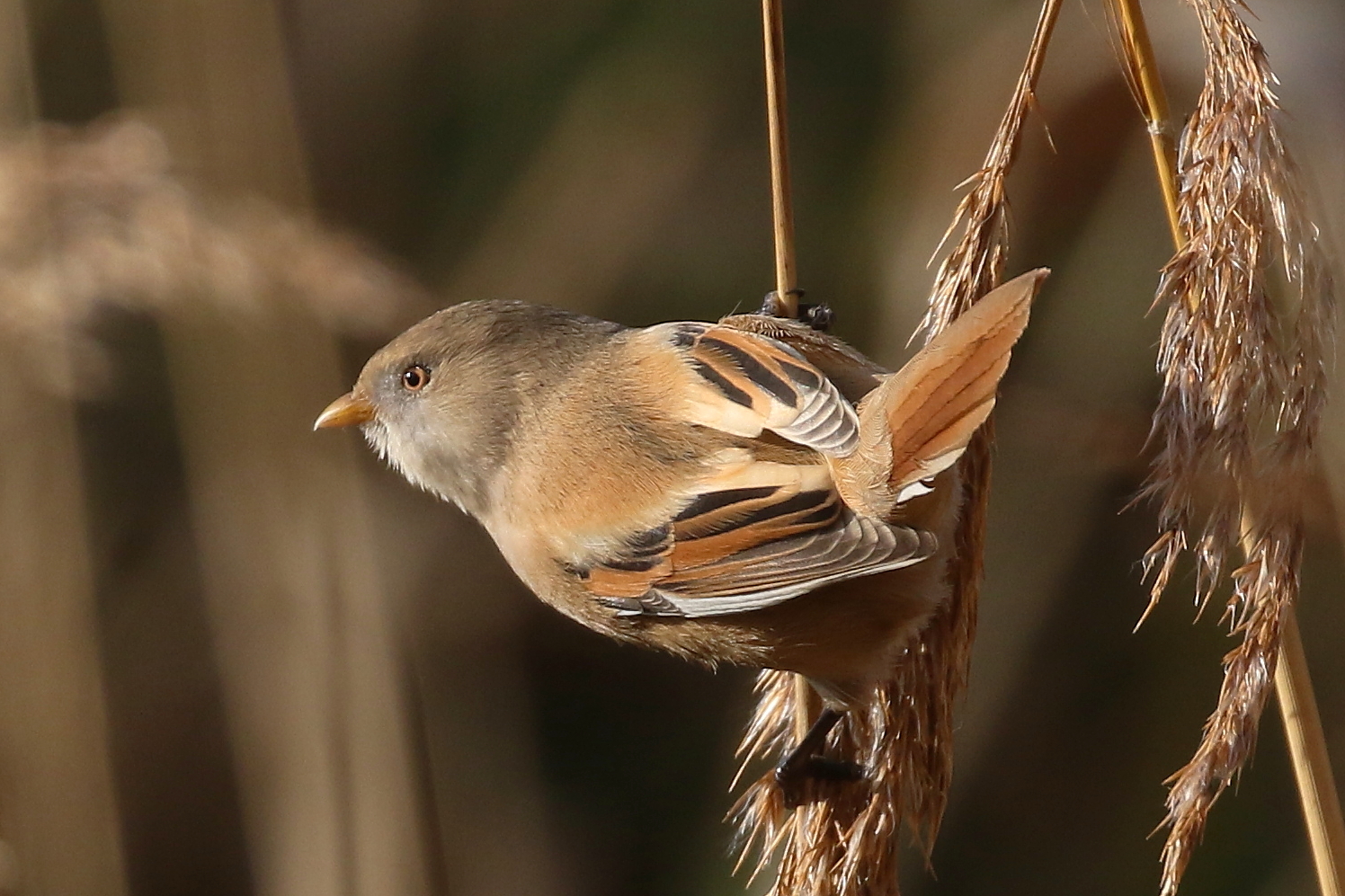
Bearded Tit, Radipole Lake
Blackbird, Radipole Lake
Carrion Crow, Chesil Cove
Dunnock, Radipole Lake
Shelduck, Radipole Lake
Black-headed Gull, Radipole Lake
Common Gull, Radipole Lake
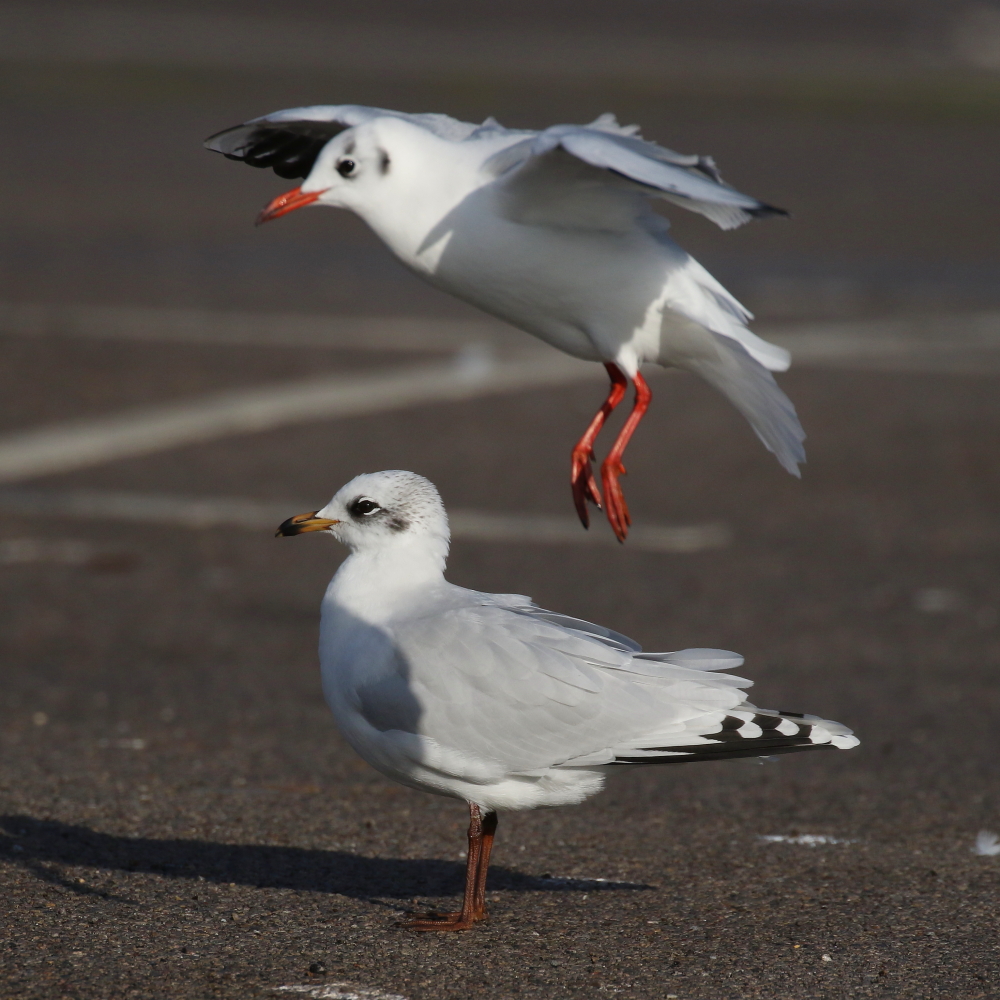
Mediterranean Gull, Radipole Lake
Med Gull with Black-headed Gull above
The drake Hooded Merganser still displaying at Radipole
Always a show-off

Male Marsh Harrier at Radipole
Moorhen, Radipole Lake
Feral Pigeon, Radiploe Lake
Rose-coloured Starling, Dorchester
Not looking so good after a bath
Starling murmuration at Studland