Showing posts with label Baird's Sandpiper. Show all posts

Monday, 4 September 2017

300 up

I come from a long-line of under-achievers so when it comes to listing, I try to keep my goals to a bare minimum to avoid disappointment. At this stage of mid-life, in fact, I have just two self-imposed targets - first, to see 300 species of bird in Dorset before reaching the age of 50 and, second, to see 500 species in Britain before I die. Daft these targets may be, but yesterday I ticked off the first of them by adding Baird's Sandpiper to my county list, and with a couple of years to spare.
Common Sandpiper was one of a number of migrant waders on Brownsea
300 species for Dorset is no big deal, of course - the top county listers are closer to 400 than 300, and the county list as a whole currently stands at 423, with at least 3 more species (Spectacled Warbler, Elegant Tern and Yellow Warbler) certain to be added when the 2017 record books come to be written. But having only moved here in 2007 I still think it represents a pretty good effort for a fully-employed father of two who can't always drop everything to chase rarities.
There weren't just migrant birds on Brownsea - this Painted Lady was also on the heath at the top of the island
Yesterday was a case in point: I wrote as recently as June how visits from family/friends were guaranteed to result in the appearance of a rare bird. This weekend the visit of my sister and sister-in-law threatened the same - the rare bird being the Baird's Sandpiper on Brownsea, found on Friday lunchtime by Paul Morton. Work commitments meant there was no chance of twitching it that day, and even though the bird went missing on the Friday afternoon and evening, a day trip to the island on Saturday seemed a good idea. Fortunately our visitors and the rest of the family agreed.
Redshank on the Brownsea lagoon
Soon after our arrival I was scanning the back of the lagoon for waders, and had a brief view of a bird with an obvious pectoral band, apparently smaller than the Dunlin with which it was associating. It was then lost to view in vegetation but I had seen enough to keep an eye on the same area. I was soon joined by Graham Armstrong and we simultaneously locked on to a bird which looked a good candidate, and similar to the one I had seen earlier.
The Spoonbill flock had risen to 26 birds by Saturday - they spent a lot of time in the air flushed by...
...the Red Arrows, in the area for the Bournemouth Air Show
Despite the heat haze and the considerable distance between us and the bird, we gradually pieced together the key features - the pectoral band in combination with otherwise pure white underparts, attenuated rear end, scalloping on the wings, shorter bill and legs, slightly paler and more concolorous upperparts compared to the more variable Dunlin it was with. It was often out of view behind vegetation, and re-locating it required some care due to the haze and the fact that a number of the Dunlin also showed relatively neat pectoral bands - but the latter invariably displayed scruffier underparts and larger heads and bills than the more diminutive Baird's.
In this record shot to end record shots, the bird on the left is the Baird's - even in this terrible image the impression of a slighter bird with a smaller bill, cleaner white underparts and more attenuated rear end is confirmed compared to the Dunlin on the right
Increasingly confident with the identification, we put the news out enabling several Dorset birders to catch up with the rare visitor in the afternoon. The rest of the day was then free to be devoted to touring Brownsea with the family and enjoying its exotic selection of non-native spongecakes and flans.
A slightly better comparison shot of Baird's Sandpiper (right) and Dunlin illustrates the key features mentioned above rather more clearly - this was taken last October at Davidstow Airfield in Cornwall

Wednesday, 28 December 2016

October...

October always brings a sense of anticipation, and October 2016, up next in my review of the year, was no exception. It brought its fair share of success, but also its fair share of frustration. First the successes, which featured a couple of American waders.
A Baird's Sandpiper at Davidstow airfield was worth an early morning visit. The closest I have seen one, photographed from the car window
This Lesser Yellowlegs was at Lytchett Bay - my second Dorset tick of 2016
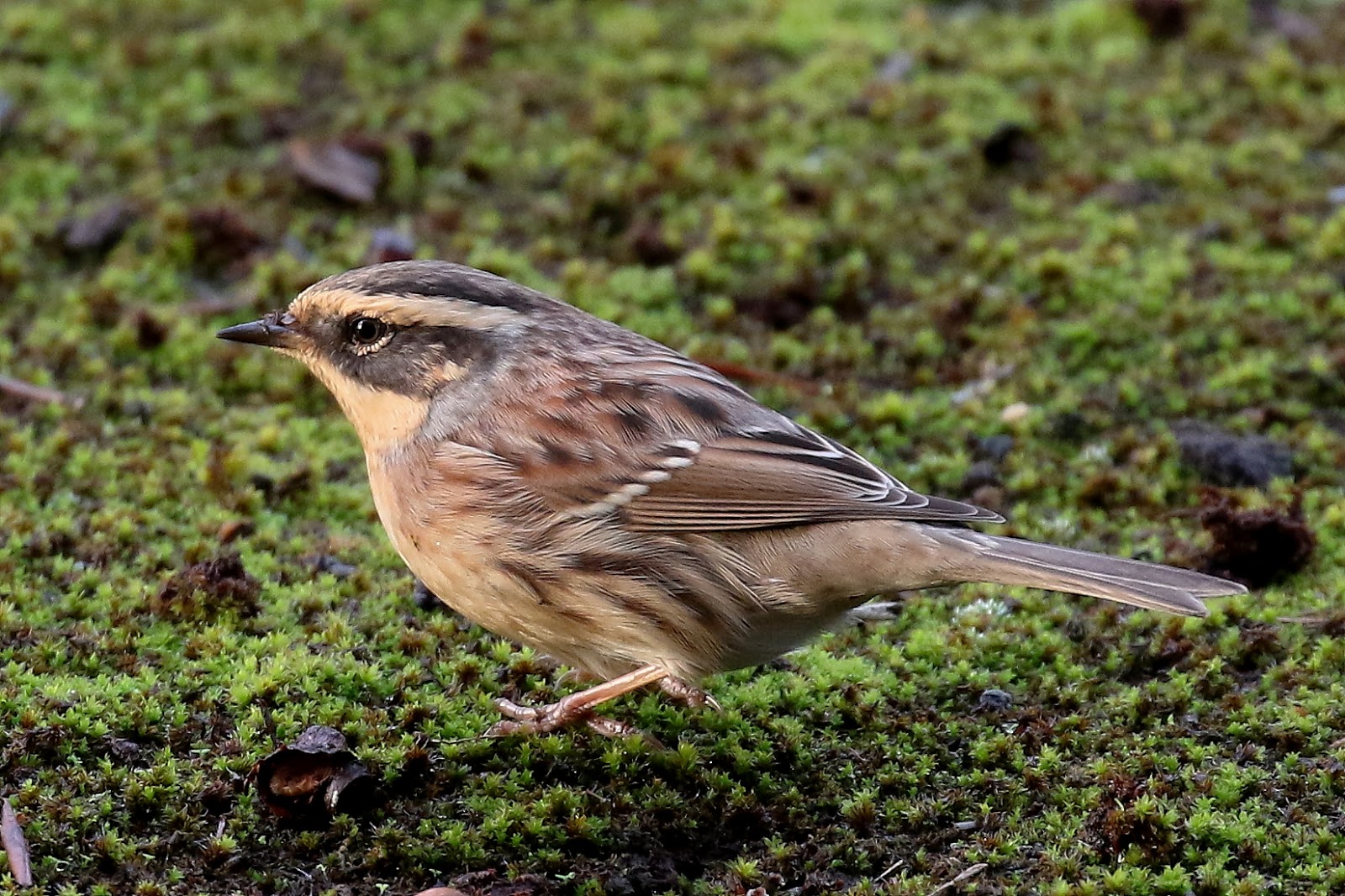
October 2016 will be remembered for the Siberian Accentor invasion, and I managed to catch up with the second one to turn up - the long-staying Easington bird which drew a crowd from the middle of the second week of the month. Fortunately it stayed until the Sunday allowing myself and Chris Patrick to pitch up, tick it before breakfast and be back home just in time to avoid social services taking our abandoned families into care.
Siberian Accentor, Easington - a special bird, and my bird of the month for October

This Shorelark was just down the road from the Siberian Accentor
A good first half to the month then - but less so the second half. Portland lay at the centre of October's frustrations with a short-staying Red-flanked Bluetail and a Pine Bunting failing to settle having been ringed at the Observatory. Still, a few scarce migrant birds made several visits more bearable over the course of the fortnight.
Hen Harrier, Portland
Turtle Dove on Portland - a sad comment on its rarity now that it was quite a well-twitched bird, My photo of the month for October
Another island - St Mary's added to the frustration at the month's end, when a day trip with Steve Smith produced nothing more exciting than a couple of Yellow-browed Warblers and a putative Eastern Yellow Wagtail. Still, it was good to be back on the island for the second time in two months, even though it wasn't as successful as the first.
Yellow-browed Warbler, St Mary's
Putative 'Eastern' Yellow Wagtail

Monday, 10 October 2016

Drive-through birding

I stopped in at the disused airfield at Davidstow on the way back from the Isles of Scilly last month, hoping to find an American wader on the closely cropped sward. There were none that day, but over the following few weeks it played host to a Buff-breasted Sandpiper, a Pectoral Sandpiper and an American Golden Plover, a species I saw here a few years ago. None of these was quite enough to tempt be back down to Cornwall, but a long staying Baird's Sandpiper, somewhat rarer than all the aforementioned species, was another matter, and as I had not previously photographed this species very well, I resolved to head down there on Sunday morning if the forecast was anything better than dire.
I decided on an early start in case the airfield was busy with model aircraft enthusiasts, but I had forgotten just how vast the site is, and even though model planes were buzzing around in one corner, there was still acres of ground for waders to feed in undisturbed. There are two useful rules for birding Davidstow: first, on arrival scan for stationary cars in the distance, and if you see one with a dirty great lens hanging out the window, head for it as it will probably be pointing at a rare bird. Second, stay in the car - the waders will tolerate a close approach from a vehicle, presumably viewing a slow moving car as some kind of lumbering livestock. Open the door, however, and you risk flushing whatever it is you are looking at.
An early morning view on the pool with Dunlin in the background
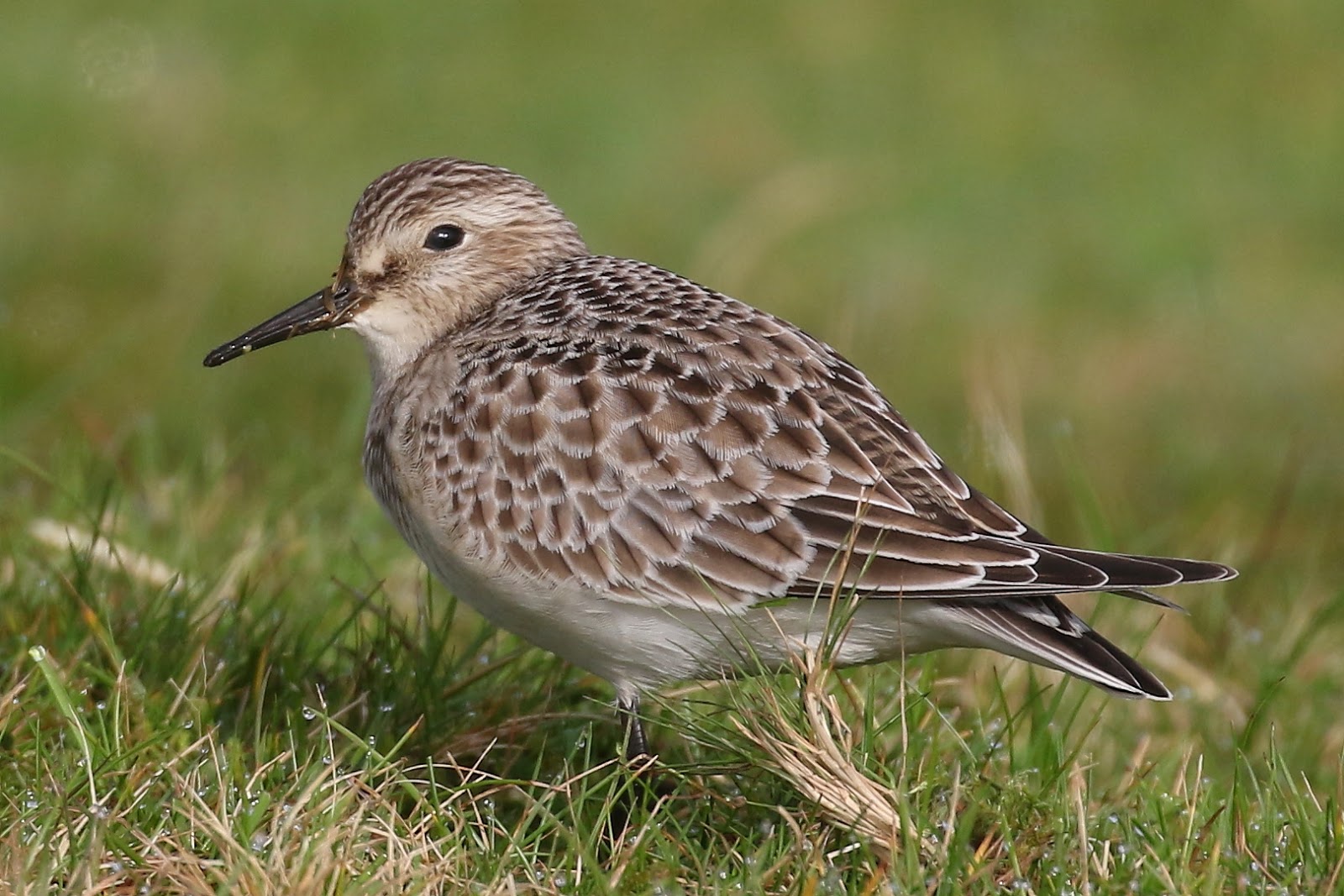
Baird's Sandpiper - the scaly back pattern makes this a juvenile bird
Note the buffy breast band and long primary projection
The bird was reported as being 'near the runway' - sometimes it was on the runway running between the cars!
Head on Baird's shows a flattened oval body shape
So with these rules in mind I arrived just after sunrise, drove up to a car parked in the middle of the capacious runway, and immediately saw the Baird's Sandpiper feeding on a small pool at close range. Eventually it, and the Dunlin it was with, had enough of the pool and headed off to feed on the grass with some Ringed Plover. A small and slightly comical convoy of vehicles tracked them as they fed along, and sometimes on, the pock-marked runway. I spent a couple of absorbing hours photographing the Baird's, by the end of which the sun had conveniently come out.
The Baird's was feeding initially with a few Dunlin
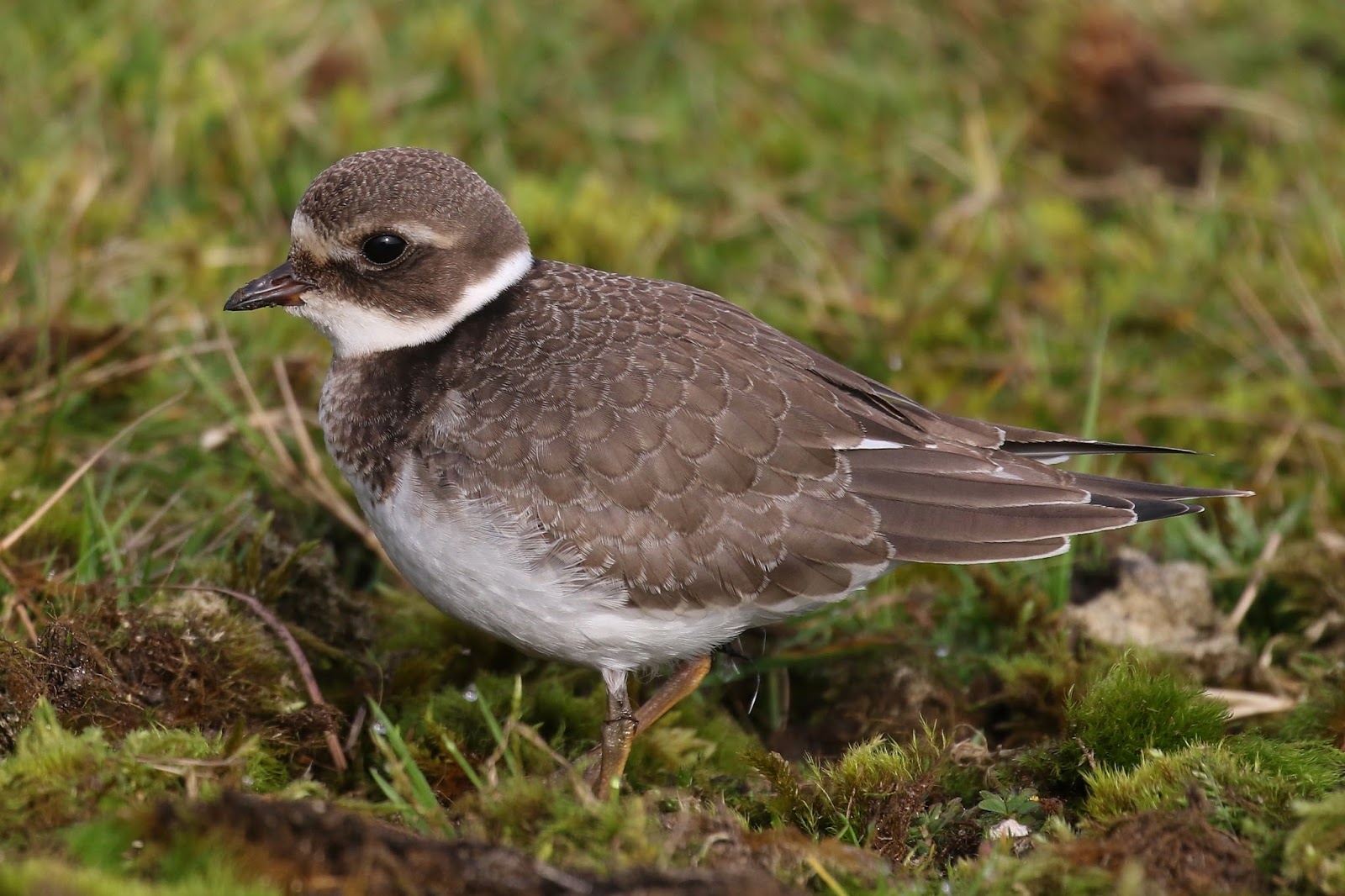
Later they joined up with a small flock of Ringed Plover
I couldn't find a Semi-P among them!
Ringed Plover with Baird's Sandpiper behind
Baird's Sandpiper