Showing posts with label Dunlin. Show all posts

Tuesday, 19 October 2021

Shetland Day 2: A Real Wild One

The forecast for Sunday 3rd October was foul. Like, proper wash-out, don't-bother-getting-out-of-bed foul. But we had waited a long time for this Shetland trip, and we weren't going to let a bit of rain stop us getting out. Or wind. Maybe hail and snow, but the forecast wasn't that bad. Bacon, on the other hand, could well delay the start of the birding day...

The result of 80mph gusts forecast on Shetland on 3rd October
News of the Semi-palmated Sandpiper (on which we dipped the previous evening) being relocated near Pool of Virkie broke pretty early and gave us the shot in the arm we needed to get moving. The wind was howling but reasonable scope views could still be obtained in the prone sniper position, even if anything but the most basic record shots were a challenge. It was hanging out with a flock of Dunlin and a bright Little Stint which provided a convenient comparison.
Poor shot of the Semi-palmated Sandpiper (right) with Dunlin, Pool of Virkie

An equally poor shot of Little Stint just for comparison
From there we trundled past the tumescent windsock on the Sumburgh airstrip around to Grutness, a spot I have always enjoyed visiting since a close encounter with an American Buff-bellied Pipit a few years ago. More lying down was required here to photograph a rather windswept Wheatear on the tarmac. Jono went for a stroll in a wet area nearby, if leaning into the wind at a 45 degree angle can be classed as a stroll, and put up a Jack Snipe. I joined him in trying to relocate it and we seemed to disturb a couple of chunky passerines which flew overhead calling. 
Windswept Wheatear at Grutness
Wheatear
Speculation over the crackling radios suggested possibly one of the scarcer Buntings, but within a few minutes, hidden from my view, they sat up on the rock armour in front of the rest of the team revealing themselves to be Shorelarks. A few pics were obtained by the others but they flew before I could point my lens at them. Although a small flock of this photogenic species showed well later in the week at Scatness, the ruthless tick-machine which is Bradders Birding Tours almost never goes back for seconds - hence stealing Howard's photo for this post! 

Shorelarks at Grutness (pic by Howard Vaughan)
Buffeted by the weather we headed back to Hoswick for a brew, then Sandwick where a couple of Purple Sandpipers were trying to be invisible on the shoreline, then Wester Quarff where we hoped that both we and a fistful of rarities might find shelter. The search for them was curtailed when news broke of a Bonelli's Warbler species a short way away, back on the main road, and we re-traced our steps to connect with it after a mercifully brief wait. Had it been an Eastern Bonelli's, it would have been a tick for two of us - but after a day of silent teasing it eventually called to reveal itself as Western - still a good bird, but no cigar.
Otter at Grutness

Purple Sandpiper at Sandwick
The twitch at the Bonelli's was the biggest we had seen all week, and freaked out by the crowd and the awful prospect of having to *socialise* we made our excuses and left to check out a few other sites, the best of which was Fladdibister, where Howard kicked up a Little Bunting which the rest of us missed. 
Western Bonelli's Warbler
Surely showing it facing the other way makes it an Eastern Bonelli's Warbler?
The hour was getting late, and the promise of Sunday roast - yours truly's main contribution to the culinary week - was calling. Fighting 50mph winds all day was by now taking its toll and when Bradders proposed one last stop at Orcaquoy in the near darkness for a Red-breasted Flycatcher, I confess to whining like a 6 year old who just wanted to get home before C-Beebies finished for the day. But I was persuaded to head once more unto the breach and, Bradders being Bradders, only went and booted up an Olive-backed Pipit on to a garden wall!
Loving those cotton white underparts
With our driver having scored another good find we were finally allowed home for some dinner and a well-deserved ale. Given that the day had been a potential write-off, the team had done pretty well. At a personal level there was some trauma, however, in discovering that what appeared to be an intermittent fault with my lens discovered whilst papping the pipit had now become permanent. Photographically, the trip was potentially over before it had barely begun and I sulked and burnt dinner until the offer of a loan of a spare by top bird photographer Gary Thoburn saved the day. We arranged to meet up the following morning so I could collect it, and I slept the sleep of the just. 
A wall-creeper, not a Wallcreeper: Olive-backed Pipit, Orcaquoy
OBP - another top find for BBT

Monday, 19 June 2017

Waders high and low

There are few greater pleasures in life for me than photographing waders on a beautiful, empty Scottish beach. Our recent holiday near Gairloch providing a few opportunities to indulge:
Dunlin
This bird was singing - it sounds like a tiny bomb dropping
Another of a small flock of Dunlin on the beach at Red Point
Summer plumaged Sanderling is in stark contrast to the silvery birds we see in winter in Dorset... 
...the clockwork running motion is the same though!
Sanderling in flight
The flock was feeding in the seaweed on the beach
Ringed Plover were also on the beach at Red Point
Ringed Plover
In contrast to the waders at sea level, this Greenshank was up at about 1,800 feet on Beinn Eighe
I walked the Bein Eighe Mountain Trail one morning to find a pair up on the plateau near some boggy pools
Greenshank
A huge dune at Red Point - my sons can be seen for scale at the base

This shows why the area is known as Red Point after the colour of the sand
Ringed Plovers at Red Point

Tuesday, 3 January 2017

Suffering for your art

The first day of 2017, normally a red letter day in the birding calendar, was a bit of a washout with heavy rain causing me to abort a planned afternoon visit to Swineham. Well it's the 'post-truth' era so much easier to conclude it would be birdless from the comfort of the armchair than to actually go there and prove it. So here are a few pictures from before and after that from two of Dorset's urban birding hotspots - Lyme Regis, which I visited to see my godsons last Friday, and the built up north shore of Poole Harbour, around which I strolled with the family yesterday. The sun shone mightily at both, and photographs were the inevitable result.
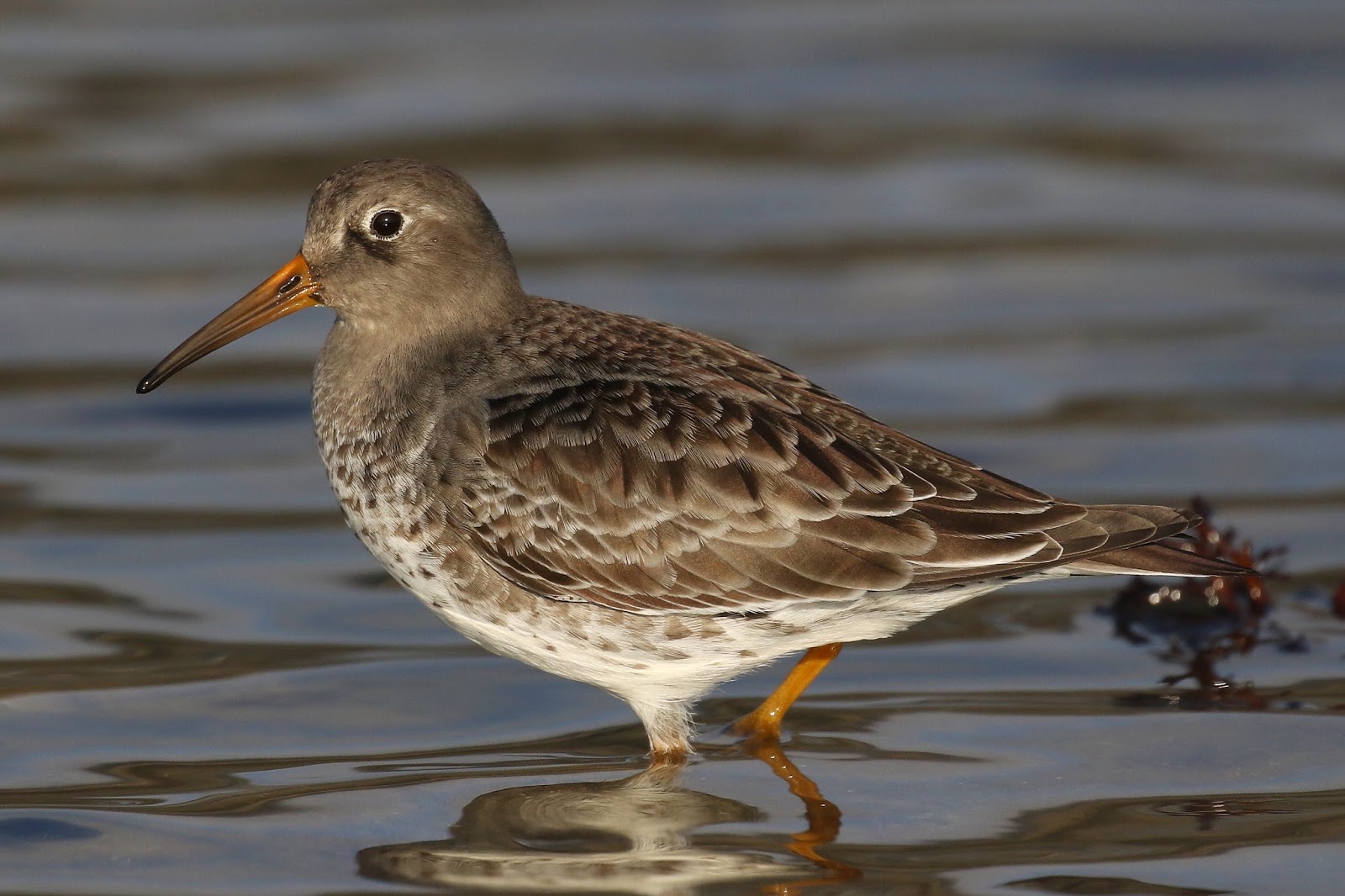
Purple Sandpipers often roost on The Cobb at Lyme Regis but they are either distant there or right underneath you making photography difficult - but it was low tide so I caught up with a flock on a rocky shelf at the beach 
The snag was they were feeding on a ledge surrounded by six inches of water and I was only wearing my 'about-town' shoes. So off they came enabling me to wade through the freezing water, lacerating my feet on the barnacled rocks. Well you have to suffer for your art...
Not often you get to see the beautiful purple iridescence on a Purple Sandpiper - but it can be seen on this one (click to enlarge)
A careful approach allowed me to get pretty close
A pair of Dipper were in the Mill stream which runs through the heart of town
A curtsying courtship display with a flash of the white eyelid
One of very few locations in Dorset where Dipper can be seen

Grey Wagtail also frequent the same stream

A misty Golden Cap from Lyme Regis beach
Mediterranean Gulls were also on the beach at Lyme Regis
No longer a rare sight on the Dorset coast
Ethereal sunset looking west from Chideock - we could see the reflection but not the sun itself
Black-tailed Godwits were present in large numbers at Upton Country Park yesterday - the first sunny day of 2017
Also a large Dunlin flock out in Holes Bay
Mixed flock of Dunlin and Blackwits against the backdrop of urban Poole
A good selection of wintering duck were in the bay including this smart drake Pintail
Blue Tit in the woodland at Upton CP
Finally from Upton a backlit male Stonechat
Earlier in the day saw me on the groynes at Sandbanks where a patient approach allowed me to get close to another favourite wader: Sanderling
Sanderling at Sandbanks
The roosting birds tolerated my careful approach and a less careful approach from a couple of dogs, but ultimately a jetski put them to flight - unfortunately an occupational hazard for the Sandbanks Sanderlings

Monday, 10 October 2016

Drive-through birding

I stopped in at the disused airfield at Davidstow on the way back from the Isles of Scilly last month, hoping to find an American wader on the closely cropped sward. There were none that day, but over the following few weeks it played host to a Buff-breasted Sandpiper, a Pectoral Sandpiper and an American Golden Plover, a species I saw here a few years ago. None of these was quite enough to tempt be back down to Cornwall, but a long staying Baird's Sandpiper, somewhat rarer than all the aforementioned species, was another matter, and as I had not previously photographed this species very well, I resolved to head down there on Sunday morning if the forecast was anything better than dire.
I decided on an early start in case the airfield was busy with model aircraft enthusiasts, but I had forgotten just how vast the site is, and even though model planes were buzzing around in one corner, there was still acres of ground for waders to feed in undisturbed. There are two useful rules for birding Davidstow: first, on arrival scan for stationary cars in the distance, and if you see one with a dirty great lens hanging out the window, head for it as it will probably be pointing at a rare bird. Second, stay in the car - the waders will tolerate a close approach from a vehicle, presumably viewing a slow moving car as some kind of lumbering livestock. Open the door, however, and you risk flushing whatever it is you are looking at.
An early morning view on the pool with Dunlin in the background
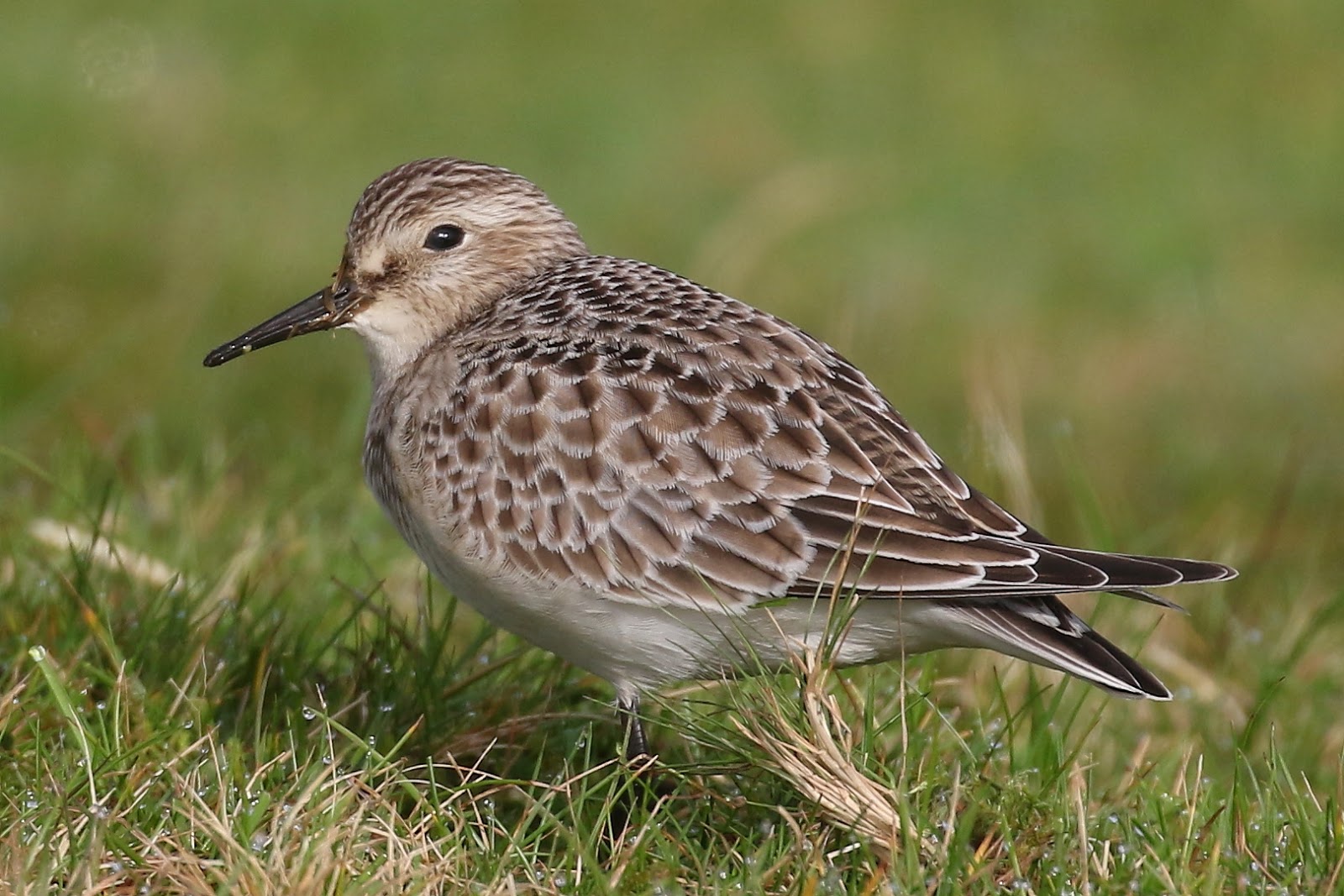
Baird's Sandpiper - the scaly back pattern makes this a juvenile bird
Note the buffy breast band and long primary projection
The bird was reported as being 'near the runway' - sometimes it was on the runway running between the cars!
Head on Baird's shows a flattened oval body shape
So with these rules in mind I arrived just after sunrise, drove up to a car parked in the middle of the capacious runway, and immediately saw the Baird's Sandpiper feeding on a small pool at close range. Eventually it, and the Dunlin it was with, had enough of the pool and headed off to feed on the grass with some Ringed Plover. A small and slightly comical convoy of vehicles tracked them as they fed along, and sometimes on, the pock-marked runway. I spent a couple of absorbing hours photographing the Baird's, by the end of which the sun had conveniently come out.
The Baird's was feeding initially with a few Dunlin
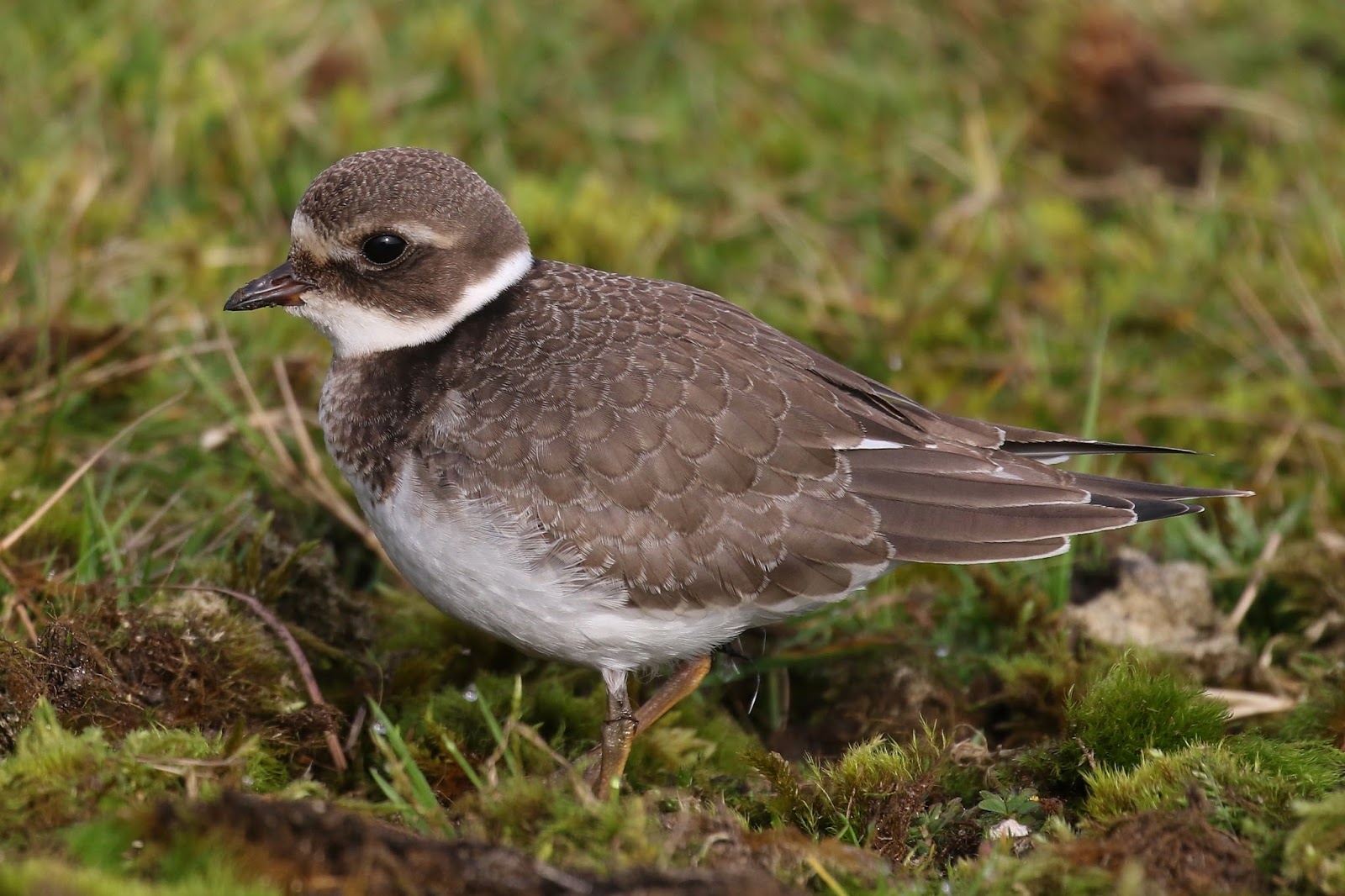
Later they joined up with a small flock of Ringed Plover
I couldn't find a Semi-P among them!
Ringed Plover with Baird's Sandpiper behind
Baird's Sandpiper