Showing posts with label Barred Warbler. Show all posts

Thursday, 15 November 2018

Shetland: part the second

To say there have been complaints about the absence of fresh content in this space would be overstating it. But a few loyal readers have passed comment to this effect, so I have been stung into action by these gluttons for punishment. And where better to resume than with a follow-up to the almost popular Shetland: part the first post.
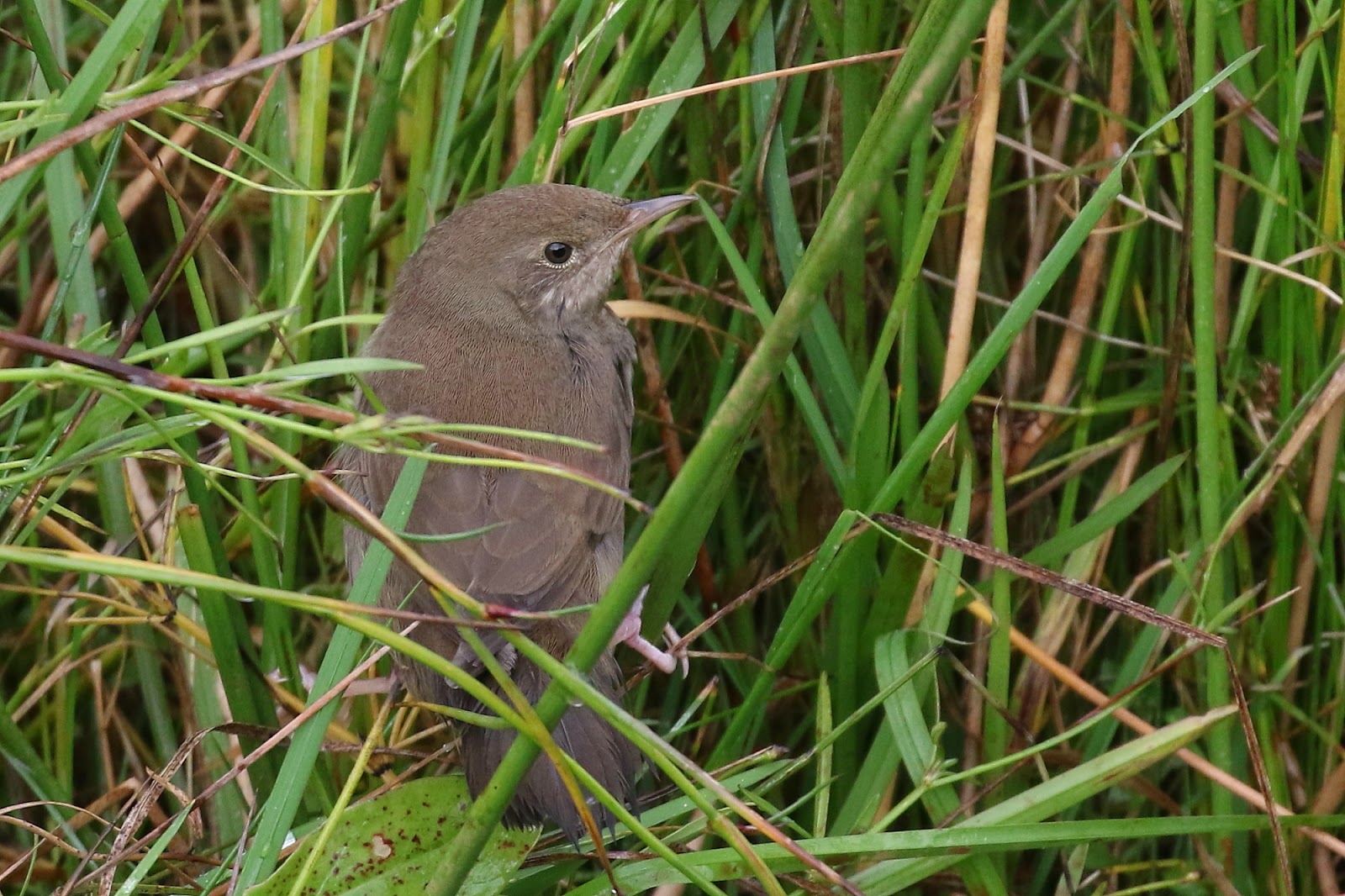
River Warbler on Unst
Probably the bird of the trip, and only my second in the UK
After proving initially skulky, it eventually gave us extended views
In this post I will canter through the rarity highlights. The first couple of days had produced very little on this front but the discovery of a River Warbler in a small iris bed on Unst changed things. We arrived at the site to find what would become a familiar Shetland scene that week: sheeting rain and no sign of the sought after bird! Both problems were fleeting though and within a short while we had enjoyed good views of this ultimate skulker as it walked between stands of iris. Returning later in the day in better weather we enjoyed extended views and photo opportunities as it bathed lower down the burn. A summer plumaged American Golden Plover was a bonus on our first visit to Unst, and our only rare wader of the trip.

Eastern Yellow Wagtail, Unst
A very grey and white individual with just a hint of a buffy chin and vent
An elongated hindclaw is a feature of Eastern Yellow Wagtail
During the middle of the week Shetland went wagtail crazy - first turning up a presumed Eastern Yellow Wagtail on Unst (consolation for dipping a Pechora Pipit, the less said about which the better). This was a tick for all of us since the split from common or garden Yellow Wagtail. The monochrome vagrant looked and sounded the part, and turned up at a place, at a time of year and with avian company which suggested an eastern origin, though it remains to be seen whether it passes muster with the rarities committee.
Citrine Wagtail, Bressay
An approachable individual
Note the complete white ear-surrounds
Having made a couple of long-distance excursions to Unst earlier in the week, on the Thursday of our stay we elected for a shorter island hop to Bressay, where a Citrine Wagtail had reportedly been showing well. We couldn't have known just how well: after a careful approach it walked towards us for a remarkably close encounter.
Common Rosefinch, Mainland
Barred Warbler, Mainland
American Golden Plover, Unst
Other minor rarities kept us entertained - a few Barred Warblers, including the one pictured here, found at Busta House Hotel by our own Bradders, a Marsh Warbler at Sumburgh and a Common Rosefinch on a mainland beach. Remarkably, Yellow-browed Warblers were notable by their absence, and we scraped just a handful in contrast to the daily sightings of the previous year.
Marsh Warbler, Sumburgh Quarry
Yellow-browed Warbler, Unst
Not a bumper year by Shetland's high standards, perhaps, but some quality all the same. I can probably wrap up Shetland in just one more post - so come back soon(ish) for the final instalment.

Monday, 9 October 2017

Shetland: the long road north

I have wanted to visit Shetland in the autumn for many years but have either lacked the time, the energy or the organisational panache to get myself there. The offer of a place in a car with David Bradnum for a nine day trip at the turn of the month was not, therefore, to be missed - time and energy are still in short supply, but the organisational skills of Bradders are second to none, so I found myself in the luxurious position of just having to send him occasional tranches of money as ferries, accommodation and other essentials were skilfully procured. Vaughans Howard and Bob (no relation) had their names on the other two seats in the car and while our mutual friend James Lowen had hoped to join the party, an apparently under-stocked brownie point jar put paid to that.
Juvenile Long-tailed Skua, Goswick, 26th September 2017
A pale phase bird
The plan was to arrive in Shetland on the overnight ferry on the morning of 28th September and comb the islands for rare birds for the following week and a bit - but first we had to get there. David proposed leaving a day early and stopping overnight at Berwick, providing time to do some birding on the east coast on the long road north. I met up with the others in Cambridgeshire, where a kindly Jim Lawrence had agreed to lower the tone of his neighbourhood by allowing me to park my old banger outside his house for the time we were away (thanks Jim!), thus reducing my driving time substantially.
Effectively a 'photo-tick' for me as I managed to lose the files of an individual of this species flying past Dungeness taken many years ago!
The Skua was feeding on worms from the short grass of the golf course fairways
The first leg of the journey to Cambridgeshire went smoothly as did the second which took us to a lunch stop on the A1. This was rudely interrupted by breaking news of a Taiga Flycatcher at Flamborough Head - precisely the sort of east coast mega we had hoped would occur en route. The excitement was short lived, however, when seven minutes later it was re-identified as a Pied Flycatcher (!). At least we hadn't diverted from the main drag and with the Passat's hyper-drive set to warp speed, we reverted to Plan A and a hoped for close encounter with a juvenile Long-tailed Skua in Northumberland.
The light was tricky for flight photography...
...these my best efforts
Skuas are normally pelagic species but every now and then one will pitch up on land allowing for closer and more prolonged study than would normally be possible on a seawatch. This one had pitched up literally on a golf course near Goswick. On arrival we were hailed by probably the friendliest and least possessive bunch of golfers we had ever met, all of whom wished us well in finding the funny seagull which had been sitting on their golf buggies over recent days. Unfortunately, as we approached the Skua's favoured fairway, Howard picked it up flying distantly away from us. After landing briefly it took off again and flew strongly to the south.
This shed on the Goswick golf course would have made a good seawatching hide given what was on the fairway!
Barred Warbler, Kilminning, 27th September 2017
We decided to check out the Lindisfarne area and try for the Skua again later. A visit to The Snook turned out to be good practice for the coming days - each of several stands of willows held a Yellow-browed Warbler and we met some local birders who had flushed an elusive locustella warbler which they thought might be a Pallas's Grasshopper Warbler - a highly desirable Siberian rarity. After an hour of searching we had seen nothing - would this be a taste of things to come on Shetland?
The chunky warbler initially appeared in the shadows... 
...before coming out into the sunshine
Heading north again, we returned to Goswick to find that the blue skies of the afternoon had given way to a thick evening sea mist - better news though was that the Skua was back. Whilst still pretty mobile, it eventually settled on a fairway by the dunes, allowing us to get superb views and some decent photographs in the fading light. At times it came close enough to touch. But that would have been weird...
A rich crop of elderberries held the Barred Warbler's attention...
...it was still there over a week later
Goswick was conveniently close to our overnight stop in Berwick, and with all day to get to Aberdeen we were able to bird a few hotspots on the Scottish East Coast - St Abbs Head produced more Yellow-browed Warblers and an amusing encounter with an incompetent sheepdog and his irate owner who turned the air blue with an excoriating critique of his technique. But the highlight of the morning was an extremely co-operative Barred Warbler gorging on elderberries at Kilminning near Fife Ness. So that was two excellent birds to start our adventure before we had even boarded the ferry - good omens for the coming days, we hoped...
Possibly the boldest Barred Warbler any of us had seen...
...and probably the most acrobatic

Monday, 15 December 2014

You're Barred!

You'd think that drinking fomented apple juice all day and intimidating the locals would be enough to have you barred, but, in this context at least, the adjective applies to the plumage of a rare Warbler and not its bearer being an unwelcome visitor. And far from being unwanted, it has been made very welcome indeed by the offerings of fruit made available by the team at the Portland Bird Observatory, from whose patio I was able to photograph it on Sunday. Whether its long stay has anything to do with it being slightly squiffy, we know not, but I was the latest in a long line of visitors to the Obs who have now enjoyed its showy performances.

Barred Warbler, Portland Bird Observatory garden

'Pick Your Own'. Note the pale iris and scaly flanks
The light was tricky but it would be churlish to complain with such a compliant subject, especially as Sunday's weather was distinctly better than forecast. I had planned a twitchy morning chasing minor rarities around Dorset so after success with the Warbler, my next stop was Bowleaze Cove, northeast of Weymouth, just beyond which a Richard's Pipit has been another long stayer. While the Pipit was reported to be flighty, it didn't take long for a small search party of myself, Jol and Joe Mitchell to locate it - first by its distinctive call, then on the deck feeding among a loose flock of Blackbirds in the corner of a field. It did indeed prove quite flighty, commuting between a field full of Shetland Ponies and Llamas (!) and two other empty ones, but we managed a few record shots between us.
Richard's Pipit, near Osmington - note strong bill and supercilium
I struggled a bit with grim light and a distant bird - but this Siberian vagrant is apparently enjoying our mild south coast winter
The hour approached when I was due to head back with the Mitchells to support my eldest son at an under-12s football match against local rivals Swanage , but news of a Cirl Bunting at Cogden provoked a rethink. A phone call home confirmed his mum was happy to take him so off I shot westwards hoping to catch up with this rare visitor to Dorset - certainly rarer than either of the morning's other star birds. The hat-trick was not to be though, as not even the return of the Cirl Bunting's finder, Al Barrett, to the scene of his original sighting, complete with an enticing meal of birdseed, could persuade it to reappear.
A front view showing the clean underside with streaking restricted to the upper breast and concentrated into a dark wedge on the throat-side
Looking large and long-tailed in flight
The weather worsened as I beat my retreat from Cogden, and just as I was approaching Abbotsbury and wondering whether to stick to the coast road or head home via the inland route, the pager alerted me to a Caspian Gull at Radipole Lake in Weymouth. This species is another rare visitor to Dorset, and typically short staying. You usually have to drop lucky and just be driving past when one is found. Fortunately, that's not far off what happened, and I arrived at Radipole within the half-hour. That was the easy bit though: the next challenge was to find it.
1st winter Caspian Gull, Radipole Lake
In the car park with Herring Gulls behind and Med and Common Gulls in front - note long, pale pink legs and upright posture
I considered the possibilities: if no-one is 'on it' when I arrive, given the state of my large larid identification skills, the number of gulls likely to be at Radipole, and only about half an hour of light remaining, that could be tricky. Worse, perhaps some equally duff birders will be watching what they think is it but it isn't which could be a distraction from the important business of finding it. Third, and least likely of all, some competent birders might actually have it pinned down for me to just pitch up and tick. At times like this you really want to arrive and see someone like, I dunno, Dave Chown or Brett Spencer with their bins and cameras stuck to their face. So it was a great relief to arrive and see, gazing into a pre-roost gathering of about a million gulls, Dave Chown AND Brett Spencer with their bins and cameras stuck to their faces.
About to take to the air...
...and show a saggy belly which is said by some authorities to be a feature of the species
They pointed out the distinctive Caspian Gull which in the end was easier to pick out and follow than I expected, with its gleaming white head and snouty visage. Dave, who first located the bird, and Brett, who found what turned out to be the first record for Britain of this species in 1992, pointed out some key ID features and when it took off shortly after we were able to follow it in the air thanks to its long-necked, long-winged and pale headed appearance. It then landed in the car park for some better photos on the deck and in the air. So the disappointment of dipping Cirl Bunting was quickly forgotten, and a good Dorset tick in the form of Caspian Gull ended a pretty good day. To cap it all Wareham Rangers beat table-topping Swanage 4-1 away. I should bale out on games and parental duties more often. Read the gripping match report here, penned by one member of my Pipit search party from earlier, and documenting a classy goal by the other.
The distinctive plumage made the Caspian Gull quite easy to pick up in flight
Mediterranean Gull, Radipole Lake - taken earlier in the day when the light was kinder

Monday, 22 September 2014

Burying a ghost

Autumn has got off to a bit off a slow start bird wise - a blessed relief really as I haven't had much time to get out lately. Such is my relationship with rare bird news at the moment that when the pager wailed a mega alert on Saturday morning I was actually relieved to find it was a Masked Shrike, the first record for Britain of which I saw in Fife in 2004. I continued my otherwise uneventful walk around Swineham and thought nothing more of it.
1st winter Masked Shrike, Spurn - only the 3rd record for Britain
When the bird was reported as still present on Sunday morning, however, and Claire agreed to attend the Sunday morning kid's football match in my stead, the offer of a lift from Steve Smith and the chance of a daft day trip suddenly didn't seem like such a bad idea. Besides, as this was one of less than 10 birds that I have seen in Britain that Steve hasn't, I thought I had better tag along just to make sure he actually saw it, rather than spending his day at Rownhams Services on the M27 stuffing his face with vegetable samosas and stringing it when he got back.
A peachy wash could be seen on the Shrike's right flank, but not on the left
My only real reservation about joining Steve was that the bird was at Spurn. If Bridled Tern was my nemesis bird in 2013, Spurn was my nemesis rarity hotpost, leaving me empty handed after two long distance twitches, for a Rock Thrush in spring and a Great Snipe in the autumn. The tension mounted as we passed the bright lights and mysterious odours of Hull, and increased as we wound our way down the funnel of the East Yorkshire peninsula to the Kilnsea Road.
Barred Warbler
My fears were misplaced as, within minutes of arriving, Spurn had given up the Shrike, followed by a Barred Warbler and a Red-breasted Flycatcher in quick succession and all within a few hundred yards. It was so easy that we couldn't even be bothered to join the queue of birders looking in an empty ditch for an Olive-backed Pipit as it seemed too much like hard work.
Red-breasted Flycatcher
Spurn certainly seemed to be having one of those days, and a few common migrants were also mixed in with the rarities - Redstarts, Willow Warblers and a Lesser Whitethroat all keeping the Shrike company in the same hedgerow, such that by the end of the day the ghost of Gallinago media had been well and truly buried. I might even go back for another one day.
Redstart