Showing posts with label Citrine Wagtail. Show all posts

Saturday, 26 October 2019

A short trip to Scilly

Time off between jobs afforded me the luxury of a few days on the Isles of Scilly earlier this week. My last visit was a two day stay in 2017 with David Bradnum, the highlight of which was seeing a Rufous-tailed Rock Thrush on St Martin's. That bird was a riot of red, white and blue - red tail and breast, blue head and a white blaze on the back. So as I booked tickets for the sailing of Scillonian III on Monday there was a certain symmetry in knowing that the rarest bird on the islands this time was the closely related Blue Rock Thrush, a species with which I became very familiar on our summer holiday to Mallorca.
Blue Rock Thrush on the Garrison
The Blue Rock Thrush could often be seen from distance thanks to its habit of perching on prominent boulders
The Blue Rock Thrush was aged as a first winter, looking quite brown in certain lights
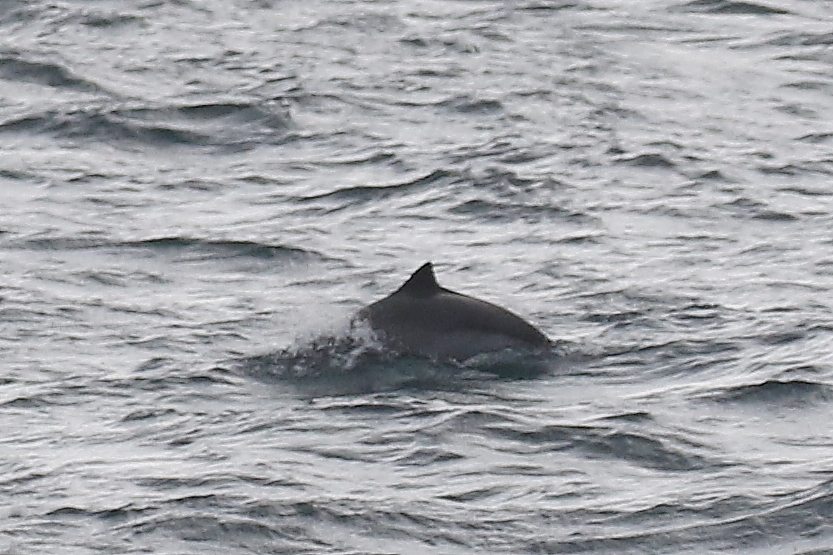
Scillonian III made good time with a largely uneventful crossing being punctuated by a pod of Common Dolphin and, as we approached St Mary's, a small group of Harbour Porpoise. On arrival I headed straight for the Garrison where the Blue Rock Thrush had been seen earlier in the day. It was reportedly moving clockwise around the Garrison, and after not too long I caught up with it between the Woolpack Battery and Steval.
I had never seen Harbour Porpoise this far out of the water before
A snub nose and small dorsal fin identify this as Harbour Porpoise
Harbour Porpoise
I had read various horror stories about visiting birders taking days to see this bird so I was perhaps fortunate to walk straight up to it. It was, however, clearly a very skittish bird, but as we sat quietly at the end of the bay it was feeding in, it paid us the courtesy of flying towards us at one point, enabling a few passable photos to be taken with the aid of a teleconverter.
Citrine Wagtail
Note the complete pale border around the cheek and broad wing bars
Just a hint of yellow on the vent of this bird
My other main target for the day was a Spotted Crake which had been giving good views at Lower Moors. I spent an hour there without success before breaking news of a Citrine Wagtail saw me heading off in the direction of Salakee Farm. This newly discovered rarity didn't play ball at first, feeding in long grass at the feet of cattle at the back of a field on a convex slope which made viewing difficult. For no apparent reason though it took flight, calling distinctively, and landed just in front of the assembled birders.
Wren
Spotted Crake, Lower Moors
Very long toes on this bird!
On the way back to my B&B in Hugh Town I called in at Lower Moors again where, thanks to a shout from Pete Aley, I enjoyed extended views of the Spotted Crake preening out in the open at close range. So an excellent start to the trip, with both of the main target birds seen well and a bonus breaking rarity thrown in.
The Spotted Crake preened out in the open
This went on for several minutes
A rare view of the underwing of a Spotted Crake

Monday, 7 January 2019

The end is nigh...

...no, not the end of the world (not quite yet, anyway), but the end of my review of 2018, broken down into two bite-sized chunks, of which this is the second. And if you're thinking 'well it's a bit late for all this', you'd be right. I spilt a bottle of water over my laptop over the Xmas break, and it took a while to recover the hard drive and procure a new one before I could bring these musings to you.
Purple Emperor, Bentley Wood
But back to 2018, and we pick up where we left off in July and the middle of the long, hot summer. The first day of the month saw me over the border in Wiltshire at Bentley Wood, well known for its population of Purple Emperor. It didn't disappoint, and a pristine male feasting on dog dirt provided some exquisite if smelly photo opportunities.
Scarce Blue-tailed Damselfly
My summer search for rare Odonata continued and I was lucky to catch up with Scarce Blue-tailed Damselfly on a local heathland just before the last of its breeding pools dried up in the baking sun. Even more exotic was a mini-invasion of Southern Migrant Hawkers - I travelled to Somerset to see my first only to find that the first for Dorset had turned up at Lytchett Bay when my back was turned.
Southern Migrant Hawker, Priddy Mineries, Somerset
August
The first half of August saw us in the French Alps for a family holiday. Two trips to the Col de la Colombiere provided some of the highlights of the trip - a couple of close encounters with Lammergeier, the first just above the car park at the col, the second a reward for an arduous climb to the ridge above the col.
Lammergeier, Col de la Colombiere
The col also held an excellent selection of butterflies, most notable among which were the rare Apollo and Mountain Clouded Yellow. We also enjoyed close encounters with Ibex and Alpine Marmot and a long list of new butterflies for my European list including, Alpine Heath, Lesser Mountain Ringlet, Meadow, Mountain, Shepherd's and Niobe Fritillary
Apollo, Col de la Colombiere
Second only to the Lammergeiers for mountain majesty was a Short-toed Eagle which sat in a pine tree watching us as we got our of the car just below the Col de la Colombiere. My children continue to remind me how I babbled excitedly at complete strangers parked next to us about this and forced them to marvel at it through my telescope. Well I still maintain it was genuine interest they were feigning.
Short-toed Eagle, Col de la Colombiere

September
Back in Dorset and autumn migration was well underway with many common migrants passing through one of my favourite local sites, Greenlands Farm near Studland. Yellow Wagtails, Redstarts and Spotted Flycatchers were present on every visit along with the occasional Osprey. 
Spotted Flycatcher, Greenlands Farm
The end of the month saw me teaming up with David Bradnum, Howard Vaughan and Bob Vaughan once more on the long road north to Shetland. Before boarding the ferry we had seen a Woodchat Shrike and a Rose-coloured Starling at Barns Ness, and the American White-winged Scoter at Musselburgh - my second encounter of 2018 with this bird.
Woodchat Shrike, Barns Ness

October
Our week on Shetland was perhaps not a classic but we still saw some excellent birds - Citrine Wagtail, Eastern Yellow Wagtail, Pied-billed Grebe, American Golden Plover, Common Rosefinch, Marsh, Melodious and River Warbler being the highlights.
River Warbler, Unst
While the Eastern Yellow Wagtail was a tick for all four of us, views were brief and distant compared to a very obliging Citrine Wag which was present on Bressay during our stay. This bird allowed a close approach and when we had got as close as we dared it started walking towards us!
Citrine Wagtail, Bressay
Back on the south coast October was passing uneventfully - until the 15th that is, when news of a Grey Catbird in Cornwall got the birding world asking 'will it stay until the weekend?' Fortunately it did, and Jol Mitchell and I couldn't resist the lure of adding this stellar American rarity to our British lists. A jolly day with Messrs Bradnum and Lowen for company.
Grey Catbird, Land's End

November
After the excitement of Shetland and the Grey Catbird in Cornwall in October, I didn't get out much in November - but there was still time for the birding world to throw up a few more surprises in 2018. Chief among these was a late Little Swift. I had promised myself that the next time one of this species roosted on a building at dusk I would go and see it come off the roost at dawn. This one went to roost under a streetlight, allowing me the luxury of twitching it in the dark on arrival, staying over in a local motel and going back in the morning to photograph it in glorious sunlight.
Little Swift
Little Swift
Continuing the November swift theme, a Pallid Swift at Chesil Cove late in the month enabled me to add this species to my Dorset list, putting to bed the ghost of the Christchurch bird a few years ago which was taken by a Sparrowhawk just minutes before my arrival.
Pallid Swift, Chesil Cove

December
If November saw me not getting out much, December saw me go almost into hibernation, as opportunities to get out and about trickled to a halt. Just a couple of highlights spring to mind: a Mandarin Duck, a proper Christmas Cracker of a bird, which took up residence in Poole Park; and my last Dorset tick of the year, a very co-operative Little Bunting which spent a few days grovelling on the verge of a Portland side-street.
Mandarin, Poole Park
And so there you have it, a year in memories and pictures. With thanks as usual to all those who shared them, and particularly those who I neglected while searching for them!
Little Bunting, Chiswell

Thursday, 15 November 2018

Shetland: part the second

To say there have been complaints about the absence of fresh content in this space would be overstating it. But a few loyal readers have passed comment to this effect, so I have been stung into action by these gluttons for punishment. And where better to resume than with a follow-up to the almost popular Shetland: part the first post.
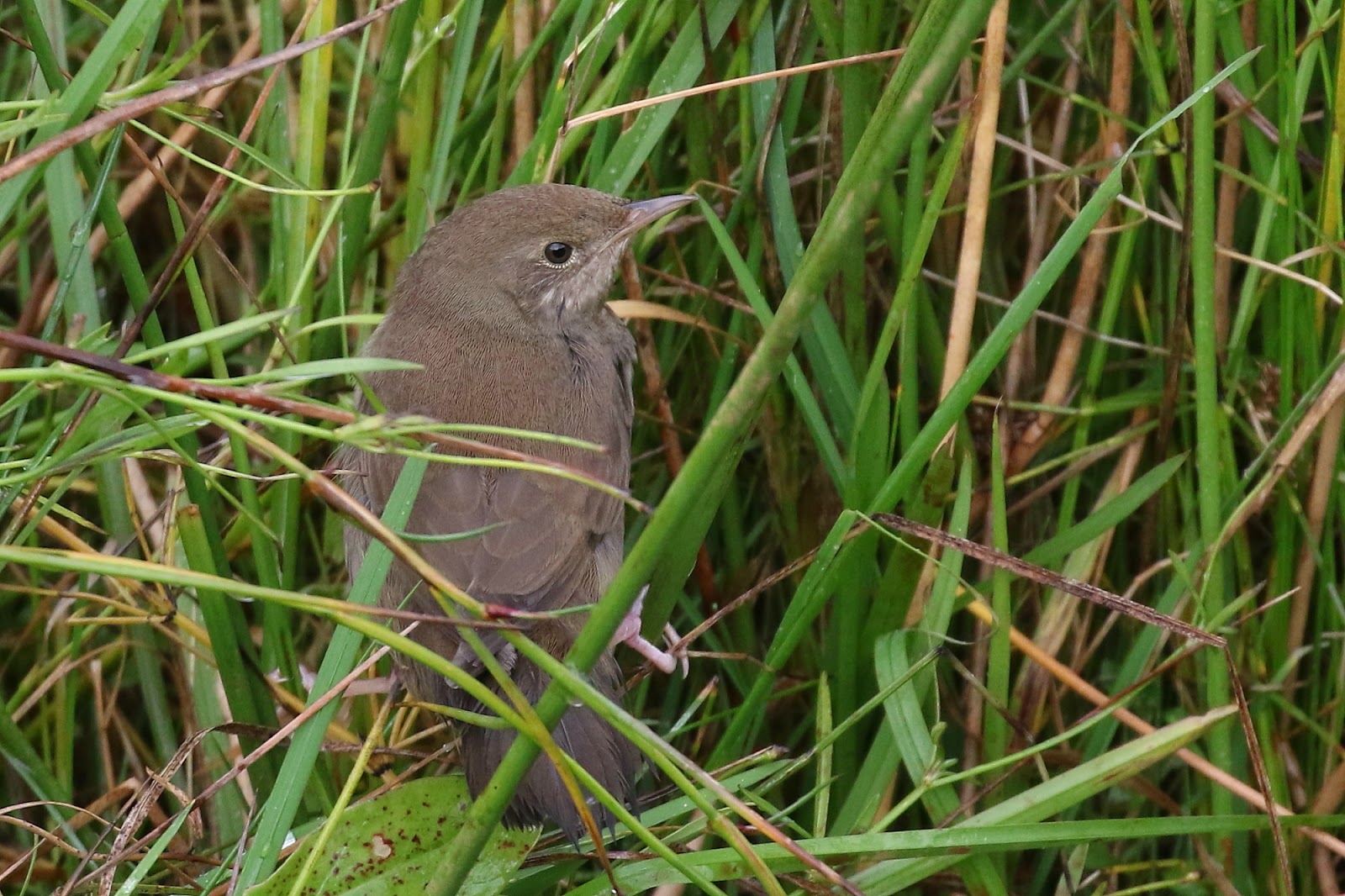
River Warbler on Unst
Probably the bird of the trip, and only my second in the UK
After proving initially skulky, it eventually gave us extended views
In this post I will canter through the rarity highlights. The first couple of days had produced very little on this front but the discovery of a River Warbler in a small iris bed on Unst changed things. We arrived at the site to find what would become a familiar Shetland scene that week: sheeting rain and no sign of the sought after bird! Both problems were fleeting though and within a short while we had enjoyed good views of this ultimate skulker as it walked between stands of iris. Returning later in the day in better weather we enjoyed extended views and photo opportunities as it bathed lower down the burn. A summer plumaged American Golden Plover was a bonus on our first visit to Unst, and our only rare wader of the trip.

Eastern Yellow Wagtail, Unst
A very grey and white individual with just a hint of a buffy chin and vent
An elongated hindclaw is a feature of Eastern Yellow Wagtail
During the middle of the week Shetland went wagtail crazy - first turning up a presumed Eastern Yellow Wagtail on Unst (consolation for dipping a Pechora Pipit, the less said about which the better). This was a tick for all of us since the split from common or garden Yellow Wagtail. The monochrome vagrant looked and sounded the part, and turned up at a place, at a time of year and with avian company which suggested an eastern origin, though it remains to be seen whether it passes muster with the rarities committee.
Citrine Wagtail, Bressay
An approachable individual
Note the complete white ear-surrounds
Having made a couple of long-distance excursions to Unst earlier in the week, on the Thursday of our stay we elected for a shorter island hop to Bressay, where a Citrine Wagtail had reportedly been showing well. We couldn't have known just how well: after a careful approach it walked towards us for a remarkably close encounter.
Common Rosefinch, Mainland
Barred Warbler, Mainland
American Golden Plover, Unst
Other minor rarities kept us entertained - a few Barred Warblers, including the one pictured here, found at Busta House Hotel by our own Bradders, a Marsh Warbler at Sumburgh and a Common Rosefinch on a mainland beach. Remarkably, Yellow-browed Warblers were notable by their absence, and we scraped just a handful in contrast to the daily sightings of the previous year.
Marsh Warbler, Sumburgh Quarry
Yellow-browed Warbler, Unst
Not a bumper year by Shetland's high standards, perhaps, but some quality all the same. I can probably wrap up Shetland in just one more post - so come back soon(ish) for the final instalment.