Showing posts with label European Storm Petrel. Show all posts

Monday, 14 August 2017

Petrel stations

It must be tempting to look at the cripplingly good photographs of Storm Petrels taken over the years by the likes of Brian Thomas and Joe Pender and conclude it must be easy when the birds clearly come so close to the boat. Take it from me, it is anything but. First you have to find them, which generally involves chugging out of High Town for an hour or two, then drifting and chumming for another hour or two before the petrels pick up the scent and arrive to check out the oily slick created by the fish guts and mealworms laid on for their delectation.

Then you have to photograph them - and shooting these rapidly moving, tiny birds from a small vessel, bobbing (if you are lucky) on the open sea whilst holding down lunch is probably one of the greatest photographic challenges I have undertaken. The failure rate is therefore extremely high but after much fiddling with camera settings, and a bit of hit and hope, some reasonably sharp images were possible. The European Storm Petrel Hydrobates pelagicus is easy enough to see on these trips but the Wilson's Petrel Oceanites oceanicus is much rarer in British waters and a particular target of late summer pelagics out of the Isles of Scilly. It has been a good year for them and one or two of this species were seen from the Sapphire on each of three trips I made over the long weekend recently.
Wilson's Storm Petrel
Wilson's Petrel shows a plain underwing...
 ...a straight trailing edge to the wing...
...toes protruding beyond the tail...
...yellow webbing between the toes...
...and a pale band along the upper-wing coverts
Wilson's Petrel patters on the surface as do other members of the family
A tiny bird compared to the gulls around the boat but...
...still visibly larger than European Storm Petrel (left)
European Storm Petrel has a plain upper-wing compared to Wilson's...
...and a diagnostic white bar on the under-wing
Note also the legs do not protrude beyond the tail
This Storm Petrel was so close to our stern it was practically being hand-fed mealworms
Another view of the distinctive under-wing pattern
European Storm Petrel - incredible how these tiny birds survive in their hostile ocean habitat

Thursday, 8 June 2017

Stormy weather

We interrupt this recent series of posts about Scottish mega-fauna to bring you a bit of news from closer to home in Dorset - this evening I added Storm Petrel to my county list, not just one but a dozen birds feeding reasonably close inshore at Hengistbury Head in poor weather. Sheltered by a groyne near the beach huts, I managed a few pictures of these tiny and extraordinarily resilient birds before beating a windswept and damp retreat.
Storm Petrel - note the diagnostic broad white band on the underwing...
...the plainer upperwing and white rump
Storm Petrels patter on the water...
...interrupting an otherwise fast, fluttering flight
Legs extended for another patter on the water
The Storm Petrels were feeding around and often inshore of a line of lobster pots

Thursday, 20 August 2015

Stormy weather

The first of four pelagics out of the Isles of Scilly last weekend saw us heading south out of St Mary's on the MV Sapphire into the glorious sunlight and stiff breeze of Friday evening. These are theoretically ideal conditions for such trips as, when foul-smelling chum, a heady mixture of fish guts, fat and oil, is deposited over the stern, the whiff is carried in the wind acting like catnip for seabirds, and particularly Storm Petrels. These tiny, free-spirited birds spend their life on the high seas, coming in to land only to breed, and then generally under cover of darkness.
Storm Petrel: not your typical bird in either appearance and behaviour
European Storm Petrel shows a white rump and white band on the underwing
An extremely difficult bird to photograph in flight
The European Storm Petrel, for which the Isles of Scilly is one of only two English breeding sites, is virtually guaranteed on a Scilly pelagic at this time of year. Its larger cousin, Wilson's Storm Petrel, comes with no such guarantee, despite being one of the most abundant species of bird in the world, as they breed in the southern hemisphere, and are unlikely to be seen in this country unless from a pelagic trip. In fact, as we set out, one had not been recorded in British waters this year.
They patter on the surface of the water when feeding in the chum slick
This picture shows the boiling sea whipped up by strong winds
Backlit on the sunny side of the Sapphire
I was optimistic that my new camera and lens would help me improve on my earlier best efforts at photographing Stormies on a similar trip two years ago. But I had forgotten just how difficult it was to capture these fast moving and erratic subjects pinging around a boat whilst rolling in a heavy swell and trying not to hurl. It took an age to get my eye in, another age to be confident I had selected the right camera settings, and another to finally get something respectable. To the extent that many of the most presentable shots were taken in the dying embers of the light.
I stood at the back of the boat next to Shropshire birder and photographer Jim Almond, as catching them coming around the stern with the sun behind us seemed the best approach
An absorbing pursuit, petrel photography...
...in which you end up content even if the results are imperfect
Just as they seemed to have died out completely (at 2034 hrs to be precise) up went a shout: 'Wilson's!'. It was time for the expensive consumer electronics hanging off my shoulder to earn their keep. Selecting a shutter speed I though would freeze the action, and dropping the ISO to Auto, I fired away. The Wilson's was surprisingly easy to pick out even without bins, being larger and having a totally different, more direct flight style with longer glides thrown in by comparison to its European relative. This also made it slightly easier to follow and thus photograph. The results were never going to be great in view of the lateness of the hour and the ISO being pushed to 16000, but I was pleased to get anything recognisable as a Wilson's Petrel, and not sure I would have been able to do so with my old 7D. An auspicious start to what became a memorable weekend in the Petrel department.
The straight trailing edge to the wing, protruding feet and pale grey upperwing bar are diagnostic of Wilson's Petrel
The square-ended tail appears forked when kinked and the white rump wraps further around the body than in European Storm Petrel
An additional diagnostic feature - yellow webbing between the toes - is obviously best seen when they are spread, but even here a hint of yellow colouration is apparent

Tuesday, 2 September 2014

Eventful

The weekend before last saw me on the Isles of Scilly for 3 pelagics out of St Mary's on MV Sapphire. Sunday's forecast was for a breezy day and showers, raising high hopes for some eventful seabirding. Quality rather than quantity was the order of the day in the end, with small numbers of good birds appearing at regular intervals to keep us on our toes throughout the six hour trip.

In the hazy, happy memories of some similar trips last summer, I had forgotten just how difficult it is to photograph fast moving seabirds from the deck of a rolling vessel whilst trying to keep down lunch. Throw in poor light and some extra chop and the challenge was magnified. In the circumstances, I came away reasonably content with the following highlights.
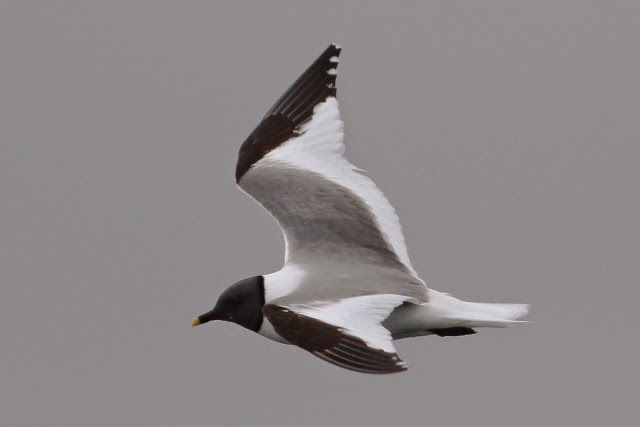
This adult Sabine's Gull was probably the bird of the day
It pattered on the surface like a Storm Petrel but turned occasionally for a few close passes
I thought the juvenile of this species I saw at Cogden late last year was pretty special but the experience of seeing this matched it for beauty, if not comfort
Yellow tip to the bill visible even at some distance
And a distinctive upperwing pattern
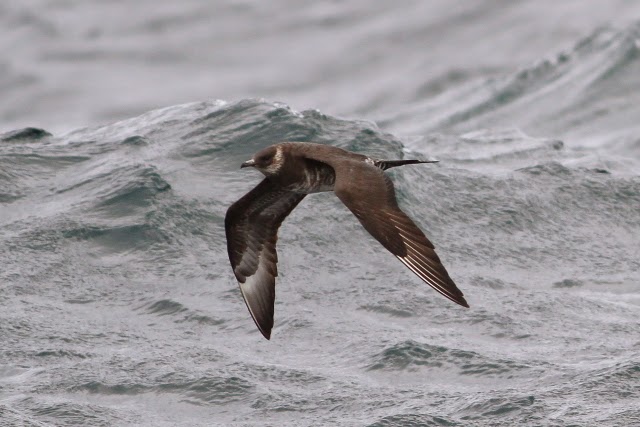
This 2nd summer Arctic Skua powered alongside the boat
It caught us up with ease
A pale phase Arctic Skua also buzzed us at one point
An elegant and powerful bird
It proceeded to (unsuccessfully) chase a Storm Petrel which was feeding in our chum slick
Dark phase Arctic Skua
A familiar sight over the course of the weekend - European Storm Petrel dancing in the chum slick
This shot shows the characteristic kinked tail and diagnostic pale bar on the underwing
Almost impossible to photograph in the conditions!
But a few shots were just about presentable
This probably my favourite
Sunday's pelagic had some success with Shearwaters following the boat - this one a Manx
Manx Shearwater
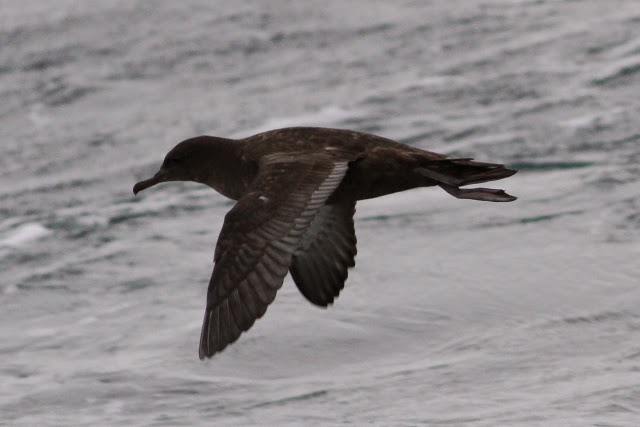
And here a Sooty Shearwater
Note the silvery underwing
Sooty Shearwater
Sunday's pelagic allowed for more prolonged views of Great Shearwater compared to Saturday's brief flypast

This bird repeatedly landed behind the boat and followed in the wake
Note the dark belly patch on this individual
Shearing with wingtip on the water
Great Shearwater
Great Shearwater
Great Shearwater
Great Shearwater