Showing posts with label Great Shearwater. Show all posts

Sunday, 20 August 2017

Feeding frenzies

There were massive seabird feeding frenzies seen from pelagic trips out of the Isles of Scilly the day before my arrival and the day after my departure for three trips out on the Sapphire earlier this month. I might have felt a bit cheated but for the fact that we encountered our own on the return journey on Scillonian III on the Sunday evening. We were approaching the mainland not far from the Wolf Rock lighthouse when Manx Sheawaters and Short-beaked Common Dolphins started appearing in large numbers.
Short-beaked Common Dolphin  - this one was taken on a pelagic on 5th August
Common Dolphin from Scillonian III
One from earlier in the day on the Sapphire
Views of Great Shearwater from Scillonian III were exceptional
A steady stream of Great Shearwaters crossed our bows as we headed for Penzance
There are five Great Shearwaters in this shot alone - the view for several hundred yards ahead of us was similar
Sooty Shearwater from Scillonian III
Manx Shearwater from Scillonian III
Cory's Shearwater from Scillonian III

Manx Shearwater
We disturbed several rafts of Manxies as we steamed through, and on close inspection some of the rafts appeared to contain more Great than Manx Shearwaters. The odd Sooty and Cory's were also present. There were birds on the water as far as the eye could see and when dolphins started to cause the surface of the water to boil it felt like we were approaching the centre of the action. This was confirmed shortly afterwards when a whale appeared to blow some distance ahead. I readied the camera as we approached the spot and managed to get a few shots of a Minke Whale surfacing close to the ship.
First view of the Minke was quite distant
A dolphin surfaces behind the Minke Whale as Manx Shearwaters track it in the air
The next time the Minke Whale surfaced it was much closer to the ship

Several flocks of Arctic Terns were seen at sea
Arctic Tern
Fulmar is a frequent companion on pelagic trips

Gannet with rising Moon behind
Great Skua was seen on all three pelagics
Close scrutiny of photos revealed this to be an adult Long-tailed Skua
Sooty Shearwater with Bishop Rock lighthouse behind

Sunday, 13 August 2017

Another shot at Great Shearwater

A few weeks ago I was pleased to be taking terrible photos of a Great Shearwater in Weymouth Bay in appalling weather - any photo of a Great Shearwater in Dorset being something to celebrate. This or another bird lingered for several days and despite a repeat visit to Portland I was unable to get anything resembling these stunning pictures taken by Keith Pritchard. So I was optimistic that a trip to the Isles of Scilly last weekend would provide better opportunities in more clement conditions to see this enigmatic species. And so it was, as we saw several on each of three pelagics, some of which treated us to close views, highlights of which below.


Friday, 21 July 2017

Great Scott!

I will be heading to the Isles of Scilly in a few weekends time for some pelagic trips to watch and photograph seabirds. Great Shearwater is always a target on these trips - a long distance wanderer which breeds on islands in the South Atlantic, migrates up the eastern side of South and North America and crosses the Atlantic to pass through our waters, typically in August, before heading south again. As such, I didn't expect to be watching one after work this evening in Weymouth Bay.

I had just arrived home when news broke that a Great Shear was lingering in the Bay. A quick change and I was heading west in the foulest weather we have seen in Dorset for a while. An update from Brett Spencer confirmed that the bird was still present, sitting on the sea, and within half an hour I was watching it, visible intermittently as it crested the waves in a churning bay, through which an Arctic Skua also passed.

At one point a gull mobbed the Shearwater, causing it to make a short flight during which a couple of record shots were possible - I would have left my camera in its bag but for a kindly birder who opened up the back of his camper van to give us some shelter from the torrential rain. A great way to start the weekend and a Dorset tick for most of those who made the effort to see it tonight. See here for some better pictures of this remarkable species.
Not a sight you expect to see in Weymouth Bay in July - either the bird or the autumnal waves
The dark capped appearance and white horseshoe at the base of the tail help identify Great Shearwater
A better view of the white collar giving the dark capped appearance
A rear view showing the white patch at the base of the tail

Monday, 24 August 2015

An improbability...

...of Shearwaters. That's the collective noun New Zealanders apparently give to this family (I can't find an English equivalent despite, ooh, 30 seconds of extensive research). We call it a raft, of course, when groups of them are sitting on the water, but that doesn't quite capture the way these birds are best enjoyed: shearing, as the name suggests, low over the sea. Four pelagics out of St Mary's in mid-August provided ample opportunity for me to practice. Best efforts below.

First up, the Great Shearwater, which, having bred on islands in the South Atlantic, winters during our summer off the coast of North America, passing through our waters on its southward migration. We saw this species on every trip, and they often followed the boat.
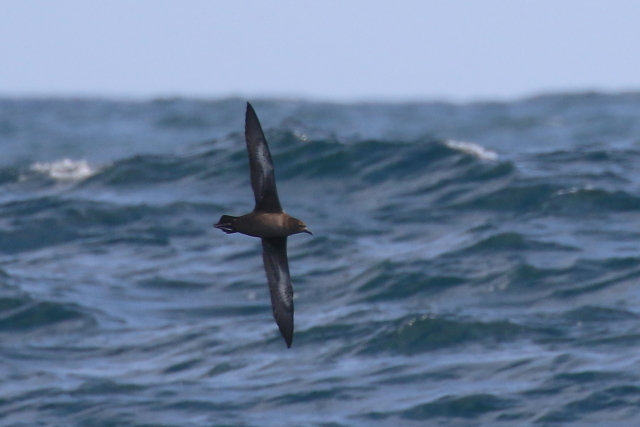
Next up, the Sooty Shearwater, another southern hemisphere breeder which spends its winter (our summer) north of the equator. Again, its southward migration brings it to our coastal waters. Several of these were seen over the long weekend, some coming in to investigate what we were leaving in our wake.
Next up, the Balearic Shearwater, which breeds much closer to home as the name suggests, but is much rarer globally than the other two - in fact, one of the rarest birds globally to regularly grace this country. Good numbers have been seen passing seawatching hotspots this year so hopefully that's a good sign. This one came in behind the boat and stuck with us for a while, risking attacks from gulls to dive for food just off our stern.
And finally, our very own Manx Shearwater, most of whose breeding population can be found in Britain and Ireland, including some on Scilly. 2014 saw Manxies successfully fledge young on the archipelago for the first time in a long time following a rat eradication programme.
Marvellous birds, every one, which with the Fea's, Wilson's and Storm Petrel, brought the photo year list up to #212.