And a long post, for which I make no apologies: writing this blog is sufficiently therapeutic to have become something of a psychiatrist's couch for me. And after yesterday, I needed a long lie down. The reason being a Cretzschmar's Bunting, an extremely rare vagrant from south eastern Europe and the Mediterranean. It was found on Bardsey Island off the coast of North Wales last Wednesday and performed erratically for a few days before appearing to settle into a routine which involved visiting seed put out in the island's lighthouse compound. It was reported as doing so every 60-90 minutes, opening up the realistic prospect of twitching this highly desirable rarity. Logistics were to prove the main obstacle as Bardsey is serviced by a small, unbookable boat with a capacity of 12, and as interest in seeing the bird grew, it became apparent that a long journey and an uncomfortable night queueing under the stars would provide no guarantee of a place on the boat.
 |
| Cretzschmar's Bunting, Bardsey Island - a monster bird and my 200th species photographed in Britain in 2015 |
There was no way I and many others were willing to travel such a distance only to find I was the 13th person in line for a 12-seater boat, and I had all but written it off when, on Tuesday, a small, independent, Buckinghamshire-based travel agency called LGRE stepped in to inject some organisation into the potential chaos. The agent himself was extremely efficient, if a little eccentric, and after talking me through my options so I could check them out with my would-be travelling companions, when I was eventually able to get through again late on Tuesday evening (his phone was ringing off the hook at this point) I was able to book three seats for us on the last scheduled boat for Friday, the 7th of 7 going that day.
 |
| The White eye-ring, dark rusty orange underparts and throat patch, and lead grey head and upper breast distinguish Cretzschmar's from the closely related Ortolan. |
With admirable transparency, he also published the names of travellers online, potentially embarrassing anyone anticipating being 'sick' or otherwise planning to be absent without leave from other commitments. I hasten to add I had a legitimate day's holiday booked and permission to go as an early Father's Day treat - a welcome change from the usual Father's Day principle that you have to do what people think you should want to do, rather than what you
actually want to do.
 |
| The Ctretzschmar's fed on seeds among the concrete pads around the lighthouse |
My travelling companions, Brett and Andy, were drawn from the small pool of regulars I have come to enjoy teaming up with. With Brett safely gathered in the dark from Weymouth, we collected Andy from a layby near the M5 as the sun rose. It looked like the sort of place which might see twilight gatherings of adults intent on nefarious activities which rhyme with 'jogging'. This set the tone for our conversation for the journey, which was enlivened by the sort of scurrilous chat which punctuates talk of plumages, favourite birds and comparison of lists on a long twitch, at least when I am involved. No-one escaped the butt of our outrageous exchanges: friends, families and each other; governments, corporations and their leaders; Next Generation Birders, retired birders and birders richer, and therefore more able to twitch distant rarities, than us. So if your ears were burning yesterday, apologies, no offence was intended.
 |
| A more substantial bird that the local Linnets as this picture shows |
The journey itself was a pleasure - we opted for the scenic route over the new Severn Bridge, via Abergavenny, Three Cocks (no sniggering at the back), Builth Wells, Rhayader and Dolgellau towards Pwllheli. This took us through two National Parks where we could admire the hulking whale backs of the Brecon Beacons and the rugged peaks of Snowdonia, either side of the rolling Kite country of Powys. It was a reminder of the natural beauty of Wales, a beauty which was even easier to appreciate when an early tweet confirmed that the Cretzschmar's Bunting was still present, and a Red Kite kinked its tail at us as it flew low over the car in a sumptuously wooded valley.
 |
| Manx Shearwater, photographed on the short crossing to Bardsey |
Traffic was mercifully light, and the journey enlivened by the realisation that my old satnav sounds just like Nigel Farage. 'Turn right to avoid Europe', I imagined it saying. We enjoyed the passing landscape and amused ourselves by asking Brett to read out the printed directions to the site, which included a Welsh place name with ten letters but only one vowel. A challenge at which he baulked, but to which Nigel the satnav rose open-mindedly and admirably.
 |
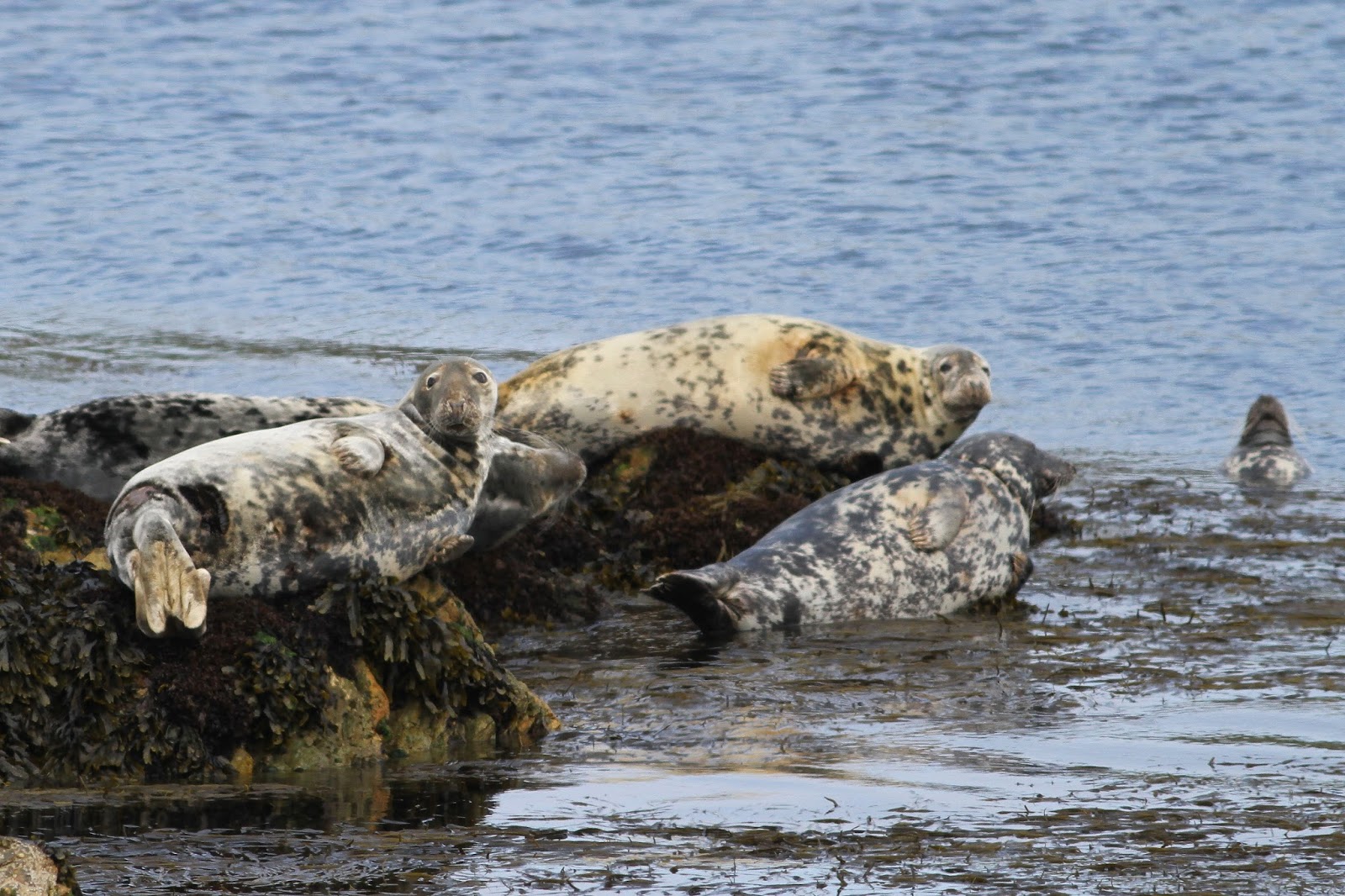
| Grey Seals were loafing near the quay on Bardsey |
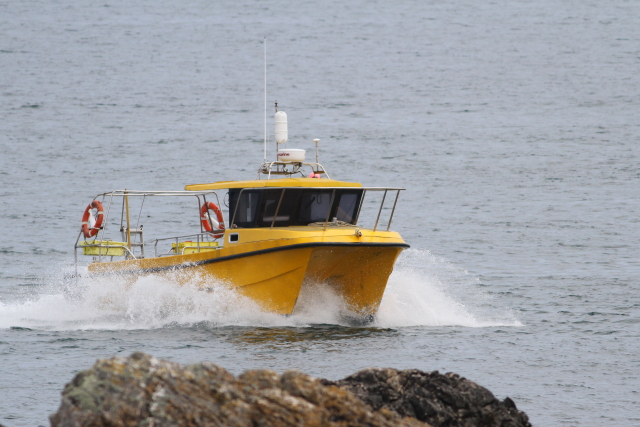
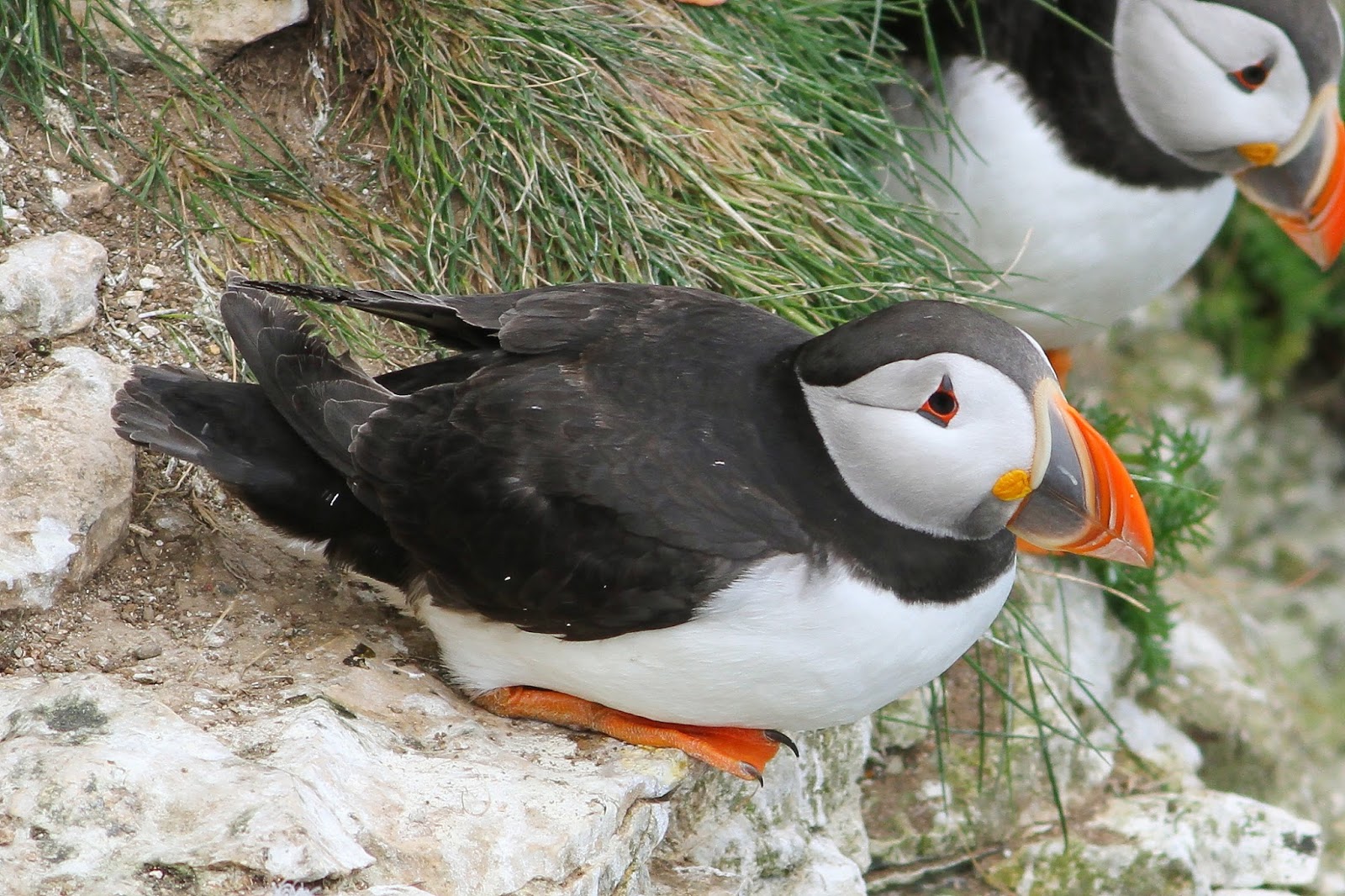
Birders had been advised to arrive at least an hour early as in the event of any 'no shows', the empty places could be allocated to those next in line on LGRE's list. We did so, and when news filtered through that one party had broken down en route, we found ourselves bumped up to the 1130 instead of a 1230 crossing. My reaction to hearing of this hapless crew's misfortune - punching the air - was, with hindsight, ungallant and shameful. I hope they got it sorted and saw the Bunting. The happy faces of those who had already done so greeted us as they disembarked Colin Evans' little yellow boat, and they gave us tips on viewing along with wishes of luck and assurances that we would all connect with our target. And so we boarded full of optimism, buoyed further by the sight of Manx Shearwaters, Puffins and other auks fizzing around the boat as we approached Bardsey. The island itself had a rugged beauty, and we hoped for a quick result with the Bunting to allow time for us to explore it at leisure.
 |
| A pair of colour-ringed Chough greeted us on our return to Port Meudwy (#201) |
This was where the plan started to come apart. We arrived at the lighthouse just after 1200 and got in position. But for the wail of a mega alert on someone's pager, bearing news of a Cedar Waxwing on Scilly, the crowd stood silently, communicating only in whispers, not wishing to do anything to spook the bird should it appear. After an hour, despite no sign, we remained chipper. Optimists assured us it was 'due in', but they obviously hadn't told the wildlife. After two hours, we were starting to look nervously at our watches. And after three, we were severely doubting not just our chances of seeing the bird but our sanity for pursuing such a ridiculous passion. Earlier in the week, before we had plans to travel to see the bird, we all confessed to secretly hoping that the thing we most desired - a Cretzschmar's Bunting - would just leave so we wouldn't have to worry about it. Once plans were confirmed, we wanted nothing more than for it to stay. Now, to have made it to Bardsey and not see the bird, having missed it by less than an hour, was difficult to take.
 |
| They were agitated by a pair of passing Raven |
It was also time for our own ears to burn after several hours in the baking sun. The forecast had predicted a cloudy day but the sun beat down on us with increasing ferocity as we were forced to stand shoulder to shoulder against a small wooden shack which seemed to reflect the heat onto our backs. My bag with lunch and sunblock in was just around the corner, but I dared not move to fetch it lest the Bunting appeared. My throat dried, my stomach started to consume itself, my back and calves screamed for relief, but there was no respite. It was like a scene out of Tenko. (For any NGBers reading this, that was a 1980s TV show about a Japanese POW camp in which sadistic guards cooked up cruel and unusual punishments for the inmates, like making them stand up against wooden shacks without sustenance in the baking sun). Had the warden walked past in a goose-step and spat water in our faces it would have been wholly in keeping with the scene.
 |
| Plenty of calling and flying around ensued |
With about an hour to go before our boat, a report of the Bunting being seen further up the island and heading our way lifted spirits briefly, but after another half-hour of no sign they had dropped to a new low - the thought of leaving knowing it was present but not being able to see it was somehow worse than it not being there at all. The usual practice in such circumstances - spread out and look - was not an option as we all diligently followed the on-site requests to stay put and not go searching among sensitive island habitats, and risk flushing the bird to who knows where.
 |
| Several other Chough were also seen on Bardsey |
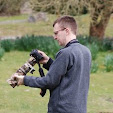
I glanced nervously at the faces of the other two. Brett's had turned redder than a tomato as the minutes ticked by - mainly sunburn, augmented by frustration as he has history with North Wales, having dipped Black Lark and Sooty Tern. He was particularly distressed at the prospect of this unwelcome hat-trick. Andy's visage was ashen, and when I caught his eye the look in it said what we were all thinking: 'not good'. As for my own, I suspect it was green, sick with the thought that our efforts had come to this, and that our luck could have been so rotten to have missed the bird by such a fine margin.
 |
| Mr Mears photographs the Bardsey scenery |
We knew that we had to leave at 1545 for our 1600 boat, and as the clock ticked 1530 I finally accepted that we were going to dip. I sent my good friend Steve a text to this effect, which fate and Vodafone conspired not to send. As I put the phone back in my pocket, a quiet voice beside me said 'there it is, at the back'. And there it was, at the back. Panic. Bins. Camera. Shaking. A quick look through Andy's scope. A truly beautiful bird. The time stamp on my camera confirms I took the first frame at 1532, and the last as it flew away at 1535.
 |
| Mr Tomato Head offers his considered opinion on twitching North Wales |
No sooner had it gone than it was time to head to the quay for our boat. We walked the first few hundred yards in stunned silence. Our nerves were shredded. There was none of the usual backslapping, congratulating and not even, at that point, a sense of relief. Just confused, shocked, 'what just happened there?' silence. It was broken by Andy who brilliantly voiced thoughts which were running through my head but which I could not articulate: 'That was like just avoiding a really bad car crash: too awful to laugh about'. We laughed anyway, and I was struck by an attack of verbal diarrhoea - my way of coping, I think, with the torturous experience we had just been through.
 |
| Mr Evans (Colin) comes to rescue us from an afternoon of emotional torment |
Of course it wasn't literally torture, it was 'just a bird', and it was entirely our choice to go and look for it knowing there was no guarantee of seeing it. But our near failure to do so hit us surprisingly hard, and it took the revitalising effects of fish and chips in Rhayader to get us back to being anything like our old selves. Until then, Brett had been deep in thought, having flashbacks to the Black Lark, I think. Andy was convinced we were going round in circles, having seen several brown signs for the same nature reserve (we had to explain that the name of the nature reserve he kept seeing was in fact the Welsh translation of 'nature reserve' on the bi-lingual signs). Even Nigel the satnav seemed to have lost it, taking us round in actual circles in Builth Wells, where we would still be now had we not ignored him to consult a map. 'Perform a U-turn when possible' he barked, in defiance of his Thatcherite heritage.
 |
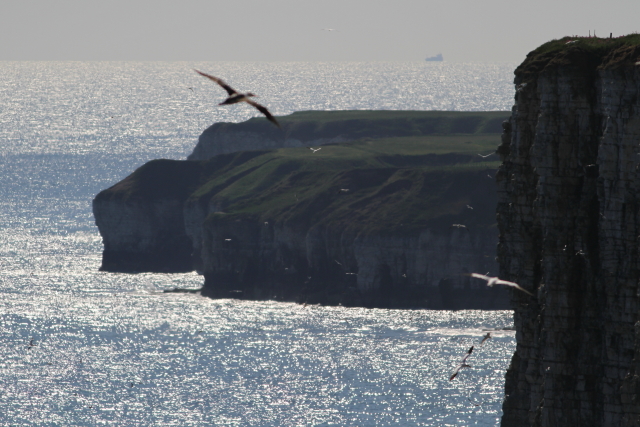
| Guillemots and Razorbill breed around the cliffs of Bardsey |
So, were we lucky or unlucky to get our 3 minute view in exchange for our 23 hour round trip? While earlier in the day I had been cursing my luck, by the end of it I think I had realised how we had benefitted from several major slices of it. For example, while we thought getting an earlier boat would be a good thing, as most sailings provided a maximum of 3 hours on the island it almost cost us seeing the bird - fortunately, a quirk in the schedule gave us the crucial 4th hour on Bardsey during which the Bunting appeared.
 |
| Red Kites adorn the 'Welcome to Powys' road signs - we saw several there |
But perhaps the biggest piece of luck was the fact that the bird was there at all. It has to go at some point, and everyone who gets to see it, however briefly, can consider themselves fortunate to have set eyes on this exquisite species in Britain. Thanks to the meticulous records kept by the travel agency, by Friday night I could count myself among 457 lucky souls who had done so. And on the subject of thanks, big ones must go to the
team at the observatory, Colin the boatman, Lee Evans for organising the list and Andy and Brett for their company. May we never have to twitch another elusive island rarity again. Cedar Waxwing, anyone?
 |
| Chough, Port Meudwy |
 |
The lighthouse around whose base the Bunting was feeding. We watched from
beside the grey building bottom left. |
 |
| Greater Butterfly Orchid on the path to Port Meudwy |