Showing posts with label Hawfinch. Show all posts

Thursday, 30 December 2021

One last hurrah

By Christmas Day I had seemingly exhausted all the possibilities which Dorset offered to add to the non-motorised year list. At this late stage of the year, it would have been tempting to hang up my bicycle clips and settle for the grand total of 221 species which had been amassed thus far. But while the Dorset possibilities may have been exhausted, there was always Hampshire...

Following reports of a Great Grey Shrike in the New Forest earlier in the winter I had been contemplating a big day in the area. Unfortunately the Shrike had gone off the radar several weeks ago, but potentially three December 'ticks' were still available if I was willing to make the effort. 
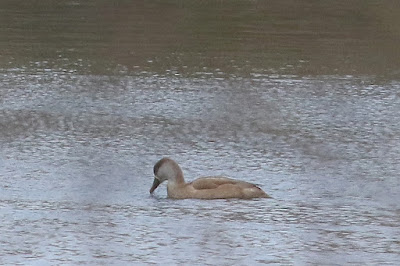
Female Red-crested Pochard, Ibsley North
A good plan, some luck and preferably decent weather would likely be needed to see all three, and the last of these wasn't really an option as every day between Christmas Day and New Year looked wet and windy to varying degrees. Tuesday 28th looked like the least worst, with a strong westerly wind to hasten my passage over the county border. This wouldn't be much help on the way home but it was due to ease off and I figured I could cross that bridge when I came to it.
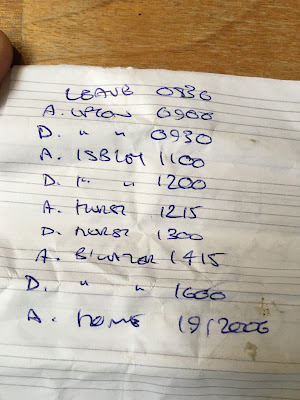
The cunning plan
A plan was therefore hatched on a scrap of paper the night before (see pic above) - all I had to do now was execute it. The first step - get on the road by 0830 - was straightforward enough. Packing the bike these days with enough clothes, food and fluids for a full day in the field without even needing to stop at a shop is quite a challenge, but I got it organised the night before and was out of the door a few minutes early. 
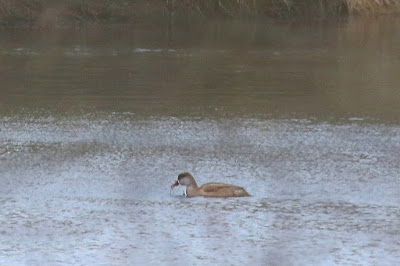
Red-crested Pochard (female), Ibsley North
First stop was Upton, just 7 miles from home, for another look at the Bean Geese which were looking good as the sun rose. John Wall arrived to pap them with his big lens, making my lame efforts at photography feel a bit redundant. And besides, there was no time to waste if I was to get to my next target - a Red-crested Pochard at Ibsley North lake, a further 17 miles to the east - by the allotted time of 1100. 

East Dorset birder Olly Frampton had been keeping tabs on the Red-crested Pochard, a female, which had been present a few weeks, and he very kindly confirmed its continued presence early morning, giving me the incentive to press on despite the deteriorating weather at my back. Google maps for cycling is pretty good, but on this occasion, having taking me over the Canford bridge - a narrow 3 plank job with gaps between the planks big enough for my wheels to slip through - it then directed me along the muddy bank of the River Stour to a double stile, requiring heavy panniers to be removed before the bike could be lifted over. Unhelpfully, the weather chose this moment to do its worst, and by the time everything was reassembled I was seriously wet and doubting the wisdom of the exercise. 
Essence of Fudge Duck (!), Kingfisher Lake
But since when did wisdom have anything to do with the non-motorised year list! I pressed on and found Ibsley North lake without too much trouble thanks to Olly's excellent directions. A couple of Portsmouth birders had just arrived and one of them located the RCP within minutes. I had lost a bit of time against schedule on the way over, but this quick result more than clawed it back. While a satisfying addition to the year list, this was not really a bird to quicken the pulse so after some manual focus record shots through the trees, I resolved to quickly move on to my next target a couple of miles back down the A338: the Ferruginous Duck at Kingfisher Lake. 

This returning bird has some notoriety as Kingfisher Lake is surrounded by a 6 foot fence, clad with a solid canvas matting to protect the bashful fishermen inside from view. Famously, therefore, visiting birders wishing to see the Fudge Duck are advised to bring a stepladder! Such a thing would not fit in my panniers, but the Portsmouth lads had brought one so I arranged to meet them there in case it came in handy. It turned out that standing on the bike pedals gave me just enough height to see over the fence,  but we scoured the fence line looking for a clear view in vain. 
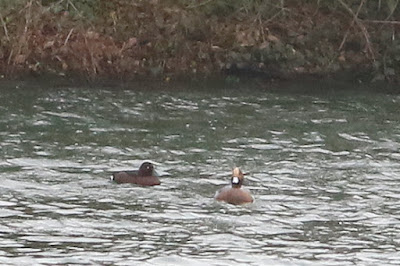
Ferruginous Duck (left) with Wigeon
I found a candidate bird through a hole in the fence but it materialised into a female Tufted Duck. We eventually found a reasonable view point which revealed a flock of Goosander and other mixed duck in the centre of the lake. Picking through them whilst perched on the pedals, right at the back a dark bird with a white bum and peaked crown caught my eye. Views through the scope balanced on barbed wire, and a few record shots confirmed it was the Fudge Duck. The Pompey lads were delighted and I was pleased to have repaid my debt to them for finding the RCP.   

With two year-ticks in the bag, lunch - the inevitable leftover turkey sandwich - was taken sheltering from the rain and wind under a bush. The sensible thing to do at this point would have been to give up on the third target for the day - a New Forest Hawfinch - head home and be satisfied with the day's haul. But since when did sensible have anything to do with the non-motorised year list! The plan dictated that I would need to be at Blackwater Arboretum - a well known pre-roost site for Hawfinch - another dozen or so miles to the east - by mid-afternoon.
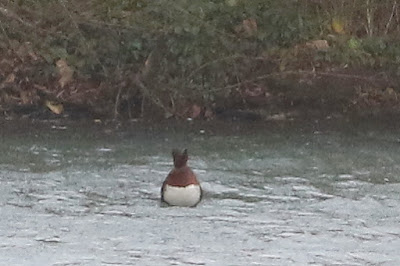
Ferruginous Duck showing sharply demarcated white belly
From Kingfisher Lake there were two options to head into the New Forest: east along Ivy Lane and across Broomy Plain before cutting under the A31 to Bolderwood and on to Blackwater; or south to Ringwood before heading east via Burley. Olly had advised that Hawfinches might be seen at Bolderwood so it made sense to try there first and, with luck, I could be on the way home well before dark. The ride through the New Forest was glorious, the sun came out for the first time all day, and I clocked an impressive 34.5mph as I coasted down through Slufters Inclosure to the A31.

As it turned out, I couldn't locate the target species at Bolderwood, so to Blackwater it was, with precise directions provided by Phil Saunders who had seen Hawfinch there within the last couple of weeks. As I rolled into the Arboretum, it was a nice surprise to see Garry Hayman, who has been present at the end of several of my long distance bike twitches this year, and his wife, obviously also hoping for a Hawfinch. 
The wheels at Bolderwood
The less good news was that they had been there since 1300 and not seen a thing! Still, I had come all this way - clocking up 40 miles by this point - so there was nothing for it but to set up scope and hope for the best. At 1545, scanning with bins in rapidly fading light, I noticed a previously unseen lump in the top of a distant pine and a quick check through the scope confirmed my suspicions: Hawfinch! I got Garry onto it and after a few quick record shots it was time to pack up and begin the long journey home. 

I took the Burley route back to Ringwood, crossed the Dorset border and followed the excellent Castleman Trailway as far as Ferndown before heading for the comfort of tarmac for the final 15 miles. At 1930 I completed the 73.5 mile epic - my second longest journey this year after Lyme Regis in June - and could safely chalk up three more additions to the year list. Barring something extraordinary happening on New Years Eve, that really does look like it for the year - a grand total of 224 species seen travelling under my own steam, all but 4 of these in Dorset. 
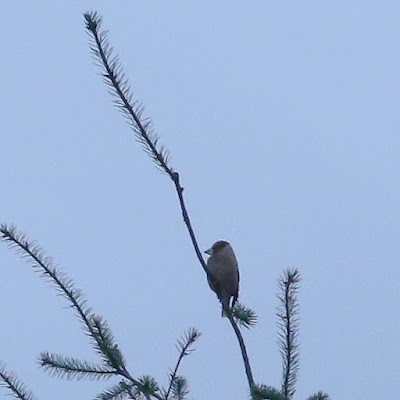
Hawfinch, Blackwater Arboretum, 28th December

Sunday, 4 March 2018

The real beast from the east

It seems to take an extreme weather event to get me out to my local patch at Swineham these days, and with the combined impacts of Storm Emma and the 'Beast from the East' bringing unusual blizzard conditions to Dorset, I felt sure it would be worth a look on Saturday morning. The walk from home to the gravel pits takes me through the graveyard of Wareham St Mary Church, the gate to which was frozen stuck. To circumvent this I stepped over a short wall and flushed a chunky finch from beneath a Yew Tree - Hawfinch!
Female Hawfinch - note the grey panel on the secondaries
Female Hawfinch
The Hawfinch invasion has been a remarkable event in British birding this winter with birds turning up across the country following a failure of the seed crop on the continent, particularly in eastern Europe where they would normally spend the winter. As the photos show, the Hawfinch has an out-sized head and bill: evolution's answer to a nut-cracker, it is said to be capable of exerting 50kg of force. That's what I call a beast from the east!
Male Hawfinch - note the more steely grey bill, richer colouration in the head, blue panel in the secondaries and all black primaries
The male stayed stubbornly in the shadows apart from this brief pose on the churchyard wall
I let my fellow Swineham irregular Trevor know about the rare visitor to our manor and as we waited for the first Hawfinch to reappear, a distinctive call behind me betrayed the presence of a second. Trevor soon located it as it dropped to feed on the ground. The next challenge was to get a photograph - easier said than done with this very shy species, especially given the amount of people wandering past the graveyard.
A good view of the powerful bill...
Note the crinkly primary feathers in this rear view
I eventually managed some decent shots by standing on the road which runs alongside the graveyard, hiding behind a parked van and peering over a chest high wall to find the female feeding on the ground just yards in front of me. This odd behaviour (mine, not the Hawfinch's) attracted the attention of several passers by so the bird was soon disturbed by their innocent enquiries about what I was doing.
Hawfinch
Hawfinch
This morning I went for the subtle approach, staking out a quiet corner of the graveyard and later lying sniper-style beside a low wall with a good view of one of the feeding areas. It's a good job the gravediggers weren't on duty, I think I might have ended up buried alive. Not that it did me much good, the 'over the wall' shots were still the best of the lot.
Cracking seeds foraged from the ground

Tuesday, 2 January 2018

Happy Yew Year!

As you can see, New Year's Resolution #1 - to plumb new depths with bad puns in blog post titles - has been acted upon almost immediately. Other candidates considered for this post included:
  • 'Yew only live twice': would have continued an historic weakness for Bond film bad puns but would have also required me to explain how I went back on New Year's Day after an enthusiastic but not exactly quiet dog walker flushed some Hawfinches from the same churchyard Yews in Lytchett Matravers on New Year's Eve.
  • 'Coccothraustes in a Yew Tree': scans perfectly with 'And a Partridge in a Pear Tree', but too tenuous even by my low standards, and would have meant breaking a policy to not use scientific nomenclature in blog post titles (way too high-brow). Plus Christmas is so last year.
  • 'Graveyard of ambition': well they were in a graveyard, and as a title it would have been a satirical comment on itself.
  • 'Give me a Finch and I'll take a mile'. Inexplicably bad.
  • 'Haw-py New Year': no, just too awful. (Haw-ful, surely?)
Anyway, some Hawfinch photos follow to get the New Year off with a big, chunky bang.
Hawfinch, Lytchett Matravers: the recent invasion by this species has been a winter birding highlight of 2017-18
Although the birds were high in the Yews, by positioning the car carefully and staying inside the vehicle, I was able to photograph them against a more pleasing background than the harsh grey sky of New Year's Day
At least three birds were present
The impressive bill is clear to see here...
...while this picture shows the short, white-tipped tail
This crinkly-winged male refused to come out in the open
A Sparrowhawk against a rare bit of blue sky sent the Hawfinches deep into cover

Sunday, 26 November 2017

Finch finding

I mentioned recently that the Hawfinch invasion was in danger of passing me by - I finally caught up with one last weekend on a visit to friends in Kent but had still yet to see one at home in Dorset, so I set out this morning with the aim of doing just that. Several sites seem to be holding Hawfinch since they arrived but Bonsley Wood near Blandford Forum sounded like one of the most reliable so I headed there. I bumped into one of these chunky, short-tailed birds before I got to the main wood, a few more whilst there, and even more on the way back, confirming the impression formed from recent reports that they can be seen just about anywhere in suitable habitat at the moment. Brambling, Redpoll and Bullfinch were also in the wood, an enjoyable couple of hours in a location I hadn't checked out before.
Hawfinch, Bonsley Wood
This head-on view shows the bulk of a Hawfinch bill
Side view of the impressive bill
The best flight shot I could manage - note the curled tips to the primaries can just be seen on the edge of the folded wing
A few Brambling were in with the Chaffinch flock in Bonsley Wood
Grey Wagtail, Bonsley Wood
Bullfinch last weekend at Sissinghurst in Kent
Fieldfare, Sissinghurst, Kent
Fieldfare, Sissinghurst
Mistle Thrush in Yew at Igtham Mote, Kent
Redwing, Sissinghurst
Nuthatch, Sissinghurst

Monday, 23 February 2015

Ton up!

I'm not sure what the run-rate for a 'good' photo year-list should be by the end of February, but I suspect 100 is well below it. Anyway, that's what I have reached and the honour of being the 100th species captured on film digital recording media falls to the Bohemian Waxwing. Naturally, I had to manipulate the order in which I notched up the ticks on my recent trip to East Anglia to bring up the hundred on such a glamorous species, but, let's be honest, it just wouldn't have been the same if it was a Skylark. We spent Friday night on the way back from Norfolk to Dorset in a budget motel at Barton Mills in Suffolk - conveniently close to Mildenhall where the Waxwing had spent much of the previous week. I was able to twitch it whilst the rest of the family were still doing their morning ablutions.
The Waxwing, a first winter bird, was feeding in prime Waxwing habitat - a modern suburban housing estate
That pesky twig spoilt an otherwise perfectly good photo - one step to the left or right and the bird would have been obscured by the vegetation in front of me (I was using a bush for cover) so there was no way around it. And Photoshop would be cheating.
As a first winter bird, the characteristic waxy red tips to the wing feathers, caused by the shafts extending beyond the barbs, could not be seen in the closed wing, but can just about be seen coming through here in the raised wing
So with that landmark chalked up, I am starting to wonder what I might get to by the year's end, whilst not being sufficiently committed or confident as yet to set a proper target. There is still significant potential for work and family commitments to scupper the whole project and leave me wishing/pretending I had never started it. For now, though, it is time to savour the milestone and admire the beauty of Bombycilla garrulous.

To rack up a really good score would require some of our more elusive and secretive species to perform for the camera. So having mobilised the rest of the family after twitching the Waxwing, I persuaded them that a trip to nearby Lynford Arboretum would be fun, more in hope than expectation that I might catch up with one of the Hawfinches that are seen there from time to time. Fortunately one had been staked out near a feeding station and was showing on and off to a small crowd of admirers. The photos were poor in view of the distance and low light but good enough to pass the 'identifiable' test.
I haven't seen Hawfinch (#108) for a few years so it was good to see one on the ground
This bird fed actively in the leaf litter
Check out that conk!
With two of the most desirable species on the British list in the bag there was time for a more leisurely stroll around the arboretum. A Brambling at the feeding station was a bonus and I was able to improve on the photos of Marsh Tit taken in the garden of our holiday cottage on the Suffolk coast earlier in the week.
Brambling (#109), Lynford Arboretum, Norfolk
Marsh Tit, Lynford Arboretum, Norfolk
Marsh Tit, Lynford Arboretum. Norfolk
Copper-headed Pre-teen, Lesser Blonde Chatterbox and Owl-headed Matriarch were three species I was not expecting to see at Lynford
So, not bad for what was supposed to be a travelling day, three potentially tricky species added to the year list and some quality time with the family (who spent the rest of the journey being totally uncommunicative and playing with handheld electronic devices). Oh go on then, one more of that twig.
Note how it is in perfect focus. The twig, I mean.

Tuesday, 25 June 2013

Kentish Men

Both of our sons were born in Kent - west of the Medway, making them Kentish Men as opposed to Men of Kent from the east - and we were back in the County of their birth this weekend, for a wedding and to catch up with old friends. The bride was my former PA when I had such a thing, and the venue was the same place where my wife and I got married over a decade ago. Very happy memories: it was great having a PA.
Male Turtle Dove - unlike the old days, none were singing over my old garden last weekend, but Kent is still a good place to catch up with them
Our former neighbours, the generous Prices, put us up, fed us, dropped us off and picked us up at the end of the night, and generally made us feel at home again. The time we lived over the road from them - the early years of the 21st century - included some of the hottest summers on record, so it was a bit of a shock to encounter strong winds and cool temperatures on our latest visit. Hopefully this explained the silence from the Turtle Doves which used to purr from the wires rather than the depressing tale of decline for which this species is now known.

This Hawfinch landed on my garden feeders for 3 minutes in 2003 - just long enough for my shaking hands to digiscope it through the French windows
My little garden in Dorset can't quite compete with the rambling patch we had in Kent in terms of birdlife, which also played host to Spotted Flycatchers, Garden Warblers, Lesser Whitethroats, Tawny Owls, Cuckoos, and, once, even a Hawfinch.

Our friendly garden fox - pictured here in 2007, the year we left Kent for Dorset
Perched over the Medway Valley, from its various vantage points I could also see Red-legged Partridges, Yellowhammers and Hobbies. Grey Wagtails visited the pond, Pipistrelles roosted in the eaves, Wood Mice chewed their way into a dustbin containing the bird food and a tame Fox poked it's head around the gate most evenings.
Male Banded Demoiselle at Leybourne Lakes, the day after the wedding

Another highlight on my inland Kent garden list was a migrating Wheatear which turned up one foggy Autumn morning. More exotic, but also more dodgy, was a Harris Hawk which used to frequent the area - that caused a bit of confusion, not to mention panic, when it first soared past the upstairs window.
This is the female Banded Demoiselle, also at Leybourne Lakes
Amid the happy memories, a stop-start journey there and back around the M25 was a jolting reminder of why we moved down to Dorset. But while we certainly have no regrets, it was good to go back for something other than a Dusky Thrush. Or a Crested Lark. Or an Eastern Black Redstart...
A rare visit 'home' for these Kentish Men and their Mum. And an even rarer visit to Church...