Showing posts with label Tundra Bean Goose. Show all posts

Monday, 10 January 2022

We go again

Several friends have asked me 'what now?' after I put quite a lot of time and effort into a non-motorised year list in 2021. I doubt I will be able to repeat seeing 224 species in 2022 - only the combination of working mostly from home, neglecting domestic obligations, and benefitting from a belting spring for migrant birds in Dorset made that possible. But I certainly don't intend to stop birding locally by bike, and for several reasons. 

First, although I've never really had to watch my weight too much, as I edge closer to the next age range up on the census form (55-65), the exercise is proving necessary to keep it at a level I am comfortable with without having to make unwelcome changes to my diet (regular readers will be aware of my fondness for chips). Second, it's become an essential part of maintaining good mental as well as physical health - the endorphins really do kick in quickly when I get going these days, and the buzz of seeing a target species at the end of a long ride is surprisingly more satisfying compared to if I'd driven. Third, it's just become my preferred mode of birding locally: with some superb areas accessible by bike nearby but not by car, it takes me to places I might not otherwise get, giving a real sense of freedom. And I can't get the bike over the now locked gate at my Swineham patch any more, so cycling gives me a good excuse to neglect that as well ;-).

There are also the obvious environmental advantages compared to driving. I try not to bang on about them (I'll save that for the day job), but even if you aren't concerned about that low carbon/end-of-life-on-earth-as-we-know-it stuff there are other more direct impacts to worry about. To give just one example, on my travels at lower speeds last year I became visibly aware of the toll taken by vehicles in the form of roadkill. There were of course copious numbers of 'invasives' splattered on the roads - Grey Squirrels and, in these parts, Sika Deer, whose loss won't be mourned too much. But I also saw my first eared bat (of any kind, alive or dead) on the roadside, numerous thrushes, warblers and tits, a native Roe Deer and, most recently a dead Otter. So any reduction in that risk, however marginal, has got to be good too.

Anyway, as I say, I can't see myself reaching the dizzy heights of the 220s again this year in terms of the list - but with a few good wintering species lingering into the New Year in Dorset I thought I'd better sweep them up just in case. I'm nowhere near last January's total in terms of species, but while I clocked up about 120 miles in the first month of 2021, so far in 2022 I've done about 145 - so above par on that score at least. A few highlights of the year to date below.

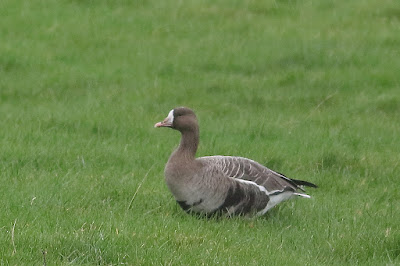
New Year's Day saw me heading west to Charminster, a very wet 40 mile round trip, to see a flock of 11 Russian White-fronted Geese

The Charminster White-fronts were a lot closer than the flock I saw at Hampreston in December - and accessible via one of the best bits of cycle path in Dorset!
A short detour to Silverlake on the way home enabled distant scope views of a redhead Goosander - a species I didn't see until August last year. It was a long way off!
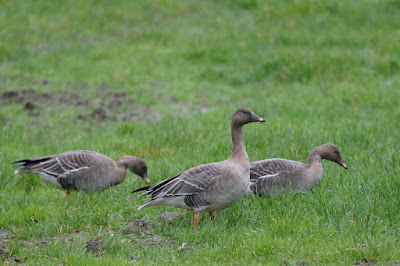
When I got back to Wareham from Silverlake, I knew the Tundra Beans were still at Upton - but for how much longer? I pressed on, adding another 15 miles to the journey, and saw them in fading light.
A good job I did - they were gone the next day
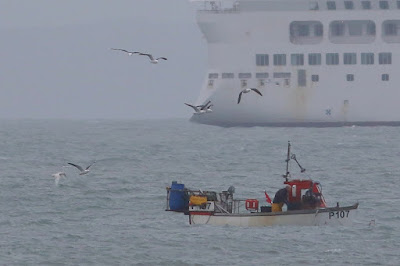
Iceland Gull as it should be seen: following a fishing boat miles out in a windswept bay (far left-hand bird). I really should have visited the Preston chippy on the way down and thrown some out to tempt it closer! Not the greatest of views, and not the nicest of journeys to Weymouth either, but a good bird to have under the belt in 2022. 

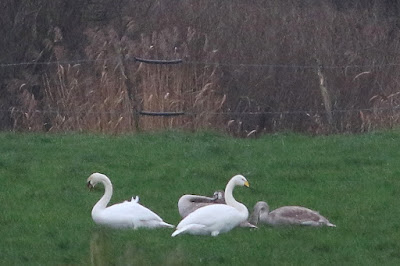
This Saturday took me back to Hampreston (another 30 miles in yet more foul weather) where the wintering Whooper Swan was still present
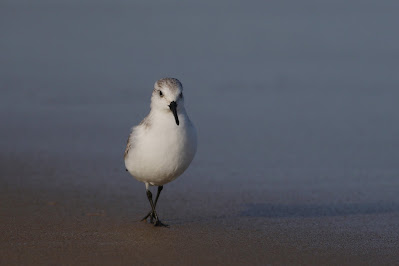
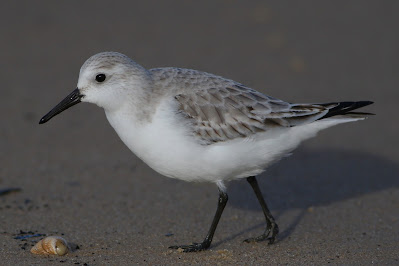
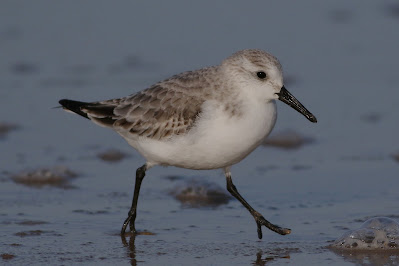
Sunday brought what felt like the first sunshine of 2022, and the lure of Studland proved irresistable despite heavy legs from the day before. Sanderling on the beach was my first of the year.
I like the shell adding a dash of colour to this picture
Studland also produced my first Scaup, Slavonian Grebe, Black-necked Grebe and Goldeneye of 2022

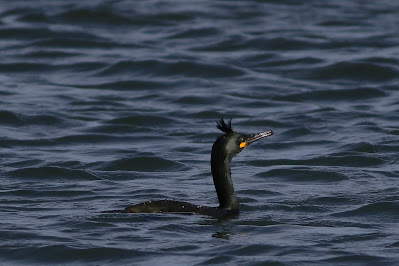
A bottle-green Shag looking glorious in the sunlight at Studland

Thursday, 30 December 2021

One last hurrah

By Christmas Day I had seemingly exhausted all the possibilities which Dorset offered to add to the non-motorised year list. At this late stage of the year, it would have been tempting to hang up my bicycle clips and settle for the grand total of 221 species which had been amassed thus far. But while the Dorset possibilities may have been exhausted, there was always Hampshire...

Following reports of a Great Grey Shrike in the New Forest earlier in the winter I had been contemplating a big day in the area. Unfortunately the Shrike had gone off the radar several weeks ago, but potentially three December 'ticks' were still available if I was willing to make the effort. 
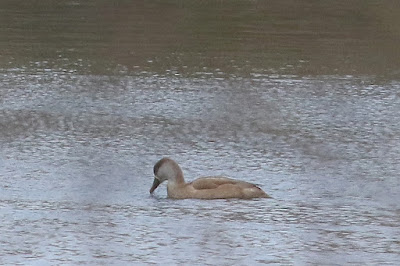
Female Red-crested Pochard, Ibsley North
A good plan, some luck and preferably decent weather would likely be needed to see all three, and the last of these wasn't really an option as every day between Christmas Day and New Year looked wet and windy to varying degrees. Tuesday 28th looked like the least worst, with a strong westerly wind to hasten my passage over the county border. This wouldn't be much help on the way home but it was due to ease off and I figured I could cross that bridge when I came to it.
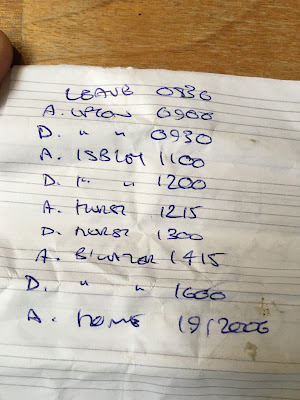
The cunning plan
A plan was therefore hatched on a scrap of paper the night before (see pic above) - all I had to do now was execute it. The first step - get on the road by 0830 - was straightforward enough. Packing the bike these days with enough clothes, food and fluids for a full day in the field without even needing to stop at a shop is quite a challenge, but I got it organised the night before and was out of the door a few minutes early. 
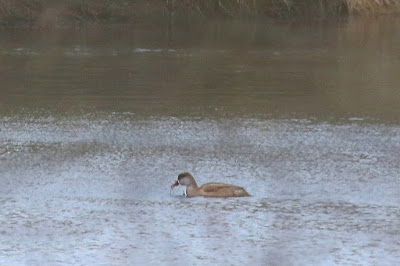
Red-crested Pochard (female), Ibsley North
First stop was Upton, just 7 miles from home, for another look at the Bean Geese which were looking good as the sun rose. John Wall arrived to pap them with his big lens, making my lame efforts at photography feel a bit redundant. And besides, there was no time to waste if I was to get to my next target - a Red-crested Pochard at Ibsley North lake, a further 17 miles to the east - by the allotted time of 1100. 

East Dorset birder Olly Frampton had been keeping tabs on the Red-crested Pochard, a female, which had been present a few weeks, and he very kindly confirmed its continued presence early morning, giving me the incentive to press on despite the deteriorating weather at my back. Google maps for cycling is pretty good, but on this occasion, having taking me over the Canford bridge - a narrow 3 plank job with gaps between the planks big enough for my wheels to slip through - it then directed me along the muddy bank of the River Stour to a double stile, requiring heavy panniers to be removed before the bike could be lifted over. Unhelpfully, the weather chose this moment to do its worst, and by the time everything was reassembled I was seriously wet and doubting the wisdom of the exercise. 
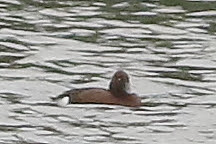
Essence of Fudge Duck (!), Kingfisher Lake
But since when did wisdom have anything to do with the non-motorised year list! I pressed on and found Ibsley North lake without too much trouble thanks to Olly's excellent directions. A couple of Portsmouth birders had just arrived and one of them located the RCP within minutes. I had lost a bit of time against schedule on the way over, but this quick result more than clawed it back. While a satisfying addition to the year list, this was not really a bird to quicken the pulse so after some manual focus record shots through the trees, I resolved to quickly move on to my next target a couple of miles back down the A338: the Ferruginous Duck at Kingfisher Lake. 

This returning bird has some notoriety as Kingfisher Lake is surrounded by a 6 foot fence, clad with a solid canvas matting to protect the bashful fishermen inside from view. Famously, therefore, visiting birders wishing to see the Fudge Duck are advised to bring a stepladder! Such a thing would not fit in my panniers, but the Portsmouth lads had brought one so I arranged to meet them there in case it came in handy. It turned out that standing on the bike pedals gave me just enough height to see over the fence,  but we scoured the fence line looking for a clear view in vain. 
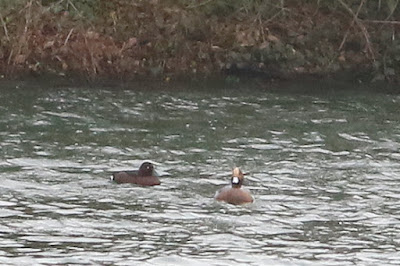
Ferruginous Duck (left) with Wigeon
I found a candidate bird through a hole in the fence but it materialised into a female Tufted Duck. We eventually found a reasonable view point which revealed a flock of Goosander and other mixed duck in the centre of the lake. Picking through them whilst perched on the pedals, right at the back a dark bird with a white bum and peaked crown caught my eye. Views through the scope balanced on barbed wire, and a few record shots confirmed it was the Fudge Duck. The Pompey lads were delighted and I was pleased to have repaid my debt to them for finding the RCP.   

With two year-ticks in the bag, lunch - the inevitable leftover turkey sandwich - was taken sheltering from the rain and wind under a bush. The sensible thing to do at this point would have been to give up on the third target for the day - a New Forest Hawfinch - head home and be satisfied with the day's haul. But since when did sensible have anything to do with the non-motorised year list! The plan dictated that I would need to be at Blackwater Arboretum - a well known pre-roost site for Hawfinch - another dozen or so miles to the east - by mid-afternoon.
Ferruginous Duck showing sharply demarcated white belly
From Kingfisher Lake there were two options to head into the New Forest: east along Ivy Lane and across Broomy Plain before cutting under the A31 to Bolderwood and on to Blackwater; or south to Ringwood before heading east via Burley. Olly had advised that Hawfinches might be seen at Bolderwood so it made sense to try there first and, with luck, I could be on the way home well before dark. The ride through the New Forest was glorious, the sun came out for the first time all day, and I clocked an impressive 34.5mph as I coasted down through Slufters Inclosure to the A31.

As it turned out, I couldn't locate the target species at Bolderwood, so to Blackwater it was, with precise directions provided by Phil Saunders who had seen Hawfinch there within the last couple of weeks. As I rolled into the Arboretum, it was a nice surprise to see Garry Hayman, who has been present at the end of several of my long distance bike twitches this year, and his wife, obviously also hoping for a Hawfinch. 
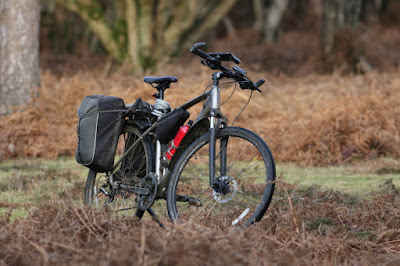
The wheels at Bolderwood
The less good news was that they had been there since 1300 and not seen a thing! Still, I had come all this way - clocking up 40 miles by this point - so there was nothing for it but to set up scope and hope for the best. At 1545, scanning with bins in rapidly fading light, I noticed a previously unseen lump in the top of a distant pine and a quick check through the scope confirmed my suspicions: Hawfinch! I got Garry onto it and after a few quick record shots it was time to pack up and begin the long journey home. 

I took the Burley route back to Ringwood, crossed the Dorset border and followed the excellent Castleman Trailway as far as Ferndown before heading for the comfort of tarmac for the final 15 miles. At 1930 I completed the 73.5 mile epic - my second longest journey this year after Lyme Regis in June - and could safely chalk up three more additions to the year list. Barring something extraordinary happening on New Years Eve, that really does look like it for the year - a grand total of 224 species seen travelling under my own steam, all but 4 of these in Dorset. 
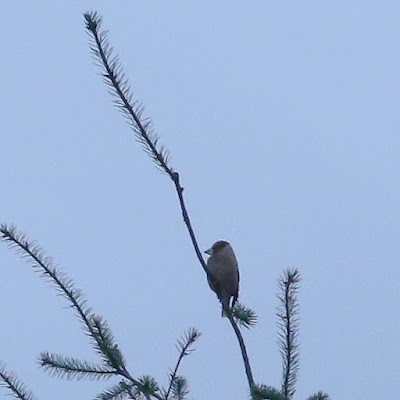
Hawfinch, Blackwater Arboretum, 28th December

Monday, 27 December 2021

Christmas is coming and the Geese are, well, everywhere

With the obvious exception of the Greylag, the other 'grey' geese - Pink-footed, White-fronted and Bean - are pretty scarce in Dorset, so after failing to see any of the three at the end of last winter, I didn't hold out much hope of adding them to the non-motorised year list. The week before Christmas changed all that though as geese starting appearing all over the place, presumably in response to colder conditions further east. 

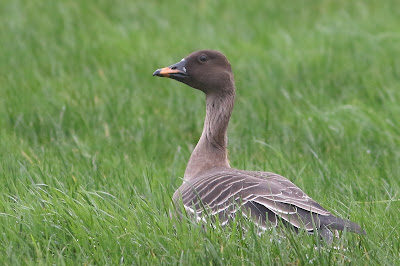
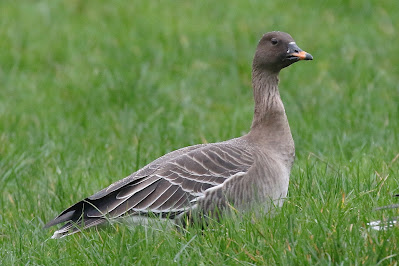
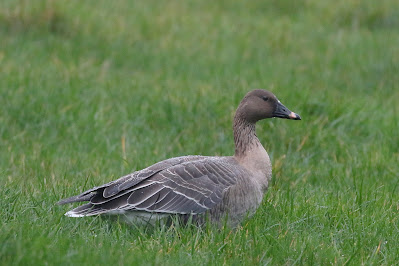
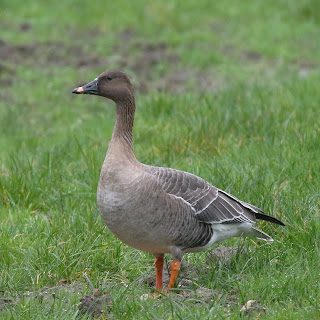
Tundra Bean Goose
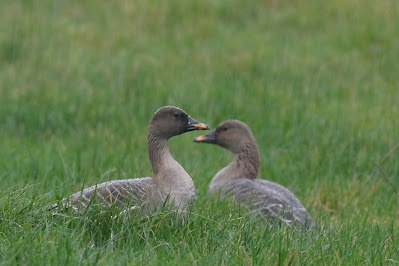
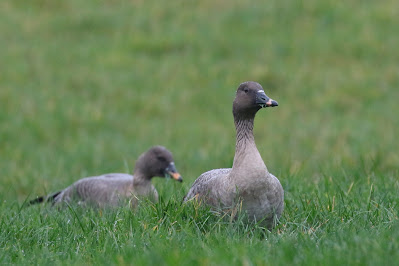
On Monday a flock of Russian White-fronts appeared at Hampreston, scene of my successful Whooper Swan twitch earlier in the month, while on Tuesday a trio of Tundra Bean Geese arrived even closer to home in Holes Bay. Fortunately both species lingered long enough for me to catch up with them, the Beans, a particularly desirable species in these parts, requiring an early start before work. 
Tundra Bean Goose
It's about seven miles to Upton Country Park where the geese had been seen, and on arrival, even in the dark I could recognise the familiar figures of Rob and James who clearly had the same idea as me to have 'Beans for breakfast'. We went to the field where the birds had been reported but it was disappointingly goose-less. Just as my deadline to return home was approaching, the Birdguides app reported that the birds were still there - but the directions pointed to the empty field we were stood next to. The mystery was soon solved though when a phone call from Phil Saunders confirmed the correct field (to the west of the one we were watching). After a short sprint and I was there to enjoy good views in the half-light.
The three Bean Geese together at Upton
I figured (correctly) that the geese might be the last additions to the non-motorised year-list before Christmas Day, by which time other priorities, like spending time with the much-neglected family, would finally take precedence after a year in which most of my spare time has been consumed with cycling around looking for birds. Unfortunately 'spending time with the family' took on a cruel twist when my wife tested positive for Covid-19 and had to spend the big day in isolation. 
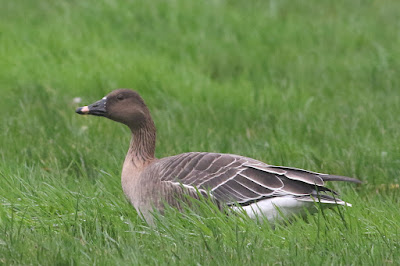
Tundra Bean Goose
She remains there as I write, ordering refreshments via the 'Room service' whatsapp group set up by my eldest when he was 'pinged' and forced to isolate back in the autumn. My youngest son (who caught Covid earlier in the year) and I (who had a booster jab a week earlier than my wife) have been testing negative on a daily basis so fingers crossed it stays that way.
Tundra Bean Goose
So it's been a slightly odd festive season, preparing meals, snacks and drinks, leaving them on a tray outside the plague-room door, giving it a tap to let the inmate know that they are there, and then running away before the virus can escape the strict quarantine imposed on its reluctant host. I feel like a cross between a night porter and a beneficent cherry-knocker.
Tundra Bean Goose
As for herself, fortunately the symptoms have been very mild, consisting mainly of a new, continuous craving for Netflix and, judging by the Christmas music coming from the bedroom, a complete loss of taste. Plus she's getting five-star catering, has a cast-iron excuse not to see the in-laws and doesn't have to share a bed with me. So I suspect she's secretly delighted to the extent that I am starting to wonder just how reliable these 'positive' lateral flow tests really are...
The Hampreston White-fronted Geese were a bit more distant than the Beans!
Anyway, there is precious little left of the 2021 and I'm not sure if I will be able to add to the yearlist, so there may not be many more of these breathless posts, which I'm reliably informed are almost as exhausting to read as the journeys on which they are based were to complete. So it's looking like the year may end on 221 (220 of which have been in Dorset). 222 would be a satisfyingly memorable number to end on of course, but not even Father Christmas can guarantee that!

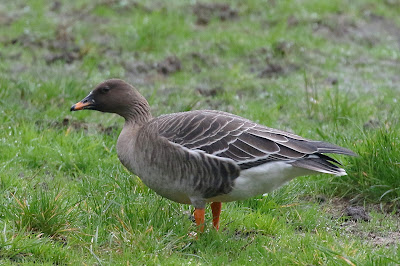
A view of the orange legs of the largest (male?) Tundra Bean Goose

Wednesday, 10 December 2014

Tundras on toast

The appearance of a pair of Tundra Bean Geese in the Swineham area this weekend had Dorset birders digging out old notebooks to establish whether an earlier Poole Harbour record in the 1980s were of the Taiga or Tundra sub-species. The conclusion - that nobody knew or had taken sufficiently detailed note to be able to work it out in retrospect - harked back to simpler days when they were just good old 'Beans'. 

I had visiting family to entertain all weekend, virtually guaranteeing a patch mega, and it was pretty clear that spurning my little sister's company to go see some birds would be frowned upon. So I waited until early Sunday morning when she was still having a lie in to twitch them and was back to make coffee and muffins like a dutiful host before anyone else had stirred. I think that's allowed.
Tundra Bean Goose at Swineham
The Beans were originally seen from distance and thought to be Pink-feet - this shot shows the darker back and upperwing of Bean Goose...
...and this shot the orange feet of Bean Goose. For better pictures of both birds see Joe Mitchell's photo on the Dorset Bird Club website.