Showing posts with label Large Skipper. Show all posts

Saturday, 15 July 2017

Get counting

Yesterday's launch of the 2017 Big Butterfly Count reminded me that it has been a colourful summer so far for lepidoptera, including a number of subjects I haven't got round to posting about yet. Many butterfly species seem to be having a good year - the count will help establish whether or not that is true - and I have caught up with some spectacular ones around Dorset and beyond over recent weeks.

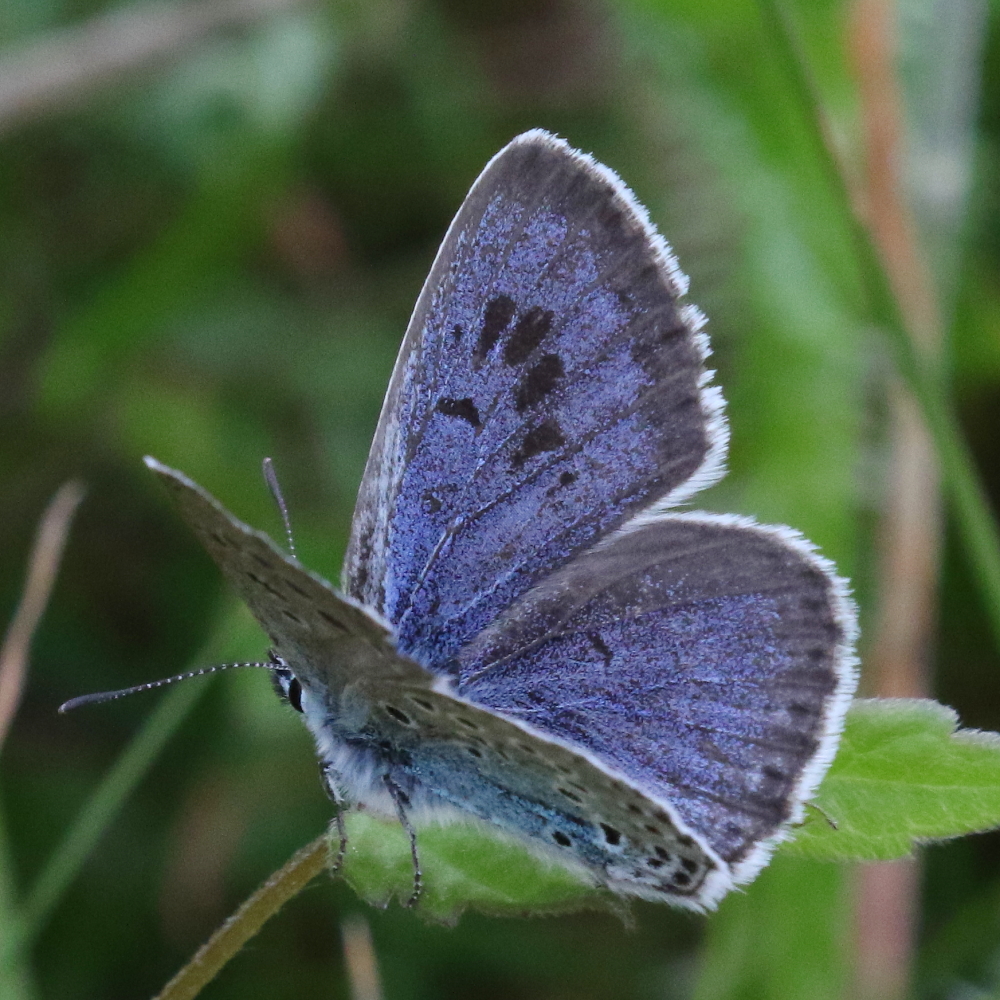
After a business trip to Cardiff at the end of June I was travelling back through Somerset and despite the lateness of the hour, the temperature was sufficiently high to make it worth dropping in to Collard Hill, site of a successful Large Blue re-introduction scheme, to see if they were still on the wing. The sky had clouded over by the time I arrived but with a little patience I found one or two of these striking butterflies roosting in the long grass of the down. One opened its wings just enough to get a half-decent photograph of the exquisite finger-print pattern on the forewing.
Large Blue
A close-up of a roosting Large Blue...
... and the same individual from a wider angle
A conservation success story, the Large Blue is now established at a number of sites in the south west
Marbled White was also on the wing at Collard Hill
Back in Dorset, a visit to Brownsea provided me with an opportunity to catch up with the White Admiral, one of our most impressive species. It's so many years since I saw them there that I had almost forgotten White Admirals could be found on the island, but I was reminded when another visitor in the bird hide asked if he might have seen one near the start of the track to the hide. Sure enough, on returning there two or three individuals were still coming to the same flowering shrub to nectar.
White Admiral
The White Admiral is a shade tolerant species
The White Admiral posed above me for an underwing photo
The underwing must be one of the most attractive of the British butterfly species...
...here the underwing catches the light to reveal its bright rust colouration
Silver-studded Blues were also out in Dorset early this year and I photographed several in Wareham Forest and around Morden Bog in mid-June. These diminutive blues have declined historically in parallel with the loss of the lowland heath habitat they prefer, but they can still be found in good numbers on the Dorset heaths.
Female Silver-studded at Morden Bog
The silver studs were particularly prominent on this female...
...but more under-stated in this male
Upperwing of a male Silver-studded Blue
These males seemed to have each other in a head-lock
Much rarer than the Silver-studded Blue in a Dorset context is the Small Pearl-bordered Fritillary - I called in at its last remaining site in Purbeck on the way back from Brownsea one afternoon and was pleased to find a few among the grass and gorse in a short visit. Hopefully the Purbeck colony will have a good year. Another brief visit last week to Durlston Country Park produced good numbers of Lulworth Skipper, only found in the UK along the stretch of coast between Swanage and Portland. Another local speciality which we must hope benefits from seemingly benign weather for butterflies this summer.
Small Pearl-bordered Fritillary
Small Pearl-bordered Fritillary underwing
Large Skipper was also at the Fritillary site - compare with...
...the Lulworth Skipper, photographed at Durlston
These Marbled Whites were engaged in synchronised nectaring at Durlston

Sunday, 12 June 2016

Summer's lease...

..hath all too short a date. So said Shakespeare and I know what he meant - it will soon be gone, we will wonder where it went and wish we had done more with it. Fortunately, as we're on a literary theme, a new book by my friend James Lowen has arrived on the shelf to help make the most of it.
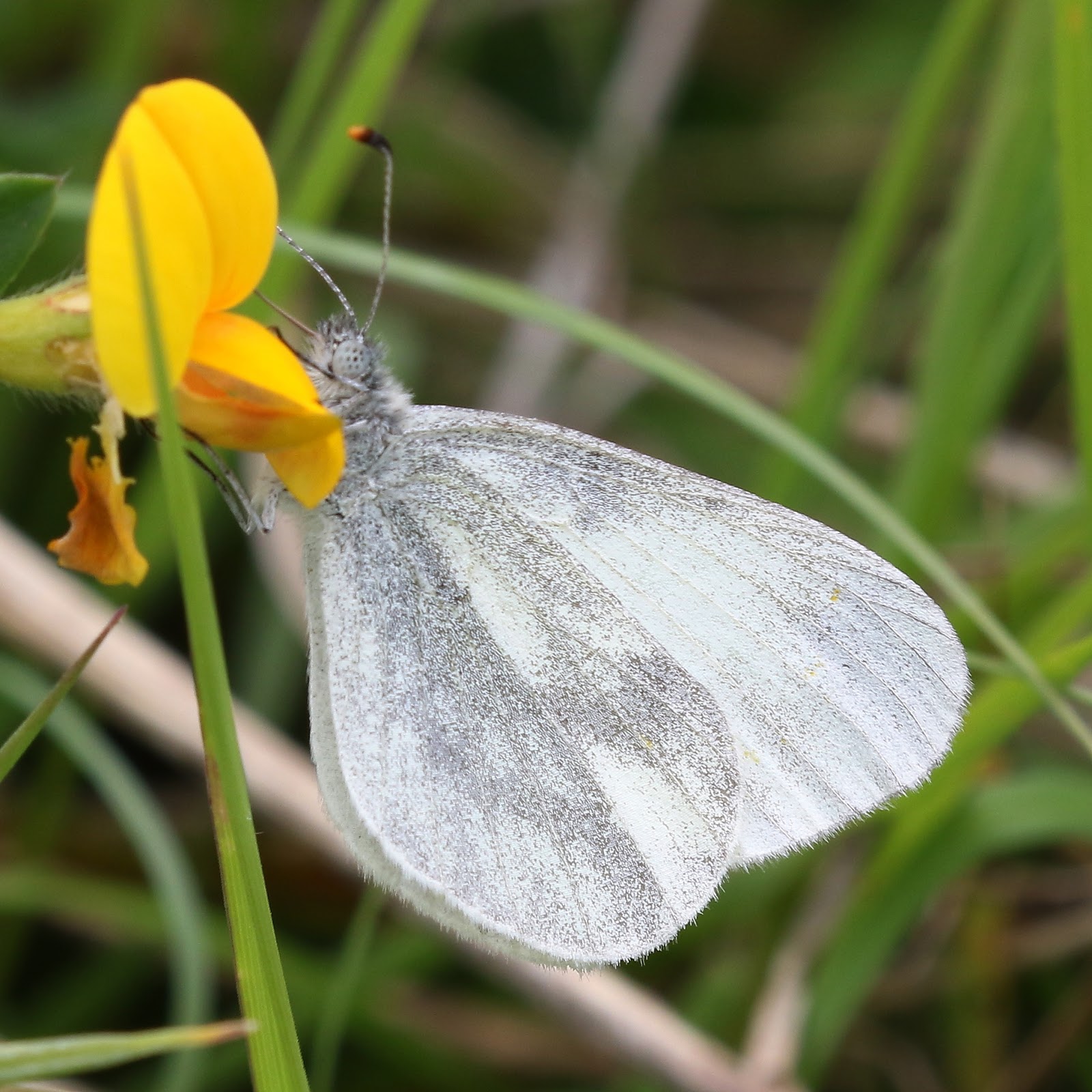
Wood White - the rarest and daintiest of the Pieridae

A Summer of British Wildlife condenses 100 days worth of special wildlife-watching opportunities into a beautifully illustrated, pocket-sized volume which should remove any excuse for not making the most of the sunny weather. I should add at this point that I'm not on commission, or I would be promoting it on more widely read media than this. I did, however, get a complimentary copy thanks to having a photo included and an acknowledgement as one of the 'notable rabble' who provided information and inspiration for some of the content.
A female Wood White ovipositing

I am rarely short of ideas for where to go and what to do when it comes to wildlife - shortage of time to do it all being a more common complaint - but when flicking through my copy a feature on the Wood White butterflies of Branscombe caught my eye. I have seen Wood Whites in their more typical woodland habitats, but never on the crumbling undercliffs of the Jurassic Coast World Heritage Site, despite having some professional responsibilities for stewardship of the latter.
A pair of Wood Whites in courtship mode...

So that seemed reason enough for an 'out-of-county' excursion to neighbouring Devon. Having not been to the precise location before, and being on a bit of a tight timescale, the site directions and advice on where to look were an invaluable aid to discovering the butterfly colony without too much aimless wandering. As the book points out, why this primitive species thrives on the primeval slopes of the Jurassic Coast is a bit of a mystery given its typical habitat. Such snippets punctuate the book nicely, though the drafting remains concise and to the point such that even the most impatient reader should be able to get what they want from it without wading through too much superfluous text.
...a rare sighting of the male's open upperwing during courtship
Neither is this book restricted to the wildlife superstars of the bird, mammal and butterfly world - it delves into moths, amphibians, wildflowers, dragonflies, beetles and bugs of all descriptions. So there should be something in it for the experienced wildlife-lover, not just the novice. Having wildlife itineraries all mapped out isn't for everyone of course: some people like to do all the planning, discovering and researching for themselves, and some seem to know-it-all already and have no need for 'where to watch' guides. Well the good news for those folks is that they don't have to buy it! But if you're not one of those folks, and are interested but not quite sure where to start, then you could do a lot worse than get a copy to guide you through the summer months. 
Wood White nectaring on Bird's-foot-trefoil
As I said of James's previous publication, there's really no excuse not to buy A Summer of British Wildlife, except perhaps grinding poverty, a total lack of access to all good bookshops, or a complete disinterest in Britain, Summer and Wildlife. Which, if you're reading this, seems unlikely. Just one complaint about the book really. While the wonderful Durlston Castle and Country Park quite rightly gets its own feature, the ownership and stewardship of this successful, self-funding gem of a facility by Dorset County Council doesn't get a mention. (OK, declaration of interest time: that's my employer, and hard-pressed local authorities don't get much credit for getting things right so we need to claim it wherever we can!).
Large Skipper also nectaring on Bird's-foot-trefoil

Anyway, enough praise for the latest from the Lowen collection, and back to Branscombe, and the Wood Whites, which were just brilliant. The first ones I came across were doing their courtship 'dance', the male bobbing his head back and forth and caressing the female lovingly with his extended proboscis. Several more males were floating around spirit-like, nectaring on wildflowers, prospecting for females and occasionally coming to rest as if to pose for photos in the overcast conditions. A single, fresh Large Skipper was also on the wing, along with a Thick-kneed Flower Beetle - a first sighting of this 'Iron Man' of the entomological world for me. A fine mini-beast safari, then, and not even a broken down car back at the car park could take the shine off!
Thick-kneed Flower Beetle

Sunday, 29 June 2014

Coats of many colours

Claire went to London to see Dolly Parton this weekend, while the boys and I visited their Grandad in Devon to mark his turning 70 - just a couple of years older than Dolly. Coats of many colours were therefore being admired not only at the O2 but also on the Fritillaries of north Devon's coastal slopes - Dark Green, High Brown, Silver-washed specifically. Saturday morning saw us at Heddon's Mouth, a well known site for the rare High Brown Fritillary. Not a particularly long or leisurely visit due to commitments back in Dorset on Saturday evening, but long enough to locate just one fairly fresh specimen, along with a few of its commoner cousins.
Male High Brown Fritillary: I suspected High Brown on this initial view but needed to see the underside to be sure...
...which shows the diagnostic row of rust red spots with silver centres on the hind-wing.
Dark Green Fritillary: note the similarities in the upper-wing pattern to High Brown...
...but also the differences in the under-wing.
The High Brown, as it is now, has been through a veritable rainbow of names over the years - initially know as the Greater Silver-spotted, then the Dark Green, then the Violet Silver-spotted (a reference to the foodplant). Common across much of England until the 1950s, its decline was one of the more sudden and dramatic of all the British species, and it is now the subject of intensive conservation efforts in its remaining strongholds.
Male Silver-washed Fritillary
The stunning underwing pattern of Silver-washed Fritillary
This one was outside the toilets at the Hunter's Inn. Not a great place to hang about with a camera.
The long black lines on the forewing show this is a male.
The Dark Green Fritillary can be found in a wider range of habitats, particularly coastal areas, and while it too has declined, this has been nothing like as steep as that faced by the High Brown. I've struggled to get good undwerwing photos of either species, so when the one above sat with an almost closed wing in full sunlight on a thistle that was a bonus.
Fritillaries were note the only butterflies at Heddon's Mouth - this a Large Skipper
A smart Ringlet resting on a fern.
Small Heath.
Dark Green Fritillary.
The Silver-washed Fritillary, named for the silver streaks on the underwing, is one of our most graceful and spectacular. The footpath to Heddon's mouth descends through a steep valley so sometimes the canopy below is at eye level and we could see territorial males perched up and seeing off passing rivals. Another species having experienced long-term decline, it's range has at least expanded in recent decades, possibly due to climate change to which it appears particularly sensitive. 
Heddon's Mouth and the Bristol Channel beyond


Sunday, 22 June 2014

The energy crisis

No not that one, it's my own I'm talking about. Work is a bit manic; my social life is hectic by my anti-social standards; and the fine weather and (not-so-fine) hay-fever are all combining to make it all a bit, well, oppressive. I can barely summon up the energy to refresh these sunburnt pages. Just about managed to wave a white-hot lens in the general direction of some wildlife this weekend though, so perhaps I'll let the pictures do the talking.
This Buzzard made getting around look easy while I huffed and puffed and hid in the shade.
Willow Warbler at Morden Bog: a mixed singer, with bursts of Chiffchaff amid the normal song.
Keeled Skimmer, Morden Bog.
Four-spotted Chaser, Morden Bog.


Large Skipper, Morden Bog.
Silver-studded Blue, Morden Bog - many on the wing today.
Silver-studded Blue underside, Morden Bog.
A day at the beach yesterday was enlivened by a passing Mediterranean Gull, bringing its namesake climate with it.
Almost forgot about this one - Hooded Crow on Portland last weekend - an unexpected Dorset tick for high summer.
Broad-bodied Chase are also on the wing at the moment - this one at Swineham to which I was reminded I am particularly allergic at this time of year.