I read a behavioural psychology piece during lockdown which suggested that the longer a new behaviour was adopted by necessity, the more likely it was to 'stick', even after the freedom to abandon it returned. Hopefully this will be the case for all those people who've been buying bikes to get around (I had been dithering about upgrading mine and now can't get one for love nor money!) - but it certainly seemed to apply in the case of my regular visits to my local patch at Swineham. Badly neglected over the last few years, birding there once again became a firm fixture of my weekly routine.
 |
| Reed Bunting, singing his heart out at Swineham |
 |
| Sand Martins roosting in the Swineham reedbeds on one of the rare dull mornings of recent weeks |
Whether it was the combination of reduced disturbance during lockdown, the consistently fine weather, the more frequent visits on my part or a combination of all three, birding at Swineham this spring seemed much more rewarding than other recent years. The late April glut of singing Reed and Sedge Warblers sustained well into May and, touch wood, both look set for a good breeding year.
 |
| Reed Warbler - now much easier to see than when they first arrive in April |
 |
| Reed Warbler |
I enjoyed some rewarding morning walks along the river banks, more recently taking the 'long' route which follows the meanders of the River Frome from Wareham for a couple of miles before rounding the eastern end of the main Swineham gravel pit, then heading west up the Piddle Valley back towards town. I would normally follow this route anti-clockwise but on the morning of 29th May I went clockwise figuring it would be better to have the sun behind me as I approached the pool where I had found the Temminck's Stint a few weeks earlier. It was rapidly drying out but still held a Little Ringed Plover, a species which normally just passes through Swineham briefly in spring but which was seen either here or elsewhere around Wareham this year throughout April and May.
 |
| A couple of pairs of Sedge Warbler have stayed to breed this year - this one bearing a leg-ring |
 |
| Stock Dove is often seen around Swineham - but rarely poses this well |
I trudged back along the bank of the Frome, a little disappointed, and as I entered the avenue of small trees and bushes just before the churchyard in Wareham, which completes the circular walk described above, I heard a snatch of birdsong which stopped me in my tracks. It was difficult to pick out as the wind was tearing through the poplars above, but my instinct said Marsh Warbler, a rare migrant to Dorset and a species I had heard and seen well last year at Lodmoor in Weymouth. I phoned a couple of local birders to say that I thought I'd found a Marsh Warbler, and had the presence of mind to make a quick recording with the voice memo function on my phone. No sooner had I done so the bird went quiet and remained so for over the next hour.
 |
| Marsh Warbler in early morning light at Bestwall |
 |
| Marsh Warbler in song at Bestwall |
The recording wasn't very good and of several people I shared it with, some felt it sounded ok for Marsh Warbler, others favoured Reed Warbler. I was convinced it wasn't the latter so returned in the evening to find the bird still singing, audible more clearly now as the wind had died down. Fellow Swineham regular Trevor arrived and we both felt sure it was a Marsh Warbler. I circulated a better recording to Paul Morton, of Birds of Poole Harbour, who consulted other Sound Approach experts and the diagnosis was confirmed. We remained with the bird until almost dusk but despite singing almost constantly we didn't see it once.
 |
| Little Gull at Swineham on 1st June |
 |
| My first Little Gull at Swineham for several years, possibly because I rather than they haven't been visiting |
The following morning Paul was first on site making some fabulous recordings of the Marsh Warbler's varied repertoire of mimicry - over its four day stay it was heard to do Nightingale, Blue Tit, Great Tit, Blackbird, Green Woodpecker, Cetti's Warbler, Magpie, Goldfinch, Swallow, Wren, Chaffinch, Song Thrush, Jackdaw and Whitethroat. I was hoping for a few more patch ticks from it to be honest (Nightingale being the only one) but you can't have everything...
 |
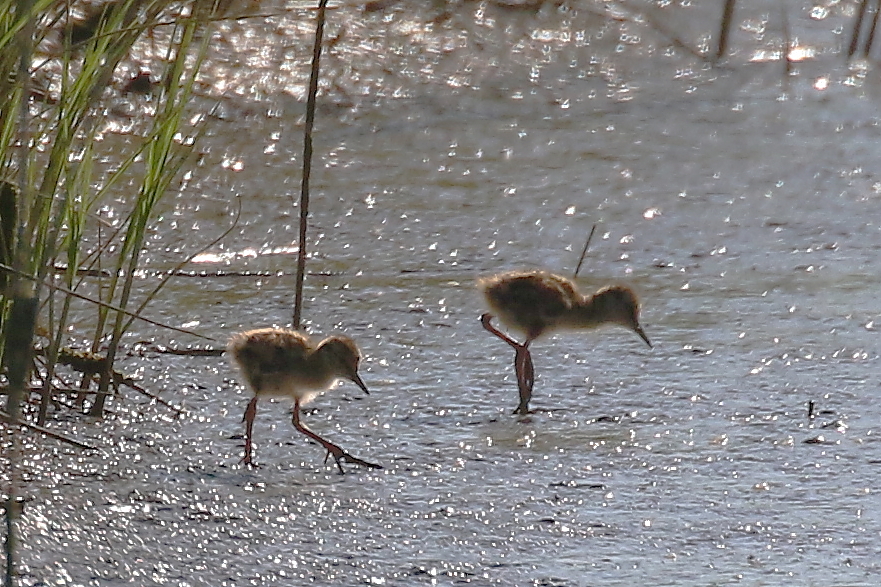
| Thrilled to see Redshank breed successfully at Swineham this year |
 |
| Two of three Redshank chicks at Swineham on 31st May |
After the Temminck's Stint and Marsh Warbler I was on a bit of a roll so, following an early start with the latter, I spent the rest morning of the morning of 31sy May searching Swineham for a good 'hat-trick' bird. It came in the form of an unseasonal Short-eared Owl flushed from the path at the end of the gravel pit - not unheard of at Swineham, but very rare for the time of year. It landed on Swineham Point and stared at me for a few minutes before fleeing in response to repeated divebombing by a pair of protective Redshank looking out for their brood of youngsters which can't have been more than a few days old. My best day at Swineham of the spring was capped by capturing a distant image of the hepatic (rufous morph) female Cuckoo which I had seen several times but never for long enough to raise the camera.
 |
| Short-eared Owl at Swineham Point |
 |
| An unexpected bird for late May |
The following evening Phil Saunders, who'd come to listen to the Marsh Warbler, picked up a probable Caspian Tern flying up the Frome towards Poole Harbour. Finding that would have made for a superb hat-trick of Swineham spring rarities! Trevor and I headed to Swineham Point and although we couldn't relocate it, we were rewarded at dusk with a 1st summer Little Gull calling over the gravel pit and a Nightjar churring way across the water of the Wareham Channel on the Arne peninsular - a superb ending to a memorable month at Swineham.
 |
| Hepatic Cuckoo - a stunning bird |
 |
| Orange Tip on Bluebells - another memorable moment from an excellent spring on the local patch |