Showing posts with label Tree Sparrow. Show all posts

Sunday, 3 June 2018

Banished to the fens

Another family camping trip over the Whitsun Bank Holiday weekend saw me, again, surplus to requirements, opening up the possibility of a few days away at a destination of my choice. I have not seen Swallowtail butterflies in some time or photographed them since investing in some decent camera gear, so heading for the Broads and Fens of Norfolk seemed like an attractive option.
Avocet, Frampton Marsh
The reserve holds a healthy breeding population
Avocet feeding on the muddy scrapes
Not too difficult to photograph in flight due to its highly contrasting plumage making it easier for autofocus to lock on

Checking the forecast before departure, my first morning away didn't look like great butterfly weather so I started my road trip with an early start at Frampton Marsh, over the border and the from Norfolk in the Lincolnshire section of the Wash. A group of Ruff had been lekking on the reserve viewable from the car park and having only seen this spectacle once before the opportunity to do so again was not to be missed.
 A few Avocet chicks had hatched at Frampton Marsh
Avocet
Lapwing chicks were also on the reserve
The adult Lapwing was nearby
A Little Stint was another wader of note on the reserve
As a Schedule 1 breeding bird, Ruffs can't be photographed at or near the nest without a licence, but as these birds were viewable from a safe distance the RSPB has been encouraging visitors to the reserve to enjoy the spectacle. On arrival I parked near the reserve centre and walked to the old car park near the sea wall from where the lek could be viewed. Avocet chicks had recently hatched in the scrapes by the roadside and the adults were alert to danger, calling loudly and mobbing any passing traffic on the road.
Two of the three males present in the Ruff lek
The female can be seen skulking on the water's edge - looking a bit disinterested here
The male Ruff's headgear looks very Elizabethan
This male appeared to be bowing to the female
The battles between males were brief but fierce
Much has been written in natural history literature about the sexually charged nature of the Ruff lek but for an unconventional take on it, check out this Guardian article about 'Ruff Sex'. I would have borrowed 'Let's talk about leks, baby' from this piece as the title for this post but for the intellectual copyright theft it would have represented.
A distant Glossy Ibis was at Frampton Marsh
Several Little Gull were feeding over the water
Swift feeding over the neighbouring farmland
Tree Sparrows were around the nearby farm buildings
Spring was certainly in full swing at Frampton, and with so many farmland birds seemingly in trouble and numbers of migrants apparently down, it was a tonic to see Tree Sparrows and good numbers of singing Sedge Warblers alongside the breeding waders. Unfortunately I could not locate the Turtle Doves which were present on my last visit to the reserve but I was reassured that one of their favourite 'purring' trees had blown down in winter storms and that they were still in the wider area.
Sedge Warbler
An energetic singer
Sedge Warbler

Wednesday, 30 August 2017

Better late than never

Blogging appears a bit passé these days, what with Twitter and the like offering more instant gratification and immediate feedback for and from today's time-poor social media user. So passé, in fact, that I needn't feel remotely guilty about posting almost pre-historic news from a family holiday in Yorkshire earlier this month. Today the wonderful Bempton Cliffs RSPB reserve is playing host to two Greenish Warblers - one of a small number of species I have seen in Britain but not yet photographed. A couple of weeks ago there were no Greenish Warblers - but there were signs of early migration with a juvenile Cuckoo providing me with my best opportunity this lifetime to photograph a normally skittish species. Wheatears, Whitethroats and Wagtails were also in evidence in the fields behind the clifftops.
Cuckoo at Bempton Cliffs
Feeding on caterpillars in the long grass
Wheatear
Whitethroat
Yellow Wagtail
Bempton is world renowned for its Gannet colony - thousands were still on the cliffs, providing, in my humble opinion, about the best natural spectacle one can see in mainland Britain today. I now know I am not alone in holding this opinion - to quote another visitor overheard behind me at one of the many well-positioned viewpoints: 'That's, like, the most amazing nature I have ever seen. You know, with my actual eyes'. Quite.
Gannet
An imposing bird in an imposing setting
Note the pin-striped feet
Still much displaying taking place
A family party at Staple Newk
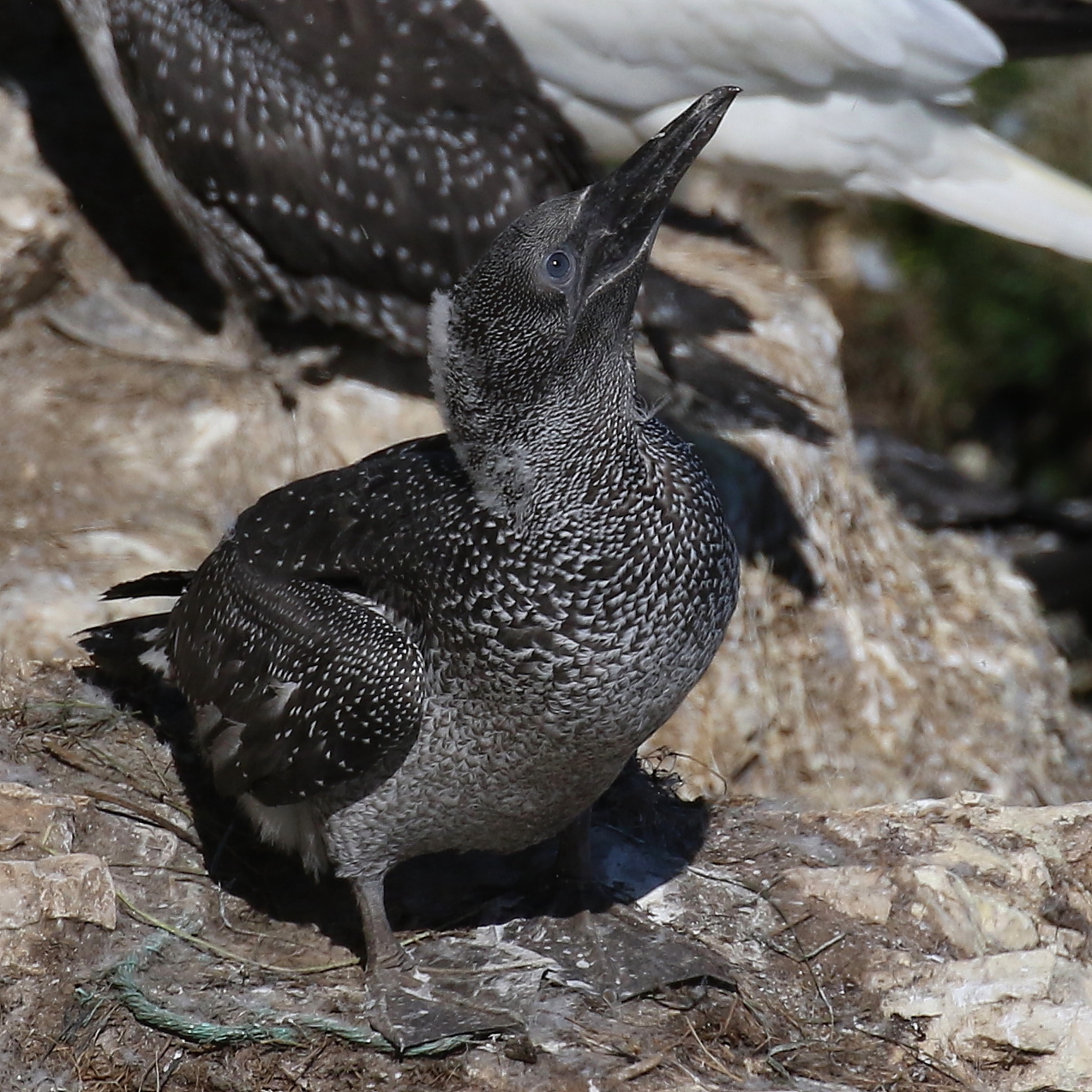
I had not been to Bempton at this time of year previously, so it was an opportunity to study Gannet chicks and fledglings at close quarters and in a variety of stages of advancement towards making their first flight. Some still looked like the plush toys in the RSPB shop, others were similar in proportion to the adults but their flecked grey-brown plumage was in complete contrast to the black, white and cream colours of the parent birds.
Gannet nestlings are prehistoric looking creatures
They breed so closely together that constant squabbling is the order of the day
Young birds can be viciously pecked by neighbouring adults if they cross an invisible line
Very young birds look like polar bears with dinosaur faces grafted on
They can get very large before the white down is replaced by feathers
Over 11,000 pairs of Gannet breed at Bempton, and at such a high density disputes between neighbours are inevitable - we winced as we watched young birds take quite a battering if they strayed into the wrong territory.
The rocky outcrop at Staple Newk is prime real estate for Gannets
A tiny fraction of the extensive Gannet colony
Gannet preparing to lunge off the sheer cliff
Gannet
It was quite difficult to isolate a single bird in the frame
The auks - Puffins, Guillemots and Razorbills - which are also a feature of Bempton in the summer had left their breeding ledges before our arrival in Yorkshire. But it wasn't just Gannets to admire - Kittiwakes were also still present in good numbers, and the Tree Sparrow flock around the visitor centre also appeared to be in good health.
Juvenile Kittiwake
Kittiwake on the rudimentary nest
Tree Sparrow
Tree Sparrow
Tree Sparrow
Tree Sparrow

Monday, 6 February 2017

The best laid plans

'Fail to plan, plan to fail' say the text books, an aphorism I sometimes find myself using when being unnecessarily pompous at work. Then when my own plans come crashing to the ground, I am reminded of the alternative philosophy posited by the well known management guru, Mike Tyson: 'Everyone has a plan - until they get punched in the face'.
Distant Pacific Diver at East Chevington: incapable of sticking to a perfectly good plan
Pacific Diver shows a vent strap, part of which is visible here
These conflicting truisms rather sum up my weekend before last. The plan was as follows: drive through the night to see the sun rise at Druridge Bay Country Park in Northumberland, where a Pacific Diver had been giving the definition of crippling views on Ladyburn Lake. I have seen the returning Cornish bird several times so while it would not have been a new bird for me, the opportunity to photograph a confiding major rarity is what makes me tick these days, so it seemed worth the effort. If the Diver was present, I would fill my photographic boots and be on the road south by 1000 at the latest, get down to North Yorkshire for noon, tick my first British Pine Bunting, and then take a birder's detour on the way home via another long-staying, photogenic diver, the Lincolnshire White-billed, to complete a remarkable rare double-diver day. And with luck, I would still be home in time to tuck the children in to bed.
Pacific Diver lacks the white flank patch of the commoner Black-throated Diver, and is generally a dinkier bird - as comparison with a Coot shows
Pacific Diver has a paler grey hindneck compared to Black-throated Diver
The perfect plan, then: all I needed to do was execute it. Originally I was going to go on Saturday, but a poorly wife, and a glance at the weather forecast, persuaded me to leave it until Sunday. I drove part way up on Saturday evening and stayed at a motel to make Sunday's driving less tiring, and pulled into an icy car park at Druridge Bay as the sun was rising. Julian Thomas from Somerset, a familiar face from the Portland scene, pulled up next to me and with no-one else around, we strolled to the lake in anticipation of a close encounter with the Pacific Diver. It soon became apparent that the Diver had gone - the first day in nine that it had not graced Ladyburn Lake with its presence. I resolved to check the pool at East Chevington, where the diver had been seen before it relocated to Ladyburn, and concluded it wasn't there either after a cursory scan of the pool - too cursory as it turned out, as a call from Julian relayed that it had been found at the far end of the pool by a more diligent observer.
A mixed flock of White-fronted and Pink-footed Geese flying over Druridge Bay
Another skein of Pink-footed Geese over East Chevington
A breathy canter to the far end of the pool enabled a few record shots to be taken, and excellent telescope views to be had, and while it was bitterly disappointing that the Diver had chosen today to not perform at close range, at least I had seen it. By the time I left, I was half-an-hour behind my original plan - an imperfect, but recoverable situation, or so it seemed at the time. A relatively smooth journey to Dunnington near York saw me arrive just after 1230, and as I made the short walk from the car to the paddock near where the Pine Bunting was showing, birders leaving told me that it had been seen just minutes earlier.

I spent the next couple of hours grilling a large feeding flock with which the Pine Bunting had hooked up, as birds flew from a weedy field to the surrounding trees. Yellowhammers, Corn Buntings, Reed Buntings, Tree Sparrows, Bramblings, Chaffinches, Greenfinches and Bullfinches came and went but no Pine Bunting. It had been seen on and off in previous days either here or in a nearby sheepfield, so with enough daylight left to still go for the White-billed Diver, I tried the sheep field, where a seeded area was attracting plenty of Yellowhammers. While there, the Pine Bunting showed briefly back at the paddock - too briefly for me to get back in time to see it unfortunately. It didn't show again before I left at 4. So no Pine Bunting, and no time for the White-billed Diver either.
Tree Sparrows are much easier to see in the north of England - they were present at Druridge Bay and the Pine Bunting site
Close, but no cigar: Yellowhammer is a near relative of the Pine Bunting, another bird which hadn't read the script
Unbroken rain accompanied the long journey home. By the time I reached Dorset I had rationalised it quite well with the usual guff about how it would be no fun if rare birds always did what they were supposed to etc etc, and consoled myself with the thought that I had the best views of Pacific Diver I have enjoyed to date. Pine Bunting becomes officially my bogey bird, having now dipped a few, though with several being found this winter, perhaps I will get another opportunity to see one before long. A Plan B, if you will.