Showing posts with label Red-throated Pipit. Show all posts

Sunday, 27 October 2019

Island hopping

Day two of a short trip to the Isles of Scilly saw me heading to St Agnes, an island with a legendary record for hosting rare birds. A few minor rarities had been reported there the previous day, including a Spotted Sandpiper from the Americas, which was enough to tempt me into making the journey.
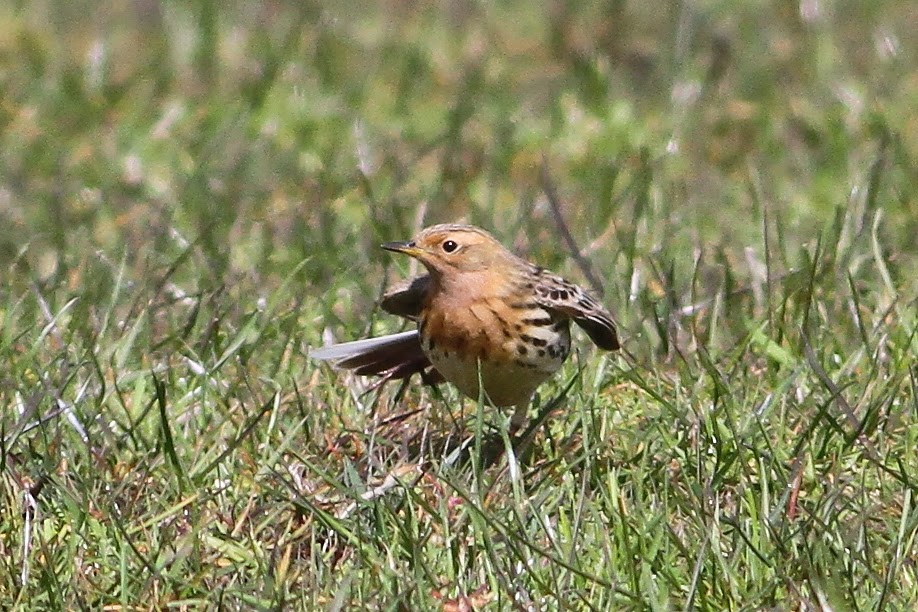
Red-throated Pipit, St Agnes
Red-throated Pipit in this plumage shows strong black streaks on a white breast...
On arrival there was no sign of the Sandpiper but St Agnes certainly held promise, with a larger number of common migrants than I had seen on St Mary's the previous day. I headed inland to search for an apparently photogenic Lapland Bunting which I saw, but only in flight as it headed back to the beach I had just left. Retracing my steps the Bunting continued to elude me so I headed back up the slope to where I had first seen it in the hope that it would return, as indeed it did.
..and normally whitish mantle stripes but these were not so prominent in this individual
Note the short, spiky bill with yellow base
In the intervening period news had broken of a Red-throated Pipit, a top drawer rarity which breeds in the most northern parts of Europe, on the island. As is often the case, the report concerned a bird heard calling in flight, and in such circumstances that is usually the end of it. As I was watching the Lapland Bunting with a small group of birders, a shout went up that the Red-throated Pipit was in the field behind us less than 100 yards away.
The whitish mantle stripes more visible from this angle
Red-throated Pipit
Approaching the field and peering over the dry stone boundary wall, there was the Pipit, parading in the grass at close range with Meadow Pipits conveniently close by for comparison. It flew around a couple of times, giving its distinctive call, before moving off after just a few minutes. It was a very fortunate encounter, illustrated by the fact that a friend from Dorset who was staying on the island missed the bird in the short time it took him to walk up from nearby Porth Killier.
Lapland Bunting, St Agnes
I had resolved to get the 1415 boat back to St Mary's so headed for the quay where breaking news of an Isabelline Wheatear on Tresco caused a re-think. Initially I didn't think I had the energy for a yomp the length of Tresco, but was talked into it by the promise of seeing only my second individual of this species. The Guiding Star returned to St Mary's but the same launch took us straight to Tresco, removing any need to disembark. We would have only a couple of hours before the return trip which would leave from the 'wrong' end of Tresco, so a brisk march was required to get to King Charles's Castle at the north-western tip of the island where the Wheatear was being watched.
Pink-footed Goose, St Agnes
This Pink-footed Goose shared a field with the Red-throated Pipit
On arrival we saw the pale Wheatear straight away, standing out like a beacon against the dark heather. Initially distant, it was flushed closer by some castle visitors, enabling us to get a few record shots - not easy in the light of that Scilly speciality, a late October heat haze!
Isabelline Wheatear, Tresco - sandier brown upperparts compared to Northern
Isabelline Wheatear, Tresco
Despite the no-show by the Spotted Sandpiper, a good second day then with two high quality breaking rarities seen in T-shirt weather, and without the usual stresses of island hopping on Scilly in October.
Isabelline Wheatear, Tresco - note broad black band on the tail
Northern Wheatear on St Agnes for comparison

Sunday, 22 October 2017

Shetland Day 7: far from the madding crowd

We decided on an off-island excursion on our 7th day on Shetland - to Unst, the most northerly inhabited island in the UK, where we could get away from the hordes of literally, er, tens of birders on the Mainland. The forecast, and a report of an Olive-backed Pipit, suggested that we should stop at the Kergord Plantation en route before leaving the Mainland, one of the largest areas of woodland on Shetland.
Otter on Yell while waiting for the ferry to Unst
The Otter surfaced with a fish then vanished
Seeing trees on both sides of the road is a rarity on Shetland: this is Kergord
Although Howard got a brief view of the OBP, the rest of us didn't see it, but compensation came when we each independently heard, and subsequently saw, another small group of Parrot Crossbills in the plantation. These attracted another massive crowd of at least three birders, so we set off again on the quest to get as far from the madding crowd as possible.
A female Parrot Crossbill to go with the males from the previous day
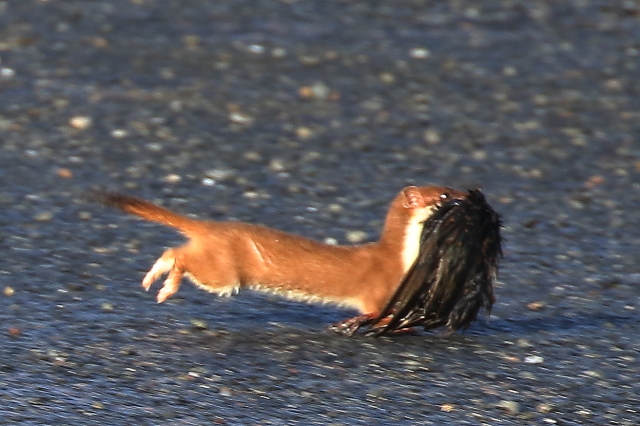
Stoat with Starling as we waited for the ferry to Yell
And this is the ferry to Yell
Speaking of Thomas Hardy, Rustic Bunting may sound like something the townsfolk hang out on May Day in one of his novels, but it is in fact an attractive vagrant from the east. News of one at Lower Voe persuaded us to make a short detour before heading for the ferry. Time was short, but the Bunting was feeding on the roadside as we arrived and was soon flushed by a passing car, assuaging our guilt at ticking-and-running.

Rustic Bunting at Lower Voe
Strikingly white underparts
Thus Ruff was feeding near the Otter
We then hit a lucky streak with Shetland mammals - first a Stoat surprised us by running across the road with a Starling in its mouth as we waited for the ferry to Yell, then an Otter surfaced holding a fish as we waited for the ferry to Unst.
A couple of Bonxies at Skaw on Unst
Curlew on Unst
The cliffs and sea at Skaw were carpeted with Shag. No pun intended.
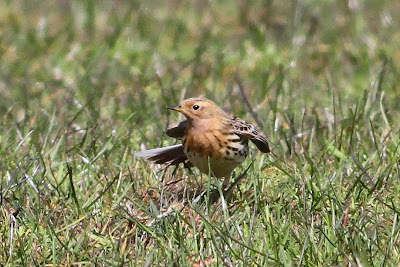
The main target on Unst was a Red-throated Pipit which had been present for several days. We arrived as another carload of birders was leaving, and they advised us to comb the grassland above the beach at Skaw to search for the elusive pipit. A short distance from the car, a Pipit flushed out of the grass in font of us and sat up on a post.
An attractive graveyard on Unst
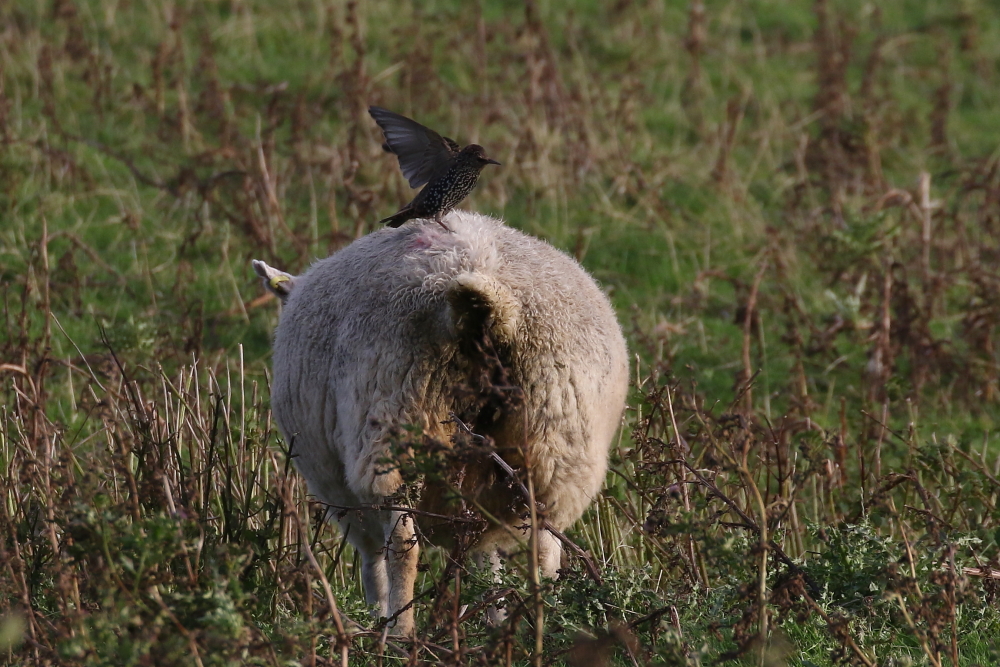
Well at least it's an anagram of 'Starling on sheep's ears' 
We stalked this Pipit at Skaw hoping it was the Red-throated, but photos revealed it to be a Tree Pipit
We instinctively raised our binoculars, expecting a Meadow Pipit, and had a good view at close range before it flew again. Then we all looked at each other: 'That had bright mantle stripes'. 'Yeah, and a yellow base to the bill'. 'Well that was it then!' Too easy! I kicked myself for not grabbing a photograph of the bird at point blank range, and though we attempted to refind it, it had flown beyond a wall into a private garden, and did not look like reappearing.
After burying itself in the grass the Red-throated Pipit eventually came out on the beach 
Clean whitish underparts
A better view of the pale mantle stripes and fine bill with yellow base
The weather had taken a turn for the worse by this point, and we turned to leave - no sooner had we done so than the Pipit reappeared. It was flighty but after sweeping the area with another group of visiting birders we eventually pinned it down for some photos on the beach and in the long grass beyond. 
A rear view of the pale mantle stripes
The best of a bad lot of Red-throated Pipit flight shots
Yet another Redstart - this the most obliging of the lot

The rest of the day was spent birding Unst, the highlight being a White-tailed Eagle which an observant soul had picked up perched on a distant hillside. A great excursion and a welcome bit of peace and quiet before returning to the seething metropolis of Hoswick.
The Popemobile: they pushed the boat out when His Eminence visited Shetland

Record shot of a very distant White-tailed Eagle
The long road home to Mainland Shetland

Friday, 8 May 2015

TGIF

Last year I managed a British tick every month until July, but after a disastrous start to 2015, Little Bustard-wise, this year did not exactly get off to a flyer. It wasn't just a lack of opportunity but a lack of rarities which I have yet to see, the inevitable diminishing returns of twitching taking their toll.
Red-throated Pipit: a long way from home, but at least I didn't have to identify it 'on call'...
Workshy and retired birders will scoff at this, but conscientious breadwinners, burdened by full-time employment, will surely recognise what I mean when I say that there is nothing worse than a short-staying mega which turns up during the working week and bales before you have even plucked up the courage to ask if you could be relieved of parenting/shopping/DIY duties on Saturday for a bit of R&R. If travelling the country in a state of heightened anxiety can be described as R&R.  
...and thankfully it turned up the day before I went 'on call'
Spring is usually the time of maximum frustration as short-staying megas tend to turn up at inconvenient times and not hang about. Spring 2015 seems to have bucked the trend though, with the star birds turning up on weekends, lingering for a bit and even coming back for seconds after an initially brief stay. So much so that, since the start of April, I have been able to see a Greater Yellowlegs and a Hudsonian Godwit within one county of my home in Dorset, a Great Blue Heron in slightly farther afield Scilly, and a Red-throated Pipit on the edge of the Peak District. Three of which were new British birds for me in consecutive weekends.
Hudsonian Godwit - a mere (Meare?) 60 miles from home, and on a Saturday
News of the Yellowlegs and the Godwit also broke sufficiently early in the day to allow me to nip out before the rest of the family were fully mobilised and get back before I was really missed. Even the Pipit could have been twitched on the day of its discovery, though being 5 hours away I am not sure 'I'm just popping out for a paper' would have cut the mustard by way of an excuse, so I had to wait until the following day for that.
Greater Yellowlegs - even closer at 56 miles from home. And a big thanks to the staff at Titchfield Haven who returned my lost memory card - a credit to Hampshire County Council who run the reserve!
Of course this fortunate streak must come to an end - probably this weekend, as I am again 'on call' and have to stay within an hour or so of HQ - precisely the constraint which deprived me of the chance to clap eyes on the Little Bustard at the turn of the year. So I guess I'll just sit tight, ride it out and put away my twitching boots for the next few days. Unless of course that breeding plumaged male Rock Thrush decides to pitch up on Portland. Preferably on Saturday...
The Great Blue Heron arrived on a Tuesday, but had the decency to stay until the weekend


Monday, 4 May 2015

More quality time with the family

The Pipit family, specifically. Having spent a fun day with the kids at the excellent Lyme Regis Fossil Festival yesterday, I was allowed out to play for Bank Holiday Monday. The Greater Manchester/Derbyshire border was not really on my birding radar prior to yesterday but reports of a showy Red-throated Pipit started to put it there. Red-throated Pipits tend not to hang around, and for me and many others, it has been a bit of a bogey bird. I had yet to see one despite a decade of family holidays to Scilly in October, one of the most likely places to do so, and several mad dashes to its airport over the years trying to catch up with one. Many birders have it on their lists thanks only to a calling bird flying over. That would have been not entirely satisfactory, so a summer plumaged male such as this, I thought, was not to be missed.

At the same time, I rated the chances of it staying until today as slim so, not entirely committed, I resolved to go as far as Gloucester early this morning, wait on news and, if none was forthcoming, head off to my childhood home, the Forest of Dean, for a day with the Goshawks, Pied Flycatchers and Wood Warblers. Refuelling at the fancy new Gloucester services, 0800 came and went without news, so slightly disappointed, but still looking forward to reacquainting myself with the Nagshead RSPB reserve, I turned off the M5 to head westwards at the A417 exit. No sooner had I done so than the pager bleeped the presence of the Pipit, and a few roundabouts later I was back on the M5. The next two-and-a-half hours passed without further news, so by the time I arrived I was ever so slightly tense and wondering if I shouldn't have been bolder and gone through the night to have been there for first light.
But then I had to find the site, high on Ludworth Moor near the village of Chisworth. The Satnav on my phone took me down a dead end so I called in at the Chisworth Stores, a local shop for local people, to ask for directions, only to find that the shop assistant had never heard of Ludworth Moor, or Gun Road, and didn't seem entirely sure where Chisworth was either. To be fair, she went to the trouble of phoning 'him', an unseen proprietor, I assumed, but although 'he' had heard of it, he was none the wiser about how to get there. It was all getting a bit Royston Vasey at this point, so I made my excuses and left to find my own way.
An old back-up Satnav, retrieved in an archaeological dig from the glove compartment, eventually did the trick, and when I finally encountered a long line of cars and birders I knew I had found the right place. A well-placed barbed wire fence between them and the bird ensured all were kept at a respectful distance - I fear it might have been flushed long before my arrival if it weren't for that - and the Pipit paraded better than could be expected for a bird that should be heading for its breeding grounds in the north European tundra.
The journey home was altogether more relaxed, and, as I sat in heavy traffic behind a refuse truck and saw the signs for the A57, I was reminded that the last time I was in these precise parts was in the 1990s on business. A potential client had invited us up to ask how they might persuade the Government to give them lots of cash for what they then called the Mottram-in-Longendale, Hollingworth and Tintwistle by-pass. The only advice I can remember giving them at the time was that they would have to give it a catchier title. We didn't get the contract.