Showing posts with label Blue Rock Thrush. Show all posts

Saturday, 26 October 2019

A short trip to Scilly

Time off between jobs afforded me the luxury of a few days on the Isles of Scilly earlier this week. My last visit was a two day stay in 2017 with David Bradnum, the highlight of which was seeing a Rufous-tailed Rock Thrush on St Martin's. That bird was a riot of red, white and blue - red tail and breast, blue head and a white blaze on the back. So as I booked tickets for the sailing of Scillonian III on Monday there was a certain symmetry in knowing that the rarest bird on the islands this time was the closely related Blue Rock Thrush, a species with which I became very familiar on our summer holiday to Mallorca.
Blue Rock Thrush on the Garrison
The Blue Rock Thrush could often be seen from distance thanks to its habit of perching on prominent boulders
The Blue Rock Thrush was aged as a first winter, looking quite brown in certain lights
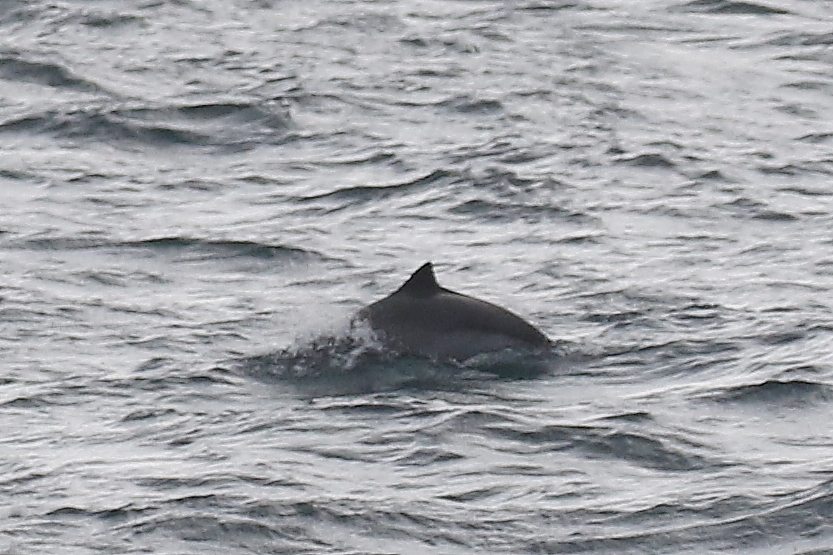
Scillonian III made good time with a largely uneventful crossing being punctuated by a pod of Common Dolphin and, as we approached St Mary's, a small group of Harbour Porpoise. On arrival I headed straight for the Garrison where the Blue Rock Thrush had been seen earlier in the day. It was reportedly moving clockwise around the Garrison, and after not too long I caught up with it between the Woolpack Battery and Steval.
I had never seen Harbour Porpoise this far out of the water before
A snub nose and small dorsal fin identify this as Harbour Porpoise
Harbour Porpoise
I had read various horror stories about visiting birders taking days to see this bird so I was perhaps fortunate to walk straight up to it. It was, however, clearly a very skittish bird, but as we sat quietly at the end of the bay it was feeding in, it paid us the courtesy of flying towards us at one point, enabling a few passable photos to be taken with the aid of a teleconverter.
Citrine Wagtail
Note the complete pale border around the cheek and broad wing bars
Just a hint of yellow on the vent of this bird
My other main target for the day was a Spotted Crake which had been giving good views at Lower Moors. I spent an hour there without success before breaking news of a Citrine Wagtail saw me heading off in the direction of Salakee Farm. This newly discovered rarity didn't play ball at first, feeding in long grass at the feet of cattle at the back of a field on a convex slope which made viewing difficult. For no apparent reason though it took flight, calling distinctively, and landed just in front of the assembled birders.
Wren
Spotted Crake, Lower Moors
Very long toes on this bird!
On the way back to my B&B in Hugh Town I called in at Lower Moors again where, thanks to a shout from Pete Aley, I enjoyed extended views of the Spotted Crake preening out in the open at close range. So an excellent start to the trip, with both of the main target birds seen well and a bonus breaking rarity thrown in.
The Spotted Crake preened out in the open
This went on for several minutes
A rare view of the underwing of a Spotted Crake

Sunday, 1 September 2019

Mallorca day 8: a rest day (almost)

After the exertions of Dragonera, family enthusiasm for another Dadventure remained lower than a limbo-dancer's back, but as we entered week two I couldn't face spending all day by the pool/on the beach so made an early morning return to Formentor. I fell in love with it on our first visit and, being just a short drive away, it was no hardship to leave the rest of the family snoozing and retrace my steps.
Sunrise over Formentor
The same view a couple of hours later
Formentor
The view from Formentor back towards Boquer Valley
The same scruffy Blue Rock Thrush was hanging around the lighthouse as on my first visit, but there were no close encounters with Warblers this time. The birding may not have delivered then, but the light - oh the light! - certainly did: the view at dawn was spectacular, as was the partial cloud sea which developed as the sun rose.
The male Blue Rock Thrush at Formentor - a slight case of 'body off Baywatch, face off Crimwatch'
I tried to make him look good with a more flattering camera angle
Almost dapper in this one
The female Blue Rock Thrush backlit on the cliffs of Formentor

Friday, 16 August 2019

Mallorca day 2: a first on Formentor

To my surprise and delight, my proposal to make an early start to the Formentor peninsular on the second day of our Mallorcan holiday met with approval from the rest of the family who, perhaps shocked by the heat of our first day, agreed to join me in search of cool morning air. With the switchback roads to the Formentor lighthouse successfully negotiated, we arrived shortly after sunrise to a scene of quite breathtaking beauty.
Balearic Warbler showing the paler throat compared to the similar Marmora's Warbler of Corsica and Sardinia
A similar species to our more familiar Dartford Warbler
As with the previous day's excursion to the Boquer Valley, the first notable bird of the day was a Blue Rock Thrush - a pair frequented the lighthouse compound on all three of my early morning visits so I would recommend it as a 'banker' site for this species. Unfortunately, the male of the pair had suffered some feather damage to the face so he wasn't the prettiest of specimens.
Blue Rock Thrush was quite tame around the Formentor headland
This female was on the lighthouse wall
Quite a few other visitors had made the effort to get to the lighthouse for dawn but fortunately the birds at this location seemed a little more habituated to human presence than compared to the Boquer Valley. Nowhere was this more evident than in the case of a Balearic Warbler, which I was amazed to see foraging on the ground just below the viewpoint, almost at the feet of the visitors milling around. I sat down and filled my boots photographically.
This male Blue Rock Thrush was a case of 'nice body, shame about the face'!
Compare to this, the Stow-on-the-Wold bird from 2016 - my only previous Blue Rock Thrush. And some said this shouldn't be accepted because of some tatty feathering on the breast!
A note on the ethics of wildlife photography seems appropriate at this point: it seems almost impossible these days to post a half-decent picture of a bird on social media without someone suggesting that some kind of improper or unethical behaviour was necessary to acquire the image. Clearly there are some people who overstep the mark, but I hope I am not among them. For the record, then, all of the images posted here were taken from public viewpoints, hides or paths, and none of them involved playback, harassment or otherwise inappropriate action towards a bird in the search for a picture.
A rare view of a Sardinian Warbler out in the open

Another unusually obliging Sardinian Warbler at Formentor
As my friends will tell you, I always bird with a camera at the ready slung over my shoulder, and if you are quick on the draw it's possible to get decent pictures through sheer opportunism as well as via the more traditional routes of waiting patiently for ages or deploying careful fieldcraft (both of which I also do). And sometimes the bird isn't remotely bothered anyway, as in this case - the Balearic Warbler pictured was unconcerned by the tourists around whose feet it was scuttling, oblivious to its significance as a Balearic endemic.
Even some normally sceptical members of the family got into birding at Formentor - but, as you can see, it was not embraced by all of them!
A glimpse of the switchback roads to the Formentor lighthouse
Of additional significance for me was the fact that, having heard but not seen one in the Boquer Valley the previous day, Balearic Warbler was my first 'world tick' of the trip - it wouldn't have been a few years ago before the split from the closely related Marmora's Warbler as I'd seen one of those in Wales in 2010! Balearic Warbler is resident on the islands after which it is named, while the Marmora's which breed on Mediterranean islands further east is a short-range migrant. So a special bird to see both globally and for me personally.
A typically perky Balearic Warbler pose
Spotted Flycatcher at Formentor. Not a very streaky one - could this be of the Balearic race, split by some authorities as Mediterranean Flycatcher?

Mallorca Day 1: getting to know the locals

I've just returned from a fortnight's family holiday in Mallorca - my first visit to the island - and was sufficiently impressed by its beauty, birds and butterflies to resuscitate this comatose corner of the internet with a few posts on our time there. Stand by then, dear reader, for a day-by-day write-up, recorded not just for posterity, but also in the hope that the up-to-date gen might be of some interest to would-be visitors to the island.
Audouin's Gull - one of the special birds of Mallorca. This one photographed in early morning light on the beach at Port de Pollenca 
First the basics. The self-imposed family flying ban, which held for 17 years but for the occasional short-hop to offshore islands of the UK, had to be breached to get there - suffice to say, this was a necessary hit to the household carbon budget taken in the interests of marital harmony. We booked flights and accommodation via a local travel agent, who negotiated her way through our conflicting aspirations with the skill of a relationship guidance counsellor (thanks Jackie!). Her recommendation to base ourselves in Port de Pollenca in the north of the island was spot on, and aligned with the advice of birding friends who had been previously.
A male Blue Rock Thrush was the first bird I saw in the famous Boquer Valley
Getting to, through and out of Bournemouth airport from home in Wareham was a breeze and we arrived in an uncomfortably warm Palma late on the evening of 1 August. After some tetchy queuing for the hire car (organised independently at a fraction of the price offered by the travel agent, with insurance waiver cover procured separately at a fraction of the price offered by the car hire company) we made the 45 minute journey to Port de Pollenca before hoisting luggage and tired bodies up several flights of stairs to our apartment. This, we were relieved to find, housed a small air-conditioning unit to take the sting out of the Mallorcan night's humidity.
The greyer female Blue Rock Thrush
Day one was largely spent exploring every corner of the swimming pool, but by late afternoon I was feeling the need to explore a more natural habitat, and with the entrance to the famous Boquer Valley just a couple of hundred yards from the apartment, that was the obvious place to start. I had borrowed a copy of Graham Hearl's excellent 'Birdwatching Guide to Mallorca' (2nd edition) but this being printed in 1999, I did wonder whether the advice within it, which warned of constantly changing access arrangements, would still stand. It seemed not when I arrived at the large metal gates at the entrance to the valley as described in the book only to find them padlocked. Uttering some ill-tempered magic words (which did not include 'abracadabra') did the trick when I realised to my embarrassment that there was a small 'gate within the gate' through which the traveller could freely pass.
I soon tuned in to the rattling call of the local Sardinian Warblers, seemingly the most abundant warbler on Mallorca - more often heard than seen, this female was an exception to the rule 
With this hurdle overcome, the warning in Graham's book about needing to brave barking dogs proved out of date (the finca which they previously guarded appeared to have been abandoned, at least temporarily) and from then on the obvious path led up past olive and almond groves to two huge boulders just as described in the text. Passing through these was like entering a hidden world as the majesty of the ridges either side of the valley became apparent. The first birds to be seen just past this point - a pair of Blue Rock Thrush - also appeared as a good omen.
Male Sardinian Warbler is a smart bird - the last one I saw before this trip was in sea buckthorn on the north Norfolk coast!
It being August, the valley was not dripping with the migrants which can reportedly be seen in spring, but it was still a good introduction to the local avifauna: in addition to several more Blue Rock Thrush, the walk to the Cala Boquer at the seaward end of the valley provided an opportunity to familiarise myself with the calls of the seemingly ubiquitous Sardinian Warbler and the more elusive Balearic Warbler (a recent 'split' from Marmora's Warbler). Otherwise, Spotted Flycatcher and Goldfinch appeared to be the most numerous passerines.
The seaward end of the Boquer Valley
Mammalian movement invariably turned out to be one of the goats which roam wild throughout the island, and of raptors, for which the Valley is famous, there was unfortunately no sign but for a calling Kestrel. That said, I was only carrying bins and it became clear that the decision to squeeze the telescope and tripod into the suitcase was probably a good one for the purposes of the rest of the trip.
Spotted Flycatchers darted around the finca at the entrance to Boquer Valley
As well as introducing me to the local wildlife and habitats, the walk to the end of the valley also provided my first view of the Formentor peninsular. I was sufficiently impressed by this to plan an early morning visit there the next day, not least as local signage suggested that the road to the end of the peninsular would be closed to traffic from 1000-1900, a sensible policy to manage visitor pressure to this stunning area. Come back soon for a report on how that went.
Hummingbird Hawkmoth feeding on flowers at the apartment in Port de Pollenca

Saturday, 31 December 2016

And finally...

This quick look back at December completes my series of posts reviewing 2016. Thanks for sticking with it - from the comments and texts urging me on recently, I got the impression that some of you didn't think I was going to make it. I could pretend it was all carefully planned to conclude as the sun sets for the last time on 2016, but that would be a lie. In fact, there was a point last week when I too thought I would never reach the end: it was, to borrow the sporting image of 2016, my Jonny Brownlee moment, and you, dear readers, were my Alistair, dragging me to the finishing line despite having much better things to do with your time.

2016 was of course a year of shock election results, famous folks' funerals and controversial rare birds. The evidence on climate change appeared stronger than ever but the peoples of the free world decided not to let the facts on this and several other matters of public debate get in the way of a good story, especially when it was being told by wealthy demagogues with their fingers crossed behind their backs. On those shock election results, I merely observe that just 27% of eligible Americans voted for Trump, and less than 38% of voting age Brits voted to leave the EU. Whatever you think of the results of both polls, this surely can't be taken as a sign that western democracy is in rude health. I recall fondly the ennobled billionaire tax-exile Lord Ashcroft tweeting after the US election and Brexit results that 'the elites' had lost touch with the people - how fortunate we are to have such down-to-earth meritocrats holding these damned elites to account.
Egrets: I've had a few - Dorset got in on the December Cattle Egret invasion, this bird being one of five with Little Egrets at Nottington
Corn Buntings were singing at Maiden Castle in the unseasonably warm weather of mid-December
 Corn Bunting, Maiden Castle
Much loved celebrities seemed to drop like flies in 2016 - or did they? My theory is that with a rising global population and the bar for celebrity being substantially lowered over time, there are just a larger number of them around to perish - so we'd better get used to more 'Sad death of tragic Brian off of Big Brother' type headlines in 2017. That said, there were some genuine mega-stars who left us during the year, and I had to smile at a recent suggestion on social media that Bowie had created a parallel universe and was in the process of populating it one by one with his own hand-picked choices. 
Marsh Harrier at Middlebere - from a visit early in the month

Little Egret, Middlebere: one of the few beneficiaries of our warming climate
Peregrine at Middlebere from the same visit
As for the controversial rarities, it started early in the year with the Dalmatian Pelican's tour of the south west, and ended with the Cotswolds Blue Rock Thrush. Establishing the provenance of a wide-ranging Lammergeier (not seen by me) and the wandering east coast Western Purple Swamphen (which I did see) was also potentially complicated by the influence of continental re-introduction schemes, even though neither were thought likely to be of captive stock.
A memorable December day saw me heading up to Derbyshire for a close encounter with a Dusky Thrush
Willow Tit at Carsington Water was a long overdue 'photo-tick' on the way back from the Dusky Thrush...
...as was the bonus of an Eastern Black Redstart in Tewkesbury on the way home - the first I had seen of this form and therefore my bird of the month for December
A quick attempt, then, to dish out some meaningless titles for 'whatsit of the year', an exercise fraught with danger not just due to fickle memory, but to the risk of implying that anything not mentioned wasn't fun or special - that would be nonsense, of course, but I'm afraid it's not going to stop me:
  • Bird of the Year: it has to be the Siberian Accentor - the fact that it was part of a multiple occurrence of the species in Britain 'devalued' it for some, but for me it did the opposite, illustrating a genuine natural phenomenon and adding to its authenticity in a year which had more than its share of plastic controversy.
  • Dorset Bird of the Year: Portland's Great Spotted Cuckoo was everything a rarity should be: big, beautiful and photogenic - and a county tick for me.
  • Patch Bird of the Year: a very short shortlist due to a shameful lack of effort - but a self-found autumn Great White Egret claims the title, if stumbling across the birding equivalent of a Concorde in a haystack counts as 'self-found'.
  • Twitch of the Year: it has to be the day trip with my son to St Mary's for the Cliff Swallow - though the Hebridean adventure for the Black-billed Cuckoo, the campervan sleepover for the Great Knot, the smash and grab for the Siberian Accentor and the Dusky Thrush/Eastern Black Redstart bonus ball day ran it a close second, third, fourth and fifth respectively. Not that I''m obsessed with lists, you understand.
  • Photo of the Year: had to think about this one. But I love American waders, and I love photographing rare birds up close, so it's the second one from this series taken during an intimate encounter with the Hudsonian Whimbrel in Cornwall early in the year. 
  • Dip of the year: I learnt long ago not to go too early with 'review of the year' posts and this year is no exception. I was looking forward to reporting 'no long distance dips' to speak of, when last week's Pembrokeshire trip failed to turn up the hoped for Masked Wagtail!
  • The Donald Trump Award for services to climate chaos: having raised the spectre of climate change, I should reflect for a moment on my own carbon footprint: too much driving chasing all these birds around, obviously, but I managed more lift-sharing than usual in an A-rated car, and, apart from two short hops on crop sprayers to the Isles of Scilly, I never got on a proper plane or left the country by any other means in 2016. So not too bad relatively speaking, but certainly room for improvement. Mind you, given the state of sterling, not leaving the country may be less of a choice and more of a necessity in 2017!
The news in 2016 was full of talk of 'blue on blue' conflict, as leading Conservatives knocked lumps out of each other with their Polo hammers. This image of 'blue on blue' - the Blue Rock Thrush against the perfect sky of a cold December afternoon in Stow-on-the-Wold - presents, I feel, a more restful image, and one much less likely to have my Dad shouting at the telly. My photo of the month for December.
So, thanks to the various peregrinations chronicled in these pages in 2016, the number of birds I have seen in Britain according to the official list crept up from 452 at the start of the year to 458 by the end - not including the Swamphen, the Pelican and the Blue Rock Thrush, all suspended in listing purgatory pending consideration by the British Birds Rarities Committee. In statistical terms, therefore, whether or not 2016 can go down as a good or a very good year will in part depend on what these wise folk decide about the year's most controversial birds. The Swamphen should be fine, who knows with the other two. But in the final analysis, the numbers don't much matter: the birds, the butterflies and other interesting critters I saw this year took me to some inspiring places, in the company of some great people, and sometimes with just myself for company, in a search for natural beauty, solitude and fulfilment which undoubtedly kept me sane amid the madness of the modern world.

My thanks, then, to the wildlife, for still being there despite the best efforts of humanity to eradicate much of it; to my fellow travellers, for their companionship and for subjecting themselves to my incessant witterings en route; and to my family, for joining me when it was possible, and tolerating my absence without too much overt celebration when it wasn't. And finally thanks to all of you for reading. It appears that the review of the year by instalments idea was insufficient to avert one last mammoth post for the year, so my resolution for 2017 is a simple one: I'll knock that on the head next year. Assuming the fingers of President Trump's tiny hands haven't already punched in the nuclear codes by then of course. And on that cheerful note, may I wish you a Happy New Year!