Showing posts with label Spotted Flycatcher. Show all posts

Friday, 22 October 2021

Shetland day 4: D-I-V-O-R-C-E

Day 4, like day 3, dawned bright and not very breezy - a rare treat in these parts two days running - so we started with a thrash around our temporary home patch at Hoswick. A nice selection of common migrants were seen, and Jono took one for the team by putting up a Jack Snipe at the price of falling balls-deep into rancid mud. As he returned to the house to clean up, I managed to locate another Jack Snipe bobbing in the sunshine in the incongruous setting of a field full of Aylesbury type white ducks. As we watched it we chatted with Claire and Nick Oliver, who had just arrived on Shetland and were staying nearby, before re-grouping at the house and heading off in the car.
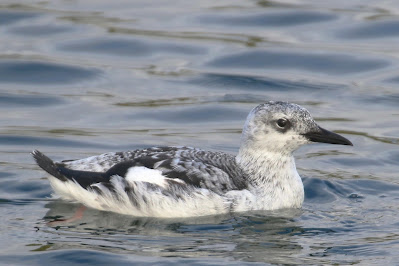
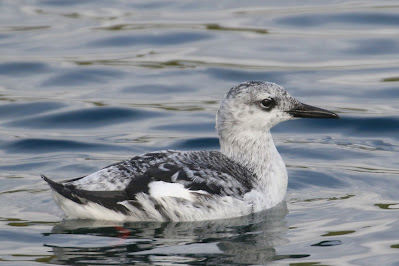
Black Guillemot, Toft

Black Guillemot, Toft
Before we got far reports started to come through of a Lanceolated Warbler on Unst. This was my nightmare scenario: a species notorious for being misidentified on Shetland, on an island two ferry rides away, which the other three in the team had already seen and would thus be less inclined to take a punt on. Any potential tension over this predicament soon dissipated however, when Claire and Nick offered a lift to Unst to anyone wanting to go for the Lancy. 
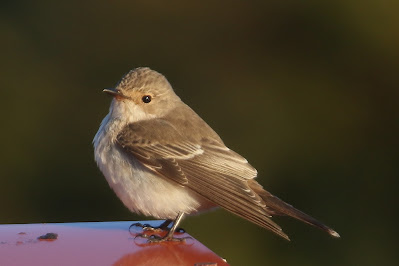
Spotted Flycatcher, Hoswick
Jack Snipe, Hoswick
I really didn't want to leave the team, but Lancy was high on my 'most wanted' list, and after two previous Shetland trips without success, I felt I had to go for it. So we arranged to meet the Olivers in a lay-by and initiated divorce proceedings. There was no bitterness or acrimony as the paperwork went through, in fact it was all very civilised. But I'm sure I saw a tear in one of the team's eyes as I popped my satchel into the leather back-seats of my adopted folks' Range Rover. Perhaps in hindsight it was just jealousy at the fancier ride I was hitching, but I like to think not.
A poor year for Yellow-browed Warblers on Shetland - and this shocker at Gutcher was the only photo I managed!
And speaking of shocking photos, this one of the Ring-necked Duck on Yell made the other members of the BBT team extremely jealous 
The report of the Lancy sounded pretty definitive, but I had learnt from previous bitter experience that such reports could quickly evaporate as a result of misidentification. Memories resurfaced of one particularly grim scenario in a rain-swept Quendale with birders chasing a 'Lancy' around which turned out to be a very wet Chiffchaff. As we boarded the first ferry from Mainland to Yell, news came through that the bird hadn't been seen since the original report - not great, but not terrible either as this ground-dwelling species could easily go missing for such a time. We were then approached by another birder, Phil, who couldn't get a space on the ferry from Yell to Unst, so joined our make-shift crew in the hope that the Lancy would reappear.
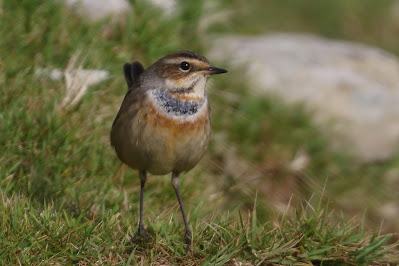
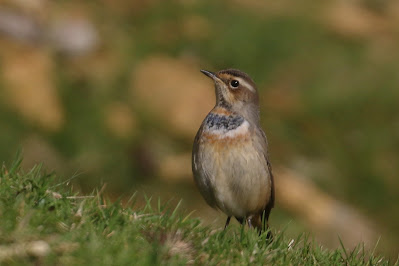
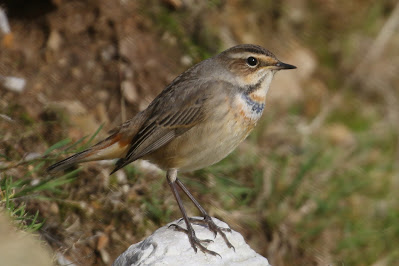
Bluethroat, Quoys
Bluethroat, Quoys
We had a few minutes to spare before catching the Yell-Unst ferry, enough to stop by a loch on the main drag to tick a distant Ring-necked Duck. But just as we were about to board the ferry, the worst case scenario unfolded: news reached us that the 'Lancy' had been reidentified as the much commoner Grasshopper Warbler. 
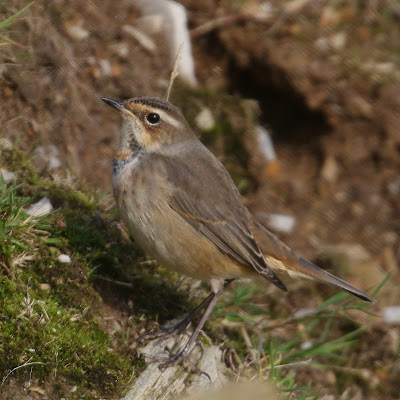
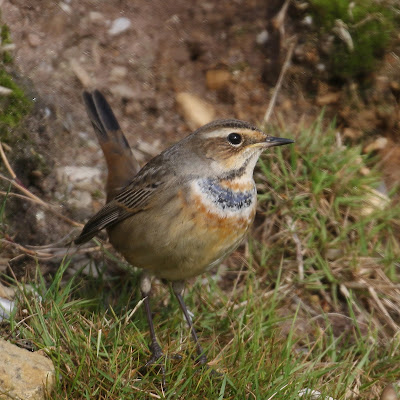
Bluethroat, Quoys
Bluethroat, Quoys

My eye started to twitch like Herbert Lom in the Pink Panther films at this point, but we quickly concluded that we had passed the point of no return and pressed on to Unst. We didn't even bother to seek out the Gropper site and headed straight for a quarry at Quoys where a Bluethroat had been reported. An hour's kicking around produced nothing and then Phil managed to deduce that the dropped pin we had made for based on the Birdguides app had been dropped in the wrong place, and we were looking in the wrong quarry!
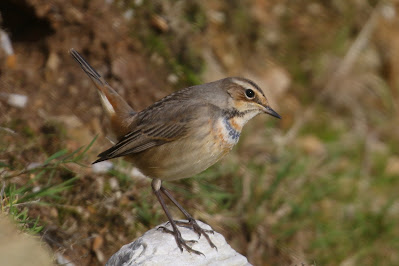
Bluethroat, Quoys
Bluethroat, Quoys
Heading a mile back down the road we quickly found the correct spot and within minutes had located the Bluethroat. This normally shy species first appeared at the back of the quarry hopping around a rusty manger, but then to our surprise and delight it started to head in our direction, and kept coming until it was barely a few metres away. A characterful bird, it completely saved the day with such a performance, and significantly lifted our spirits for the rest of the trip to Unst. 
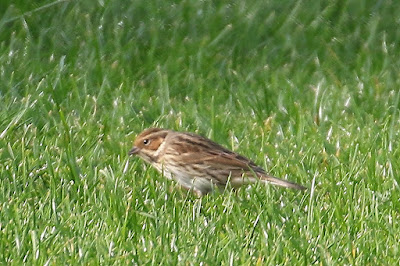
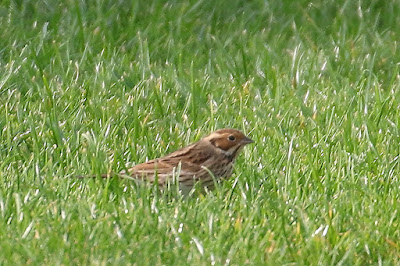
Little Bunting, Gutcher
On the way over whilst waiting for the Yell-Unst ferry we had seen a Yellow-browed Warbler in the last garden before the slipway, but were unable to locate a Little Bunting being looked for by Yell resident Adrian Kettle. On the way back Adrian was still staking out the same garden and got us onto the Little Bunting with plenty of time to get the final ferry of the day back from Yell to Mainland. 

In the meantime I had, of course, missed a belter of a day with BBT. Bradders had found a Radde's Warbler at Kergord, and Jono had picked up an adult White-billed Diver at South Nesting, plugging the gap on his trip list as he was absent when we saw one on the Northumberland coast on the way north. The Olivers were keen to catch up with at least one of these before dusk so we headed for the Radde's and managed fleeting views as it skulked in the long grass.

We returned to Hoswick and I was reunited with the rest of the team just before the decree nisi was pronounced. We patched things up over dinner and agreed never to speak of my unfaithfulness again. As for the Lancy, well that goes into the 'good reasons to keep going back to Shetland in Autumn' category for another year... 


Saturday, 17 August 2019

Mallorca day 2, part 2: into the swamp

After the early start at Formentor we returned to the apartment to cool off in the pool. With the rest of the family planning a late afternoon siesta, I was free to make my first visit to the renowned S'Albufera marsh, a 20 minute drive from our base in Port de Pollenca. Heavy traffic on the popular coast road extended this a bit but I located a reasonably close parking place and headed into this mother of all swamps with high expectations.
Purple Swamphen (or Gallinule) at S'Albufera from Sa Roca hide
Striking plumage colours were revealed by the evening light
To get to the reserve information centre from the road requires a 1 km walk along a straight track, the latter part of which rises onto a boardwalk alongside which the vocalisations from various herons could be heard and occasional glimpses snatched of the sources of these exotic sounds. Most were Little Egret but among them were Cattle Egret, Night Heron and Squacco Heron - and all this before getting to the information centre to seek a permit! When I got there it was closed anyway so, following the advice of the Hearl guide book about not waiting for the erratic opening hours to pan out, I didn't hang around before exploring further.
Adult Black-winged Stilt from Sa Roca hide
Juvenile Black-winged Stilt from Sa Roca hide
The first hide I entered was presumably a new one as it didn't appear in my old guide book, or indeed on any of the reserve maps, but was reached via a short track just south of the information centre. It can be seen on Google maps as the most easterly hide in the vicinity of the visitor centre, overlooking the main lagoon to the south. It was something of a showcase hide - a well-appointed structure with, most important of all, stacks of birds just outside.
Adult Black-crowned Night Heron from the Observation Deck immediately north of the information centre, looking back east down the canal - a ditch of diversity holding at least four breeding species of heron 
Juvenile Black-crowned Night Heron from the information centre
Among the numerous Little and Cattle Egret seen from this hide were good numbers of Little Ringed Plover and, more exotically, Black-winged Stilt and Glossy Ibis. Most eye-catching of all though were several Purple Swamphen - a species which is flourishing at S'Albufera following a successful reintroduction scheme in the 1990s.
Adult Squacco Heron from Observation Tower on Cami d'Enmig
Juvenile Squacco Heron from the boardwalk near the information centre
Not being much of an international traveller, like quite a few other birds seen on this trip, my only previous sighting of Purple Swamphen had been in the UK (I twitched the first British one with Marcus Lawson and Jol Mitchell at Minsmere in 2016). The Minsmere bird chose a similar habitat to those at S'Albufera: dry, reed-fringed pools around which it could strut, breaking off stems which it would hold in its long toes and strip with a powerful bill.
Red-knobbed Coot from Es Canal Gran hide
As I scanned the bird-filled lagoon it suddenly emptied - an Osprey was lumbering past flushing everything in sight. Returning to the visitor centre I walked the short loop to the south marked on the reserve map as the Sa Roca trail which produced a similar selection of birds plus a few Greenshank, Green Sandpiper and an inquisitive Fan-tailed Warbler.
Fan-tailed Warbler from Cami de ses Puntes
Fan-tailed Warbler on Sa Roca trail
The Sa Roca trail rejoined the main track through the centre of the reserve at three stone bridges, which produced another world tick for the trip - Red-knobbed Coot. The best views of this species were obtained from the Es Canal Gran hide with the sun behind me as one performed just outside the window, allowing comparison with the regular Coot which were also present.
Osprey from Sa Roca hide
This shot gives some impression of the havoc caused by the Osprey as it flew low over the lagoon
The guide book suggested that evenings were a good time to see Eleonora's Falcon, one of my main targets for the trip, hunting over the reserve. I had seen my first, another world tick, earlier in the day at Formentor but only at great distance through a scope, so was keen for closer views. Despite making the long slog to the Observation Tower on Cami d'Enmig as recommended, however, I could not locate one though the diversion provided views of yet more herons - Little Bittern and Purple Heron being added to the trip list.
Juvenile Little Bittern from the Observation Tower Hide on Cami d'Enmig - given away by its constant grunting noises
Purple Heron flypast from the Ses Eres Observation Deck on the Cami de ses Puntes
The hot walks between hides made for pleasant birding - Nightingales croaked and occasionally flushed from the path; Sardninian Warblers rattled away from every other bush and presumed Mediterranean Flycatchers provided constant distraction. Butterflies and dragonflies were disappointingly scarce with Speckled Wood and Black-tailed Skimmer being the most evident representatives of both groups.
Plenty of pale-foreheaded, unstreaky presumed 'Mediterranean' Flycatcher at S'Albufera
This one flycatching by the Stone Bridges
The light was fading by now and while it had been an excellent introduction to S'Albufera I had barely scratched the surface - unlike the local mosquitoes which, I realised the following night when awoken with intense burning sensations in the arms and legs, had been burying their proboscises deep into my exposed shins, calves and forearms. I vowed to return later in the holiday - but not without a bucket of insect repellant and some long trousers!
Butterflies were disappointingly few and far between on Mallorca - but every shaded path at S'Albufera seemed to hold a colony of Speckled Wood
Purple Swamphen catching the late evening light from Ses Puntes track

Friday, 16 August 2019

Mallorca day 2: a first on Formentor

To my surprise and delight, my proposal to make an early start to the Formentor peninsular on the second day of our Mallorcan holiday met with approval from the rest of the family who, perhaps shocked by the heat of our first day, agreed to join me in search of cool morning air. With the switchback roads to the Formentor lighthouse successfully negotiated, we arrived shortly after sunrise to a scene of quite breathtaking beauty.
Balearic Warbler showing the paler throat compared to the similar Marmora's Warbler of Corsica and Sardinia
A similar species to our more familiar Dartford Warbler
As with the previous day's excursion to the Boquer Valley, the first notable bird of the day was a Blue Rock Thrush - a pair frequented the lighthouse compound on all three of my early morning visits so I would recommend it as a 'banker' site for this species. Unfortunately, the male of the pair had suffered some feather damage to the face so he wasn't the prettiest of specimens.
Blue Rock Thrush was quite tame around the Formentor headland
This female was on the lighthouse wall
Quite a few other visitors had made the effort to get to the lighthouse for dawn but fortunately the birds at this location seemed a little more habituated to human presence than compared to the Boquer Valley. Nowhere was this more evident than in the case of a Balearic Warbler, which I was amazed to see foraging on the ground just below the viewpoint, almost at the feet of the visitors milling around. I sat down and filled my boots photographically.
This male Blue Rock Thrush was a case of 'nice body, shame about the face'!
Compare to this, the Stow-on-the-Wold bird from 2016 - my only previous Blue Rock Thrush. And some said this shouldn't be accepted because of some tatty feathering on the breast!
A note on the ethics of wildlife photography seems appropriate at this point: it seems almost impossible these days to post a half-decent picture of a bird on social media without someone suggesting that some kind of improper or unethical behaviour was necessary to acquire the image. Clearly there are some people who overstep the mark, but I hope I am not among them. For the record, then, all of the images posted here were taken from public viewpoints, hides or paths, and none of them involved playback, harassment or otherwise inappropriate action towards a bird in the search for a picture.
A rare view of a Sardinian Warbler out in the open

Another unusually obliging Sardinian Warbler at Formentor
As my friends will tell you, I always bird with a camera at the ready slung over my shoulder, and if you are quick on the draw it's possible to get decent pictures through sheer opportunism as well as via the more traditional routes of waiting patiently for ages or deploying careful fieldcraft (both of which I also do). And sometimes the bird isn't remotely bothered anyway, as in this case - the Balearic Warbler pictured was unconcerned by the tourists around whose feet it was scuttling, oblivious to its significance as a Balearic endemic.
Even some normally sceptical members of the family got into birding at Formentor - but, as you can see, it was not embraced by all of them!
A glimpse of the switchback roads to the Formentor lighthouse
Of additional significance for me was the fact that, having heard but not seen one in the Boquer Valley the previous day, Balearic Warbler was my first 'world tick' of the trip - it wouldn't have been a few years ago before the split from the closely related Marmora's Warbler as I'd seen one of those in Wales in 2010! Balearic Warbler is resident on the islands after which it is named, while the Marmora's which breed on Mediterranean islands further east is a short-range migrant. So a special bird to see both globally and for me personally.
A typically perky Balearic Warbler pose
Spotted Flycatcher at Formentor. Not a very streaky one - could this be of the Balearic race, split by some authorities as Mediterranean Flycatcher?

Mallorca Day 1: getting to know the locals

I've just returned from a fortnight's family holiday in Mallorca - my first visit to the island - and was sufficiently impressed by its beauty, birds and butterflies to resuscitate this comatose corner of the internet with a few posts on our time there. Stand by then, dear reader, for a day-by-day write-up, recorded not just for posterity, but also in the hope that the up-to-date gen might be of some interest to would-be visitors to the island.
Audouin's Gull - one of the special birds of Mallorca. This one photographed in early morning light on the beach at Port de Pollenca 
First the basics. The self-imposed family flying ban, which held for 17 years but for the occasional short-hop to offshore islands of the UK, had to be breached to get there - suffice to say, this was a necessary hit to the household carbon budget taken in the interests of marital harmony. We booked flights and accommodation via a local travel agent, who negotiated her way through our conflicting aspirations with the skill of a relationship guidance counsellor (thanks Jackie!). Her recommendation to base ourselves in Port de Pollenca in the north of the island was spot on, and aligned with the advice of birding friends who had been previously.
A male Blue Rock Thrush was the first bird I saw in the famous Boquer Valley
Getting to, through and out of Bournemouth airport from home in Wareham was a breeze and we arrived in an uncomfortably warm Palma late on the evening of 1 August. After some tetchy queuing for the hire car (organised independently at a fraction of the price offered by the travel agent, with insurance waiver cover procured separately at a fraction of the price offered by the car hire company) we made the 45 minute journey to Port de Pollenca before hoisting luggage and tired bodies up several flights of stairs to our apartment. This, we were relieved to find, housed a small air-conditioning unit to take the sting out of the Mallorcan night's humidity.
The greyer female Blue Rock Thrush
Day one was largely spent exploring every corner of the swimming pool, but by late afternoon I was feeling the need to explore a more natural habitat, and with the entrance to the famous Boquer Valley just a couple of hundred yards from the apartment, that was the obvious place to start. I had borrowed a copy of Graham Hearl's excellent 'Birdwatching Guide to Mallorca' (2nd edition) but this being printed in 1999, I did wonder whether the advice within it, which warned of constantly changing access arrangements, would still stand. It seemed not when I arrived at the large metal gates at the entrance to the valley as described in the book only to find them padlocked. Uttering some ill-tempered magic words (which did not include 'abracadabra') did the trick when I realised to my embarrassment that there was a small 'gate within the gate' through which the traveller could freely pass.
I soon tuned in to the rattling call of the local Sardinian Warblers, seemingly the most abundant warbler on Mallorca - more often heard than seen, this female was an exception to the rule 
With this hurdle overcome, the warning in Graham's book about needing to brave barking dogs proved out of date (the finca which they previously guarded appeared to have been abandoned, at least temporarily) and from then on the obvious path led up past olive and almond groves to two huge boulders just as described in the text. Passing through these was like entering a hidden world as the majesty of the ridges either side of the valley became apparent. The first birds to be seen just past this point - a pair of Blue Rock Thrush - also appeared as a good omen.
Male Sardinian Warbler is a smart bird - the last one I saw before this trip was in sea buckthorn on the north Norfolk coast!
It being August, the valley was not dripping with the migrants which can reportedly be seen in spring, but it was still a good introduction to the local avifauna: in addition to several more Blue Rock Thrush, the walk to the Cala Boquer at the seaward end of the valley provided an opportunity to familiarise myself with the calls of the seemingly ubiquitous Sardinian Warbler and the more elusive Balearic Warbler (a recent 'split' from Marmora's Warbler). Otherwise, Spotted Flycatcher and Goldfinch appeared to be the most numerous passerines.
The seaward end of the Boquer Valley
Mammalian movement invariably turned out to be one of the goats which roam wild throughout the island, and of raptors, for which the Valley is famous, there was unfortunately no sign but for a calling Kestrel. That said, I was only carrying bins and it became clear that the decision to squeeze the telescope and tripod into the suitcase was probably a good one for the purposes of the rest of the trip.
Spotted Flycatchers darted around the finca at the entrance to Boquer Valley
As well as introducing me to the local wildlife and habitats, the walk to the end of the valley also provided my first view of the Formentor peninsular. I was sufficiently impressed by this to plan an early morning visit there the next day, not least as local signage suggested that the road to the end of the peninsular would be closed to traffic from 1000-1900, a sensible policy to manage visitor pressure to this stunning area. Come back soon for a report on how that went.
Hummingbird Hawkmoth feeding on flowers at the apartment in Port de Pollenca